Likes
Comments
Share
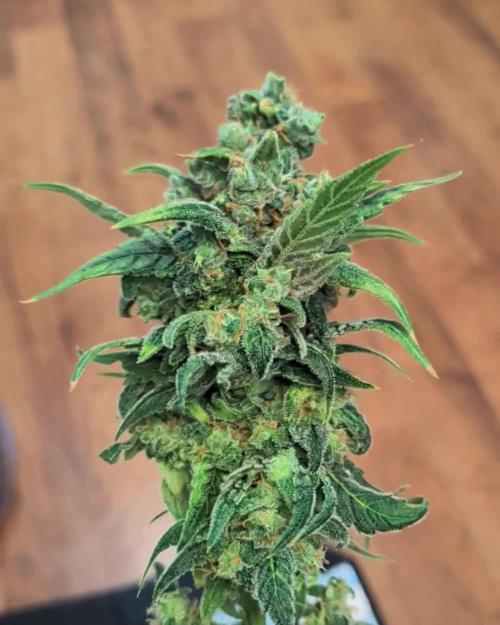
This lady is 8 weeks old now, and has been grown with Bio-Bizz nutrients before i transplanted her, to her final 10 gallon home. This round i'm using the Complete Bio Tabs Line-up for her during late veg & flower🙂 ( this stuff gives a amazing taste to whatever your growing @ home😉 ) Talking about flower😃 i feel the need to switch her to 12/12 real soon. Stay tuned Growmies👍
Likes
43
Share
added trellis netting this week to start SCROG. two layers close to eachother so I don't have to wait for entire square of growth to tuck under higher growth to keep flat even canopy. also minimizes my need for zip tie and garden ties needinf adjustment. I'm happy with veg growth thus far, and once the screen fills up with more green in a week or two these two ladies will both be ready to flip to flower. waiting on lower nodes to develop a bit more and get best use I can from a big(ish) 315 w LEC light. the girls are getting foliar every 3 or 4 days. using heavy 16 foliar only at the moment but will follow their foliar mix as grow progresses. smell has gotten much heavier, especially in nemo, the more blueberry pheno of the two, looking at the fan leafs I think V is more haze pheno with super thin sativa leaf structure.
Likes
27
Share
GELATO-K BY KANNABIA WEEK #20 WEEK #9 Flower Mar 22nd-29th This week she it's starting to show she's almost done. Leaves are getting yellow and dry. She's also getting purple hues in her buds. She has some large buds covered in trichomes she's definitely a producing plant that can also be trained to your growing desires. She smells outstanding!! Thank you for taking a look!! Stay Growing!!
Likes
7
Share
estamos no 6° dia de 12/12 por aqui, ela está crescendo muito e tomando muita água. Esperar mais uns 10 dias pra fazer uma limpeza de folhas e seguir no MiP mais uma semana. já comecei a usar JLF ( jadam) faz 10 dias pra suprir algo que possa faltar. estou gostando demais do desenvolvimento dela.
Likes
6
Share
Defoliated for lateral growth on her branches…
Likes
43
Share
@Just_Weed
Follow
Day 155 - Watering 7l solution rain water with 4 mL Top-Max and 4 mL Bio-Bloom, 1mL of calmag Solution ph 6.3, ppm 550, runoff ppm 1060, ph 6.3 looking at the trichs I think around 2 weeks until harvest. Day 158 - Watering 7l solution rain water with 3 mL Top-Max and 2 mL Bio-Bloom, 0.5mL of calmag Solution ph 6.6, ppm 350 runoff ppm 1100, ph 6.4 Looking at runoff it's good I reduced nutrients. I will start flushing from next watering. Thinking of maybe giving blackstrap molasses for last few waterings. Will she how is ppm after next straight rainwater watering and decide. Smells very strong right now and trich are still mostly clear with around 25% cloudy going towards 50%. Day 161 - Watering 7l solution rain water 7.5 ph, 30 ppm Water ph 7.5, ppm 30 runoff ppm 1040, ph 6.5
Likes
19
Share
Day 16-27/12/21 all looking good!!!! Day 20-31/12/21 still haven’t got space in other tent yet so hopefully can move half of them out this one next week!!!!
Likes
37
Share
OK guys so i figured i would do a video update instead of pictures now that we have some flowers! They are gaining weight everyday now that i got things under control. I went through a pH upswing again and still cannot find the cause of it. but regardless we are back on track i believe
Likes
5
Share
@Deli_Weed
Follow
Hice un poco de defoliación esta semana, y un lavado de raíces el domingo ya que eh notado sobrefertilizacion, bajaré la dosis de ec a 1.4 la semana que viene a ver qué tal responde, va increíble me esta gustando mucho su desarrollo 💪🏻🌱
Likes
5
Share
[ Information ] For all grow information, including strain and room details, please see the first week of veg. [ Updates ] (Flower) Day 1 - Light intensity increased to 65%. C02 increased to 1300ppm average. Day temp/humidity 85/70 (1-1.2VPD), night temp/humidity 75/65 (.8-1VPD). Fed a diluted compost tea mixture before lights on. Base water was R/O and tap water mixed lightly with silica and Tribus microbes. Tea was a mixture of Fish Hydrolysate, Bat Guano, Molasses, Fulvic/Humic, Kelp, and Earthworm Castings. 8 gallons of tea were added to 72 gallons of water mixture for an 80gal batch total. The batch was mixed for a half hour before feeding to the room. I did not PH or PPM test the mixture, organic material is hard to get an accurate PPM reading so the numbers are useless to me. I will be working to bring the lights to 100% power over this first week of flower. Day 4 - Light intensity increased daily, currently at 90%. Will raise to full power tomorrow. C02 increased to 1800ppm average. Temp and humidity for day and night are still the same. Lights were raised slightly to maintain 12 inches from canopy height, and a few growth nodes that were above the canopy got topped. Watered today with an 80gal (1.25gal p/pot) mixture, 10% tap 90% r/o water. 6.8 PH, 2.2ec. Foliar sprayed yesterday before lights off with a neem mixture for weekly IPM. Canopies are stretching relatively evenly, though I will be adding in support nets within a few days to help maintain the even spread. I've run this strain before so I'm fairly confident that I know what to expect during these few stretch weeks. Day 7 - Lights have been at 100% since day 5. C02 still 1800-2000ppm on average. Plants are stretching quickly into the lights, I have yet to readjust their height. The best growth usually happens when I do nothing, and I've done almost nothing the past couple days besides enjoy the unusually warm spring weather my area is currently experiencing. Watered today, 100gal (1.5gal p/pot) mixture, <1ec. Mainly an organic feeding for microbe health, also wanted a bit more runoff than normal due to the high ec feeding previously.
Likes
45
Share
(CHOPPED AT DAY 100 ) great strain - long branching - strong lemon pledge smell - gigantic buds - pest resistant this is the only pheno i grew , but i would definatelly try Lemon-Ak again
Likes
16
Share
I still believe that Banana Kush #2 and Zkittlez are stunted, I wanted to remove those two but i think i will just let them grow out for the experience. I'm really banking on Banana Kush #1 to bring home the bacon.
Likes
56
Share
What's in the soil? What's not in the soil would be an easier question to answer. 16-18 DLI @ the minute. +++ as she grows. Probably not recommended, but to get to where it needs to be, I need to start now. Vegetative @1400ppm 0.8–1.2 kPa 80–86°F (26.7–30°C) 65–75%, LST Day 10, Fim'd Day 11 CEC (Cation Exchange Capacity): This is a measure of a soil's ability to hold and exchange positively charged nutrients, like calcium, magnesium, and potassium. Soils with high CEC (more clay and organic matter) have more negative charges that attract and hold these essential nutrients, preventing them from leaching away. Biochar is highly efficient at increasing cation exchange capacity (CEC) compared to many other amendments. Biochar's high CEC potential stems from its negatively charged functional groups, and studies show it can increase CEC by over 90%. Amendments like compost also increase CEC but are often more prone to rapid biodegradation, which can make biochar's effect more long-lasting. biochar acts as a long-lasting Cation Exchange Capacity (CEC) enhancer because its porous, carbon-rich structure provides sites for nutrients to bind to, effectively improving nutrient retention in soil without relying on the short-term benefits of fresh organic matter like compost or manure. Biochar's stability means these benefits last much longer than those from traditional organic amendments, making it a sustainable way to improve soil fertility, water retention, and structure over time. Needs to be charged first, similar to Coco, or it will immobilize cations, but at a much higher ratio. a high cation exchange capacity (CEC) results in a high buffer protection, meaning the soil can better resist changes in pH and nutrient availability. This is because a high CEC soil has more negatively charged sites to hold onto essential positively charged nutrients, like calcium and magnesium, and to buffer against acid ions, such as hydrogen. EC (Electrical Conductivity): This measures the amount of soluble salts in the soil. High EC levels indicate a high concentration of dissolved salts and can be a sign of potential salinity issues that can harm plants. The stored cations associated with a medium's cation exchange capacity (CEC) do not directly contribute to a real-time electrical conductivity (EC) reading. A real-time EC measurement reflects only the concentration of free, dissolved salt ions in the water solution within the medium. 98% of a plants nutrients comes directly from the water solution. 2% come directly from soil particles. CEC is a mediums storage capacity for cations. These stored cations do not contribute to a mediums EC directly. Electrical Conductivity (EC) does not measure salt ions adsorbed (stored) onto a Cation Exchange Capacity (CEC) site, as EC measures the conductivity of ions in solution within a soil or water sample, not those held on soil particles. A medium releases stored cations to water by ion exchange, where a new, more desirable ion from the water solution temporarily displaces the stored cation from the medium's surface, a process also seen in plants absorbing nutrients via mass flow. For example, in water softeners, sodium ions are released from resin beads to bond with the medium's surface, displacing calcium and magnesium ions which then enter the water. This same principle applies when plants take up nutrients from the soil solution: the cations are released from the soil particles into the water in response to a concentration equilibrium, and then moved to the root surface via mass flow. An example of ion exchange within the context of Cation Exchange Capacity (CEC) is a soil particle with a negative charge attracting and holding positively charged nutrient ions, like potassium (K+) or calcium (Ca2+), and then exchanging them for other positive ions present in the soil solution. For instance, a negatively charged clay particle in soil can hold a K+ ion and later release it to a plant's roots when a different cation, such as calcium (Ca2+), is abundant and replaces the potassium. This process of holding and swapping positively charged ions is fundamental to soil fertility, as it provides plants with essential nutrients. Negative charges on soil particles: Soil particles, particularly clay and organic matter, have negatively charged surfaces due to their chemical structure. Attraction of cations: These negative charges attract and hold positively charged ions, or cations, such as: Potassium (K+) Calcium (Ca2+) Magnesium (Mg2+) Sodium (Na+) Ammonium (NH4+) Plant roots excrete hydrogen ions (H+) through the action of proton pumps embedded in the root cell membranes, which use ATP (energy) to actively transport H+ ions from inside the root cell into the surrounding soil. This process lowers the pH of the soil, which helps to make certain mineral nutrients, such as iron, more available for uptake by the plant. Mechanism of H+ Excretion Proton Pumps: Root cells contain specialized proteins called proton pumps (H+-ATPases) in their cell membranes. Active Transport: These proton pumps use energy from ATP to actively move H+ ions from the cytoplasm of the root cell into the soil, against their concentration gradient. Role in pH Regulation: This active excretion of H+ is a major way plants regulate their internal cytoplasmic pH. Nutrient Availability: The resulting decrease in soil pH makes certain essential mineral nutrients, like iron, more soluble and available for the root cells to absorb. Ion Exchange: The H+ ions also displace positively charged mineral cations from the soil particles, making them available for uptake. Iron Uptake: In response to iron deficiency stress, plants enhance H+ excretion and reductant release to lower the pH and convert Fe3+ to the more available form Fe2+. The altered pH can influence the activity and composition of beneficial microbes in the soil. The H+ gradient created by the proton pumps can also be used for other vital cell functions, such as ATP synthesis and the transport of other solutes. The hydrogen ions (H+) excreted during photosynthesis come from the splitting of water molecules. This splitting, called photolysis, occurs in Photosystem II to replace the electrons used in the light-dependent reactions. The released hydrogen ions are then pumped into the thylakoid lumen, creating a proton gradient that drives ATP synthesis. Plants release hydrogen ions (H+) from their roots into the soil, a process that occurs in conjunction with nutrient uptake and photosynthesis. These H+ ions compete with mineral cations for the negatively charged sites on soil particles, a phenomenon known as cation exchange. By displacing beneficial mineral cations, the excreted H+ ions make these nutrients available for the plant to absorb, which can also lower the soil pH and indirectly affect its Cation Exchange Capacity (CEC) by altering the pool of exchangeable cations in the soil solution. Plants use proton (H+) exudation, driven by the H+-ATPase enzyme, to release H+ ions into the soil, creating a more acidic rhizosphere, which enhances nutrient availability and influences nutrient cycling processes. This acidification mobilizes insoluble nutrients like iron (Fe) by breaking them down, while also facilitating the activity of beneficial microbes involved in the nutrient cycle. Therefore, H+ exudation is a critical plant strategy for nutrient acquisition and management, allowing plants to improve their access to essential elements from the soil. A lack of water splitting during photosynthesis can affect iron uptake because the resulting energy imbalance disrupts the plant's ability to produce ATP and NADPH, which are crucial for overall photosynthetic energy conversion and can trigger a deficiency in iron homeostasis pathways. While photosynthesis uses hydrogen ions produced from water splitting for the Calvin cycle, not to create a hydrogen gas deficiency, the overall process is sensitive to nutrient availability, and iron is essential for chloroplast function. In photosynthesis, water is split to provide electrons to replace those lost in Photosystem II, which is triggered by light absorption. These electrons then travel along a transport chain to generate ATP (energy currency) and NADPH (reducing power). Carbon Fixation: The generated ATP and NADPH are then used to convert carbon dioxide into carbohydrates in the Calvin cycle. Impaired water splitting (via water in or out) breaks the chain reaction of photosynthesis. This leads to an imbalance in ATP and NADPH levels, which disrupts the Calvin cycle and overall energy production in the plant. Plants require a sufficient supply of essential mineral elements like iron for photosynthesis. Iron is vital for chlorophyll formation and plays a crucial role in electron transport within the chloroplasts. The complex relationship between nutrient status and photosynthesis is evident when iron deficiency can be reverted by depleting other micronutrients like manganese. This highlights how nutrient homeostasis influences photosynthetic function. A lack of adequate energy and reducing power from photosynthesis, which is directly linked to water splitting, can trigger complex adaptive responses in the plant's iron uptake and distribution systems. Plants possess receptors called transceptors that can directly detect specific nutrient concentrations in the soil or within the plant's tissues. These receptors trigger signaling pathways, sometimes involving calcium influx or changes in protein complex activity, that then influence nutrient uptake by the roots. Plants use this information to make long-term adjustments, such as Increasing root biomass to explore more soil for nutrients. Modifying metabolic pathways to make better use of available resources. Adjusting the rate of nutrient transport into the roots. That's why I keep a high EC. Abundance resonates Abundance.
Likes
15
Share
@Theia
Follow
A really explosive week of growth. I pushed PPFD up to 310umols. Dimmers are at 60% which is drawing 224w plus 18w of DRRB. I have alos started Emerson effect ... Another The Emerson effect is triggered by the simultaneous exposure of plants to light in the deep red and far-red spectra Deep Red 660 nm /Far-Red 700 nm . A bit of boring science that explains why you need both far red and deep red in order to trigger Emerson. The effect occurs because photosynthesis is driven by two distinct pigment systems working in series:Photosystem II (PSII): Absorbs energy most efficiently at shorter wavelengths (higher frequencies), like 680 nm (441 THz). Photosystem I (PSI): Absorbs energy most efficiently at longer wavelengths (lower frequencies), specifically 700 nm (428 THz). When you provide only the higher frequency (deep red), PSI becomes a bottleneck. When you provide only the lower frequency (far-red), PSII is not sufficiently excited to provide electrons. Providing both frequencies simultaneously allows both systems to work at peak efficiency, resulting in a rate of photosynthesis that is greater than the sum of the two lights used individually. To understand the Emerson Effect, think of photosynthesis not as a single engine, but as a two-stage assembly line. What is the Emerson Effect? Discovered by Robert Emerson in 1957, this phenomenon shows that plants perform photosynthesis much more efficiently when they are hit by two specific types of light at the same time: Deep Red (660 nm) and Far-Red (700+ nm). If you give a plant only Far-Red light, photosynthesis is very slow. If you give it only Deep Red, it's better but still limited. However, when you give it both at once, the total rate of photosynthesis is significantly higher than if you just added the two results together (1+1=3). What is Happening? (The "Assembly Line") Inside the plant's chloroplasts, there are two "workstations" called Photosystem II (PSII) and Photosystem I (PSI). They work in series, meaning the first one must pass "parts" to the second one. PSII (The First Station): This station is tuned to catch Deep Red light (660 nm). It harvests electrons from water. PSI (The Second Station): This station is tuned to catch Far-Red light (700 nm). It takes the electrons from the first station and uses them to create energy (ATP and NADPH). The Problem: If you only provide Deep Red light, the first station works fast, but the second station can't keep up because it isn't being "powered" efficiently by that specific frequency. This creates a traffic jam of electrons. The Solution: By adding Far-Red light, you power up the second station. It now "pulls" the electrons from the first station much faster, clearing the traffic jam and making the whole assembly line run at full speed. The Benefits for The Grow.. Because i am using the Biotabs water-only method, my plants already have a steady supply of organic nutrients. Implementing the Emerson Effect offers several distinct advantages: Increased Biomass: Because the "engine" is running faster, the plant produces more sugars and carbohydrates, leading to heavier fruits or flowers. Faster Finishing: Plants often reach maturity sooner because they have more surplus energy to complete their life cycle. Better Light Penetration: Far-Red light is very good at passing through the upper leaves. This "wakes up" the lower parts of the plant that would otherwise be shaded, allowing the whole plant to contribute to growth. Enhanced Secondary Metabolites: In many crops, this synergistic light can stimulate the production of terpenes and antioxidants, improving the "quality" (smell, taste, and potency) of the final harvest. The "Sunrise/Sunset" Trick I am using 4x Invisible sun Far red/Deep red bars,they use high-quality Samsung LH351H (660nm Deep Red) and specific Far-Red (730nm) diodes for 10–15 minutes at the start or end of the light cycle. This mimics the natural shift in light at sunrise and sunset, "waking up" the photosystems or signaling the plant to go into "sleep mode" faster, which can further optimize the flowering cycle. Enviromentally i am chasing a VPD of about 1,1kpa. My room seem to sit nicely at lights on at 24c with no real drama and a little help from a 220W greenhouse bar radiator. Its using abot 4kw/h a day atm because my room is attached to the side of my house and its been -5c.. I have had to add some humidity as its also very dry atm. Im aiming for RH of 65% with my 24c but it is more around the 62s.. VPD is crucial and is the focus for this grow for me. The autopots and Biotabs make it so easy ican really just focus on perfect enviroment. A VPD of 1.0–1.2 kPa provides enough "atmospheric pull" to move calcium and magnesium up from the roots, which is critical for the rapid cell division happening now.. Plants will be flipped on Saturday which is their week 5 as im a bit behind.. As this happens i will push PPFD upto 4-500umols. by week 2 of flower. Thats the plan anyway..
Likes
9
Share
Satisfecho con los resultados y el control sobre la temperatura con nuestro Cooltube reduciendo eficientemente cerca de 5-6 grados al armario. El itinerario para nuestro cultivo es mantener en las condiciones actuales a nuestras 5 bebes y durante la tercera semana germinar La sexta. Recordar que este diario está enfocado solo en 4 babys, macetas de 11Litros 3xGlueberry OG Auto de DutchPassion y 1xLSD-25 de FastBuds, muy buenas genéticas de muy buenos bancos que esperamos potenciar en cosecha con tecnicas de Bajo estrés incluyendo el mallado SCROG, y ya en etapa avanzada de crecimiento una tecnica de Alto estrés conocida como popping (poda de bajos) además de un casi completo programa de fertilización, contando con los nutrientes básicos de vegetacion y floracion (top veg y top bloom) y para las primeras semanas ya en uso un enraizante (Top underground) y otros productos para terminar la floración de la mejor manera posible. Sígueme en IG @cestlaweed para mayor información, y cualquier comentario o consejo es sumamente bien recibido ✨🌱
Likes
25
Share
Likes
5
Share
1st week of 12/12 light going beautifully. They are doing really well. Although I still experienced root issues. I think this spot is cursed :P
Likes
19
Share
@DevelGrow
Follow
Hallo Freunde 👋 Grande l Daddy ist 70 Tage alt! Es wird jetzt geerntet ✌️🍀✌️🍀
Likes
49
Share
@Roberts
Follow
The Mandarin Squeeze sisters smell just like Mandarin oranges. Hence the name. She has been busy bulking. She is looking pretty good, and full of frost. I am rather eager to try them when the time comes. For now she will work on bulking some more. It's already looking like it will be a killer flower. Thank you again Spider Farmer, and Terpyz mutant Genetics. 🤜🏻🤛🏻🌱❄️ Thank you grow diaries community for the 👇likes👇, follows, comments, and subscriptions on my YouTube channel👇. Thank you Happy Growing 🌱🌱🌱 https://youtube.com/channel/UCAhN7yRzWLpcaRHhMIQ7X4g