




Likes
4
Share


@ChiloteAnonimo
Follow
SEMANA DOS VEGE (12-05-2022)
* Al día 15 desde que salieron del sustrato entra en el día 1 de la segunda semana de vegeta
* Se agrega al riego 1m/l del fertilizante para vegetación de Laboratorio LAAOS, "Vegalquimia"
* Al día 20 desde que salieron del sustrato, se le aplico LST a las 6 plantitas


Processing
Likes
89
Share


@biggreens420
Follow
This girl is down dont do wet weight she was looking beautiful faded well smells very sweet extra sticky and buds are formed well i only remove fans when wet dry trim the rest I find it tastes and smokes better this way its cool for drying at the min so using a small heater to warm the room slightly no issues with mold looks like shes packing some weight uploaded a Christmas video dont know which one to use for the competition this or my critical will update harvest when dry and tested thanks for reading happy growing guys


Likes
6
Share


@mattipups
Follow
Langsam verwelken die Fächerblätter, ich glaube die Pflanze nähert sich ihrem Ende.


Likes
17
Share


@Appoldro420
Follow
Well.. nice start of a new week. Still stretching so today changing water for fresh water. Going to level up the EC from tapwater 0.3 tot 0.7 with CalMag before adding nutrients. Then raising the EC to 2.2 I hope (depending on the PH not dropping below 5.8). Hopefully they will consume less water and therefore stop stretching.. We will just see what happens. Easy to lower EC afterwards and also easy to raise PH. I just have to add some tapwater.
13/7 some shortages and maybe too much light. Reducing time with half an hour daily. Raised EC to 2.3


Likes
25
Share


@pifflestikkz
Follow
Day 22
25/07/24 Thursday
Still no Feed/water since Tuesday.
Been a humid and overcast two days so not as much evaporation as normal.
All plants happy and healthy 💚
Video updates
Day 23
26/07/24 Friday
De-chlorinated watering pH 6 with 5ml calmag to 5L water.
Watered each with 250ml and had small run off.
I will continue to feed/water with small run offs to help prevent salt build ups.
Video update.
Day 26
29/07/24 Monday
Nice feed today, using de-chlorinated tap water pH 6.
They each had 300ml with small run off.
All looks incredibly happy and healthy!
The Auto Kabul that was mutated and twisted has pulled herself through and is just a bit shorter than the others.
Day 28
31/07/24 Wednesday
End of week😁
De-chlorinated water pH 6 today with Plagron pk13-14 5ml to 5L
Plagron power buds 5ml to 5L
Used 300ml of the 5L solution.
I will be using these on water days from now on as they are advised to be used every irrigation.
We'll see how they perform 💪💚


Likes
8
Share


@pzwags420
Follow
On day 1 the plants are looking good. I confirmed that my one cola was seeded, so I removed all visible seed pods. After this run I will do a deep cleaning to make sure there is no pollen in my grow box. The rest of my plant colas seem fine... I changed out my reservoir and adjusted the PH to 6.1. I also dimmed my light to 75% to mimic spring conditions. On day 2 I adjusted the PH of the reservoir down to 6.1. The plants are looking great besides a few fox tails from too much light. On day 3 the PH in the reservoir is 6.2. On day 4 I diluted my reservoir with plain water to lower the ppm down to 400 ppm, and I adjusted PH to 6.2 . The buds are ripening for sure and smell great! I haven't gotten any autumn colors yet even though I have dimmed my grow light and lowered my night time temps. I hope by 8 weeks the plants will have some more purple tones but if not I'm good with the flower quality thus far :). The breeder says 7-8 weeks so I'm hoping I am close to the finish line. I will continue to monitor the trichomes for ripeness. On day 5 I adjusted the reservoirs PH to 6.0. I harvested my seeded cola on Pheno #1 as it had stopped growing/ripening and would be a good tester ;) On day 6 the reservoirs PH is 6.2. On day 7 the PH is 6.0 50 % pistils have turned amber so I believe I have entered my harvest window and expect to flush and harvest soon:) very excited!
Likes
1
Share


@Unfumadormas
Follow
Lavé raices, aprox 30 litros hasta que quedó 0.3 de ec en el sustrato, demoró 6 días en secarse la maceta, después regué durante una semana con flaweless finish (2 riegos) este fue el resultado de esta hermosa amnesia haze Autofloreciente, Su fuerte olor a café exquisito, ahora solo queda esparar secado y curado de tal.

Likes
3
Share
@Sr_mezo
Follow
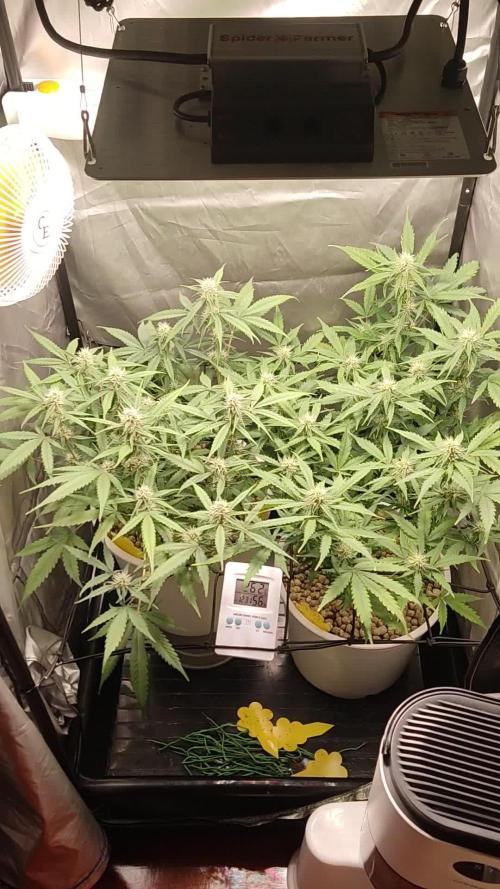
Video y fotos del día 47, se nota que los cogollos están engordando.
Me preocupa un poco el calor que ronda los 30°C todo el día y la humedad algo alta, el problema es que el deshumidificador me sube mucho la temperatura, veremos como avanza y si puedo controlarlo.
De todas formas las plantas están bien aunque algunas hojas bajas de la cheese se van secando y amarilleando, las voy quitando a medida que se debilitan.

Likes
56
Share


@Prilyfe13
Follow
March 29, 2024 Day 43
This week will focus on watering and light intensity. Training is done for the most part. At least the structures are on point. Now it's just a matter of keeping the canopy level. So far everything looks great! There's a couple branches on each plant that aren't quite as tall yet, but they are strong. I expect them to grow quickly very soon.
The plants are 14" tall now and will definitely be taller by the end. If I'm right, I should get a height of 24" to 36" total. Unless both stunt somehow, but I don't think so. Anyway, just by the health and current growth time and amount, I can expect some robust plants. The buds are going to be super heavy. Just by looking at the bud structure now, tells me I'm going to have to fat dense and sticky weedy do.
I changed the lighting as I was scheduled to do today. The light was at 22" from the plants growth. For the week, I reset the light height back to 24" and increased the light power back up to 90%. The DLI is 44 mol/m²/d. PAR should be around 675 ppfd. However, as I said at the beginning of the grow, I focus on DLI over everything else. PAR is fine, I just prefer the DLI. It tells me more I think.
As it's a new week, watering needed some maintenance. I cleaned out the other reservoir and filled it up with the new nutrient regimen. That includes the B-52 today and Sensizym next watering for when it gets here. I had to look up a good feeding schedule specifically for autoflowers and advanced nutrients. As the time is all wrong with BudLabs. It's designed for Photoperiods only. So things needed to be adjusted. For example, I'll be starting Big Bud later this week as it calls for week 2 of flower with a photoperiod. But the schedule I found makes more sense and calls for the Big Bud a week earlier. Anyway, it's a good schedule. Just makes sense.
The environment will be staying the same this week. 77° and 55%. In the next 2 weeks, I'll drop the temp down to 75° with the humidity at 50%. Then I'll drop it weekly until I get to the final week. I'll drop the temp down to 73° and the humidity down to 40%. 35% if I can manage. However, I'm not all that worried about 40% to 45%. The space is extremely clean and the room itself is really dry. So no worries.
So, now that the auxiliary branches are just as tall as the side branches, Banana Purple Punch B has an extremely level canopy. The branches have all caught up to the top and everything is looking great! Banana Purple Punch A is doing the exact same thing. They are both the same height. I wonder if that is the plants keeping up with each other. Like a reaction to the other plants in the tent? Who knows. This is my first completely level canopy for all 4 plants. Very happy so far. As long as none of them take off, we should see a beautiful ocean of fat buds throughout the whole tent.
Grow System Environment:
Temp: 76.0°
RH: 53.8%
VPD: 1.38 kPa
March 30, 2024
Some notable information today. I'm very curious about this, so if anyone knows what's up, leave me a comment. Thanks!
Banana Purple Punch A is taking in way more water than Banana Purple Punch B. I believe now it has to do with the roots. The bottom of the container for Banana Purple Punch A is FILLED with roots, while Banana Purple Punch B doesn't have any roots showing yet except for the bottom outside of the container. I thought the roots would have shown up by now.
The thing is though, Banana Purple Punch A is still roughly the same height as the rest of the plants in the tent, but clearly is further along than the rest. Not saying she isn't growing, she is. It's just that she should be stretching like crazy right now and she isn't. The canopy is staying level. I will say that the Tropicana Cookies sharing the tent is slight taller and stretchier. It's ok though, the SCroG net is going up at 18" from the container base.
Anyway, it's kind of confusing how these two plants are growing in such a different way, but not any bigger or smaller than the other. Insight please. Lol.
Both ladies got a haircut today. Just clearing out the massive leaves that grew and some of the outside leaves to keep them in their own quadrant. It worked wonders. No stress, no issues so far that I can see.
I also had to lift the light a couple inches today. The DLI was actually a bit higher than I wanted and it showed last night with one of the plants. A bit droopy before lights out. That tells me there's too much light in that one quadrant. So the light went up to 25" from the canopy. I could drop the power level, but I really like this footprint. Dead center of the tent is around 48 mol/m²/d while the outside is at 43 mol/m²/d. What a spread. Honestly though, I really want a bar style light setup. One for a 4x4 so it fills the whole 3x3 tent.
Back to watering. Banana Purple Punch A got a full gallon today. She's drinking a half gallon a day now. I also realized the nutrient schedule I'm using doesn't have the Tasty Terpenes in it. So I started that today as well as the big bud. I also increased the Cal/Mag dose from 4 ml to 8 ml. Big Bud and Tasty Terpenes are both at 4 ml/gal. I also added this week's dose of Recharge. HOWEVER... The PH was Way off. Down to 5.4, so I dosed the shit out of it with PH Up. I got to 6.18 and that's where I stopped. The nutrients are supposed to be PH Perfect, but adding something slammed it down. So I'll start to PH before adding nutrients. Then I hopefully won't have to dump 3 ml of PH Up in a gallon of water. However, I will say the PH in our tap water is ridiculously high at like 8.2, so that may be a factor. But shouldn't the high PH balance out the PH with nutrients? No real clue what happened. It doesn't make sense. It definitely has to be one of the new nutrients. When I do another mix, I'll PH after each nutrient. That way I can see which nutrient is messing up my perfection. I've also read that a PH of 6.5 to 7 is ideal for the flowering stage. Is this correct? If so, how the hell do I get the PH to increase more? Or is my PH meter out of calibration? Damn, things I need to learn. Moving on.
The environment is a bit off. The temp is kinda high at 79.5°. However, the humidity is perfect at 55%. Unfortunately the temp is throwing the VPD way off. It's now 1.50 kPa where it should be around 1.33 kPa. I'm trying to fix it, but it takes time. It should be fine by this afternoon.
Grow System Environment:
Temp: 75.9°
RH: 54.5%
VPD: 1.35 kPa
March 31, 2024
Not much to do today. The plants are doing their thing. Banana Purple Punch A drank about a half gallon from yesterday's reservoir top off. She'll definitely need to be watered tomorrow though. In which case I'll be adding the Sensizym. However, Banana Purple Punch B needs a reservoir refill today. Not first thing, but maybe just after noon. The reservoir is nearly empty, not enough to fill, but enough to be completely dry tomorrow. That can't happen with this system, so I'll have to refill today.
I'd also like to note the lack of roots on Banana Purple Punch B. There are none. I'm really confused now. One would think the roots would be through by now. I hope they didn't just stop there. Hopefully I start seeing them in the next couple days.
Banana Purple Punch A has roots through everywhere.
Honestly, it seems as though growing in my setup with my techniques extends the veg time. That's the only thing I can think of. The lack of roots shows lack of growth. But it's an Indica dominant phenotype. Maybe the root system just takes longer. But she's definitely in flower. Still waiting for the stretch to start, by the way.
They are both 14.5" now with yesterday being 14". That's not stretching. I seriously cannot have small and big plants together in this size tent. Maybe if it were a 4x4, it would be fine, but a 3x3 is much smaller... Weirdly enough.... and for 4 plants, there just isn't that type of space. I'll will absolutely implement the SCroG net if things get out of control. I'd rather not use it yet though. I still want to be able to pull them out and clean out the reservoirs and check over each plant thoroughly. At least until I need the net. But really only to keep the tops from falling over. But training has stopped for these ladies. I don't have anymore horizontal space to train them out. But I have plenty of vertical space. Maybe they will only grow to 24" after all. We shall see. Either way, I'm going for quality, so regardless of the size, everything is in order. Maybe they average on the smaller side.
Still, they have really packed buds already popping up. They will definitely be super dense.
I didn't move the light today. No point. The plants are very happy and reaching slightly. Just a nice little prayer.
The environment is really good. Sticking at 55% humidity and the temp has been steady between 76° and 79°. Very nice. The VPD is happy as well.
Grow System Environment:
Temp: 77.4°
RH: 54.6%
VPD: 1.43 kPa
April 1, 2024
Not much to do today. Banana Purple Punch A got her full gallon top off. I also got the Sensizym in so that went in as well.
Also, I need to calibrate my PH meter. It seems to be reading low. Maybe. It's reading 5.4 with PH Perfect Nutrients. I also added a full 1 ml of PH up. It brought it up to 5.49. No idea what's happening.
Both plants grew a couple inches last night. Now they are at 16" tall. Let the stretch begin!
Banana Purple Punch B is just hanging out. Still not drinking as much as her sister plant, but still very healthy and happy. The roots aren't showing either. Still confused by that.
I had to cut a couple leaves off each plant today. Just a bit of overcrowding. Like 2 leaves each. Not much, obviously, but it's still important to notate. And good to keep up with the leaf coverage.
I raised the light nearly 2" today. It was too close, and the DLI was close to 50 mol/m²/d with the center being 58 mol/m²/d.
Now the DLI is sitting pretty at 45 mol/m²/d with the inside being closer to 50 mol/m²/d. However, I have an advantage. The center of the tent is not filled in totally. I did this on purpose to keep the light intensity fairly even throughout the canopy. (I really need to get a bar style light.)
The environment is pretty good today. It's a smidge off. The temp is cooler at 75° with the humidity being closer to 58%. So the VPD is slightly off at 1.20 kPa. It should adjust accordingly in the next few hours as it has been. However, the daily average is right on point.
Grow System Environment:
Temp: 75.4°
RH: 55.2%
VPD: 1.31 kPa
April 2, 2024
A bit to do today. No watering or anything, but I did some defoliation and raised the light an inch.
Banana Purple Punch A got a bit more trimmed off than I had originally intended, but I wasn't off by the mark completely. So it should be all good. She also grew another 2 or so inches and is now a bit taller than her sister plant at 19". Not much, but enough for me to notice. She looks great! Roots galore, beautiful green color. Fat buds and a wonderful aroma. She is 19" and still stretching. Let's see what she turns out to be.
Banana Purple Punch B also got a haircut. She definitely needed it. In 2 days, she completely filled back out and needed to be opened up a bit. As I said before, I have stopped training, so if she doesn't catch up, which she may, I'll have to lift her up to the canopy. She's 18" now. An inch or so shorter than Banana Purple Punch A. However, she finally has roots showing throughout the bottom of the container. Nothing crazy, but lots of them popping up. It should be a matter of a couple days and those roots should be pretty long and sucking in water like crazy. Maybe not as much as her sister plant, but much more than she is now. Also, I think she may end up being a much more robust plant than her Banana Purple Punch A. The roots took longer to hit bottom and that may mean the root ball is already massive. That being said, I can hopefully expect her to take off and catch up to the rest of the occupants in the tent. Like she's setting up to stretch.
The light definitely needed to be raised again. It was all the way down to 22". I may raise it again if I don't see praying. Anyway, I dropped the DLI back down to roughly 45 mol/m²/d. It should be good now. But may be a tiny bit too high. I'll see what happens in the next couple hours.
The environment is pretty good today with the temp hovering around 76° and the humidity at 55%. The average for the day looks great as well.
Grow System Environment:
Temp: 74.2°
RH: 58.2%
VPD: 1.18 kPa
April 3, 2024
Today has been enlightening. The plants weren't reaching this morning. That meant the light was too close. So I lifted it up AGAIN. I'm running out of space between the light and the exhaust fan. I still have a good 6" or so left. I can also lower the power level if need be.
Both ladies got reservoir refills today. Banana Purple Punch A was still a out half full, but Banana Purple Punch B was empty. So now that they are the same level and seem to be drinking roughly the same amount now, they should drink evenly now.
Banana Purple Punch A is about 21" with Banana Purple Punch B slightly behind at 20". Either way, they are growing quite nicely. The stretch is in full swing now. I may have to put the SCroG up afterall. Some of the tops in the canopy are starting to take off. I'll install it tomorrow when my side bar support gets here.
The lighting, as I said, needed to be raised up again. The DLI was up to 50 mol/m²/d and now I have it back down to 45 mol/m²/d. I also have the light distance just above to 24". Should be good for now.
The environment is a bit off today. It's raining and the humidity is a bit high even with the dehumidifier on. The humidity is stuck around 59% with the temp staying around 75°. Hopefully it adjusts in the next couple hours. I may have to turn my main dehumidifier on. It doesn't work the best, but it should be fine.
Grow System Environment:
Temp: 75.6°
RH: 56.2%
VPD: 1.29 kPa
April 4, 2024
Not a lot going on today. I got my side bars in and mounted the SCroG net. Some of the tops are noticably taller than the others, so they needed to be taken care of.
No watering today. The reservoirs still have water in them. They might not need water tomorrow. I'll see how things go.
I didn't move the light today as I am pushing the tops down some. I may have to turn the power down a bit if they stretch as tall as I hope, but that would be a good thing. I'll just make sure to use the supplemental lighting I have for the tent.
The environment is actually pretty good today. The temp is 76° and the humidity is at 55%. The VPD is basically perfect at 1.33 kPa. So everything looks pretty good from here. I'll start dropping the humidity down more in a week or so. Just after the stretch.
Grow System Environment:
Temp: 75.5°
RH: 54.8%
VPD: 1.33 kPa


Likes
Comments
Share


@Samurai_Huan
Follow
Vagwan Ma Boy! How is your mood? I'm sure I have something to interest you in!
- The thing here is:
The ubiquitous "BOOM" of indica, in particular OG, did not leave many fans of a good staff without close attention and observation for a long period... At one time, as a lover of a good "head bang", I was only interested in a high-quality head-bearing, dense and sofa. Oh, this OG, ma Donna...
...and what do you think, Ma Boy!?😎😛
Likes
2
Share


@Home_Grower
Follow
Día 51 de Floración: Agregamos otra lámpara de Sodio HPS de 70W colocando las dos lámparas en pantallas águilas. Continuamos los 3 riegos semanales intercalando con agua.
Día 57 de Floración: Comenzó el engorde de las flores y ya se puede ver tranquilamente el cambio de color de las hojas. 😍
Likes
8
Share


@GrownwithLED
Follow
Both plants have almost stopped growing in heigth now and are in full flowering mode now. Barbarian (=AK-47 x Barbara Bud) Plant #1 is 15 cm shorter than plant #2, but a little bushier. Both have grown very well and are strong and healthy. They get more and more flower clusters now and start to fill up all branches. Trichomes start to appear all over...the plants start to get sticky and develop a weak sweet aroma now. Its time to take off the biggest fan leaves now for defoliation, I took a round of pics before and after.
Likes
11
Share


@GodZilla_Owner
Follow
Week 3 – Day 22 (VT22)
RedPure#4 was transplanted into a 15L fabric pot this week and received 💧 2.5L of water.
She’s showing the first signs of preflower 🌸 and is staying nice and compact – just as expected.
Looks like she’s going to turn a beautiful purple 💜 soon!
She reacted well to the transplant and shows no signs of stress.
The overall light intensity (DLI) was reduced to 27 to keep stress low, but RedPure handled it like a champ 💪.
📅 Looking ahead:
🔹 Watering volume will increase to 4–5L depending on demand.
🔹 Root growth looks promising – they’ve started exploring the new pot.
🔹 Light LST will continue, and I might remove a few bigger leaves 🍃 if needed.
Likes
4
Share



Likes
4
Share


@2x2UkGrow420
Follow
Had to tie up branches to take the weight of these heavy ass nugs, can’t want to taste this smell orangey as f**k! 🔥🔥🔥 started flush midway through the week.