


Likes
Comments
Share


@LoganatorDude
Follow
Yeah it’s not anything like I had planned, but like I said last week, there is always next year. I’m just giving her molasses here and there. I don’t know the pH or ppm of the feed water. It’s just molasses and my 8 pH well water. Then back to just plain water if I’m not feeding. There are obviously a lot of soil amendments that I’m leaning on. I suppose the picture of her trunk isn’t that impressive because it lacks a reference of scale. But those are some big roots on the top there.

Likes
33
Share


@Hawkbo
Follow
Did a full leaf strip on everything this week, the pics and videos were taken 2 days ago I just havnt got around to uploading them. Everything bounced right back after the strip but the pots arent drying out as fast and humidity went down a little bit.
Use the code bangdang for 10% the following sponsors..
@greenbuzzliquids
@rainscience_growbags
@gorilla_grow_tent
@growlightscience.led

Likes
22
Share


@donovanliam
Follow
It was so sticky trimming I did a wet trimm then let them dry for 7days. Then cleaned up the buds a little more before putting them all in the jars. I'll update on the taste and effect when I finally get to try it !. Gorilla glue #4 is up next but that wont be starting till may .. update gave it a little try and is already stronger than the Acapulco gold I bought online

Likes
19
Share


@Gruenerfinger85
Follow
5 Blütewoche:
In der 5 Blütewoche kann man Tag täglich sehen wie die Buds immer mehr an Größe zu nehmen. Die hübschen Ladys achten nicht auf ihre Line. Sie haben sehr großen Hunger alle 2-3 Tage bekommen sie zwischen 1,5l bis 2l Essen. Bei einer hab ich vielleicht ein Calcium Problem oder aber es kann dieser Pilz Befall sein denn Namen habe ich vergessen, ist aber nicht leicht voneinander zu unterscheiden weil sich der Mangel und Pilz Befall sich sehr ähnlich im Aussehen sind.
Ansonsten geht’s allen gut ich werde mich wieder melden vielen Dank für dein Interesse, ich werde euch auf dem laufenden halten.


Likes
59
Share


@JeyGanesha
Follow
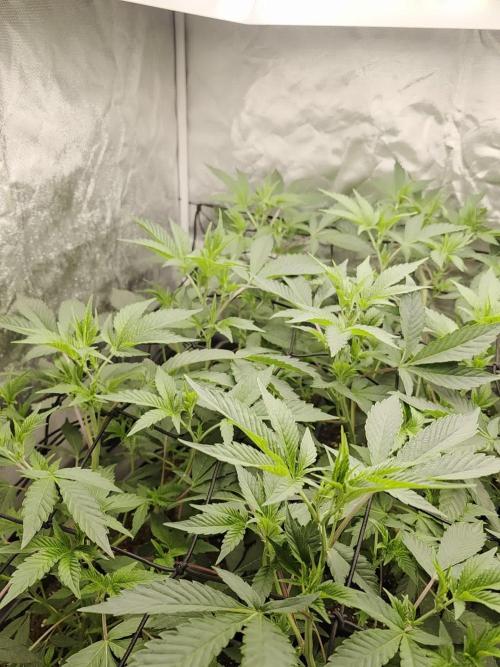
Prima settimana di fioritura,tutto procede più che bene,,anche questi altri giorni si sta riprendendo ogni giorno di più. ..


Likes
2
Share

@Ultraviolet_
Follow
We become aware at such times of man's wonderful ability to bring seemingly unrelated elements into harmonic balance, and receive a glimpse into a world where everything exists in conscious sympathetic attunement to everything else. When we listen to a piece of music that seems to strike a beautiful chord somewhere inside us, or view a painting that simply glows with harmonic awareness well executed, we probably do not spare much time to contemplate the wonderfully intricate combination of vibrations that our sensors make it possible for us to perceive. We tend to appreciate the relationship between the parts of something by an awareness of the harmony or dissonance of the whole. This ability enables us to say "what a beautiful house!" instead of "analysis has proven that this collection of building materials exhibits certain elements of harmonic proportion." While this ability to instinctively appreciate the beauty of true harmony has an important role to play in evolution, a more analytical understanding of the laws involved can be most useful. This is especially so if we wish to create works of art where each part exists in true harmony, not only with the other part of that particular whole, but with the universe within which the creator and the created exist.
Everything vibrates. From the most dense matter to the most subtle cosmic rays, everything which our senses allow our thoughts to become aware of, can be specified in terms of wavelength or frequency of vibration. These two terms define the same thing, but from different points of view.
The following are the approximate wavelengths of various energy carriers:
Cosmic rays 0.000,000,001 mm
Gamma rays 0.000,000,1 mm
X rays 0.000,500 mm
Ultraviolet rays 0.003 mm
Visible light 0.006 mm
Infrared 0.01 mm
Sound waves 1 meter
Radio waves 300 meters
Violet light 400 nm to 450 nm
Blue light 450 nm to 500 nm
Green light 500 nm to 570 nm
Yellow light 570 nm to 590 nm
Orange light 590 nm to 610 nm
Red light 610 to 700 nm
1 nanometer (nm) = 0.000,000,1 cm = 1/10,000,000 cm
If a guitar string is plucked and we hear a sound, it is not too difficult for the human mind to associate this sound with the vibration of the guitar string. With color it is quite different. It is difficult for us to conceive that the color of a substance is not an inherent property of the substance itself, but an indication picked up by our senses of that substance's ability to absorb or reflect the light which happens to be shining on it at that moment. Neither the matter nor the light is colored. What happens is that the brain learns to differentiate between the frequencies reflected or transmitted by the substance the eyes are focused on. The same thing happens with sound. When we say "Oh! Listen, they're playing my favorite song," what we really mean is: "My brain has stored within it a particular pattern of frequencies. I have compared the new information being received with this stored pattern and have deduced the answer that the two patterns are similar within certain specified tolerances." The 'pleasure' involved could have something to do with our running the pre-recorded pattern at the same time, in 'sympathy' with the new pattern as it is received.
The word sympathy describes very well our ability to appreciate color and sound. It also describes the reason behind certain elements of harmony. For instance, if a substance vibrating at 100 cycles per second (tone 1) is in the proximity of another substance vibrating at 200 cycles per second (tone 2), we could perceive, if we had the right equipment, a certain sympathetic relationship between the two.
We will see from this that there is a uniform doubling of the first tone seen in the second. At various points along the waves, the two are the same in amplitude. At other points, they are at opposite poles to each other. This doubled frequency has more points of similarity to the original than any other frequency except the original itself. If the equipment we had available for measuring these two frequencies was a soundboard amplifier and a pair of ears, then we would hear what would sound to us like one tone. If we had the opportunity to hear one at a time, we would hear that although they sound the same, one is higher in pitch than the other. This characteristic of 'the same but different in pitch', musicians have called the octave. Any two tones produced where one has exactly doubled the frequency of the other is called an octave. Speaking in ratios, an octave would appear then as the ratio 2:1 or 1:2, depending on whether we are talking of an octave up or down.
A single note produced by almost any instrument will contain more than one wavelength or frequency. It will have a dominant frequency, the wavelength of which we would call the note's 'fundamental' or 1st harmonic. It will also have a varying number of upper harmonics, gradually fading in intensity into infinity or silence.
Natural harmonics always have the same pattern of intervals between them. The interval between the 1st and 2nd harmonic is a perfect octave; between the 2nd and 3rd a perfect fifth; between the 3rd and 4th a perfect 4th; and so on, the intervals becoming smaller and smaller until they lose any relationship with the western 12 tone scale as it exists at the moment. Just as an octave has certain elements of sympathy with its fundamental, so some intervals have been noted to be more perfectly in sympathy with the fundamental than others. The ratio of the 'perfect 5th' or interval of 7 semitones, as it occurs in the harmonic series, is 3:2 or 2:3, while that of the 'perfect fourth" is 4:3 or 3:4. All the tones in the western 12 tone scale can be expressed in terms of the ratio between the upper tone and its fundamental. This would seem to be an ideal way of generating a scale from any given fundamental and several attempts have been made to do this, the Pythagorean system being probably the most well known. Although when working with a single tone instrument playing on its own, the Pythagorean formula works wonderfully well, if we had several instruments tuned this way together and asked them to play almost any western music, we would find that at times they sounded quite out of tune to each other.
The lack of flexibility of the various scale systems based on the harmonic series has led to what is known as the 'tempered' scale. This uses as its primary unit of interval the ratio of the octave or 2:1. It then proceeds to divide the interval between any fundamental and its upper octave into 12 smaller intervals by applying the ratio: two to the one-twelfth power, to one (21/12:1). This equals 1.059463094, so by multiplying any frequency by this number, we will obtain the tempered semitone next up from our fundamental. We will also find that any tone twelve semitones up from any other tone, in a scale generated in this way, will have exactly double the frequency.
If we took the note middle C on a piano and halved the wavelength, we would have the note C one octave above. If we halved this, we would have the C above, and so on. However, within about 6 octaves, we would find that although a 'sound' was being produced, no human ear could perceive it. If we kept on going, halving and producing upper octaves of our fundamental C, we would proceed through the infrared band, into the visible light spectrum. If we happened to be outside during the day, we would, for one octave only, see the note C with our eyes. The next octave above would already be in the ultraviolet band, and outside the eye's sensitivity range. If we can think of color as being an indication of a substance's vibratory rate or wavelength, we may begin to see a relationship that could exist between the color and sound spectrums.
The logical extension of what has so far been said is that there exists a scale in the color spectrum that corresponds exactly to the scale in the sound spectrum, each color tone being an octave of the equivalent note in the sound range.
This is not the end of the story but only the beginning. If we can for the moment accept that any wavelength in one band has upper and lower octave stretching out to infinity, then the next question is 'fine, but what shall we use as our fundamental? A particular color? A particular sound frequency?' The musicians among us will probably say 'A 440'. This means that the note A should vibrate at 440 Hertz, or 440 times per second. They would tell us that this is standard pitch has been adopted by most orchestras around the world; pianos are tuned to it, instruments are constructed to formulas based on it, and so to them it would probably seem the most appropriate place to begin. Some of these musicians may know of the battle that is still raging with regards to this being the standard, but few would know why A = 440 Hz was chosen except that it worked when it was set to be a suitable compromise between the many different pitches in use at the time.
432 Hz is said to be mathematically consistent with the patterns of the universe. Studies reveal that 432 Hz tuning vibrates with the universe’s golden mean PHI and unifies the properties of light, time, space, matter, gravity, and magnetism with biology, the DNA code, and consciousness. When our atoms and DNA start to resonate in harmony with the spiraling pattern of nature, our sense of connection to nature is said to be magnified.
Another interesting factor to consider is that the A=432 Hz tuning correlates with the color spectrum, while the A=440 Hz is off. Audiophiles have also stated that A = 432 Hz music seems to be non-local and can fill an entire room, whereas A=440 Hz can be perceived as directional or linear in sound propagation.
Once you adopt the idea that sound (or vibration in general) can have an equalizing and harmonizing effect (as well as a disturbing effect), the science of harmony can be applied to bring greater harmony into one's life or tune to specific energies. There is a form of absolute and relative harmony. Absolute harmony can, for example, be determined by the tuning of an instrument. The ancients tuned their instruments at an A of 432 Hz instead of 440 Hz - and for a good reason. There are plenty of music examples on the internet that you can listen to in order to establish the difference for yourself.
Attuning the instrument to 432 Hz results in a more relaxing sound, while 440 Hz slightly tenses up the body. This is because 440 Hz is out of tune with both macro and micro cosmos. On the contrary, 432 Hz is in tune. To give an example of how this is manifested microcosmically: our breath (0,3 Hz) and our pulse (1,2 Hz) relate to the frequency of the lower octave of an A of 432 Hz (108 Hz) as 1:360 and 1:90.
It is interesting to note that 432 Hz was the standard pitch of many old instruments and that it was only recently (19th and 20th century) the standard pitch was increased. This was done in order to be able to play for bigger audiences. Bigger audiences (more bodies) absorb more of the lower frequencies, so the higher pitch was more likely to “cut through”. One of the oldest instruments of the world is the bell ensemble of Yi Zeng (dated 423 BC), tuned to a standard F4 of 345 Hz, which gives an A= 432 Hz. The frequency of 345 Hz is that of the platonic year! Similarly, many old organs are tuned in A=432 as well; for example, St. Peter’s Capella Gregoriana, St. Peter’s Capella Giulia, S. Maria Maggiore in Rome.
Maria Renold’s book “Intervals Scales Tones and the Concert Pitch C=128 Hz” claims conclusive evidence that 440 Hz and raising concert pitch above scientific “C” Prime=128 Hz (Concert A=432 Hz) disassociates the connection of consciousness to the body and creates anti-social conditions in humanity.
The difference between concert pitch A=440 Hz and Concert A=432 Hz is only 8 cycles per second, but it is a perceptible difference of awareness in the human consciousness experience of the dream we share called existence.
Likes
78
Share


@PersonalSmok3s
Follow
She’s finally down 😸
I finished harvesting the lower buds this morning. Most of the buds appeared to have matured.
Filled another one and a half hangers, I can’t get over how much this plant has produced.
All the buds feel solid to the touch and the trichome coverage is phenomenal.
She’s got a really sweet gassy aroma, with a funky backend.
I’ve done a final trim on all the top/mid buds, they’re just having a few more days to finish up.
Sorry for the lack of pictures, I 100% plan on doing a final smoke report update with an overall yield and plenty of pictures.
Made a small test batch of rosin from the final trim, came out fantastic, it’s retained all the smell, it’s ridiculously strong and smokes extremely smooth 😻.
I’d like to thank everyone who’s had a look, commented or liked this diary. I hope it’s been helpful in some way 😸.
Another fantastic strain by In House Genetics, if you are looking for premium quality flowers grab a pack!
——————————————————
SMOKE REPORT & FINAL WEIGHT
——————————————————
For some reason it won’t let me add the final smoke report so I’m adding it here underneath 😸🤷♂️ hopefully it’ll be seen.
I’ve finally got round to trimming the last of the Slurricane and I was amazed with how well she yielded.
I got 9 ounces of solid buds that are covered in a ridiculous amount of trichomes! I don’t have any way of testing her but she looks like a 30%+ THC content, absolutely phenomenal buds.
I also got 2 ounces of smaller leafier buds that were round the bottom of the plant and a stupid amount of premium quality trim. All this has been frozen to make into Rosin at a later date.
The Buds themselves have a unique smell and taste, it’s gassy, but has a strange sweet taste that lingers In the mouth. I’ve never really had anything like it before.
She packs an absolute punch!
Immediate flushing to the face whether it be Rosin or Flower, I’d say she leans more to the indica side of things, but that could just be me 🤷♂️
All the top buds have had a weeks cure and are smoking unbelievably smooth even at this stage 😸
I’m storing some of it in a jar and I’ve posted a pic of the bottom of it, it’s almost completely white from the loose trichomes that have shaken off 😻.
The Rosin I’ve made so far has been fantastic and I’ve only used trim, I’ve yet to press any flower, but I reckon she should give some decent returns!
Overall she’s ticked a lot of the boxes for things I look for in a decent keeper plant. I’ve got a mother clone vegging so I’ll be running groups in the future.
Great plant, great smoke 😻🌱💚


Processing
Likes
4
Share


@Andres
Follow
nothing to say ... that his growth is still good and he has a small greenhouse in a bottle to keep the humidity ...

Likes
68
Share


@Ferenc
Follow
Day 44, 30th of October 2020:
Here we go I am back from holiday this girl grew a lot. The first 6 pictures before LST and the rest is after picture.
I switches the light to 12/12 from tomorrow and leave her in darkness for one day from now.
She has got already some smell also... ;)
I have ordered and extraction fan kit so with filter it will be used soon.
Next week starts more intensive fertilization as well :)
Let's start to flower hahaha :)
Happy Smokes ;)

Likes
29
Share


@TheCannaProphet
Follow
------------------------------------
~SEEDSMAN PEYOTE GORILLA~
------------------------------------
Peyote Gorilla is a cross of Gorilla Glue #4 (Chem Sister x Chocolate Diesel) and Peyote Purple, a colorful pheno-type of Bubba Kush. The potent, medicinal effect of the Gorilla meets the stimulating and uplifting high of the Peyote Purple.
With a flowering time of around 70 days Peyote Gorilla has a typically Indica structure, medium-sized with large, broad leaves. Yields are exceptionally good; indoors growers can expect to yield between 500 - 650 gr/m2 while outdoors as much as 1500 gr/m2 can be realized. Resin levels are very high and this means that it is very suitable for making extracts and concentrates with.
This strain's scent is sour with lemon, petrol, earthy and woody notes and these properties are reflected back in the taste. THC production is very high at between 22 - 26% with CBD at just 1%. The effect is a very potent, uplifting high which gradually evolves into a physically relaxing state that will be almost certain to ease any aches and pains.
__________________________________________________________________________________________________________________________________________________________________________________________________________________________________________________________________________________________________________________________________________________________________________________________________________________________________________________
-Strain Characteristics-
BREEDER/BRAND: Seedsman
PRODUCT TYPE: Seeds THC
GENETICS: Gorilla Glue #4 (Chem Sister x Chocolate Diesel) x Peyote Purple (Bubba Kush purple pheno)
VARIETY: Mostly Indica
FLOWERING TYPE: Photoperiod
SEX: Feminised
THC CONTENT: 22 - 26%
CBD CONTENT: 1%
YIELD: Indoor: 450-600 g/m2; Outdoor: 1500 gr/plant
PLANT HEIGHT: 80-160 cm
GROWS: Indoors, Outdoors
FLOWERING TIME: 70 days
HARVEST MONTH: September
MEDICAL CONDITIONS: Fatigue, Insomnia, Pain, Stress
TASTE / FLAVOR: Berry, Earthy, Fruity, Petrol, Sweet
EFFECT: Euphoric, Powerful, Relaxing, Uplifting
_________________________________________________________________________________________________________________________________________________________________________________________________________________________
_________________________________________________________________________________________________________________________________________________________________________________________________________________________
THE SETUP:
~Planted into Jiffy Peat Pellets that were hydrated with de-chlorinated water with SuperThrive added then ph'd to 6.0 @ 80℉
~Grown 100% organic in 10g fabric pots with Mother Earth 70/30 Coco/Perlite medium amended with 2tbs/g of Down To Earth 4-4-4 / 2 cups/g of Earthworm Castings / 1tbs/g of Dr. Earth Flower Girl 3-9-4, 1tbs/g of Dr. Earth Bat Guano, 3/4 cup of Down To Earth Azomite and 1 tsp/g Down To Earth Fish Bone Meal.
~24hr light cycle during Germination / 19/5 light cycle for Vegetation and 12/12 for Flower
~Straight water ph'd @ 6.2-6.8 when needed and weekly Compost Tea's.
__________________________________________________________________________________________________________________________________________________________________________________________________________________________________________________________________________________________________________________________________________________________________________________________________________________________________________________
Weekly Updates:
9/13- With approx. 10 weeks of growth behind her now she's going into her 5th week of flower now and let me tell you the pictures don't do her justice... This is one phenomenal cultivar! 😍
She was given Compost Tea yesterday and today was still fairly heavy so I skipped watering and just removed a few leaves to maintain light penetration, turned her pot and sat and chatted with her awhile!
9/15- Well she really must have liked that last batch of Compost Tea as she looks exceptionally vibrant today!
She's continuing on her mission of stacking her flowers, which are developing beautifully and have a delicious sweet citrus aroma to them right now.
I did not water yesterday, so today I watered with 1.5g of straight de-chlorinated water that was ph'd to 6.5 @ 72℉ and rotated her pot... Damn she is looking great! 🤩💖
9/17- Yesterday I top dressed her with 1/2 cup of Down To Earth Bio-Fish then watered it in with 1.5g of straight de-chlorinated water that was ph'd to 6.5 @ 72℉.
Her flowering is continuing beautifully and she's smelling stronger every day it seems! I'm staying on top of tucking leaves blocking light and turning her pot daily as well.
9/19- Five weeks of flower on the books! We're halfway there now, she's stacking her flowers tightly going into Week Six and she's looking phenomenal! 🤩
When I watered her today I added 1 tbsp/g each of Kelp Extract and Fish Emulsion (both liquid) to the 1.5g of straight de-chlorinated water she received, which was ph'd to 6.2 @ 74℉.
~Thanks for stopping in! Things should be getting a lot more interesting in the coming weeks...Stay lifted and be Blessed! 😎🙏~

Likes
46
Share


@Rollex420
Follow
Day 18
Transplanted today the plants into their 11L pots.😊
While instead i will let the Lemon Tree grow for another 4/5 days in the same pot because she only got 13 days, so I prefer to have it strengthened a little before the transplant.
Day 24
Mimosa, Meringue, and Kmintz were Topped, Defoliated and also applied a light LST to the main stems of the plants.
I will do the same for the Lemon Tree in the next 2/3 days..
I hope they have a quick recovery 🤞🏻
Day 27
LST also performed on the side branches of all plants except the Kmintz which is too small to bend its branches.
Also Today we got 21 days for the Lemon Tree which has a great shape! Carried out topping, LST and a little defoliation.. 🙌🏻
In the next few days I will let them grow them without further stress.
Have a great weekend gromies!! ☮️💚


Processing
Likes
3
Share


@XxBILLZAxX
Follow
Increased their food by a tad. Looked perfectly health raised to about 1900ppm.
Again spider mites at it crawling up every leaf and creating a colony. I thought it was over until I sat there nearly every night finding the f*****s and rubbing the leaves with the spray.
Defoliation was needed ASAP due to them stretching nicely. Started slowly from the bottom up. (repeated this process every 3-5 days.)
Likes
10
Share

@India_Calcoen
Follow
02-02-2026
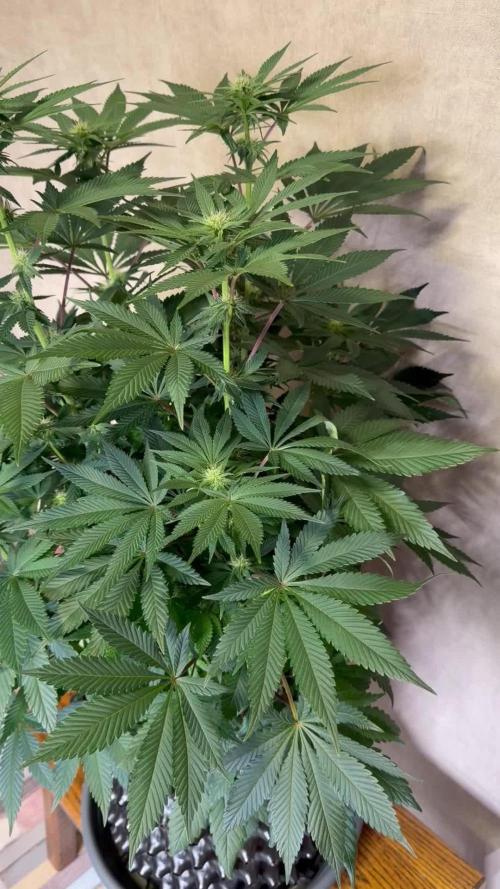
Third week of 12/12 for Colombian Gold. Her buds are developing nicely, she has nice, white hairs. I saw some brown tips but didn’t find any herming in the tent. It’s probably some stress or me touching the plant. It’s quite crowded in the tent!
I defoliated her today big time. I didn’t know where to start so I started cutting some branches. Cutting branches hurts! Some of them where lime green, have never seen any light in their short lives. I also found some dried leaves. She already started defoliating herself a bit 😉 It’s a pity I forgot to take some pictures before defoliating, but the short video gives an impression of her bushy structure.
I love how she grows ❤️❤️💚💚💛💛
Likes
8
Share


@Kirsten
Follow
26.12.24:
These are my 2 best plants P1 and P2 Purple Punch, they are looking great! Not sure what happened to P3.
They are in early flower/ pre-flower with the pistils clearly seen on P2. I am also hoping to tie some of the branches down to help light penetration on the lower canopies.
I have noticed light stress on my plants. I had moved the lights further away and increased the light intensity to 70%. Unfortunately that created some issues. Namely severe palour of the leaves.
To try and rectify the situation, I've dimmed the lights to about 30%, staying at the same distance, about 30 inches away. I measured the par levels, after I did this. They should a reading of anywhere between 40 and 150, at the canopy of the plants. They are all different sizes. This seems to have improved the colouring on all plants.
After this evenings watering, I will monitor recovery and increase lighting intensity again slowly. I am also using the light cycle of 21/3, so the plants have many hours more light to absorb, than for example 12/12 or 18/6.
I am pleased with the progress, considering all of my mistakes!
29.12.24:
So I finally gave LST a shot, it's probably a bit too late, however I really want to get the most of the triploid pheno, and I went a little crazy and LST'd all plants except 2, as they're too small.
I did that late last night, this afternoon I was amazed to see the plants turn their leaves back to the light source. I'm glad I overcame my fear of trying it. I'm very excited to see them adapt and progress! 😁 there are videos above with before and after of my LST process.
Thanks for checking out my diary 🍃 ✌️
Likes
7
Share


@DIY95
Follow
Blütewoche 6: Die Woche begann okay. Das Vergilben ist nicht gravierend schlimmer geworden.. 🙏 Also sollte es hoffentlich doch bis zur Ernte reichen 😁
.... Ich hatte jedoch das Gefühl, dass es irgendwie nicht so wirklich weitergeht.. Die Buds wurden nicht sonderlich dicker, bei 3 von 4 Pflanzen blieb der Stretch fast völlig aus.. Also nochmal jemanden fragen der Ahnung hat.
Einen Tag darauf bekam ich Besuch von meinem Kollegen, welcher den Grow das erste mal sah. Er schaute sich die Pflanzen etwas gründlicher an... und sagte, dass dort eine Stelle verdächtig aussieht...
Nach weiterer Begutachtung stand fest. Es sind 2 sichtbare Pollensäcke versteckt an der hinteren linken Pflanze...
Er beruhigte mich und sagte ich solle nicht durchdrehen.. wir schauen uns es morgen früh im hellen an und entfernen die Säcke vorsichtig..
Das Problem mit dem ruhig bleiben ist nur ... dass es mir nicht so liegt, wenn ich meine gesamte Arbeit schlagartig als gefärdet sehe... 😓😐😶
Am nächsten Tag stellte sich heraus, meine Panik war nicht unbegründet ... kurzgesagt ich habs leider trotz aller Mühen verkackt 😓😓😓
Alles ist voller Samen.. jede Pflanze wurde von der kleinen Skywalker bestäubt. Von unten bis in die Headbuds...
Aber Hey bleib locker, kann passieren, lernste draus und gut ist ... Das ist was man in solchen Momenten gerne hört 😡
Das Fazit ist jedoch... Genauso ist es. Es kann passieren. Man kann nicht alles von vornherein wissen. Man kann nicht alles perfekt machen ohne es einmal geübt oder fehler gemacht zu haben... Es ist einfach zu viel, dass man einfach wissen müsste.
Ich bin Perfektionist durch und durch .. Aber diesmal war es gaaanz weit entfernt von perfekt 😩
Die ganze Zeit, Nerven, Mühe, Vorfreude und vorallem das Geld .. alles erstmal futsch..
Aber eine Menge dazugelernt habe ich... Hoffentlich kann ich das nächste mal mehr davon richtig anwenden 🙏
Für mich ist der Grow hiermit Emotional und aus wirtschaftlicher Sicht als gescheitert zu betrachten. 💤
Alle Pflanzen werden nun wieder gemeinsam in die erste Growbox unter 200W gestellt um ihre letzten Wochen hoffentlich ganz schnell hinter sich zu bringen.. damit sie mir aus den Augen verschwinden 😕
Die neuen Samen sind bereits eingesetzt und werden mir hoffentlich etwas mehr Glück bringen! 🙏
Vielen Dank fürs Lesen. Ich hoffe bei Euch läuft alles super 😉🙏
Melde mich wieder zur " Ernte " ... Ciao Ciao 👋
Processing
Likes
2
Share


@Patillac31
Follow
•Big bud 100 days from seed start flower 3/14
•Agent Orange 116 from clone Start flower 3/14
•I was going to do a lemon G 12/12 from seed but will be doing that in her own journal

