Likes
Comments
Share
@Fred420
Follow
This grow has been very educational and new. Change in Nutrients and Grow Style by only defoliating once. Very dense harvesting. I used 4 Crop King Seeds Jack Herer Autos. My #4 plant did not look anything like the other 3. It grew out more like a Gelato plant. While harvesting it smelled of Grapefruit! Wonderful Plant to Harvest! For Drying I am using my Black Dog Kit again with putting all buds on drying discs in the Tent. I then exhaust out humidity >60%. Being it is in the middle of summer, I run a dehumidifier in front of the Fresh Air Intake into the tent. That helps keep the Humidity below 60%.
Likes
2
Share
Days 49–55 | June 23–29 The tent’s getting noticeably more fragrant - those complex notes of citrus, pine, and cardamom are now joined by a sharper diesel layer when the buds are disturbed. Buds are visibly denser this week, especially on the main colas. Stacking is steady, and trichomes are beginning to cloud ever so slightly, though most remain clear. No amber yet. Lower leaf yellowing has continued - older fans fading out slowly - but now I’m starting to see yellowing creep up into the mid and upper canopy. Nothing aggressive, but it’s definitely progressed since last week. Fan leaves are still perky, and sugar leaves remain healthy, so I don’t suspect toxicity or major imbalance - just a steady drain of mobile nutrients as the plant puts all energy into flowers. Fed with full nutrients mid-week (2L: 3 mL Micro / 1.5 mL Grow / 3.75 mL Bloom, pH 6.4), and removed a couple of fully yellowed fans from underneath. Soil has stayed evenly moist with good bag weight - I've been careful not to overdo watering volume to avoid damp pockets. RH is steady around 50–55%, with temps hovering ~25°C. VPD is within range. No signs of foxtailing, stress, or pest pressure. Canopy is even under the trellis, light at ~36 cm above tops. Still tracking macros regularly - trichomes developing well. Flush date is locked in for Week 11, based on travel plans - not trichome maturity. For now, the feed rhythm continues, and I’ll ride the line as long as I can to bulk up the flowers before transition. Final swell ahead. Holding the line.
Likes
2
Share
We become aware at such times of man's wonderful ability to bring seemingly unrelated elements into harmonic balance, and receive a glimpse into a world where everything exists in conscious sympathetic attunement to everything else. When we listen to a piece of music that seems to strike a beautiful chord somewhere inside us, or view a painting that simply glows with harmonic awareness well executed, we probably do not spare much time to contemplate the wonderfully intricate combination of vibrations that our sensors make it possible for us to perceive. We tend to appreciate the relationship between the parts of something by an awareness of the harmony or dissonance of the whole. This ability enables us to say "what a beautiful house!" instead of "analysis has proven that this collection of building materials exhibits certain elements of harmonic proportion." While this ability to instinctively appreciate the beauty of true harmony has an important role to play in evolution, a more analytical understanding of the laws involved can be most useful. This is especially so if we wish to create works of art where each part exists in true harmony, not only with the other part of that particular whole, but with the universe within which the creator and the created exist. Everything vibrates. From the most dense matter to the most subtle cosmic rays, everything which our senses allow our thoughts to become aware of, can be specified in terms of wavelength or frequency of vibration. These two terms define the same thing, but from different points of view. The following are the approximate wavelengths of various energy carriers: Cosmic rays 0.000,000,001 mm Gamma rays 0.000,000,1 mm X rays 0.000,500 mm Ultraviolet rays 0.003 mm Visible light 0.006 mm Infrared 0.01 mm Sound waves 1 meter Radio waves 300 meters Violet light 400 nm to 450 nm Blue light 450 nm to 500 nm Green light 500 nm to 570 nm Yellow light 570 nm to 590 nm Orange light 590 nm to 610 nm Red light 610 to 700 nm 1 nanometer (nm) = 0.000,000,1 cm = 1/10,000,000 cm If a guitar string is plucked and we hear a sound, it is not too difficult for the human mind to associate this sound with the vibration of the guitar string. With color it is quite different. It is difficult for us to conceive that the color of a substance is not an inherent property of the substance itself, but an indication picked up by our senses of that substance's ability to absorb or reflect the light which happens to be shining on it at that moment. Neither the matter nor the light is colored. What happens is that the brain learns to differentiate between the frequencies reflected or transmitted by the substance the eyes are focused on. The same thing happens with sound. When we say "Oh! Listen, they're playing my favorite song," what we really mean is: "My brain has stored within it a particular pattern of frequencies. I have compared the new information being received with this stored pattern and have deduced the answer that the two patterns are similar within certain specified tolerances." The 'pleasure' involved could have something to do with our running the pre-recorded pattern at the same time, in 'sympathy' with the new pattern as it is received. The word sympathy describes very well our ability to appreciate color and sound. It also describes the reason behind certain elements of harmony. For instance, if a substance vibrating at 100 cycles per second (tone 1) is in the proximity of another substance vibrating at 200 cycles per second (tone 2), we could perceive, if we had the right equipment, a certain sympathetic relationship between the two. We will see from this that there is a uniform doubling of the first tone seen in the second. At various points along the waves, the two are the same in amplitude. At other points, they are at opposite poles to each other. This doubled frequency has more points of similarity to the original than any other frequency except the original itself. If the equipment we had available for measuring these two frequencies was a soundboard amplifier and a pair of ears, then we would hear what would sound to us like one tone. If we had the opportunity to hear one at a time, we would hear that although they sound the same, one is higher in pitch than the other. This characteristic of 'the same but different in pitch', musicians have called the octave. Any two tones produced where one has exactly doubled the frequency of the other is called an octave. Speaking in ratios, an octave would appear then as the ratio 2:1 or 1:2, depending on whether we are talking of an octave up or down. A single note produced by almost any instrument will contain more than one wavelength or frequency. It will have a dominant frequency, the wavelength of which we would call the note's 'fundamental' or 1st harmonic. It will also have a varying number of upper harmonics, gradually fading in intensity into infinity or silence. Natural harmonics always have the same pattern of intervals between them. The interval between the 1st and 2nd harmonic is a perfect octave; between the 2nd and 3rd a perfect fifth; between the 3rd and 4th a perfect 4th; and so on, the intervals becoming smaller and smaller until they lose any relationship with the western 12 tone scale as it exists at the moment. Just as an octave has certain elements of sympathy with its fundamental, so some intervals have been noted to be more perfectly in sympathy with the fundamental than others. The ratio of the 'perfect 5th' or interval of 7 semitones, as it occurs in the harmonic series, is 3:2 or 2:3, while that of the 'perfect fourth" is 4:3 or 3:4. All the tones in the western 12 tone scale can be expressed in terms of the ratio between the upper tone and its fundamental. This would seem to be an ideal way of generating a scale from any given fundamental and several attempts have been made to do this, the Pythagorean system being probably the most well known. Although when working with a single tone instrument playing on its own, the Pythagorean formula works wonderfully well, if we had several instruments tuned this way together and asked them to play almost any western music, we would find that at times they sounded quite out of tune to each other. The lack of flexibility of the various scale systems based on the harmonic series has led to what is known as the 'tempered' scale. This uses as its primary unit of interval the ratio of the octave or 2:1. It then proceeds to divide the interval between any fundamental and its upper octave into 12 smaller intervals by applying the ratio: two to the one-twelfth power, to one (21/12:1). This equals 1.059463094, so by multiplying any frequency by this number, we will obtain the tempered semitone next up from our fundamental. We will also find that any tone twelve semitones up from any other tone, in a scale generated in this way, will have exactly double the frequency. If we took the note middle C on a piano and halved the wavelength, we would have the note C one octave above. If we halved this, we would have the C above, and so on. However, within about 6 octaves, we would find that although a 'sound' was being produced, no human ear could perceive it. If we kept on going, halving and producing upper octaves of our fundamental C, we would proceed through the infrared band, into the visible light spectrum. If we happened to be outside during the day, we would, for one octave only, see the note C with our eyes. The next octave above would already be in the ultraviolet band, and outside the eye's sensitivity range. If we can think of color as being an indication of a substance's vibratory rate or wavelength, we may begin to see a relationship that could exist between the color and sound spectrums. The logical extension of what has so far been said is that there exists a scale in the color spectrum that corresponds exactly to the scale in the sound spectrum, each color tone being an octave of the equivalent note in the sound range. This is not the end of the story but only the beginning. If we can for the moment accept that any wavelength in one band has upper and lower octave stretching out to infinity, then the next question is 'fine, but what shall we use as our fundamental? A particular color? A particular sound frequency?' The musicians among us will probably say 'A 440'. This means that the note A should vibrate at 440 Hertz, or 440 times per second. They would tell us that this is standard pitch has been adopted by most orchestras around the world; pianos are tuned to it, instruments are constructed to formulas based on it, and so to them it would probably seem the most appropriate place to begin. Some of these musicians may know of the battle that is still raging with regards to this being the standard, but few would know why A = 440 Hz was chosen except that it worked when it was set to be a suitable compromise between the many different pitches in use at the time. 432 Hz is said to be mathematically consistent with the patterns of the universe. Studies reveal that 432 Hz tuning vibrates with the universe’s golden mean PHI and unifies the properties of light, time, space, matter, gravity, and magnetism with biology, the DNA code, and consciousness. When our atoms and DNA start to resonate in harmony with the spiraling pattern of nature, our sense of connection to nature is said to be magnified. Another interesting factor to consider is that the A=432 Hz tuning correlates with the color spectrum, while the A=440 Hz is off. Audiophiles have also stated that A = 432 Hz music seems to be non-local and can fill an entire room, whereas A=440 Hz can be perceived as directional or linear in sound propagation. Once you adopt the idea that sound (or vibration in general) can have an equalizing and harmonizing effect (as well as a disturbing effect), the science of harmony can be applied to bring greater harmony into one's life or tune to specific energies. There is a form of absolute and relative harmony. Absolute harmony can, for example, be determined by the tuning of an instrument. The ancients tuned their instruments at an A of 432 Hz instead of 440 Hz - and for a good reason. There are plenty of music examples on the internet that you can listen to in order to establish the difference for yourself. Attuning the instrument to 432 Hz results in a more relaxing sound, while 440 Hz slightly tenses up the body. This is because 440 Hz is out of tune with both macro and micro cosmos. On the contrary, 432 Hz is in tune. To give an example of how this is manifested microcosmically: our breath (0,3 Hz) and our pulse (1,2 Hz) relate to the frequency of the lower octave of an A of 432 Hz (108 Hz) as 1:360 and 1:90. It is interesting to note that 432 Hz was the standard pitch of many old instruments and that it was only recently (19th and 20th century) the standard pitch was increased. This was done in order to be able to play for bigger audiences. Bigger audiences (more bodies) absorb more of the lower frequencies, so the higher pitch was more likely to “cut through”. One of the oldest instruments of the world is the bell ensemble of Yi Zeng (dated 423 BC), tuned to a standard F4 of 345 Hz, which gives an A= 432 Hz. The frequency of 345 Hz is that of the platonic year! Similarly, many old organs are tuned in A=432 as well; for example, St. Peter’s Capella Gregoriana, St. Peter’s Capella Giulia, S. Maria Maggiore in Rome. Maria Renold’s book “Intervals Scales Tones and the Concert Pitch C=128 Hz” claims conclusive evidence that 440 Hz and raising concert pitch above scientific “C” Prime=128 Hz (Concert A=432 Hz) disassociates the connection of consciousness to the body and creates anti-social conditions in humanity. The difference between concert pitch A=440 Hz and Concert A=432 Hz is only 8 cycles per second, but it is a perceptible difference of awareness in the human consciousness experience of the dream we share called existence.
Likes
56
Share
@Aedaone
Follow
The temperatures, humidity, and watering volume(if measured) in grow conditions are all averaged for the week. The pH is soil pH. Any watering done by me is well water which is 7.6 pH and 50° F. Any listed nutrients are ml/gallon of soil. Day 1 we had clear skies sunshine. Temperatures were in the low 80's. Day 2 we had partly cloudy skies, low humidity, and temps in the lower 80's. I watered about 1.25 gallons per pot. Day 3 we had lite showers in the morning, partly cloudy skies and temperatures in the low 80's the remainder of the day. Day 4 we had showers in the early morning until afternoon. Then it was mostly sunny with high temperature around 79. Day 5 we had lots of sunshine and temperatures in the low 80's. I watered about a gallon out of the water hose. Day 6 it was mostly sunny with temperatures reaching 82°. The pots are drying out fast. Today I watered about 1.5-2 gallons of well water from the hose. I added 50mo ferrous sulfate top dressed to each pot. Day 7 we had thunderstorms, rain, and drizzle early morning and intermittently throughout the day. Temperatures were upper 70's. This week was a success. The plants on average grew 12" in height. The excessive rain hasn't been a problem and they are thriving. The only issue is the rain is washing the iron out. This caused some mild chlorosis in the new growth. I added a little iron to each pot and that'll fix it once they start picking it up. I've decided to let these grow naturally after the topping.
Processing
Likes
29
Share
@Grey_Wolf
Follow
Ginger Nut Cookies & Aussie Music Videos Fastbuds GSC x Barneys Red diesel 6 weeks of flowering completed 9th April 2020 Hi Everyone I hope you are all feeling well and keeping busy during the lockdown. It's raining cats and dogs here (lucky there's no chinese around LMFAO) and the humidity is 100% so today Ive chopped this little lady down and she is now drying up in my shed with fans going 24/7. I was quite pleased with the amount of bud I got off her and it's smelling fantastic and is very sticky.The trichomes were very milky with a few amber as well. 😍 very easy to grow no fuss and no problems but we'll have to wait and see as to whether she is a good smoke or not . Now for this weeks Aussie Music videos 👊 Because we are almost at the end of this grow I thought I had better add a few extra songs this week to make sure I get a decent selection of Diffrent music videos for you all to check out. So for this weeks selections I chose Empire of the Sun 👊 Walking on a Dream https://youtu.be/eimgRedLkkU Big Pig 👉 (from Bill n teds excellent adventure) 👊 I can't break away https://youtu.be/f_rfXVdYelA Peking duk 👊 Reprisal https://youtu.be/4GboBAg2Syo The white stripes 👊 Seven nation army https://youtu.be/0J2QdDbelmY Grinspoon 👊 Chemical Heart https://youtu.be/58mXxWuUqYw The hilltop hoods 👊 Leave my lonely https://youtu.be/yKifJ4Q5ph0 And Silverchair 👉Not bad for a bunch of 16yr olds which they were at the time this video was made https://www.youtube.com/watch?v=RZD982yrmx4 The Next update will be the Final harvest update with the dried n trimmed buds etc. I will also have to add another heap of tunes in that I had wanted to play , so keep an eye out for my next Update of Ginger Nut Cookies & Aussie Music videos .😀 Until then Stay safe and Keep lit And we'll all get thru this Together 🙏 👍
Likes
53
Share
@Pr3m_85
Follow
Increased nitrogen at 7.5ml/L (EC=2.03mS/cm) this week. They seem to appreciate that. To monitor in the next few days. Watered twice a week with Hesi-Powerzyme at 2ml/L. May the fourth be with you 😎 Dicreased Nitrogen at 7,0ml/L. I ve got some issues with my humidity (near 40%). I try to increase it.. Peace all ✌️✌️🏽✌️🏾✌️🏿✌️🏼✌️🏻.
Likes
4
Share
Привет друзья.✋ Наше знакомство продолжается с новым фотоцветущим растением от Smail_Seeds сорт TROPICANNA POISONZKITTLEZ XXL Regular F1 reg. Сегодня растению 66 дней. Перевёл на 12/12 1.10.2023 Перешло в активную фазу цветения Растение очень хорошо развивается, ни каких сбоев в генетике не наблюдается😀 Сорт выводим сами. Смотри мой профиль, у нас всегда есть что то интересное. Не забудь поставить лайк❤️, если понравилась как прошла неделя И читайте наш TELEGRAM: https://t.me/smail_seeds #Smail_Seeds 😀
Processing
Likes
33
Share
@Ferenc
Follow
Day 36 : I did LST again plants are growing quick. I set the lamp approx 26 cm away. 600 W LED, 20 hours on 4 hours off the same with ventilation humidity approx 60 percent. Ferlizitaion will continue the same way Monday Wednesday and Friday BioBizz family and Tuesday Thursday and Saturday bat gunao and Epson salt. Water intake 100 ml per day per plant. Day 39: Pre-flowers are coming BlackBerry Kush is getting purple ❤️. All of them started flowering and colas are coming out. Day 41: All of them have pre-flowers and pistils are out. BlackBerry Kush started turning into Purple. She and LSD-25 are the most developed. I did more LST on them.
Likes
14
Share
@suchydog5
Follow
2-3 buds were moldy so i had to cut them hope it doesnt spread further😳 to be honest i havent seen more beautiful flower than this purple one❤️
Likes
8
Share
@k0nz1
Follow
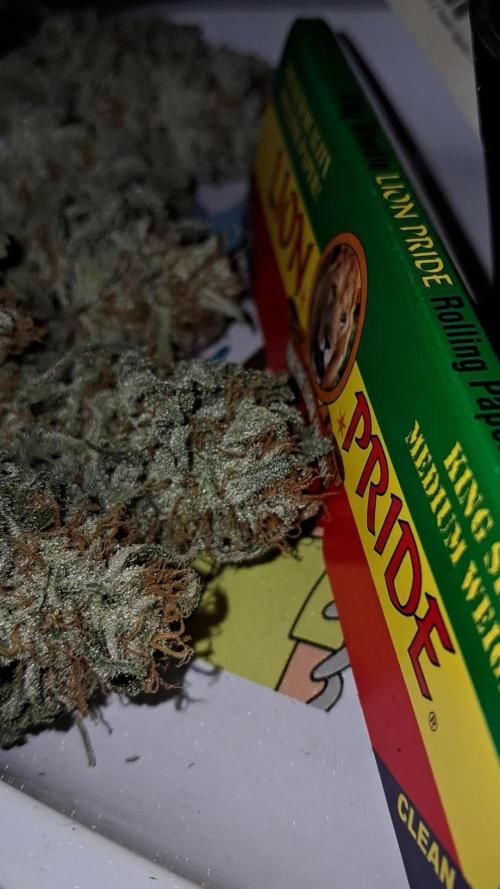
Hang dry 12 days by 60/60 Then cured with the new vivi cure Packs. They did a great Job. Final product is super smooth and tasty.
Processing
Likes
6
Share
Likes
2
Share
@LastinG
Follow
After the first update of the “Testrun of the new Setup!” grow, things have started to settle in nicely. The plants have recovered from the early establishment phase and are now putting their energy into building structure, stacking branches, and filling out the canopy. The differences between the genetics are already becoming very obvious. The two larger plants are clearly taking control of the room: * Rainbow Melon (top left in the overview) * Nectar (bottom center) Both are showing vigorous vegetative growth with strong lateral branching and healthy leaf development. The canopies are becoming increasingly dense, and the internodal spacing remains tight, which is exactly what I was hoping to see in this setup. Meanwhile, Something Good (top right) is developing at a slower pace. While noticeably smaller than the others, it remains healthy and continues to push new growth. Sometimes the slower starters end up becoming the most interesting plants later in flower, so I’m curious to see how this one evolves. Rainbow Melon Rainbow Melon is currently showing the most balanced structure in the tent. The plant has developed a wide, bushy profile with multiple strong tops emerging across the canopy. The leaves are broad and healthy with a rich green color, indicating that the living soil is doing its job. Branch development is strong, and the plant is responding well to the environment without showing signs of stress. At this stage, the goal is simply to keep opening the canopy and allowing light to reach the interior growth sites. If she keeps this pace, she should become a serious producer once flowering begins. Nectar Nectar is proving to be the powerhouse of the run so far. The plant has exploded with vegetative growth and is building a very dense canopy. The top-down view really shows how aggressively she is filling her space. New growth is vibrant and vigorous, and the branching structure suggests she will respond extremely well to further training. Defoliation and canopy management will likely become more important over the next couple of weeks to maintain airflow and prevent overcrowding. For now, though, she’s looking exactly like the kind of plant that can dominate a room if given enough space. Something Good The smallest plant of the group is still finding its footing. Compared to Rainbow Melon and Nectar, Something Good is developing at a much slower pace, but the growth remains healthy and symmetrical. The leaf color looks good, the stem structure is strengthening, and fresh shoots continue to emerge. Rather than chasing size, the focus here is simply maintaining healthy growth and allowing the root system to establish itself. There is still plenty of time for this plant to surprise me later in the cycle.
Likes
2
Share
Likes
Comments
Share
Cada dia,con mas fuerza es el crecimiento de estos clones,acostumbrandose mas a su nuevo espacio e iluminación!!!
Likes
4
Share
I am going to Hang dry with the entire plant so I will not have wet weight. But yeah dry weight coming soon!
Likes
13
Share
@NSABND
Follow
Day 50 and a new week... the summer comes back to germany and "Hilde 2.0" goes well 🙏😀 Day 51 ... the summer is back in germany ... sun and heat 😎👍... good for the Buds 😉🙏 Day 52 summer sun and warm weather....😎🙌🙏👍 Day53 hell yeah....sun and hot weather 😎🙏👍 Day54 summer sun and heat sounds like fun again 😎🙏👍
Likes
12
Share
@GhostByte
Follow
Gave her a good defoliation this week along with spreading out the branches a little. Couldnt bend the main cola over as it is still recovering from the damage. Overal she seems to be healthy. Been removing leaves here and there and she doesnt seem to mind at all.
Likes
8
Share
Sexta semana, fiz um flush nos vasos mais queimados, as outras plantas apresentam deficiência de magnésio também, segue sexta semana de flora e apesar dos problemas as flores tão bem resinadas, vou aplicar flowermind essa semana e ver se melhora. Obrigado por