


Likes
Comments
Share


@Chupus
Follow
I put it in a glass of water , later I will transfer it to paper towels . as practice shows , the method is working . It's not the first time I've used it. the main thing is to squeeze a towel well, so that the seeds do not rot. temperature 24-26 humidity around 60%


Likes
11
Share


@Le_Che
Follow
10 semaines de Flo tout de même à voir une fois sec, galère mais content du résultat, à voir une fois sec, instable
Likes
25
Share


@herewegrow
Follow
Ordered a scale the other day so should have some more numbers tomorrow! Not going to sample anything until I get the scale, then I'll update with some more details.

Likes
16
Share


@Dr_Rook
Follow
Pues después de 61 días de floración, ya les llegó su hora
La cantidad no va a ser muy buena, pero la calidad sí que promete
Actualizaré en unas dos semanas con el peso en seco y las primeras sensaciones al probarla

Likes
15
Share


@SamDo
Follow
Hello,,, fin semaine 6, semaine de 2 floraison. Le plantes se portent super bien malgré le manque de place,, le stretch est vraiment impressionnant, plus de 20cm en 1 semaine!
Aujourd’hui j’ai fait une défoliation pour enlever les parties les plus basses qui n’arrivent pas à accéder correctement à la lumière, et j’ai aussi retiré toutes les petites pousses sur les parties basses qui prennent de l’énergie pour rien, pour vraiment essayer de laisser que les fleures exposées à la lumière afin qu’elles puissent bénéficier de toutes l’énergie de la plante et aussi pour limiter le stress sur la plante.
Les premières fleures commencent a apparaître tranquillement. J’ai augmenter doucement les nutriments. Pour le moment tous semble aller se dérouler normalement. Encore 5 semaines avant la date prévu.
Voilà pour cette semaine.
Happy grow... 😎

Likes
7
Share


@KannaKullektiv
Follow
Hiiigh friends 🙌
Welcome to week 8. 😍
Due to too much unwanted stress, flowering is delayed. The big lady was unable to withstand the training. Her neck is broken. But she is far from giving up and will fight to the end.. 😊
See you next week. 👋
Arturo for KannaKullektiv
🙏
Likes
5
Share


@Plugged_Inn
Follow
I left them in LED for a few days before harvest so i could bring out some of the colours. 10/10 smoke :)
Likes
2
Share


@Fat_Olsh_Farms
Follow
Day 57. Very frosty beautiful buds going. About to do some minor defoliation.
Day 60. Fed with megacrop. Giving it megacrop every other watering, 10-15% runoff.
Likes
15
Share


@Tower84
Follow
Week 4 Update – Sunviva & Primabella Tomatoes 🍅
The girls are officially entering week 4, and the differences between the two varieties are becoming more and more visible.
The three plants in the back (Sunviva) are now around 30 cm tall and clearly focused on vertical growth. They’re stretching nicely with strong main stems and a more classic upward structure.
In contrast, the three plants in the front (Primabella) are about 15 cm tall but growing much bushier and wider. Their compact structure is already showing, with dense foliage and strong lateral development.
Today I did some light maintenance:
- Removed side shoots (pruning/suckering)
- Watered all six plants with a total of 1.5 L
- pH-adjusted water to 6.5
- Added BioBizz Root Juice at 2 ml/L
- Supplemented with 100 mg/L Epsom salt
Overall, development looks healthy and vigorous. The structural differences between the strains are really exciting to watch — Sunviva reaching for the sky while Primabella is building a solid, bushy base.
Looking forward to how they progress in the coming weeks 🌱
Likes
7
Share


@ROY4L_GU4RD
Follow
Day 53 of flower today. I filled the reservoir from empty and stopped using the macro. I replaced it with General hydroponics Ripen at 5ml a gallon. Everything is frosty and smells good. As far looks I like the RC the best and the PE the least. I'm going to end up with a sheet ton of it out of the 3 so I hope I'm wrong! 😆
I'm going to do a lower defoliation mid week to get more air flowing. RH is stable but I just want to be careful 🧐 being this close to the finish line. This is definitely one of the easiest runs I've had. It seems PE is pretty maxed when it comes to nutrition but LMC and RC could take a bit more. My PE phenotype is super stretchy compared to them as well.


Processing
Likes
52
Share


@CBD_Sweden
Follow
@MephistoGenetics,
Hi all the happy people here in GrowDiaries.
This is my second cultivation ever and it will be fun to try a bigger space than my closet grow.
First, I'm just going to say I'm done with the construction of my new growroom.
The room is 2.14 meters by 1.7 meters and has a ceiling height of 2 meters.
It provides a floor area of 3.6 square meters.
I use a 54 Watt Lightwawe T5 for germination and 2 Pcs 400 Watt HPS lamps.
I have a channel fan that replaces the room air about 40 times an hour to get a comfortable environment in the room, the air enters a fresh air intake from the outside.
The air is purified through a carbon filter to then leave the room to the rest of the basement.
Then I use that heat to heat the rest of the basement.
I will use 10 pcs 15 liter Autopots to grow with and a 100 liter water tank that supplies the pots of water and nutrition.
I will grow completely organically in soil and will watercure my buds to get the best possible medicine for me.
But there are no cultivation rooms to be displayed here, so I continue with what is most important.
I am very excited to see how the new growroom will work and how this Stilton Special will turn out.
Strain Name: Stilton Special F1
Genetic heritage - Sour Livers F3 x Northern Cheese Haze F3
Strain behaviour - Stilton grows well from the off, and develops into a stout but branchy specimine that leads to a fine yield of awesome flowers. She's not too stretchy but also is sizeable enough with good growth, to train and shape to your liking. Flowers develop pretty fast and grow to a good size, it may to advised to clear out some undergrowth and if needs be a very gentle defoliation mid-way through the grow, although leaf tucking may suffice well enough.The end product is of top shelf quality and she doesn't lack in yield either.Give your garden, nose, and body a treat and be sure to indulge in a slice of Stilton this year, You won't regret it.
Size - 50 - 70 cm
Structure - Medium height but bushy
Flower Density - 9/10
Indica/Sativa - 65/35
Cycle Time - 65 to 70 days from sprout
Yield - 90 to 140 grams as a single plant
Best Method for overall high yield - 9-12 per 1,2m x 1,2m sq in 10-15 Liter pots (Soil)
Aroma - Very strong, Cheesey/fruity/sour/spicey/ with a dash of coffee.
Taste - Dank berries
Effect - Good hybrid powerful but balanced effect
Medicinal Benefits - TBA
Best Grown - Indoor/Greenhouse
Cannabinoids - TBA
Extract information - Ideal extract candidate - High in resin, oil and terps.
--------------------------------------------------------------------------------------------------
2017-09-18. Start of week 4. I have defoliated her and she got water and nutes. She is 17 cm high and have not start to stretch yet.
---------------------------------------------------------------------------------------------------------------------------------------------------------
2017-09-19. 2 new fan is installed in the grow room. Added pic and video.
-----------------------------------------------------------------------------------------
2017-09-20. Kl 23.00. Did some massive defoliation, added video and pics
------------------------------------------------------------------------------------------------
2017-09-22. The girl has recovered well after my massive defoliation. She is now 22 cm high. I accidentally lowered the lamp a bit too far down and burned some leaves on one girl. They have got water and nutrition today.
Likes
20
Share


@Ultraviolet
Follow
Not particularly growing for speed or any dedicated reason this time round, just adding water and a abundande of positivity, gotta admit I do like the autoseed logo. Off we go again into the magical forest.
(Arthrospira platensis) cultivated in high-alkaline, mineral-rich water in Kailua-Kona, Hawaii. It is renowned for having a higher nutrient content, including more carotenoids and essential fats, compared to other spirulina brands. It is frequently cited as a "complete food" due to its dense concentration of proteins, vitamins, minerals, and pigments.
The nutritional profile of standard dried Spirulina platensis biomass. 3kg of spirulina powder has an approximate NPK ratio of 10-2-1 (or 10% Nitrogen, 2% Phosphorus, and 1% Potassium).
Here is the breakdown of the nutrient content for 3kg of powder:
Nitrogen (N): ~300g (10% of total mass)
Phosphorus (P): ~60g (roughly 2% of total mass)
Potassium (K): ~30g (roughly 1% of total mass)
3kg of spirulina powder is more than enough nitrogen for 4 cannabis plants in a 100-gallon pot—in fact, it is likely excessive and could cause severe nutrient burn or toxicity if not properly managed. Spirulina has a very high protein content (46% to 63% dry weight), which translates to a significant nitrogen source. It is often described as a 5-1-1 NPK fertilizer.
3kg (3000g) of powder in 100 gallons means 30g per gallon. General organic recommendations for potent amendments (like frass) are often around 1–3 tablespoons per gallon. 30g of powder is roughly 2-3 tablespoons, making this a very high-strength application rate if added all at once. Balance this with calcium/magnesium, and organic nutrient delivery in soil growing can lead to deficiencies in these nutrients.
Not all of that 100 gallon is used, so figuring out precise measurements was ballpark, but there is about 10kg of engineered biochar in that pot. Mostly in the top half. Ideally, I'd have 25kg in a full active 100-gallon, but......... don't mess with something that is not broken. Roots do not utilize the entire 100 gallons. This has been a couple of years of trial and error, mostly error. The amount of cations you can add in grams depends entirely on the specific cation exchange capacity (CEC) of your biochar and the type of cation being added. Biochar CEC values vary widely, typically ranging from 4 to over 300cmolc/kg. Multiple Biochars in use, ranging upwards of 100cmolc/km.
Different cations have different atomic weights
Potassium K+ 39.1g/mol.
Calcium Ca2+ 40.1g/mol.
Magnesium Mg2+ 24.3g/mol.
Nitrogen NH4+ 18.04g/mol.
You get more nitrogen bang for your buck. It all depends on the CEC of the biochar you use, but brrrrrrrrrr roughly I'm looking at 500-600 grams worth of elemental cation exchange capacity, give or take. That's just for the biochar alone. Elemental cation exchange capacity refers to the ability of materials—such as soil, minerals, and biochar to adsorb, hold, and release positively charged ions Ca2+, Mg2+, K+, Na+, Al3+, and Zn2+. This capacity is a critical measure of nutrient availability in soil and energy density in electrochemical systems.
Added calmag 2:1 to complement spirulina.
Calcium (Ca): Approximately 150g - 300g of elemental calcium.
Magnesium (Mg): Approximately 75g - 150g of elemental magnesium.
So long as pH stays in 6.3 to 6.7 ish, the plant will unlock hydrogen. Plants will be able to cycle CEC for their own needs. Hydrogen ion pumping (proton pumping) is a fundamental mechanism used by plant roots to facilitate the cycling of nutrients within a medium's Cation Exchange Capacity (CEC), directly increasing nutrient availability. A growing medium's Cation Exchange Capacity (CEC) does not contribute directly to Electrical Conductivity (EC). CEC represents potential nutrient storage, while EC represents active nutrients in the water/soil solution. A medium with a high CEC can hold many nutrients, but if there is no water present, the EC will be low.
98% of plant nutrient uptake comes directly from the soil solution.
2% of nutrient uptake is directly from soil particles.
Nutrients held on exchange sites (CEC) are not directly measured by EC until they are released into the soil solution through exchange with other ions (e.g., hydrogen ions from roots or fertilizer).
Plants source the H+ ions (protons) used in cation exchange primarily by exuding carbon sugars into the rhizosphere, then microorganisms perform root respiration, which reacts with soil water to form carbonic acid H2CO3 that dissociates into H+ and bicarbonate. Roots also actively pump out H+ ions directly to acidify the rhizosphere, plants trade hydrogen produced through metabolism for essential nutrients held by the soil.
In plant cells, the H+ (protons) used in proton pumping across the plasma membrane come primarily from the cytoplasm (cytosol). The protons are derived from internal cellular sources, including metabolic processes that release H+, and the regulation of intracellular pH homeostasis.
Distilled water is highly useful in managing the electrical conductivity (EC) of a growing medium by allowing for precise control over nutrient concentration and assisting in the mobilization of nutrients from the cation exchange capacity (CEC) into the active, plant-available nutrient solution.
Just add water & positive energy.
Potential hydrogen. pH. + - , potential charge balance for hydrogen.
So long as there is adequate oxygen in the soil and air and water moves at a decent interval, its practically impossible for the pH to skew in a soil that is taking in oxygen and releasing CO2 and nitrogen, I say practically, but meh, even with plenty of oxygen, the process of converting ammonium NH4+ to nitrate NO3- by bacteria releases hydrogen ions H+, which directly causes acidification (lowering pH). While water movement is necessary, consistent water moving through the soil can leach away basic cations Ca2+, Mg2+, K+, Na+, leaving behind acidic hydrogen and aluminum ions, causing pH to drop, especially in humid regions. High levels of CO2 in the soil (from intense respiration) dissolve in soil water to create carbonic acid, H2CO3, which lowers the pH. (barometric pumping removes that possibility) The pH in a cannabis cultivation environment, particularly in hydroponic or soilless setups, will often naturally drift towards acidic (lower pH) over time. Understand how to know when to lime the pH back up. Complex but critical. Once I understood this it helped ease the pain of understanding pH.
Base saturation directly reflects the percentage of CEC occupied by base cations. Generally, as base saturation increases, soil pH increases because fewer acidic cations, H+ and Al3,+ are present on the soil colloid surfaces.
At a pH of 7 or higher, the soil colloids are saturated with base cations, resulting in a base saturation of 90+%.
While many sources include Sodium Na+ as a base cation, some calculations focused specifically on plant nutrients (like in some nutrient management contexts) may focus solely on the "Big 3": Ca2+, Mg2+, and K+. However, in soil science and CEC (Cation Exchange Capacity) measurements, sodium is usually included in the definition of total base cations, making it the "Big 4" base cations.
At a pH around 5.5, soils often have a 45–55% base saturation, while a soil with a pH between 6.5 and 6.8 generally has an 80–90% base saturation.
Base saturation is considered a reliable, albeit complex, indicator of soil fertility and the degree of soil weathering, acting as a crucial metric in soil classification and management.
Once you take full control of the pH, so long as there is oxygen, and one keeps tabs on base saturation levels. Its near impossible for anything to go wrong. All you are essentially doing is adding water and waiting for any sign of deficiency. Not so much growing as eliminating the possibilities of things going sideways. Can't over or under water, can't skew pH, can't go anaerobic. Everything runs in optimal cycles, watering every 2 to 3 days or as required, depending on the rate of combined ET. A little warmer, a little drier, but never short on water. All the nutrients are already there in the medium, we still focus on the water, just not adding salts, but to mobilize nutrients held in the Cation Exchange Capacity (CEC) and move them into the active soil solution for plant uptake, the best supplements to add to water are fulvic acid, humic acid, or seaweed/kelp extract. Liquid solutions with high concentrations of essential trace elements. Distilled water has no alkalinity or minerals to help buffer or release nutrients. Adding these supplements turns the "empty" water into an active agent that forces nutrients off the CEC colloids into the solution for plant uptake.
When to water? When Electrical Conductivity of soil gets low. No water, no conductivity.

Likes
10
Share


@Audi_grows98
Follow
This week gorilla cookies finally got the chop! She was a very fun plant to grow and she produced dense,sticky buds that have some very pretty colors to her. If you wanna impress your friends with a plant,she’s one to do it with🔥
Likes
2
Share


@Ryno1990
Follow
Week 5 of veg for this girl she's been picking up some size still the smallest girl but not by much she's deff been growing nice an healthy under this fold 6 from medic grow she's I nice little bush with some big fan leafs
Ending week 5 this girl is doing good she's not the smallest one but she's not to far ahead she has been doing great since her transplant into her final pot so hopefully she'll start picking up some size
Likes
6
Share


@TrexyTame
Follow
One plant had to go. I’m thinking it was maybe an issue with drainage because I didn’t mix enough, but everything else is doing pretty good. They’re a little unhappy with the light intensity but it looks worse because they were just watered. Fade is looking nice but some are getting tip burn I suspect because I did a 6 week flush. They might also lose some color in the next couple of weeks but I’m gonna be fighting it. Anyways thanks for checking in!
Likes
7
Share


@100Trillion
Follow
Second week of flower went well. The plant has over double the size at this point and we have early signs buds forming within the second week. Continuing to keep the light about 12 to 14 in above the canopy as the plant stretches. Plants are getting really bushy will prepare for a day 21 leaf strip to clear out the canopy and to allow for air flow while dropping humidity. Will also try to implement a second scrog for support.Currently The single seed Sent from khalifa for grow Contest is tallest pheno in the tent and healthiest looking that pheno will show on the top right in any of the disclosed pictures and videos.

Likes
14
Share


@GoldenWeedGrower
Follow
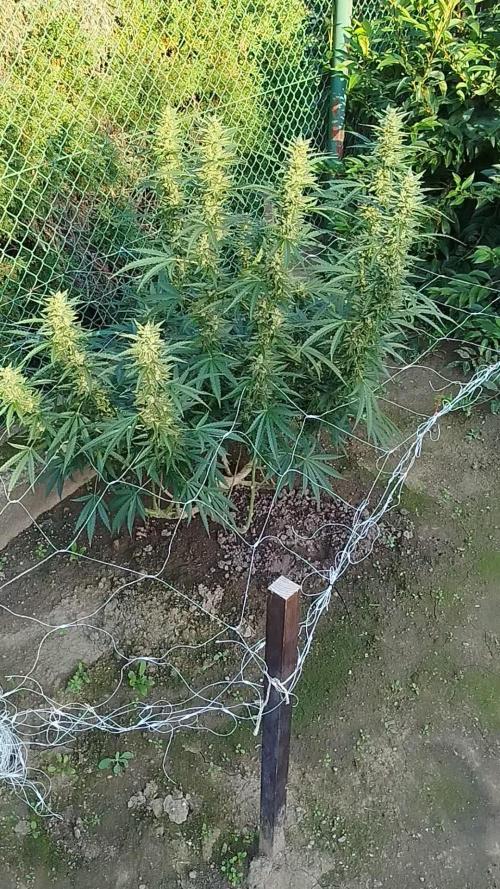
D50/F06 - 20/05/23 - Nothing to report
D51/F07 - 21/05/23 - Added water and nutes EC=1.1 pH=5.7
D52/F08 - 22/05/23 - Nothing to report
D53/F09 - 23/05/23 - Added water. EC=1.1 pH=6.4
D54/F10 - 24/05/23 - Added water and nutes EC=1.0 pH=6.3
D55/F11 - 25/05/23 - Start the week out. I set up a system to feeding Nora during my stay out (I'll take some picture about...)
D56/F12 - 26/05/23 - I leave today, 1 week away



Likes
5
Share


Likes
40
Share


@MadeInGermany
Follow
Info:
Unfortunately, I had to find out that my account is used for fake pages in social media.
I am only active here on growdiaries.
I am not on facebook instagram twitter etc All accounts except this one are fake.
Flowering day 65
since time change
to 12/12 h.
Hey guys :-)
We arrived in the last days before the harvest 😊.
The buds have swollen again the last few days.
The trichomes are 90% milky and 10% amber 👍.
This week it was poured twice with 1.2 l each time (for nutrients, see table above).
As always, it is put in the darkroom for 48 hours before it is harvested.
There is still a harvest update and a final update after fermentation 👍.
Until then, I wish you all a lot of fun with the update and stay healthy 🙏🏻
You can buy this Nutrients at :
https://greenbuzzliquids.com/en/shop/
With the discount code: Made_in_Germany you get a discount of 15% on all products from an order value of 100 euros.
You can buy this Strain at :
www.Zamnesia.com
Type:
Runtz
☝️🏼
Genetics:
Zkittlez x Gelato
👍
Vega lamp: 2 x Todogrow Led
Quantum Board 100 W
💡
Bloom Lamp : 2 x Todogrow Led
Cxb 3590 COB 3500 K 205 W
Soil :
Canna Coco Professional +
☝️🏼
Nutrients :
Green Buzz Liquids :
Organic Grow Liquid
Organic Bloom Liquid
Organic more PK
More Roots
Fast Buds
Humic Acid Plus
Growzyme Big Fruits
Clean Fruits
Cal / Mag
Organic Ph - Pulver
☝️🏼🌱
Water: Osmosis water mixed with normal water (24 hours stale that the chlorine evaporates) to 0.2 EC. Add Cal / Mag to 0.4 Ec Ph with Organic Ph - to 5.8 - 6.4
