


Likes
Comments
Share


@cents1million
Follow
These last 2 weeks the buds have started to fatten. Some have started a foxtail trait. Not sure if it's genetics or my light. The heads on the trichomes are starting to swell. It smells more like candy than weed. I put up a couple poles to keep the tent from sucking into the plants due to the negative pressure from the fan.

Likes
61
Share

@squalino
Follow
📖 Chroniques de l'Oasis : La Marque Blanche
🐪 Chapitre 7 : La Rosée d'Étoiles du Rif
Date : 8 Avril 2026
Âge : J+49
Taille : 66 cm (+4 cm depuis le 2 Avril)
Le périple continue. Je marche d'un pas lent et régulier, car je sais que l'Oasis ne livre pas ses secrets en un jour. Il reste encore bien des lunes avant d'atteindre le cœur du sanctuaire — au moins un mois de marche sous ce soleil du sanctuaire.
Mais aujourd'hui, le paysage change.
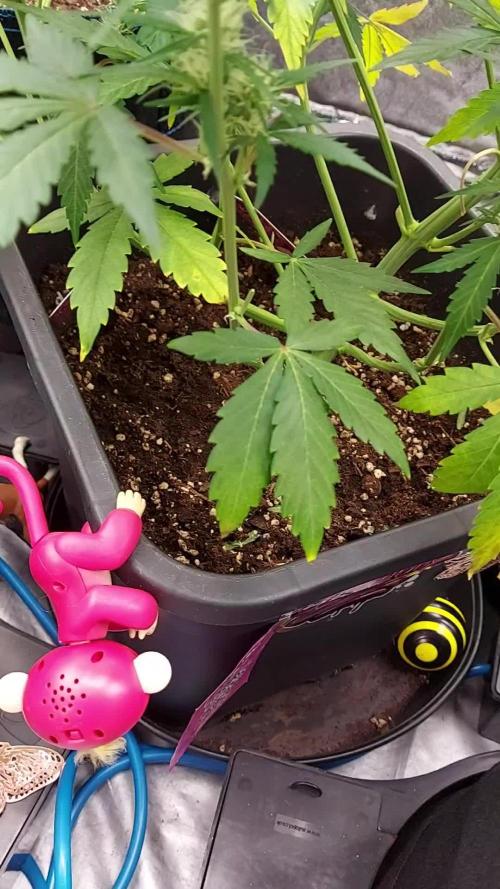
La Sultane, du haut de ses 66 cm, commence à capturer la lumière d'une manière nouvelle. Ce n'est plus seulement du vert que je vois ; sous l'éclat de la lampe, on dirait qu'une fine poudre d'étoiles commence à se déposer sur ses épaules de velours. Cette poussières d'Étoiles scintillent, transformant chaque calice en un réceptacle de délice. Elle s'habille de cette rosée céleste, préparant sa parure pour la suite du voyage.
🏜️ Le Souffle de la Vallée
Température :
24,5°C jour / 21°C nuit (Le climat reste clément et stable).
Humidité :
50% (Idéal pour laisser cette poudre d'étoiles sécher et s'incruster).
Lumière :
Intensité 75%, à 57 cm de la couronne (Le soleil se fait plus pressant, plus intime).
L'Élixir de vie (Nutrition)
Le chemin demande de la force, et la Sultane puise dans ses réserves :
le 06/04
Il y a 2 jours :
1 Litre d'eau (pH 6,3) avec 4 ml de PK 5-8. L'élixir de densité pour forger ses fleurs.
le 08/04
Aujourd'hui :
3 ml d'Orgatrex. J'ai vu ses feuilles du bas jaunir, signe qu'elle sacrifie sa base pour nourrir son sommet. Cet apport d'azote est une main tendue pour l'aider à garder sa vigueur sur la longue route qui nous reste.
le 14/04
apport de l'élixir de vie
4ml pk 5-8 1 litres d'eau ph 6,3
📜 Anecdote du Rif : Les "Nuits de Cristal"
Dans les montagnes du Rif, les cultivateurs les plus expérimentés ne regardent jamais leurs plantes en plein jour pour juger de la résine. Ils attendent la nuit, munis d'une simple lampe à huile ou à la lueur de la lune.
On appelle cela chercher le "Givre du Rif". Ils disent que si la plante "mange la lumière" le jour, elle "recrache des étoiles" la nuit. Si, à la lueur d'une flamme, la plante scintille comme si elle était couverte de diamants pilés, alors ils savent que la recolte sera d'une pureté exceptionnelle.
Note du Nomade :
"Le chemin est encore long, les horizons se succèdent. Mais sous cette pluie d'étoiles, la marche devient plus légère. La Sultane n'a pas encore tout dit, et je serai là pour voir chaque grain de lumière se poser sur elle."

Processing
Likes
3
Share


@CoC407
Follow
The plants are growing fast, we forgot to check pH in this week but no problems.

Likes
39
Share


@LilCeeDaWeedGod
Follow
Week 10
December 13
-Had to super crop P4 again as this one is growing straight into the light
-water every other day and top dressing every two weeks
-not sure how long she’ll go but we looking decent

Likes
2
Share


@wavycannabis
Follow
Few days into flowering and the lower internal nodes are already stretching up through the trellis. Hope they keep stretching for another week before they start bulking up.


Likes
10
Share


@Bvercuiel
Follow
I’ve noticed the first week before my seeds germinated my humidity was only at 50%, I’ve then placed plastic containers over my seedlings and got it higher and they sprouted the next day. Currently my temps is at 26deg and humidity at 57-62%

Likes
38
Share

@Atomik_water
Follow
Day 36 / Week 6
Issues, Solutions & Defoliation Log
1. Issues & Root Causes:
Acute Ca/Mg Lockout ("Formula 1" Effect): Pushing metabolism to the absolute redline (DLI 55, CO₂ 1200 ppm, 29°C) triggered a severe root zone acidification down to pH 5.5 alongside high EC (2.5). Heavy potassium cation competition combined with acidic media blocked calcium and magnesium uptake, causing necrotic rust spots on the leaves within 4 hours.
*Dehumidifier Failure: The 12L dehumidifier was overwhelmed by peak transpiration from four mature plants in coco, dropping air and Leaf-VPD well below safe thresholds and stalling the transpirational pull.
2. Implemented Solutions:
Substrate Reset & Buffering:** Flushed the pots with an input EC of 1.5–1.9 mS/cm cut with tap water to introduce a natural bicarbonate buffer. Runoff stabilized right inside the ideal target window for bloom: pH 6.1–6.3 and EC 2.2–2.4 mS/cm
Climate Recovery (30L Dehumidifier Upgrade): Installed a heavy-duty 30L unit, bringing humidity down to ~54% and holding air VPD at 1.44–1.50 kPa, which delivers an ideal Leaf-VPD of ~1.25–1.35 kPa
Light Intensity Relief: Dialed PPFD down to ~520 µmol/m²/s (DLI ~37 mol/m²/d) to halt photo-oxidation of damaged leaf tissue and allow vascular recovery.
3. Defoliation & Lollipopping:
Under-Canopy Strip: Stripped the entire lower third of foliage directly up to the trellis net line.
Pruning Non-Productive Growth:** Cleaned out all shaded popcorn/larf bud sites and removed necrotic leaves damaged during the lockout.
Airflow Tunnel Established:** Created an open air channel underneath the canopy and around the elevated fabric pots, preventing stagnant humidity pockets and redirecting full hydraulic pressure to the primary top colas.
Day 38
Netafim bow instaled.
Day 39
Mastered pH stability. It was dificult but now runoff are pH 6.1 ec 3.5
No lockouts. Happy
Day 42
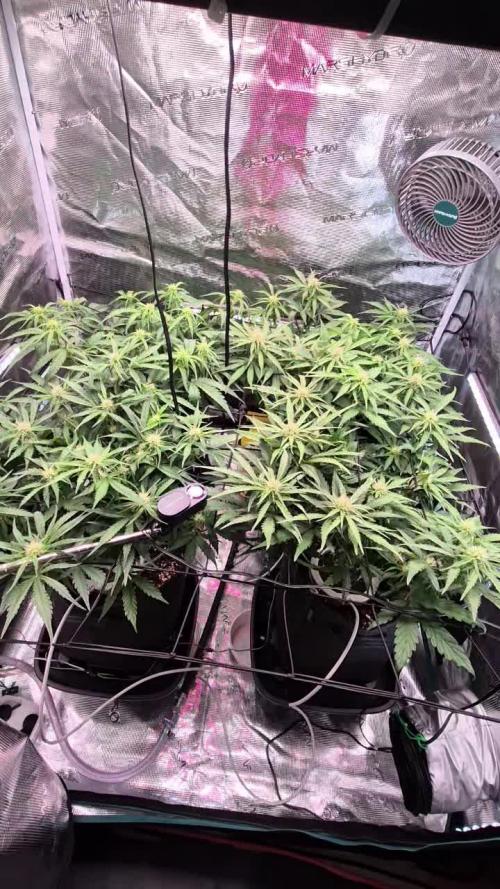
Swapped out the empty CO2 bottle today after running dry on Day 41. Dialing in relative humidity and VPD in a fully sealed room has been quite a challenge, but parameters are finally locked in: temperatures consistently above 28°C and VPD rock-steady at 1.4 kPa. Really hoping it stays this stable now, as constant swings in humidity and VPD are far from ideal for the plants. Just hoping no other equipment dies on me like the dehumidifier did 6 days ago! Canopy is looking strong and ready for peak flowering.
Netabow watering a great.
Likes
40
Share


@Chubbs
Follow
420Fastbuds
Apricot Auto/Week 4
What up everyone. Hope all are well. Weekly update on these two gorgeous girls. This past week has been fun doing a major defoliation taking off most the bigger fan leafs. Hard to tell a few days later I took anything off. Which is amazing they never skipped a beat. No big issue's and since sprouted have grown phenomenal being relatively easy. All in all Happy Growing.
Likes
2
Share


@EyeMKing
Follow
Started the first top dressing of Gaia Green All Purpose and Power Bloom at a 50/50 ratio of 1tbsp/gal each.

Likes
10
Share


@Ultraviolet
Follow
Voltage, also known as electric pressure, electric tension, or (electric) potential difference, is the difference in electric potential between two points. In a static electric field, it corresponds to the work needed per unit of charge to move a test charge between the two points. In the International System of Units (SI), the derived unit for voltage is named volt.
The voltage between points can be caused by the build-up of electric charge (e.g., a capacitor), and from an electromotive force (e.g., electromagnetic induction in generators, inductors, and transformers). On a macroscopic scale, a potential difference can be caused by electrochemical processes (e.g., cells and batteries), the pressure-induced piezoelectric effect, and the thermoelectric effect. Since it is the difference in electric potential, it is a physical scalar quantity.
A voltmeter can be used to measure the voltage between two points in a system. Often a common reference potential such as the ground of the system is used as one of the points. A voltage can represent either a source of energy or the loss, dissipation, or storage of energy.
Dropping the temps will slightly raise the humidity, air holds less % water the colder it is. Lights on 25-35rh% the same water content will spike to 50rh% + at night just by dropping the temps.
At night all the juice photosynthesis has been storing up is mashed and mixed up to make all the goodies we need for bud, water is used to transport all these things everywhere, like little solvent transport devices, once a nutrient/protein has been delivered to destination the plant needs to get rid of all this excess water molecules it was using to transport. The only solution at night is to spit it back out into the air at night. During the peak of flower, this can catch a grower unaware, with a 4x4 full tent it can be a challenge to control all that moisture exhaust overnight especially if you're really pushing the limits.
We live in a water world, above or below, our misconception is we live on dry land, we don't live in less watery conditions than above or below. We fit into a very narrow band of moisture that just so happens to be full of lots of air and everything else required for life.
Got my first full whiff of the smell of purple lemonade, always surprises me how accurately the smell fits names, the dominant terpenes in the Purple Lemonade weed strain are carene, linalool, limonene, and myrcene. Carene gives this strain its sweet, citrus flavor and some woody notes, whereas the linalool I recognize so well from Granddaddy Purp. Myrcene has been shown to have sedative qualities while bringing musky, earthy elements to the flavor profile.
Trichome production started to ramp up, and the plant that grew taller/closer to UV showed noticeably thicker coatings. The taller plant shows slight yellowing of lower leaves, and the smaller plant is green and lush but the buds are slightly less progressed, interesting.
I super-cropped the main stem of the tall one just over a week ago (clean). I expected it to be the one slightly behind in development.
The plant has roughly 10-15% "Total resources" that it keeps in case emergencies arise. Reserves if you will.
My rationale behind breaking anything goes hand in hand with slowing things down as production is lost due to the time it takes to repair damage.
I recall watching a YouTube video, where a curly hair gentleman would super crop in a manner to damage but not disrupt using a twisting method, using fingers and thumbs placing them close together one goes clockwise other counter clock this varies a lot depending on the thickness of stem but what you wait for is a tiny snap, it may take several rolls to weaken if walls are tough I found. No snapping or bending of the stem, you want just to fracture it but not puncture this way the xylem and phloem channels remain flowing,the damage is repaired almost instantly and the 10-15% is dispatched with very little repair time. Everything in the general vicinity of the stress will now grow stronger so as to prevent further similar damage.
This is why I had expected the tall one to lag behind in development once I had cropped it but low and behold it worked and the tall one has slightly more developed buds.
The effects of birdsong on plant life may at first glance be far-fetched. Nigh on ten years ago an article appeared in Nexus Magazine on the discovery or invention of a method of growing plants using bird sounds. Christopher Bird and Peter Tompkins describe the development of Dan Carlson’s Sonic Bloom in their book The Secret Life of Plants. Many others have, it seems, recognized the role of birdsong in the growth of plants, and influenced or directly helped Carlson to develop his invention.
Dan Carlson’s desire to see that no one need be hungry through shortage of food sought to understand the optimum growth of plants. He discovered that plants also feed from ‘the top down’ as well as the roots. Underneath all leaves are pores called stomata which open to take in nutrients and moisture from the air. Carlson’s observation that the more bird life there is on the farm, the more abundant is plant life, has been echoed by farmers throughout history, except in modern times. Where there is little bird life, plants are stunted, and dwarfed. Nature has the birds sing at dawn and dusk, which dilates the stomata, and so feeds the plants. One can immediately see the importance of trees.
The development of Sonic Bloom was to create birdsong, which is played to the plants, while a foliar nutrient is sprayed onto the plants at the same time as they are being stimulated by the sound, to enhance their growth. This method produced fantastic results in the amount of abundantly nutritious produce from one plant, often in poor soils and in drought conditions. Carlson showed that the breathing leaves of plants are the source of the nutrient intake for growth. This of course is also true for humans—the breath is food. We shall discourse on this on another occasion. Plants transfer nutrients to the soil via this breathing, and Carlson showed that his plants improved the soil and helped earthworms proliferate.
The secret of Sonic Bloom was the development of the music of the same frequency as the dawn chorus of the birds. With the help of a Minneapolis music teacher, Michael Holtz, a cassette was prepared. It seems that both birds and plants found Indian melodies called ragas delightfully suitable. This is actually quite profound, although the American farmers, especially women, who had to endure this music whilst it was played to the plants, found it irritating. Holtz found the “Spring” movement of Vivaldi’s The Four Seasons appropriate and concludes: “I realized that Vivaldi, in his day, must have known all about birdsong, which he tried to imitate in his long violin passages.
Holtz, it is related by the authors Bird and Tompkins, also realized that the violin music dominant in “Spring” reflected Johann Sebastian Bach’s violin sonatas broadcast by the Ottawa University researchers to a wheat field, which had obtained remarkable crops with 66 percent greater yield than average, with larger and heavier seeds. Accordingly, Holtz selected Bach’s E-major concerto for violin for inclusion on the tape. “I chose that particular concerto,” explained Holtz, “because it has many repetitions but varying notes. Bach was such a musical genius he could change his harmonic rhythm at nearly every other beat, with his chords going from E to B to G-sharp and so on, whereas Vivaldi would frequently keep to one chord for as long as four measures. That is why Bach is considered the greatest composer that ever lived. I chose Bach’s string concerto, rather than his more popular organ music, because the timbre of the violin, and its harmonic structure, is far richer than that of the organ.
Birdsong has long been loved but also studied with reference to the musical scale and harmonics. As Holtz deepened his study he said, “I began to feel that God had created the birds for more than just freely flying about and warbling. Their very singing must somehow be intimately linked to the mysteries of seed germination and plant growth.
The spring season down on the farms is much more silent than ever before. DDT killed off many birds and others never seem to have taken their place. Who knows what magical effect a bird like the wood thrush might have on its environment, singing three separate notes all at the same time, warbling two of them and sustaining the others.
Tree and bird life are essential to Earth's existence, which Carlson, Holtz, and others have shown, but indeed others see and feel. “Plants”, says Steiner, “can only be understood when considered in connection with all that is circling, weaving, and living around them. In spring and autumn, when swallows produce vibrations as they flock in a body of air, causing currents with their wing beats, these and birdsong, have a powerful effect on the flowering and fruiting of plants. Remove the winged creatures, Steiner warns, and there would be stunting of vegetation. Nothing more needs to be added here.
It has been said that you cannot hurt the humblest creature or disturb the smallest pebble without your action having a reaction upon something else...You cannot think of an evil thought, no matter how private, without it having an effect upon somebody else. Whatsoever you do in life sets up some form of resonance.
When I say the morning chorus of the birds awakens the earth I mean that the characteristic song of the birds sets in motion a series of vibrations which react upon other forms of life. Remember, the soil of the earth is full of living microorganisms. The plants are also living organisms. You, yourselves, are living organisms. Now, this is the beauty and wonder of it all—when one aspect of nature has been moved into a state of resonance it immediately relays its vibrational motion to something else.
So when I say the dawn chorus awakens the earth I literally mean what I say. I do not suggest that the earth would come to a standstill without the bird song, but I do mean that life on earth would be sluggish and ineffectual without that first instigating outburst of vibrational power poured forth at just the right pitch and tone to set off a chain effect.
I know some of you will say, what happens in those parts of the world where there are no birds? Well, what does happen? Very little, I assure you. The hot deserts and the polar regions where there are few, if any, birds are not renowned for their wonders of nature. It is as though they are asleep. Nothing grows, few things live. Little resonates and there is a great stillness over everything.
You see, that outburst of sound just before dawn is like the little lever that works the bigger lever which turns the wheel which moves the machine…and so on. Never underestimate small things.
Animals are blessed with instantaneous and unthought-out wisdom. They are in direct contact with God and they act and live as though they are fully aware of it. Men are also in contact with God, but most of them act as though they have never heard of God because they are largely veiled from their divine center by their own thinking minds of which they are so proud.

Likes
17
Share


@Broedt
Follow
Day 70 of flowering
It has only been three days since my last update.. But hence the confusion of days past, I'll update it now again since this is day 70 and that markes week 10.
The girls are looking very nice, if I may say so myself. The smell has intensified very much during the last days, yesterday when I opened the tent it really hit me hard in Tha nostrils in a good way.
That smell that I couldn't set in words are still present but it smells lovely!
I'm not at all sure how fast the trichomes are developing, so I'm checking up on them every day. This leads to alot of uncertainty of when I should start to flush. Some leaves have been yellowing for a while, at a slow pace and I fear that I might start the flush to early or late. But I'm thinking around day 71-75 will be the last day with nutritions.
I have uploaded a picture of the trichomes, please let me know what you think?

Likes
88
Share


@Lady_NugWitch
Follow
Getting ready to chop her down!!!! Yay! No issues other than she would not stop growing!! Lol 😂

Likes
7
Share


@Zuppler
Follow
Vegetation Phase - Week 4
The Donutz ladies are cruising through Week 4 in style, with no major changes to their routine. Simplicity is the key: just consistent care, reverse osmosis water, and keeping the vibes steady in the tent. Growth is strong and steady, with no signs of stress or issues.
Updates & Maintenance:
Watering: Still exclusively using RO water. No overwatering, just light and consistent hydration as needed.
Lollipopping: The plants got a little cleanup this week. Lower growth was trimmed back again, keeping the stems neat and focusing energy on the upper canopy. This helps maintain that signature Sea of Green look and primes the plants for fat main colas later.
Observations:
The plants are uniform, healthy, and stacking nicely. Each one is starting to show its individual character, but they’re all working toward that tight SOG canopy.
Marienkäfer buddy is still around, keeping the ecosystem in balance. No pest issues, no drama.
Next Steps:
It’s all about staying steady and letting the Donutz do their thing. The lollipopping ensures the plants are focused on upward growth, and the stable environment in the tent is creating the perfect conditions for success. Week 5 is around the corner, and everything’s looking set for these plants to keep stacking up!

Likes
6
Share


@GreenForce
Follow
Very happy with harvest , in more three weeks I will give my feedback about terpenes , etc.

Likes
2
Share


@Fat_Olsh_Farms
Follow
Looking good. One more dose of nutes day 99, then flush.
Some of the prettiest purple bud I've grown. Def running again next grow.
Day 101, chopped and trimmed a sample nug.

Likes
Comments
Share


@Uneasy
Follow
The stretch period is considered to be over. I did the last leaf cleaning. I won't touch it anymore. I did super croping because the branches got too long.

Processing
Likes
4
Share


Processing
Likes
2
Share


@BigGGrows
Follow
She is now coming into preflower and loving the new T5's. She is growing nice and bushy with future tops shooting for the stars. The stretch is definitely near. She will continue to be tied down and has been pruned and defoliated as needed to give her that sexy shape i want her to have in flower. Her terpines are beginning to be noticeable and is of lemons, earthy notes, and loud gas. She is now also getting kelp extract added to the nutes. She is growing very nicely and i could not be happier at the moment. So far OSSC has my attention as their phenotypes have been very nice.

Likes
12
Share


@Terpyboyz
Follow
This grow should be coming to an end next 2 weeks or so some are looking to be in the last stages, only issue is having multiple strains is strains finishing at diff times.
There’s one exodus cheese that looks like she’s going to go 10/11 weeks but she’ll be cut well before that to start a new batch.
There’s 3 clones that were taken
1 being a big Buddha blue cheese that absolutely reeks of tangie/Clementine terps with a slight sour cheesey smell. This is getting revegged and cloned for the next run.
Ripper seeds - this is another strain I’m going to try to reveg as this is another keeper I should have taken cuts.
Platinum x harachata - 2 different pheno / one with rock solid nugs other is more Sativa.


