





Likes
29
Share


@Silverback_Guerilla
Follow
11/16:
I fed them today. Everybody's looking good.👍
11/18:
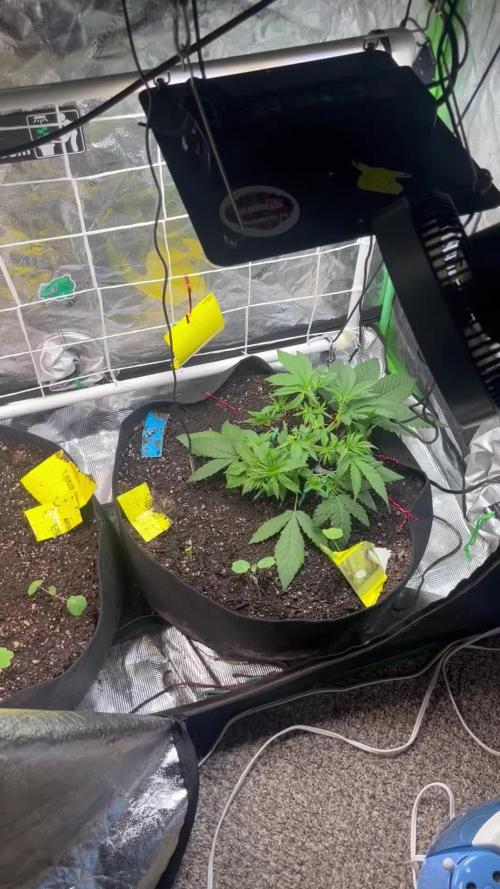
I potted up the other 5 plants in 2 gallon pots and except for a few photos that aren't quite big enough to flower yet, they've got the whole tiny tent to themselves.
11/20:
I fed them and sprayed them with BoomBoom Spray and Axiom today and let it soak in nice and slow under low light with no air circulation. All but the Strawberry Pie are flowering..Pineapple Express is a beast. "Red Channel on Quantum Boards.....Engage."

Processing
Likes
93
Share


@Ferenc
Follow
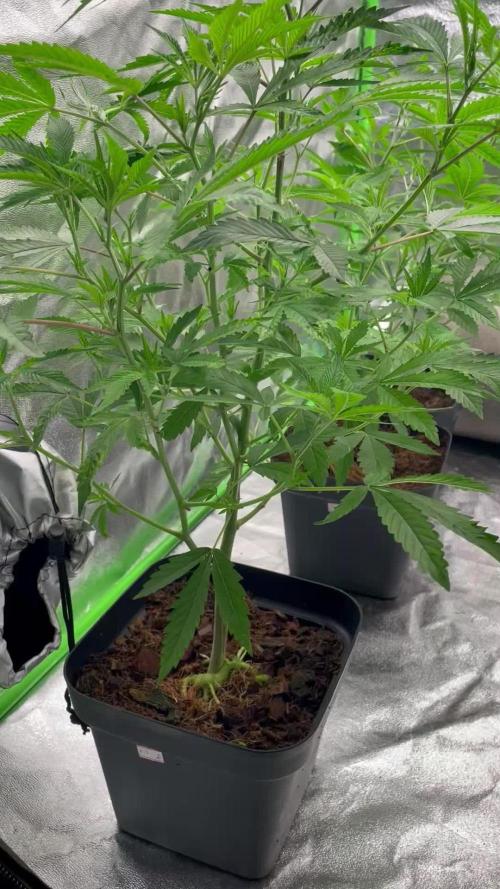
Week 6th started. I will add each plant 100 ml water 2x a day so 400ml altogether. I still always spray the topsoil also. The same fertilization method will be done, Monday, Wednesday, Friday 2x 100ml acacia honey and bat guano water mix for each plant. I changed their places so Purple Punch is the left side now and the Gelato Cookie D'ohpe placed to the right. I always rotate them to get equal light. Last day of the 6th week. Gelato Cookie D'ohpe doubled its height. I decided to make the Purple Punch flower but it is not autoflower I separated it for 36 hours darkness and then I will give 14 hours darkness and 10 hours light the first 7 days. So every night I will put it in the tent with the other one and remove in the morning to be in darkness. I also need to reset the timers. End of this week Gelato Cookie D'ohpe is 65 cm, Purple Punch is 35cm.

Likes
8
Share


@skaterblasted
Follow
Lamp Brightness: 100% @ 16" - estimated 914 PAR
(experimented with angling the light slightly to achieve roughly 16" distance on both sides)
Feeding schedule once-a-week, all other waterings strictly water-only
Day after feeding, soil is given a sst + fresh organic kefir whey 4oz+ per gallon
(kefir grains grown in local organic grass-fed milk)
IPM 1oz per gal EM5 solution foliar spray + applied directly to mulch/cover crop (before lights-out) - once a week
Note: had to move a couple pots around this week due to watering restrictions
GMO 2 is now back left - GMO 1 moved ahead to front left
stem rubs: GMO 1 - strong/gas
GMO 2 - mild/faint/gas
GMO 3 - strong/citrus/floral/gas
Likes
24
Share


@SolitudeCorners
Follow
Can't wait to blazeeee
Feeding💪
10/17 Water30L+Cleanse80ml+calmag@190ppm
Ph6.3
Ebb 10.42/11.32/12.26/13
Clone 11.35/12.21/13.05/14
Average runoff ec1.5
Keeper 300ml per pot
10/18 Water26L+Flawless90ml+calmag@300ppm
Ph6.3
Ebb 11.38/12.24/13.17
Average runoff ec1.2 ph6.5
Clone 12.38/13.56/15.20/16.10
Average runoff ec1.5 ppm750
10/19 Water26L+Cleanse80ml+calmag@200ppm
Ph6.3
Ebb 11.12/11.48/12.24
Average runoff ec1.4
Clone 11.50/12.12/12.37/13.37/14.40
Average runoff ec1.3 ph6.6
10/20 Water30L+Cleanse30ml+Calmag@190ppm
Ph6.4
Ebb11.42/12.22/13.20/14
Clone 12.40/13.20/14.20/14.45/15.15
Average runoff 1.2ec ph6.4-6.7
10/22 last light day
10/23 2 Pm Cut and hang
Plan 21day at 23temp 55rh

Likes
44
Share

@Silverback_Guerilla
Follow
11/2:
I flushed all 4 of them with 8 gallons each of warm water and liquidsoil. Won't be long now....👍
11/5:
I put them in the dark....harvest tomorrow!
11/6:
Harvested and washed all 4 of them. They are hanging to dry and smell great!

Likes
1
Share

@magicbudsgrow
Follow
Última semana de Vega. Vou fazer uma flora com 100% remo nutrients + 720w de luz.
Organizando o sistema de rega automática


Likes
29
Share


@JeyGanesha
Follow
Quinta settimana di fioritura 💪 forza bella mia,vai avanti così e fammi delle belle e grandi pannocchie 🙏🕉️💚💛❤️

Likes
34
Share


@crystal_garden_0
Follow
End of week 4 , huge difference each week. Buds started fast, strong purple genetics showing instantly. Can't wait to see what happens. So far everyone is healthy and happy
Likes
42
Share


@rhodes68
Follow
2/14 Week 14 and things get interesting from here
Hell of a journey so far, do not expect that to change now
Just taking care of them and enforcing a good neighbor policy with defoliation
Without going into a lot of detail we looking at a harvest every three days or so for six weeks starting next week, grow will end 4/4 with the harvest of the Green Crack clones at @63 days of flower.
So earlier is possible
2/15 FFT-7 Clones have hit 36 inches already but should not go too much further. famous last words
2/16 Trying all of it on the same feed see how it goes, clones pretty far along think its ok.
2/17 So far so good on the feed, some concern over FFT-7 stretch so what else is new
Had to adjust the Peak running out and deliveries are messed up from weather so stretching it out
2/20 Final update on the week:
Clones are doing well only the FFT-7 proved undependable on the flowering stretch LSD and Green Crack look on track for 36 inches or less, FFT-7 headed to 4 feet
Dropping Grow again on the main flowering feed , clones remain as is, less Nitrogen is needed
Ran out of Soul Peak so full dose of KoolBloom till we get more
Bambi on the block next looks like Monday followed by Chew Mee and Dink Thurs or Friday.
Clearing this tent out so more can come in.
And that was the week that was


Likes
10
Share


@DrDuhboto
Follow
Very Happy plants, soaking up the rays.
When you place your face near the buds you get an amazing sweet fruity aroma, the leaves smell like skunk and cheese.
Each plant is getting 10 liters every 4 days. I water with 6.3ph tap water twice for every time I add nutrients.
I use Alaska fish fertilizer when its been a few times since a nutrient feed but the plants are showing no deficiency's.
They are Fed by a drip system which takes 16 hours to deliver the 10 liters to each plant, this works really well in the Fabric smart pots.
I use metal racks to keep the plants off the ground then place a drip tray underneath each plant. When using the drip system very little run off occurs.
I added a spider farmer sf-1000 to the room, it is full spectrum and ir, and is great for getting the corners of the room or the less dense areas of the canopy.
Processing
Likes
29
Share


@Hasard
Follow
June 13th
This is my first grow.
5x Gorilla - 3x Pineapple Chunk
Both from Barney
2x Moklum from Canna-Seed are growing but won't be the focus.
Enjoy !
And feel free to give tips ;)
Likes
55
Share


@Ganjagrandaddy
Follow
Day 8: All settled in and game for the grow now.
Six shooter is a lanky looking lady with longer leaves than the other two girls. She has a sativa look to her already !. lol
shebis on her 3rd set and possibly 4th at a pinch
Strawberry pie is the smaller of the group in overall size so far with her leaves resembling the six shooter. onher 4th set of nodes
Mexican Airlines is a broad leaved girl indeed. lots of area to power those growth spurts hopefully . All around 2 inches tall and now directly under the sp3000 with the room fan keeping them dancing. Lets hope they are thick stemmed ,multi noded ,monsters next week!!!.
With their position in the room , they will be trained but not to keep their height down as they are next to a tall lady and need to keep the light up.
Be safe Growmies.
Likes
39
Share


@Mastr
Follow
Only 1 plant is flowering while other 2 still on veg witch is good
Day 23 come along and I just start using bloom and topmax and try my best on lst training want to get max yield off each Plant finger crossed 🤞
Day 24 still not flowering for other 2plant witch it very good I'm not rush and I glad they can grow up to max yield
Today i have mate around and he couldn't believe they only 24days from seed next week they will be double in size or even bigger will keep pic and video daily on this stage due very fast grow in preflowering
Day 25 come along and she grow so fast guys when I wake up I check them I see alot different I feed them with silica on every watering till day 35 (when stop grow in size )this run be come very very big size of autoflower let see guys
Day 26 I start bring down grow nuts and add more bloom I feed
1ml silica
.5 calmag
2.5 bio grow
2ml bio heaven
2ml acti vera
1 alg amic
1ml bio bloom
.5 top max
I just use silica every other watering also I feed with the 1.5 L nut everyday
Will reduce bio grow and then day 35 I'm going to stop feeling with grow
Likes
11
Share


@Sledge1
Follow
Very good growth this week, smell is coming on strong. As said won't be expecting much on yields but it smell delicious, lemony/piney.
Few more weeks then harvest.
Happy growing!!

Likes
6
Share


@SirBudAlotts
Follow
So I used the paper towel germination method.
Once the taproot sprouted. I directly planted her into a 20l plastic pot with the above medium.
She gets feed once dry.
I keep the humidity quite high as at the stage the babies need warmth.
I fed her some AgriSil to boost root development.
Now it's just keeping the temperature in check until the first sign of the true leafs 🍃 😉

Likes
390
Share


@Cyrusdavirus
Follow
Doctors Choice = Cali Crasher
Hello 👋 guys, I took the pictures the other day and never did my update on here 😆 🤣 I apologize I'm in the middle of C treatments right now and things get so messed up for me 😆
These ladies are still swelling up and stinking up the growroom, it's a good sweet smell I still say they smell like Dr Pepper. I did some defoliation on the left plant it's like days from the chop 😁 ✂️ the other one has a little more to go
Thank you Doctors Choice and Mars Hydro
Mars-Hydro.com and doctorschoice.farm coupon code "Cyrus"

Processing
Likes
16
Share


@Naturalist
Follow
Uped lights to 30000 lux today added some mosquito bits as a few fungus gnats have been flying around, should be topping Gelato #1 soon its been really shooting ahead.
