


Likes
Comments
Share


@Roberts
Follow
Quebec Blast is growing good, she is starting to develop flowers, and stretching. She is the shorter one in the room. I am figuring a stocky frosty plant at end. 🤞 I get there with no major issues. A solution change of a gallon every 4 to 5 days has been my current schedule. Future grows I wanna try to keep roots higher up through pruning to allow more solution for better stability, and longer between changes. She is in a New Level Hydro bucket, under a Spider Farmer SE5000 light at 80 percent. Thank you Spider Farmer, New Level Hydro, and Quebec Seeds. 🤜🤛❄️🌱
Thank you grow diaries community for the 👇likes👇, follows, comments, and subscriptions on my YouTube channel👇. ❄️🌱🍻 Happy Growing 🌱🌱🌱
https://youtube.com/channel/UCAhN7yRzWLpcaRHhMIQ7X4g
SE5000
https://amzn.to/3qFpAML
Spider Farmer Official Website Links:
US&Worldwide: https://www.spider-farmer.com
UK: https://spiderfarmer.co.uk
CA: https://spiderfarmer.ca
EU: https://spiderfarmer.eu
AU: https://spiderfarmer.com.au
Coupon Code: saveurcash
Www.newlevelhydro.com
Www.hygrozyme.com

Likes
3
Share

@Seeds_growforgreen
Follow
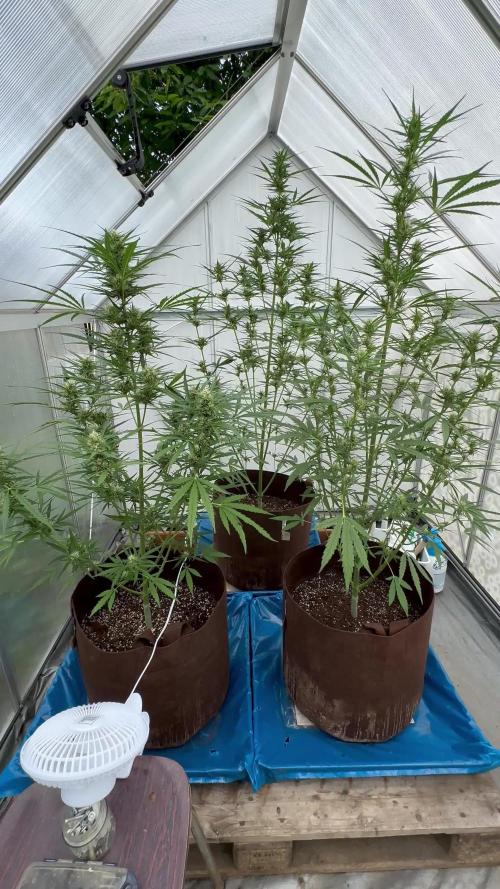
Nice start flowering time. Need sunny weather now. Left flower has bigger blooms, it is nice.
Edit: The left flower goes faster..
Start nutrients Plagron Green Sensation and Royal Sugar for maximum blooming now.

Likes
7
Share


@Hightable420
Follow
Day #21 Defoliation
Not topped (left) Topped (right).
Super impressed so far.
Likes
13
Share


@skimaskbandit
Follow
NO SMELL YET
PK BOOSTER EVERY FEED
BUSHY AF I AM TIRED OF DEFOLIATING
Likes
44
Share


@Belverde
Follow
Hello guys
Welcome 🙂
We are at week n°15 from seed with this delicious, GREEN GELATO 🌲🍦
67° days of bloom..
That's the last sweet few weeks with this young lady..
Sweet weeks mostly for the her perfume..
I can only say..
Awesome 😍
It will can really has almost like a fruit/vanilla gelato aroma..
I hope also the taste..
And she makes a nice quantity of trichomes , very sticky 🔥
But first it's the lovely aroma..
All the big leafs are almost die and also the little ones , she will comes out nice and clean..
The majority of her energy she has use for produce a big central cola , so I think she can be good one for a SOG system from seed..
But don't trust too much my experience , because It's my first time with this genetics , I was start from only one seed , I was give her not so much nutrients , but , the most important thing was this phenotypes it's was super slow from the beginnig and so , for that reason , she has stay a little lady even she has grows for fifteen weeks 🙌
But I repeat , the quality of the terpens profile are impressive and still become more potent day by day..
Probably in the end she will give me around 20g perfectly dry and cure , super tasty cannabis..
We will see..
Now , I think in the end of the next week I will can do harwest ✂️
She will tell me exactly when to do it..
🌱👌
Ah and obviously I gave her only water..
I also don't flush or use any "specific product" for this final bloom period..
I have only add regular h2o for the last three weeks..
Anyway..
If you like too see , for almost her entire life cycle , she share the space with other girls that you can find in the links here below 👇👇👇
https://growdiaries.com/diaries/46286-barney-039-s-farm-dos-si-dos-33-grow-journal-by-fun-clouds
This..
https://growdiaries.com/diaries/46282-barney-039-s-farm-blue-gelato-41-grow-journal-by-fun-clouds
And another one..
https://growdiaries.com/diaries/48209-barney-039-s-farm-dos-si-dos-33-grow-journal-by-funclouds
That's all..
See you next week the final one of this diary , n°16 from when she born..
Thanks for reading 👍
Hope you enjoy 😎
Ciao✌️
🇮🇹

Likes
13
Share


@FowerTwennyNoob
Follow
Day 7---Defoliated good bit from all plants removing afflicted leaves, looks to be typical cal/mag deficiency with ph issues.
Topped off 2 big plants with ro water, added 6ml micro 6ml bloom and 3ml gro to 2 big plant ppm 900, 2 smaller plant ppm over 1000.
Day 6--- Topped off all plants with RO water, added 1ml ph up to plants 1,3,4 to adjust ph. PH of plant 2 more basic than the other 3.
Day 5--- Topped off biggest plant 2, added back 10ml cal mag, ppm about 600-700 will check again soon and add back some nutes.
Added 1ml ph up to plants 1 and 3 , didn't adjust other two yet.
Day 4---
Added 3ml cal mag to all plants as it could be lacking. Added 5ml soul grow and 5ml soul bloom to plant 1 to see something, ppm up to about 1020.
Some light defoliation of afflicted leaves on all plants.
Day 3---Added 5ml micro and 5ml bloom to plant 2 now at 750ppm. All plants are above 700ppm but below 900ppm. All plants showing signs of something on the leaves but IDK what, manganese?
Added 3ml cal mag to biggest plants. Topped off water of 2 biggest plants.
Day 2---Checked PH, more minor defoliation of afflicted leaves and to uncover a few more bud sites.
Day 1---
Added about 1.5ml ph up since the waters keep going a bit acidic. Some leaves still show some issues but didn't wanna defoliate too much. IDK if it is from PH or over/under feeding plants. Added 2ml cal mag.
These plants are continuing to grow and flower, 2 biggest drinking lots of water and making the water more acidic. Topped of water in buckets with RO water. Added 3ml cal mag to all plants
Added 5ml micro,bloom, 3ml gro to 2 smallest plants. Added 10ml micro, bloom, 3ml gro to 2 bigger plants. Added .75ml ph up to all plant water to help the PH stay in range. TDS on all are around 800
Light defoliation of all plants to uncover bud sites and remove afflicted leaves.


Likes
7
Share


@Ninjabuds
Follow
My Bubble OG plants are looking really good. I chopped down the first one a few days ago, and it's almost dried. The other two plants are absolutely covered in buds. The tall one's a monster, totally solid and covered in crystals. And that purple plant is just gorgeous, stacked with buds all the way down. Can't wait to try them all out.
The past week has been awesome for drying my plants. The weather's been perfect – nice and dry, with just enough breeze to keep things moving. I finally got around to chopping down those two big plants I've been meaning to trim. They're almost ready, just need a little more time to dry out completely. I can't wait to see how they turned out.

Likes
119
Share


@DogDoctorOfficial
Follow
Day 9 and she looks as you guys can see lol i mean to my eyes she just looks amazing, she is fully recovered and full on going like there is no tomorrow , she is praying for 11h strait non stop and i could not be more happy with the way things are running.
For this week i will keep the same food regime as last week, man i love how my girls love Aptus Holland and how well they respond to it all 💚💚💚🙏🙏🙏✊✊✊
I know she has a lot of leafs , but its only that hehehe since i clean the branches all up to the top before flipping her to flower leaving just the leafs to help them get more energy for this first 2 weeks of the flowering stage, after it i will defoliate the hell out of this lady best and let her focus her energies on but production, but for now i want her to stretch the most she can since she is not phenotype that stretches a lot 😅 non or lees she is an amazing bud machine i believe she will do it once again hehehe
As for the Light intensity i took 12 readings over my canopy to find out my PAR and the average PPFD is 1013 Umol/m2/s, for those of you that do not know the meaning of this, it means photosynthetic photon flux density , this basically the number of photons going arround for plants to absorve in a determinate area, in this case my 3x3 room
Day 11 and there were toooo many leafs for what my eyes are use too so i decided to defoliate her, this will also help stopping the stretch since she is doing it more than her mother did and space is not something i have in this 3x3 area lol she is drinking like crazy, 5,5 liters day and increasing, curious to see how much will she be drinking wen in full flower.
And she didn’t care at all the fact that i defoliate the hell out of her and she just keep on going and praying like there is no tomorrow , amazing, but amazing phenotype from an amazing genetic, caps off to ZamneziaSeeds for this one, i was impressed with the first round and even more impressed day bay day with the clone I selected 💚💚💚🙏🙏🙏🙌🙌🙌✊✊✊
As always thank you guys for your love , your time, your support and it all, i fell blessed and i am truly thankful 💚💚💚🙏🙏🙏🙌🙌🙌
All i grow is medicine for myself, for me and for my best friend with is me 😆 nothing to sell, so don’t even ask 😅💚💚💚
All info and full product details can be find in can find @
https://viparspectra.eu/collections/grow-lights DISCOUNT CODE 5% - DOGDOCTOR ( all store )
https://www.zamnesia.com DISCOUNT CODE 10% - GROWITGD ( just for seeds )
https://aptus-holland.com/
#aptus #aptusplanttech #aptusgang #aptusfamily #aptustrueplantscience #inbalancewithnature #trueplantscience #viparspectra #zamnesiaseeds #growerslove
With true love comes happiness 💚🙏 Always believe in your self and always do things expecting nothing and with an open heart , be a giver and the universe will give back to you in ways you could not even imagine so 💚💚💚
More info and updates @
https://growdiaries.com/grower/dogdoctor
https://instagram.com/dogdoctorofficial
https://youtube.com/channel/UCR7ta4DKLFMg2xxTMr2cpIg
💚💚💚Growers love to you all 💚💚💚

Likes
13
Share


@TheMightyHermit
Follow
Honey Cream is starting to smell wonderfully, a Sweet almost candy/bubblegum smell, incredible !
Likes
23
Share


@adam_pawloski87
Follow
This week went real great , one has been getting flushed and the rest we will start flush Tomorrow! These ladies are doin so amazing! Hope you all enjoy !! Stay tuned for next week! Cheers an happy holidays!
Likes
2
Share


@Shefman93
Follow
Took them out the tent so I can clean the grow room & tent. The ladies look amazing in natural light.will flip to flower in 7 days. Transplanted into a 25 gallon bag, lollipops and placed under a scrog. I also had to super crop some branches for it to fit below the scrog.

Likes
13
Share


@frenchysmoker
Follow
It took more than 5 months to grow this lady.. Top quality budd but what a yield only 47 grams dry... Maybe its because the seeds were too old (5 years) but its still very nice terps and the profile of geno that I was hunting for 😊


Likes
103
Share


@JuanHaze_Arg
Follow
3era semana. El efecto de "Amazonia" se ve reflejado en las hojas hacía arriba adorando al sol. Se la ve linda y creciendo con fuerza. Al menos 0.5cm por día.
Finalizando el día 19 de su crecimiento le hice una poda apical. Por su estructura sativa y mí poco espacio decidí hacer topping y poner hacer un guiado con lst para luego poner la malla de scrog.
Día 21 me olvidé de regar y se achicharraron las dos primeras hojas por deshidratación. Después de regar se la ve linda y feliz.

Likes
38
Share


@Aedaone
Follow
This week is going to be hot. I expect everything to hit generative 2/mid flower this week. The #1 & #2 plants should hit that phase day 2 and day 3 of this week. The #3 plant around day 7. The coop poop I top dressed with is still feeding. It should be just supplemental about mid week. I'm feeding my gen 2 formula that's in the nutrient section for this week. The plants will get that feed daily once generative two phase begins.The one I didn't top is over 7' tall. I used it's height for the plants height. The other two I topped are just over 5'.
Likes
31
Share


@TacoKart
Follow
Added another 1800w LED (pulls like 250w from the wall) to the 1800w one we already have. Provides a better even spread of light so they aren't all reaching for the middle and they can grow upwards towards the light instead. Raised average temps by a few degrees with still below 80 so its good.
Ended up flooding the tent on accident when the water was left on and it drained our reservoir. The plants experienced some nutrient burn probably because of the 4 gallons of nutrient supplemented water they were flooded with. The time lapse will show the flood :P
Refilled the reservoir with 5.8 pH'd water with no nutrients to help the nute burn.
Did some defoliation and LST. Janice and Rachel were topped. Ended up accidentally snapping one of the lower branches on Monica and just propped it up and its healing well no issues. Have some great before and after pictures of some of the defoliation and growth on the plants.
With the defoliation tons of new bud sights are growing well since the light can penetrate better and the addition of the new light helps too.
The runt (Pheobe) is still.... runty. basically just gonna use the zkittlez to fill out some empty spaces that the sour grape kush doesn't fill. The sour grape kush is super bushy and is doing noticeably better.

Likes
22
Share


@bypado_farm
Follow
Day 43:
Watered each plant with 1L with nuts
1589 ppm, 3380 us/cm, 3.3 EC (purple punch and wedding cheesecake)
1563 ppm 3325 us/cm 3.3 EC (strawberry banana)
1476 ppm 3180 us/cm 3.1 EC (gorilla cookies)
I have 3 different feedings for the 10 plants
They look healthy
Day 45:
Watered each plant with 1L with nuts
1563 ppm, 3325 us/cm, 3.3 EC (purple punch, strawberry banana, wedding Cheesecake)
1286 ppm, 2765 us/cm, 2.7 EC
(gorilla cookies)
2 different feedings for the 10 plants
Day 47:
Watered each plant with 1L with nuts
1584 ppm, 3380 us/cm, 3.3 EC (purple punch, strawberry banana, wedding Cheesecake)
1481 ppm, 3180 us/cm, 3.1 EC
(gorilla cookies)
2 different feedings for the 10 plants
Likes
21
Share


@BLAZED
Follow
Week 14 (2-5 to 8-5)
2-5
Temperature: 27.3 degrees (lights on) 19.5 degrees (lights off)
Humidity: 69% (highest) 52% (lowest)
Watering: 2000 ml.
3-5
Temperature: 24.2 degrees (lights on) 19.3 degrees (lights off)
Humidity: 68% (highest) 50% (lowest)
Watering: None.
No pictures.
Increased the light's power output to 90%
LUX: 22.500
4-5
Temperature: 24.1 degrees (lights on) 20.3 degrees (lights off)
Humidity: 63% (highest) 43% (lowest)
Watering: 1000 ml.
5-5
Temperature: 24.8 degrees (lights on) 20.3 degrees (lights off)
Humidity: 66% (highest) 43% (lowest)
Watering: 1000 ml.
No pictures.
6-5
Temperature: 24.4 degrees (lights on) 19.4 degrees (lights off)
Humidity: 66% (highest) 44% (lowest)
Watering: None.
7-5
Temperature: 24.4 degrees (lights on) 19.2 degrees (lights off)
Humidity: 66% (highest) 44% (lowest)
Watering: 1000 ml.
8-5
Temperature: 24.2 degrees (lights on) 19.4 degrees (lights off)
Humidity: 65% (highest) 48% (lowest)
Watering: 1000 ml.


Likes
3
Share


@BR1CK_SANCHEZ
Follow
Starting off this new run strong!!! Loving how fast the sprouties are growing. They look pretty happy to me. Maybe bottled nutes are best for my indoor.