


Likes
Comments
Share


@HitMan_DW
Follow
Alright Week 1 of flower.. whew I'm here and everyone looks Healthy and Happy and On Track... I think... Let me know Y'all it's kinda quite.

Likes
49
Share


@masterofsmeagol
Follow
7/18 Plants are looking great. I was able to rearrange the plants so they have a little bit more space and so I can get around every plant. I have small random pest damage (i.e. I caught a four lined plant bug while hunting jpn beetles) but not enough h to warrant treatment. I will probably spray before flower. Sun's out amd plants were praying. I rotated a couple and it only took a few hours for them to "straighten out." I went to look again rhis morning and made the final determination to expand the cage. I'm looking for the 2x4's and the wire in the next couple days. The work that ive done now will but me sometime. I wonder how this rain impacted my soil.
7/19 Plants are looking fantastic. The stretch is starting. One purple punch looks like it's beginning to flower. I think I'm entering the transition period. Jpn beetle damage is evident but not significant. I defoliated a leaf with a a leafminwr or something in it. It's so much easier to get around the plants now. I'm seeing some chunks missing sporadically though. Went to the roses out back and found TONS of jpn beetleson top of each other reproducing. They destroyed that rose bush. I'm going to keep it as a trap plant. My dad's girlfriend wanted to spray it but that doesn't make sense as theflowers are all gone. Dad's grabbing the materials to extend the cage today I think. Right now I can get around every plant but the two big ones in the back. I just cant get to the backs of them and they are huge. Almost reaching the top of the cage. A 4'-6' extension will do wonders in flower. Can't wait.
UPDATE: Dad got the 2x4's and we assembled the extension and attached it. He's grabbing the wire as I type this. This worked out beautifully. I had no idea how big the blueberry cheese in the 50 gallon was! This extension (4ft i think) is PERFECT! Then I can get a little extra wire and pull it out if I wanted to. I think I have another 2x4 that I'm going to use in the middle. Lots of great pics and a video I'll upload tomorrow. Hot af today and humidity still super high. Even the commercial dudes was surprised I don't have wpm l and that judging by some of my plants structure that I may do better than I think. I certainly hope so. I WATERED 3 GALLONS OVER THE WHOLE GARDEN. The blueberry cheese in smart pots were drooping. They drink far more water than tje others. I would've given more but we are supposed to have thunderstorms. I left my back tarp off for the night. It will increase airflow and wind is down. I feel like this is going to be my year.
7/20 I updated and loaded everything on the app but notjing would save. Did it again in the website hopfully this saves
i didnt put it all up. Didn't water the plants today. Bags seemed okay weight wise. Good thing I did the extension yesterday because those three plants were drooping they were so thirsty. I focused most of the water yesterday on those plants that needed it. The others were somewhat dry but still had some weight. Like i said the blc drinks much more water than any of the other plants. I'm impressed with the growth I'm seeing. Especially since I have been being very stingy with the water and I've only fed like twice and that was just the kelp me/you and big bloom in negligible amounts. I'm watching for deficiencies. I'm just not seeing them. I'm picking up the wire and finishing the extension and then rearranging things. I'll update.
UPDATE: WATERED 4 GALLONS CONCENTRATING ON THE PLANTS THAT WERE DROOPING THE MOST. FINISHED ENCLOSURE AND INCREASED PLANT SPACE. TRELLIS WILL GO UP THIS WEEK. VIDEOS WILL BE UPLOADED TOMORROW.
7/21 I should've watered more volume last night. I noticed two plants that seemed much lighter than the rest. After some deliberation I gave them each a half gallon of water. One was the purple punch in the 10 that's huge amd the other was that huge blueberry cheese. I think I'm going to swap places with them, take out a pallet and get some other way to elevate that ONE plant and I'll have even more room. Then I'll add my supports. It's a dream working in there now. I noticed some small interior leaves being used up and dieing. I defoliated them but it was only a couple. I'll need to start nutes at some point. Doesn't need it yet though. I'm going to add some kelp me/you for the heat stress. I need to get the watering down better but it's more difficult when they each have different needs. I kinda have to read the plant. I'd rather be overwatered than underwatered. I tried to upload what I could but some won't.
UPDATE: I went over to clip off some fencing that was doubled up AND just to check on tge girls. Found two caterpillars (small but hairy so they were older not the inch worms and possibly what has been contributing to damage on those plants. Things are spread out so it will be harder for insects to move from plant to plant and I have better air flow. I worry that leaving my tarp off might lead to high winds and plants not able to take it buf I digress. I'll add supports later. Plants are huge and drinking far more water than I've been giving them. When I got there several were drooped right over and dry as a bone. The bags are essentially all roots now. I mixed up 8 gallons of water and split it between the plants. I gave less to the two Co trainer plants that weren't drooping and the 10 I watered yesterday that wasn't drooping but for the most part the ones that needed if got at least a gallon or more. The others a little under a gallon. It might rain A LITTLE tonight too. Oh, and since it's been so hot I added 1/2 tsp per gallon of kelp me kelp you to help the plants deal with heat stress. I also noticed that some of the very bottom interior leaves are being used up. I have a feeling ill need to switch to nutes pretty soon. Plus I need to suppirt those plants if I'm going to leave that tarp off and Gove them air. Took a video. But it won't upload here. I'll have to wait till tomm.
7/22 Didn't have much timevthis morning bit I dod a video. Boy those plants loved that water and that kelp. This morning everyone was standing straight up at attention. Supposed to get rain last night but didn't. Good thing I watered. I think I'm going to up the water next watering and then again to the 10% mark if necessary. Especially with the Blueberry cheeses. I'm noticing that a FEW INTERIOR leaves are showing nute deficiencies so I'm probably going to have to start feeding soon. I'll update later.
UPDATE: Went back over and cut off the extra wire. I'm going to need to water more volume. Specifically on two plants. The two huge blueberry cheese in 20 gallon smart bags dries out much faster than the rest. I'll have to out that on a different schedule or increase the amount given. Next watering will be 1.5 or 2 gallons a plant and it might be tomorrow from what I was seeing. It's super hot and with the added airflow the bags dry out faster. I also went through EACH plant looking for pests and defoliating old leaves that needed it. Plants are still nice and green but a VERY few older interior leaves are showing deficiencies. I know this is Normal especially since they are trying n g to transition to flower. I also saw pest damage on a couple plants. Four lined plant bug. I already found the one on the other plant and killed it but I'm considering doing a spray before flower. I'm thinking either captain Jack as a "catch all", BT which works great but mostly just on pillars or the organocide bee safe 3 in one pesticide. I also have pyrethium and other things. Thus far picking things off manually has been good enough. At the very least they will get an application of BT very soon.
7/23 Held off on watering this morning. Supposed to get thunder storms I DID split a gallon with two blueberry cheese that were the lightest in the 20 gallon smart pots. Thet drink way more. My water volume is going to need to increase. We haven't had nearly enough rain. I'm going to bump it up to 1.5 to 2 gallons each plant which will be 10% for the 20s and a little less for the others. I'm still seeing various pest damage. Nothing bad but I found another couples leaves that were chomped on by a four lined plant bug so I'm debating applying something tonight when I water. I'm also noticing old leaves being used up and some interior leaves showing slight deficiencies. It will be time to start nutes soon. I'll update as I go.
UPDATE: GOT THE FEELING I NEEDED TO CHECK THE PLANTS. SOMETHING DODNT LOOK RIGHT ON THE CAMS. WENT OVER AND EVERY PLANT BUT THE TWO I SPLIT A GALLON WITH AND THE PLANT IN THE 50 WERE DROOPED RIGHT OVER. LIFELESS. I SHOULD'VE WATERED THIS MORNING BUT I DIDNT HAVE TIME. I FIGURED THEY COULD WAIT UNTIL NIGHT. EACH PLANT GOT 1.5 GALLONS AT LEAST. I USED SIXTEEN OR SEVENTEEN GALLONS ON THE GARDEN. I GAVE EACH CONTAINER PLANT ONE GALLON AND GOT RUN OFF FROM BOTH. IM NOTICING SKIGHT FADING IN LEAVES BUT IM NOT INTRODUCING NUTES TO UNDERWATERED PLANTS. I THINK 10% IS GONNA BE TGE MAGIC NUMBER. 2 GALLONS EACH. EVEN THE 10 GALLON SMART POT. ALMLST AS BIG AS THE 30S BUT DRIES OUT QUICKER.
7/24 Plants looked fantastic this morning. Defoliated a few leaves that needed it. Showed my commercial buddy and he said things looked fantastic. Since the soils still holding nutes and I'm not seeing many deficiencies I may hold off on feeding. I'm starting early flower now. I will be using nutes soon. I think ive got the watering schedule pretty much down.


Likes
27
Share


@Reaper
Follow
THE critical got harvested. these are the girlscout coockies at WEEK 8
ill wait 2 more weeks


Likes
65
Share


@Dendegrow
Follow
Week 4 update! 🌱 Week 3 is done, and the ladies are now three weeks into their flowering phase. So far, everything has gone really well. However, one bud and the plants in the front showed slight signs of potassium overfertilization, which likely caused a calcium uptake issue and led to minor necrosis.
No worries, though – today I completely flushed the entire system and replaced it with a fresh solution. With this reset, everything should be back on track 💪💧.
On top of that, I decided to bring out an old Cree& Osram LED lamp as a booster. This will provide the two smaller front plants with more light intensity so they can metabolize the higher nutrient levels more effectively 💡🌿.
Everything is looking great so far! Stay tuned, follow along, and let’s see how this journey continues 🌺📸.
Woche 4-Update! 🌱 Woche 3 ist geschafft, und die Ladies sind jetzt drei Wochen in der Blütephase. Bis jetzt lief alles super. Eine Bud und die Pflanzen vorne zeigten jedoch leichte Anzeichen von Kalium-Überdüngung, was wahrscheinlich zu einer Kalzium-Aufnahmehemmung geführt und leichte Nekrosen verursacht hat.
Kein Grund zur Sorge – heute habe ich das komplette System gründlich durchgespült und die Lösung durch eine frische ersetzt. Mit diesem Reset sollte jetzt wieder alles reibungslos laufen 💪💧.
Außerdem habe ich beschlossen, eine alte Cree& Osram LED-Lampe als Booster herauszuholen. Damit bekommen die beiden kleineren Pflanzen vorne eine stärkere Lichtintensität, damit sie die höheren Nährstoffwerte besser verstoffwechseln können 💡🌿.
Es sieht alles richtig gut aus! Bleibt dran, folgt mir, und lasst uns schauen, wie sich die Reise weiterentwickelt 🌺📸.

Likes
38
Share


@FrulaFrulaki
Follow
Nothing special to add this week. The photos are of worse quality, sorry about that.


Likes
18
Share


@AlexJekomust
Follow
Finally we are in bloom, the plants are fine and continue to grow with few problems, in this phase the Mimosa Evo in the abs pot, has some leaves locked inwards, while the others are fine, I wonder if I should worry about An excess of fertilizers or environment? The Tutankhamun has these tips pointing downwards and I don't understand why, I only gave water for almost 1 week but nothing has changed, the Gorilla Zkittlez is exploding with flowers and the other Mimosa continues to grow, although I believe that I will harvest a few grams from that plant! I also started giving him Bud Candy to increase the flavor and a little yield!

Likes
23
Share


@555ABKY555
Follow
A NOTE ABOUT greenhouse zstrawberry
the scent of the leaves is reminiscent of lemon peels it is very strong and more pungent than the others it differs from other houses the log suffered mortally from the heat the leaves curled up without water.
HOT WEEK😵
the temperatures have risen abundantly and for three days the plants have not taken water they have lost a lot of foliage but I took advantage of the incident to defoliate and implement lollipopping I hope that B-52 will sanitize the structure before fertilizing with big bud in the meantime I have started to fertilize with SPRINT linea herba and fertilizer for flowering after several rinses I will keep low with the fertilizer and try to water more


Likes
Comments
Share


@LokalGrenz
Follow
Transplanted and topped on the 30th this is week since I don’t think it took to the new home completely but it looks okay still I think another week and we should be good had to get a new humidifier old one broke so I got the T3 from acinfinity works great I’m dialed in pretty good 01/06/25
1/9/25
Decided to give that thang a cut and pinned it down first time trying this so hopefully I get a good result also used the new dynomyco wettable powder added 1ml per gallon and also fish shit and growers recharge ph all that in reverse osmosis water to 6.7 did a good watering on 1/10/25
Likes
3
Share


@Ieiogrow94
Follow
Eccoci qui...
Tutto va per il meglio, questa settimana si inizia a vedere la resina e ora si inizieranno a formare le cime, per questo aggiungo Sugar Shot di @xpertnutrients vedremo l'evoluzione settimana prossima.
Odore intenso, sta recuperando dalla carenza presentata è davvero molto bella e sembra anche pesante.
Grazie a tutti per il supporto🔥🌲❤️

Likes
15
Share


@NiBaMeCa420
Follow
I came to the realization that we forgot to change the height they are now about 50 cm in height and the smell is now pretty strong but nothing out exhaust can't handle
This strain is advertised as fast flowering should be about 6-7 weeks we are in week 4 of flowering at the moment so we really don't see this happening unfortunately, but if it does so we are pleasantly surprised with that being said they develop really nice but slow
And another pleasant surprise is that we have our Trips problem under control
for those whom are following us from the beginning they know how much trouble we had in the past with mites
so very happy to say that the Trips are almost eliminated YAY!
That's all for now
Cheers,
Nibameca


Likes
2
Share


@Canaryweed_tf
Follow
Aquí tenemos la primera semana de la GingerPunchAuto de la familia de @Kannabiaseeds. En está primera semana han crecido muy bien y tienen muy buen color, lo que una de ellas tiene un color muy pálido, estoy agregándole nitrógeno haber si se recupera. El resto de plantas están muy bien, buen color, buena estructura... 😍

Likes
128
Share

@Schnabeldino
Follow
📅 Week 5 | 🗓️ Days 29–35 – Low, wide, and locked-in
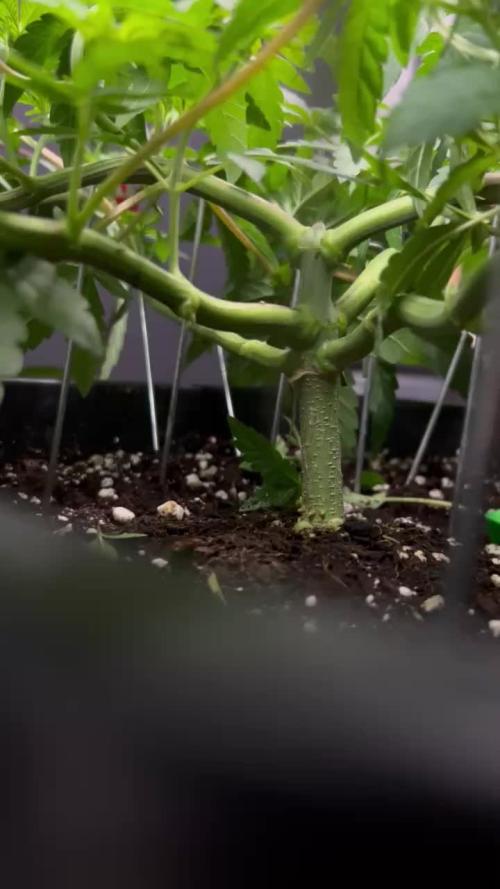
🔸 Growth & structure: Biscotti Gelato is loving life this week. She’s sitting low and proud with a tidy, pancake-flat canopy—tops marching in perfect formation. The main stem is chunky with neat training “knuckles,” and the undercarriage is clean so light and air glide right through. Leaves are a deep, happy green and holding that cute “hands-up” pray—no burns, no drama.
🔸 Training: Kept the LST/manifold rhythm going. Tie-downs are doing their job and everything stays level. I plucked a few interior fans—just enough to let the center breathe and give those fresh tips some runway
🔸 Looking to Week 6: Keep the table-top shape. Only snip leaves that clearly throw shade, and give the ties a gentle retighten so all leaders stay shoulder-to-shoulder. Once the footprint is nicely packed, we’re ready to flip—time to trade squats for stretch. 🌸
📈 Current Conditions:
🌡️ Day: 26 °C
🌡️ Night: 19 °C
💨 Humidity: 60%
🔦 PPFD: 400–500 µmol (18/6 light cycle)
🛠️ Setup:
💡 Spider-Farmer 100 W
⛺ Tent: 120 × 120 × 180 cm
🍯 Pots: 18 L plastic pots
🌱 Medium: Bio-Bizz Light Mix
💊 Nutrients: Advanced Nutrients
💧 Water: Tap water (0.5 EC)
Likes
29
Share


@cherokee
Follow
Прошла третья неделя цветения. Растения активно набирают массу и увеличиваются в размерах.
________________________________________________________________________________________________________________________________________
Ребята предлагаю всем желающим подписаться на мои социальные сети где я делаю еще больше контента о каннабисе.
Подписывайтесь пожалуйста, буду рад всем 😜 !!!
👽 Instagram - https://www.instagram.com/jedi_genetics/?hl=ru
👻 YouTube - https://www.youtube.com/channel/UCRFN2LzgQ4gxDj-6CIIr82g
________________________________________________________________________________________________________________________________________
Processing
Likes
10
Share


@HisHope
Follow
After dry
Maddie dry weight 126 grams, Tammy now in dry wet weight 815 grams
Tammy yield dry 153 grams

Likes
11
Share


@MrGoonai
Follow
12/12/24 Short Facts:
Watered: 1 x 2.4L, 1 x 2.5L, 1 x 2.5L — Total: 7.4L
VPD @ 1.4
Light @ 70% (~700 to 950 PPFD)
Stopped watering with fertilizers, only water, CalMag and Silicia Force
---------------------------------------------------------------------------------
I’ve stopped watering with fertilizer because I’m planning to harvest her in the coming days.
You can already see that she’s slowly dying. I hope she’ll put all her remaining energy into her flowers in these final days.
I’m going to dry her, but only because there’s a new method I want to try. You can now place the harvested buds into a special plastic bag immediately after harvest. These bags are designed to let water out while preserving the terpenes almost completely intact. One of the German grow shops selling these bags tested different samples in a lab, and the results seem to support their claims.
If it works, great! If not and the harvest ends up molding, I don’t mind. 98% of the harvest will already have to be trashed due to the legal limit.

Likes
30
Share


@Herbz_Unkraut
Follow
very nice strain with 2 great ancestors, solid taste and scent, got some great buds with great taste and awesome looking plants with incredible colors
Likes
20
Share


@GrowinHome
Follow
Exciting first few days setting up everything in and around the propagator.
I think I'll start counting the vegging days when the seedlings are 7-10 days old.

Likes
3
Share


@BossDean81
Follow
Day 22- She stopped putting on height due to one night of a dramatic temperature drop. It's a cooler fall this year plus a freeze came through the night before. That night, I was up doing some studying when I noticed the reading on the remote display. N o telling how long it had been in the very low 60's. The problem was fixed simply by adding a heater to the room. Now, the temp is only in the 68 degree range for the final 2 1/2 hrs. before the lights are cut back on.
Day 26- Her bud branches hav grown at least 2 -5 innches in length and have at least 2-4 bud sites already. Instead of Defoliation, I decided to actual two different types of LST. The first is simply bending to fan leaf branches under to expose the bud branches to more light. The main benefit is that you still keep the ability to absorb more of the light energy with them. I look at the fan leaves as your plant's " Personal Sun Panels". Since they store energy in the day and use that reserve to grow at night, why would you take something away for her that is meant to help her? Also, the second method I used is something I like to call" wind thickening". The technique is using wind resistance to train your plant's stem and branches to become more rigid by growing thicker to stablize itself. So, instead of a gentle breeze, I use a three speed box fan at varies distance. I started doing this on Day 22 and the results are definitely showing. The main stem went from 1/16 in. to a nice 3/8 in.