Likes
Comments
Share


@cheetah844
Follow
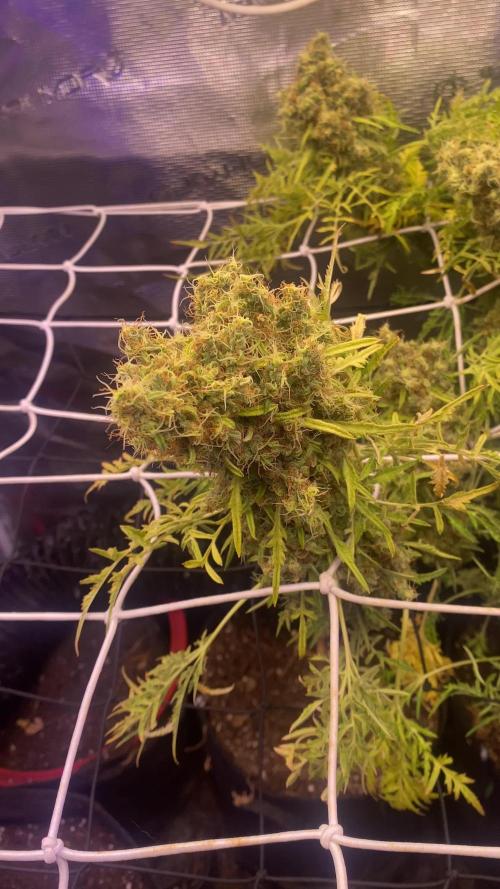
This one is surprising me with it's height. I guess I just assumed with it being very indica dominant that it'd squat a little more. But hey more plant to train = more budsites, I'm okay with that.👍
I topped every bud site on every plant, both indoors & outdoors.

Likes
10
Share


@Ultraviolet
Follow
Voltage, also known as electric pressure, electric tension, or (electric) potential difference, is the difference in electric potential between two points. In a static electric field, it corresponds to the work needed per unit of charge to move a test charge between the two points. In the International System of Units (SI), the derived unit for voltage is named volt.
The voltage between points can be caused by the build-up of electric charge (e.g., a capacitor), and from an electromotive force (e.g., electromagnetic induction in generators, inductors, and transformers). On a macroscopic scale, a potential difference can be caused by electrochemical processes (e.g., cells and batteries), the pressure-induced piezoelectric effect, and the thermoelectric effect. Since it is the difference in electric potential, it is a physical scalar quantity.
A voltmeter can be used to measure the voltage between two points in a system. Often a common reference potential such as the ground of the system is used as one of the points. A voltage can represent either a source of energy or the loss, dissipation, or storage of energy.
Dropping the temps will slightly raise the humidity, air holds less % water the colder it is. Lights on 25-35rh% the same water content will spike to 50rh% + at night just by dropping the temps.
At night all the juice photosynthesis has been storing up is mashed and mixed up to make all the goodies we need for bud, water is used to transport all these things everywhere, like little solvent transport devices, once a nutrient/protein has been delivered to destination the plant needs to get rid of all this excess water molecules it was using to transport. The only solution at night is to spit it back out into the air at night. During the peak of flower, this can catch a grower unaware, with a 4x4 full tent it can be a challenge to control all that moisture exhaust overnight especially if you're really pushing the limits.
We live in a water world, above or below, our misconception is we live on dry land, we don't live in less watery conditions than above or below. We fit into a very narrow band of moisture that just so happens to be full of lots of air and everything else required for life.
Got my first full whiff of the smell of purple lemonade, always surprises me how accurately the smell fits names, the dominant terpenes in the Purple Lemonade weed strain are carene, linalool, limonene, and myrcene. Carene gives this strain its sweet, citrus flavor and some woody notes, whereas the linalool I recognize so well from Granddaddy Purp. Myrcene has been shown to have sedative qualities while bringing musky, earthy elements to the flavor profile.
Trichome production started to ramp up, and the plant that grew taller/closer to UV showed noticeably thicker coatings. The taller plant shows slight yellowing of lower leaves, and the smaller plant is green and lush but the buds are slightly less progressed, interesting.
I super-cropped the main stem of the tall one just over a week ago (clean). I expected it to be the one slightly behind in development.
The plant has roughly 10-15% "Total resources" that it keeps in case emergencies arise. Reserves if you will.
My rationale behind breaking anything goes hand in hand with slowing things down as production is lost due to the time it takes to repair damage.
I recall watching a YouTube video, where a curly hair gentleman would super crop in a manner to damage but not disrupt using a twisting method, using fingers and thumbs placing them close together one goes clockwise other counter clock this varies a lot depending on the thickness of stem but what you wait for is a tiny snap, it may take several rolls to weaken if walls are tough I found. No snapping or bending of the stem, you want just to fracture it but not puncture this way the xylem and phloem channels remain flowing,the damage is repaired almost instantly and the 10-15% is dispatched with very little repair time. Everything in the general vicinity of the stress will now grow stronger so as to prevent further similar damage.
This is why I had expected the tall one to lag behind in development once I had cropped it but low and behold it worked and the tall one has slightly more developed buds.
The effects of birdsong on plant life may at first glance be far-fetched. Nigh on ten years ago an article appeared in Nexus Magazine on the discovery or invention of a method of growing plants using bird sounds. Christopher Bird and Peter Tompkins describe the development of Dan Carlson’s Sonic Bloom in their book The Secret Life of Plants. Many others have, it seems, recognized the role of birdsong in the growth of plants, and influenced or directly helped Carlson to develop his invention.
Dan Carlson’s desire to see that no one need be hungry through shortage of food sought to understand the optimum growth of plants. He discovered that plants also feed from ‘the top down’ as well as the roots. Underneath all leaves are pores called stomata which open to take in nutrients and moisture from the air. Carlson’s observation that the more bird life there is on the farm, the more abundant is plant life, has been echoed by farmers throughout history, except in modern times. Where there is little bird life, plants are stunted, and dwarfed. Nature has the birds sing at dawn and dusk, which dilates the stomata, and so feeds the plants. One can immediately see the importance of trees.
The development of Sonic Bloom was to create birdsong, which is played to the plants, while a foliar nutrient is sprayed onto the plants at the same time as they are being stimulated by the sound, to enhance their growth. This method produced fantastic results in the amount of abundantly nutritious produce from one plant, often in poor soils and in drought conditions. Carlson showed that the breathing leaves of plants are the source of the nutrient intake for growth. This of course is also true for humans—the breath is food. We shall discourse on this on another occasion. Plants transfer nutrients to the soil via this breathing, and Carlson showed that his plants improved the soil and helped earthworms proliferate.
The secret of Sonic Bloom was the development of the music of the same frequency as the dawn chorus of the birds. With the help of a Minneapolis music teacher, Michael Holtz, a cassette was prepared. It seems that both birds and plants found Indian melodies called ragas delightfully suitable. This is actually quite profound, although the American farmers, especially women, who had to endure this music whilst it was played to the plants, found it irritating. Holtz found the “Spring” movement of Vivaldi’s The Four Seasons appropriate and concludes: “I realized that Vivaldi, in his day, must have known all about birdsong, which he tried to imitate in his long violin passages.
Holtz, it is related by the authors Bird and Tompkins, also realized that the violin music dominant in “Spring” reflected Johann Sebastian Bach’s violin sonatas broadcast by the Ottawa University researchers to a wheat field, which had obtained remarkable crops with 66 percent greater yield than average, with larger and heavier seeds. Accordingly, Holtz selected Bach’s E-major concerto for violin for inclusion on the tape. “I chose that particular concerto,” explained Holtz, “because it has many repetitions but varying notes. Bach was such a musical genius he could change his harmonic rhythm at nearly every other beat, with his chords going from E to B to G-sharp and so on, whereas Vivaldi would frequently keep to one chord for as long as four measures. That is why Bach is considered the greatest composer that ever lived. I chose Bach’s string concerto, rather than his more popular organ music, because the timbre of the violin, and its harmonic structure, is far richer than that of the organ.
Birdsong has long been loved but also studied with reference to the musical scale and harmonics. As Holtz deepened his study he said, “I began to feel that God had created the birds for more than just freely flying about and warbling. Their very singing must somehow be intimately linked to the mysteries of seed germination and plant growth.
The spring season down on the farms is much more silent than ever before. DDT killed off many birds and others never seem to have taken their place. Who knows what magical effect a bird like the wood thrush might have on its environment, singing three separate notes all at the same time, warbling two of them and sustaining the others.
Tree and bird life are essential to Earth's existence, which Carlson, Holtz, and others have shown, but indeed others see and feel. “Plants”, says Steiner, “can only be understood when considered in connection with all that is circling, weaving, and living around them. In spring and autumn, when swallows produce vibrations as they flock in a body of air, causing currents with their wing beats, these and birdsong, have a powerful effect on the flowering and fruiting of plants. Remove the winged creatures, Steiner warns, and there would be stunting of vegetation. Nothing more needs to be added here.
It has been said that you cannot hurt the humblest creature or disturb the smallest pebble without your action having a reaction upon something else...You cannot think of an evil thought, no matter how private, without it having an effect upon somebody else. Whatsoever you do in life sets up some form of resonance.
When I say the morning chorus of the birds awakens the earth I mean that the characteristic song of the birds sets in motion a series of vibrations which react upon other forms of life. Remember, the soil of the earth is full of living microorganisms. The plants are also living organisms. You, yourselves, are living organisms. Now, this is the beauty and wonder of it all—when one aspect of nature has been moved into a state of resonance it immediately relays its vibrational motion to something else.
So when I say the dawn chorus awakens the earth I literally mean what I say. I do not suggest that the earth would come to a standstill without the bird song, but I do mean that life on earth would be sluggish and ineffectual without that first instigating outburst of vibrational power poured forth at just the right pitch and tone to set off a chain effect.
I know some of you will say, what happens in those parts of the world where there are no birds? Well, what does happen? Very little, I assure you. The hot deserts and the polar regions where there are few, if any, birds are not renowned for their wonders of nature. It is as though they are asleep. Nothing grows, few things live. Little resonates and there is a great stillness over everything.
You see, that outburst of sound just before dawn is like the little lever that works the bigger lever which turns the wheel which moves the machine…and so on. Never underestimate small things.
Animals are blessed with instantaneous and unthought-out wisdom. They are in direct contact with God and they act and live as though they are fully aware of it. Men are also in contact with God, but most of them act as though they have never heard of God because they are largely veiled from their divine center by their own thinking minds of which they are so proud.

Likes
2
Share


@Dagnele
Follow
Date: June 29, 2025
Stage: Flowering
Growth: Plants have stopped vertical growth. The tallest one is now 75 cm, the shortest 63 cm. Buds are swelling and flowering is progressing well.
Health: All plants are in excellent condition. Lower leaves have started to yellow due to the flowering stage and have been removed.
Smell: Very intense aroma, noticeable even from a distance.
Watering: Almost daily due to high temperatures – approx. 7 litres total for the four plants.
Feeding: Alternating between ATA Terra Max (5ml/L) and plain water.
Sunlight & Weather: Another very hot and sunny week. Max temperatures around 35°C.
Notes: A small praying mantis was spotted on one of the plants.

Likes
8
Share


@HiCultureClub
Follow
Hi Guys
Let's continue now with the vegetation week three and one thing is for sure there are still some...
👉 Lighting
The Lumatek was increased from 80 watts to 120 watts on vegitation day 20. This corresponds to dimming from 40% to 60%. This corresponds approximately to a PPFD of 400.
👉 Pot size
On day 19 of the vegetation phase, the size was changed from a 1.5 liter to a 3.5 liter pot. This was done due to slight deficiency symptoms in the lower part of the plants and due to their size.
👉 Climate
Has remained the same.
Grow Report:
--------------
The plants also grew well during the week and still look healthy and happy. Once again, the genetics coped well with the stress of transplanting and got used to the new pot very quickly. Unfortunately, the plants were a little too dry before transplanting, but they also coped well with this.
This week they were also watered with fertilizer for the first time, 2ml BioBizz Fishmix per liter of water. The plants are watered as soon as they are close to being dry. The plants are watered with a total of approx. 400 ml in two stages of 200 ml each. I wait approximately 5-10 minutes between watering.
Have fun growing,
HiSpycy 💜

Likes
55
Share


@Njaak
Follow
So WHY is this auto taking so damn long to mature??? Is this normal? It's my first hydro grow, but my wife's soil grow started after mine (more than a week) + was grown in the exact same room .... but has been harvested over the past TWO weeks. Thoughts?
Not much needed doing this week. Did a huge trim mid week that was posted to a mid week update in last week's diary entry. She didn't like it at first but then bounced back pretty well. I think I have a very slight touch of nutrient burn on some of the tips, but it could also be a touch dry as we're having a hard time keeping the room over 40% humidity as the outdoor temps here are stupid cold recently.
Hoping to harvest in 2 weeks or so.. but could be longer. Urgh.
She's a big, bountiful, heat-loving lady that's finally a under a bit of vegetative control... but apparently REALLY likes to take things slow.


Likes
89
Share


@nonick123
Follow
Antes del resumen, decir que el controlador Tent-X de TrolMaster es una pasada. Puedo ver y controlar la VPD en tiempo real con la app de mi Smartphone
Una maravilla en esta fase de floración avanzada! 😍
_______________________________________________________________
Día 69 (25/03) Su hermana Gorilla Cookies FF muestra una ligera necrosis... me preocupa...
Día 70 (26/03) Necrosis en Gorilla Cookies muy avanzada en solo 2 días. Hablo con el gran @dogdoctorofficial y me hace ver que estoy regando mal...
He dejado que se seque demasiado el sustrato! (como en la fase vegetativa) Y la Gorilla Cookies FF al ser la planta más grande y que más agua pide, está demasiado sedienta...
Voy a modificar los patrones de riego para que el problema no persista en Gorilla Cookies FF ni aparezca en las otras plantas!
Riego 0,5 Litro H20 sin nutrientes. TDS 225 PPMs - pH 6,6
Día 71 (27/03) Riego 1,25 Litro H20 + Wholly Base 3 ml/l + Solid Green 1,75 ml/l + Early Flower 0,75 ml/l + Big Bloom 1,5 ml/l de Gen1:11
TDS 1150 PPMs - pH 6,2
Día 72 (28/03) La necrosis en Gorilla Cookies FF se ha detenido 😁 y las flores siguen creciendo
Observa alguna mancha de necrosis también en Wedding Cheesecake FF y decido a subir un poco la lámpara
Ahora el PPFD en apical es de unos 830 PPFD
Día 73 (29/03) Riego 0,5 Litro H20 sin nutrientes. TDS 225 PPMs - pH 6,6
Día 74 (30/03) Riego 1,25 Litro H20 + Wholly Base 3 ml/l + Solid Green 1,75 ml/l + Early Flower 0,75 ml/l + Big Bloom 1,5 ml/l de Gen1:11
TDS 1150 PPMs - pH 6,2
Día 75 (31/03) Detecto una ligera necrosis en Purple Lemonade FF y en Wedding Cheesecake FF.
Voy a aumentar un poco la distancia de la lámpara para tener un DLI de 37, por si fuese estrés por luz.
💦Nutrients by Gen1:11 - www.genoneeleven.com
🌱Substrate PRO-MIX HP BACILLUS + MYCORRHIZAE - www.pthorticulture.com/en/products/pro-mix-hp-biostimulant-plus-mycorrhizae
🎚️Controlled by TrolMaster TCS-1 Tent-X System Main Controller - https://www.trolmaster.com/Products/Details/TCS-1
Likes
4
Share


@Bvercuiel
Follow
Tallest Auto I’ve ever grown. Not the fattest buds bud, but overal good grow


Likes
9
Share


@Mr_nugs_lover_David
Follow
This plants have developed beautiful branches that will develop awesome fat nuggets for sure! Really nice strain to grow, would be awesome to apply lst some time on this strain, I have applied a selective defoliation on them, let's see how this ladies keep developing, I start to count the days of flower on April 10th!
Likes
2
Share


@Ultraviolet_
Follow
The main purpose of chlorophyll is to capture photons of energy. When growth is no longer a priority for a plant in nature, it will naturally sink its "no longer needed" nitrogen and switch pigments to carotene and anthocyanin, which are better-suited pigments for environmental protection rather than capturing photons (growth). This is because of all nutrients used by a plant, nitrogen in its nitrate form is highly stable and required for the rigours of electron capture, ammoniacal nitrogen readily evaporates into the air during cure/dry. The ripening stage is no longer about growth, but the main priority is protecting trichomes and opening up the oxidative capacity of the plant so it can focus 100% of filling those trichomes. Nitrogen in its elemental nitrate form is no longer required during ripening to the same degree as it was; the vast majority of growth is over. Understanding when to shift a plant's focus from rapid growth to maturation is the key to maximizing the trichome quality and terpene profile of the final product. That is the single most important decision you will make during a grow in terms of dictating smoothness, taste, and smell, I have found from my limited years of dedicated and driven study into the matter.
Synthetic nutrients maintain a near full nitrate ratio comparable to ammoniacal nitrogen, whereas organic nutrients maintain a supply of ammoniacal and convert only to nitrate what is needed. This is far more beneficial for organic growers when it comes to smoke smoothness, as the higher levels of ammoniacal nitrogen are far easier to dispose/convert than nitrates come harvest, cure/dry with far more efficient margins held within leaf/bud when it comes to conversion to aminos. A good dry and cure can go a long way to a quality smooth smoke, but without a proper senescence sequence or triggered autophagic sink of nitrogen, then you will be asking far more than can be expected from a dry/cure. It's one thing to sink the last 5-10% and convert the last drips to amino acids during the dry and cure, but leaving the plant fully charged with nitrogen in the form of nitrate is simply not going to taste good, no matter how much smoke you blow up your own ass or how long you have been growing. Means nothing. Smoke quality relies on pre-harvest physiology, not just the dry and cure! The dry and cure cannot fix poor pre-harvest metabolic states. A high-quality, smooth smoke requires correct signalling before harvest. While a proper dry and cure can gently soften the edges and convert the last 5-10% of sugars into amino acids, it fundamentally cannot perform magic on a fully fertilised plant. You cannot oxidise stable nitrates (+5 charge) into a smoother state during drying. Ultimately, accept it's going to be a heavy smoke and be grateful, onwards upwards!
The way in which ammoniacal nitrogen reacts to carbon sugars is critical in how it acts during oxidation and is responsible for oxidizing leftover sugars that can make the buds smoke harshly. Limited ammoniacal equals limited oxidation of excess carbons held within tissues. Just so you know, it's not an anecdotal rule that's unresolved and unsubstantiated. It's called the Maillard reaction. Signal triggers and stressors. Normally, you can only use 10-30% ammoniacal nitrogen, but as harvest closes, it is beneficial to increase this ratio 50% of ammoniacal as it assists in steering the plant towards maturation. Rather than running 50% ammoniacal nitrogen continuously until harvest, use it in short, targeted flushes/additions (e.g., 7 days) to slow internode elongation and hasten maturity. Use alongside forced larger "dry backs" (allowing the root zone to dry out significantly between watering events). Raising the Electrical Conductivity EC of the medium to create mild osmotic stress. Widening the day-to-night temperature difference and increasing the vapour pressure deficit VPD.
How would you like your cola's sir? Arm length, please, no gaps with trichomes as thick as snow.
Likes
12
Share

@Crazy_Doofus
Follow
Another few days, cut her half, ready end of the week ♥️👍
03/01 trichomes still blanc
05/01 trichomes not ready
Likes
11
Share


@OrionSparkles
Follow
🐩
-Yá puestas a fotoperiodo 12/12.
-La planta más pequeña la trasplantè a maceta de 11L.
-Apliqué via foliar la primera dosis de Delta 9;via foliar,5ml x1L.
🤙🏻Todo super.


Processing
Likes
31
Share


@NorCal311
Follow
11/3/19 - These bitches are sooo strong! Everything is going very good. Feeding is changing this week. I am so excited to see what they do! The stretch has slowed. I will lower the lights next week. Added a new light for the one I moved to the corner. We will see on how it affects the evromntals.
11/4/19 - Gave a feeding tonight 4 cups per plant. 2 cups are Coco Bloom A&B with Silica Blast. The other two cups are terp, candy, cal, big, sens. This combo of nutes and water volume every two days seams to be doing very good. I premix my nutes in gallon water bottles. I love the Crystal Geyser bottles. They only $1 and have nice handles. I refill each bottle with a Zero Water filter pitcher. That keeps the TDS down low.
11/5/19 - WOW, I just love after a good feeding. The girls just JUMP right up. When I took the environment pic, the temp was a little high while the RH was a little low. It has now laid down to 75/55 with the lights on.
11/6/19 - They are drinking a bunch. Gave them 1 cup each of the solutions to keep them good till Friday.
Likes
127
Share


@DreamIT
Follow
There isn't much more to say about this fantastic strain. Hardy, easy to clone, quick to flower and absolutely delicious in every respect. It resists well to high temperatures, "accidental" over fertilization, and recovers soon after a period of drought. Easy and fast.
Likes
15
Share

@ZhulenejJohny
Follow
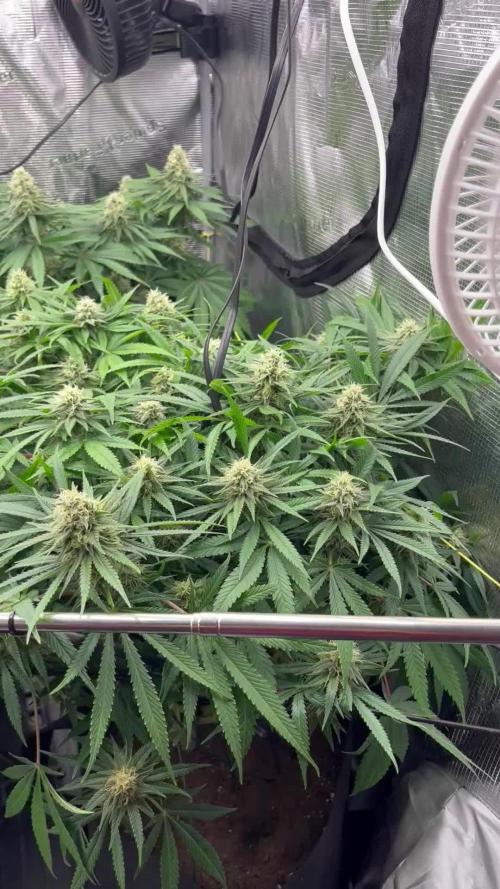
Zdar hombres, holky v cajku. Snížil jsem světlo na 35cm ať maj maximum. Přišli hnojky od Shogunu tak rovnou dostali nálož. Big bud dávám dnes naposledy příště dostanou už PK od Shogunu. 5l zálivka každé 3dny. Peace

Likes
29
Share


@yvet_te
Follow
Waited a little long to top the three shorties. Made a little time lapse from weeks 4.5 and 5.5, kind of cool to watch them puff up and grow! They’re coming along nicely!
Likes
15
Share


@tokesly
Follow
Flush ended two days before the darkness period. Decided on a 48 darkness periods though some prefer 24 or 72. The darkness did help trichomes reappear at the tops of the canopy. Going for a longer dry of 10 days, best temperatures are 60-70F to preserve the terps with 50-60RH. This has been an amazing experience, definitely putting in more passion into the next run.

Likes
32
Share


@Dunk_Junk
Follow
She's filling out a bit more this week. Just watching and waiting though.