


Likes
Comments
Share


@Kraken85
Follow
1 er Cycle : Gourmande e crossance et Flo ...
La Tangerine Dream est une variété de cannabis à dominance sativa au goût acidulé, doux et intense. Les arômes d'agrumes ainsi que les effets qui sont à la fois cérébral et relaxant satisferont aussi bien les amateurs de THC comme les amateurs de CBD. Les juges de la Cannabis Cup 2010 étaient d'accord avec cette description car ils l'ont élu comme la meilleure variété de cannabis 2010.
Barney's Farm annonce un temps de floraison de 60-65 jours, ce qui est court pour une variété sativa aussi puissante. La Tangerine Dream donne des plantes de un mètre de haut en intérieur avec beaucoup de branches latérales robustes.
La production de la Tamngerine Dream est impressionnante, 600 gr/m2 en indoor. Les têtes sont grandes, compactes et recouvertes de pistils rouges orangés ainsi que d'une résine très odorante remplie de THC.
L'effet de la Tangerine Dream de Barney's Farm dure longtemps. Quant à ses parents, la G13 est une variété de cannabis légendaire reconnue pour ses saveurs intenses ainsi que ses effets très puissants et la Neville's A5 Haze est une plante exotique raffinée.
La Tangerine Dream de Barney's Farm est une variété de cannabis très productive et de floraison courte. Les taux de THC et de CBD annoncés par Barney's Farm sont exceptionnels car peu de variétés du marché actuel arrivent à 25% de THC et 1.8 de CBD.
Parfait rien a dire.
2 ème Cycle:



Likes
13
Share

@C17H19NO3
Follow
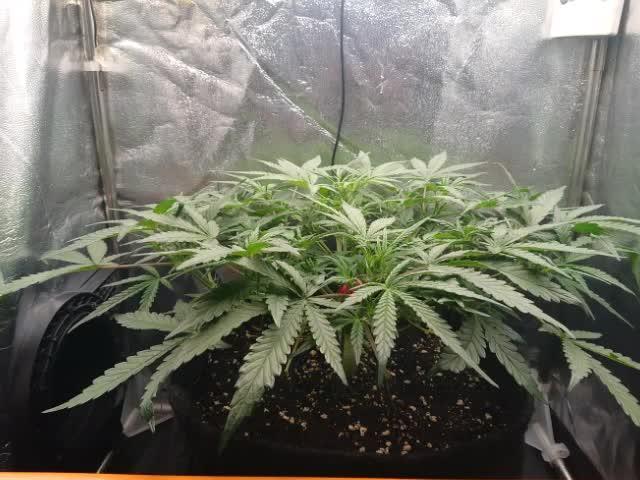
🤙🏻
16.August (29) 500ml Wasser
17.August (30)
18.August (31) 1,5l DüMi
19.August (32) par Blätter entfernt
20.August (33) UV auf 2std
21.August (34) 1,5l Wasser / 500ml Wasser in Untersätzer
22.August (35)
Licht 65%

Likes
31
Share


@The_Doctor_Green
Follow
En esta nueva semana he trasplantado a macetas de 10 litros a 2 plantitas que estaban en macetas de 3L .
La que he planteado a tierra ha tenido un crecimiento significativo de una semana a otra.
Likes
28
Share


@Borberad
Follow
Woche drei der Blüte und alles Bestens! Aufgrund der dichten Struktur habe ich die Pflanze an Blütetag 19 großzügig ausgedünnt. Bei photoperiodischen warte ich damit bis mind. Blütetag 21. Die kleine Auto Blueberry Banana scheint aber schon recht weit, daher habe ich hier keine Bedenken. Seit Mitte der Woche scheinen die Blattspitzen etwas Überdüngung anzuzeigen. Der Drain mit Osmosewasser bei ph 6,4 und 20 microSiemens hat ph6,7 und 800microSiemens. Setze die Stickstoffgabe etwas herab indem ich Hesi Blüte reduziere und pk13/14 ergänzend zuführe. Erhöhe somit gleichzeitig Phosphor und Kalium.

Likes
6
Share


@thenotillwizard
Follow
The Red Hot Cookies are looking beautiful. Very nice looking buds with fantastic colors. Very promising in terms of bag appeal :)
The pheno 1 shares many traits with the GSC. The effect is amazing despite of the quite boring terpene profile which is unidimensional (very sweet base notes along with creamy peach head notes that reminds me of the peach flavored campino hard candys). The high has the soothing and calming effect of the GSC while being more uplifting and energizing.
The pheno 2 is more on the Tangie side for both the effects and the terp profile. The high is energetic but a little bit racy. The limonene content seems far higher than the myrcene, and it translates itself in both the taste and the effect. I will be looking for a Tangie-dom pheno that is richer in myrcene, in hope of getting more of the tangerine taste/aroma and the relaxing effect that we can find in the Tangie and Tangerine Dream strains.
As for the Amherst Sour D, they all share the same woody and tropical aromas with subtle specific nuances (pepper, fuel, skunk/sulfur, lavender). The effects go from slightly sedating to highly energizing and euphoric. A great afterwork hard hitting sativa that tastes awesome, without being the terp bomb of the year.
The Dinamed CBD plus is a very short, bushy and stalky plant. The Pheno 1 smells like straight pine/fir on sweet and fruity base notes. The structure is nice with lots of lateral branching and the buds are looking very good too. I could have got a way better yield be giving her an extra 10 days of veg.
The pheno 2 is more one the fruity/fuely/tart side. Definitely not the best pheno. Very slow growth...


Likes
17
Share


@Ashbash
Follow
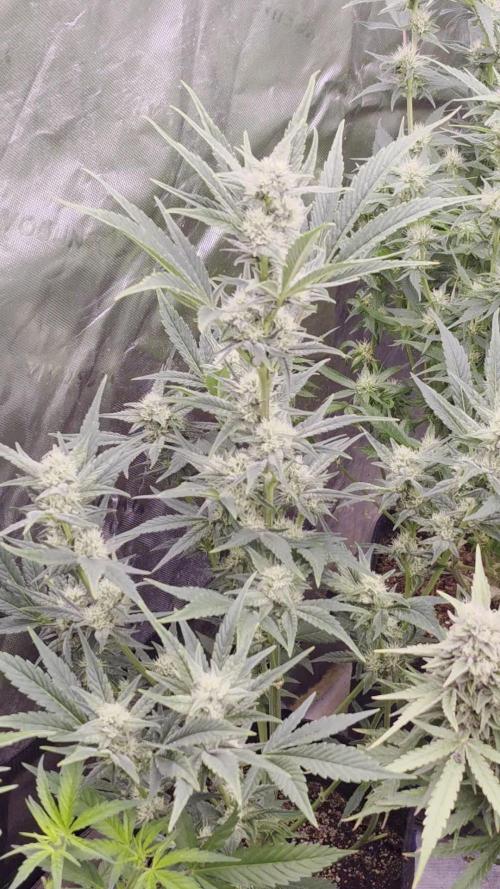
A week of fattening up here. The smell from this one is divine :) Really sweet. I am flushing this one with just water as i see a lot of amber on the trichomes and think its very close to the end.


Likes
69
Share


@nonick123
Follow
Día 44 (15/07) Wow! No hay shock de trasplante! 😍💥😁
Todas las ramas se han estirado hacia arriba tras el ajuste de LST y se están formando nuevos nodos rápidamente
Esta combinación de nutrientes de Lurpe + substrato de PRO-MIX HP es una maravilla 😍
Día 45 (16/07) Ayer tuvimos ola de calor (37 ºC) y han aguantado muy bien!
A última hora de la tarde (cuando ya no había sol directo) les apliqué H2O en spray foliarmente para refrescar los estomas
Hoy parece que vuelven las temperaturas estándar para esta época del año: 29 - 30 ºC en las horas centrales del día
Riego con 1 litro de H20 pH 6,5
Día 46 (17/07) Pequeños ajustes de LST
Hay algunas ramas inferiores que no se han formado / estirado mucho
Lo más probable es que haga una buena limpieza este domingo, 7 días después del trasplante, para dejar solo los brotes por encima del 4º nudo
Día 47 (18/07) Riego con 0,5 litro de H20 pH 6,5
Este domingo (día 50) haré limpieza de partes bajas y tal vez también de nuevo topping en las 4-6 ramas principales 😁
Día 48 (19/07) Día de muchísimo calor con 37 ºC. A ver como lo llevan!
Riego con 0,5 litro de H20 pH 6,5
Día 49 (20/07) Para ayudarles a llevar mejor el calor de las horas centrales del día, coloca una malla de sombreo (70%) sobre el invernadero
Lo cierto es que se nota que baja mucho la temperatura debajo de la malla! Van a estar más fresquitas! 😍
Riego con 0,5 litro de H20 pH 6,5
Día 50 (21/07) Training session!
Hago limpieza del tercio inferior de la planta, de todas las ramas y nudos que no superan la línea del dosel marcada por el 4º nudo (1er topping)
También hago topping (2º) a todas las ramas principales
La idea es tener 12 ó 14 colas principales para que no se hagan muy altas
De paso saco unos cuantos clones de las ramas inferiores eliminadas 😁💥
Para superar el estrés, hago las siguientes aplicaciones y riego:
- Riego con 1 Litro de Té Vegetativo de Lurpe Solutions. Preparación: 24 horas con bomba de aire (oxigenación) con ingredientes:
Green Sunrise 8 ml/L + Insect Frass 16 ml/L + Hummus Lombriz 8 ml/L + Melaza 1 ml/L + Kelp Hidrolizado 0,25 g/L
- Aplicación foliar Kelp hidrolizado de Lurpe Solutions a 0,25 ml/l
💦Nutrients by Lurpe Solutions - www.lurpenaturalsolutions.com
🌱Substrate PRO-MIX HP BACILLUS + MYCORRHIZAE - www.pthorticulture.com/en/products/pro-mix-hp-biostimulant-plus-mycorrhizae

Likes
15
Share


@Deli_Weed
Follow
Esta es mi primer planta que cosechó con éxito, y estoy muy feliz con mi resultado final 😄 obtuve una muy buena cantidad de flores premium con alrededor de 15% de thc (desde mi punto de vista claro 😅)
Tuve algunos problemas durante el cultivo, principalmente que deje que se estirara mucho, debi hacerle LST a la punta principal para que no siguiera aumentando la altura y tener más flores del mismo tamaño, las flores más bajas quedaron chicas y les faltó madurar un poco, también tuve problemas de sobrefertilizacion aun a pesar de que seguí las instituciones de los fertilizantes y de sus indicaciones que me dieron los de servicio al cliente, incluso ya teniendo en cuenta eso siempre use la menos de la dosis de la base ya hasta que crecieron más le fui aumentando, igual creo que es muy cierto lo que dicen de que “menos es más” a la próxima empezaré usando muy pocos nutrientes, aparte creo que si hubiera usado unos leds más potentes, las plantas hubieran aprovechado más los nutrientes, pero igual me sirvió de experiencia, pienso cultivar de nuevo esta genética y sacarle más provecho. Muy recomendada 👌🏻😁

Likes
3
Share


@Cupboardgrowuk
Follow
blueberryz as harvest this weekend. Limoncello be coming down next weekend cannot wait

Likes
4
Share

@DogDoctorOfficial
Follow
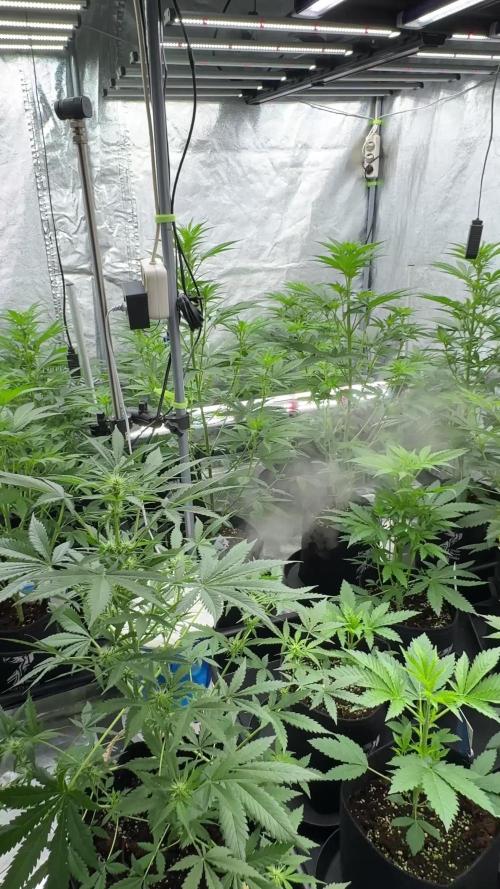
🌿 Lava Cake – Week 5 (First Week Flower) | Pre-Bloom & Heat Talk 🌿
The Lava Cakes have officially stepped into their flowering tent… though, to be fair, they’re still enjoying a little extra veg time before showing pistils. Both phenos are healthy, lush, and stretching beautifully, clearly ready for the show ahead.
⸻
📸 Photo Studio Glam
We took them out for another studio shoot, bright lights, clean background, and every angle showing off their deep greens and perfect branching. Soon, their beauty will be dressed in flowers, but for now, the leaf structure alone is worthy of the spotlight.
⸻
🌡️ Current Conditions
• Room Temp: 31°C
• Humidity: 50.3%
• VPD: 2.23 kPa
• PPFD: 766 µmol/m²/s
• Soil EC: ~2.0
• Soil Temp: 25.6°C
Yes, the temperature is running hot — AC unit is on the way to lock it back into our ideal zone.
⸻
💬 Heat in the Grow Room – Risks & Benefits
Potential Risks:
• Faster substrate drying = more frequent irrigation needed
• Higher transpiration rates can stress plants if roots can’t keep up
• Slightly increased risk of light stress at high PPFD without proper cooling
• Possible reduced terpene retention if sustained into late flower
Possible Benefits (short term in veg/pre-flower):
• Accelerated metabolism — plants grow and stretch faster
• Increased water/nutrient uptake (if well-fed and watered on time)
• Can improve CO₂ usage efficiency if levels are high enough
Bottom line: As long as they’re hydrated, fed, and ventilated, short bursts of high temp are manageable. But for flowering, we want to keep daytime temps closer to 24–28°C for optimal quality.
⸻
💧 Watering Strategy
We water when the soil dries to about 25% moisture remaining, this encourages:
• Stronger root growth searching for water
• Better oxygenation of the root zone
• Less risk of root rot in warm temps
Right now: They’re drinking daily due to the heat, so we’re feeding daily as well.
⸻
Current Feeding (per L of water)
• Aptus Regulator – 0.15 ml
• Aptus CalMag Boost – 0.25 ml
• Aptus All-in-One Liquid – 1 ml
• Aptus Top Booster – 0.25 ml
With the increased drinking rate, nutrient uptake has increased — meaning no signs of deficiency, just steady lush green.
⸻
🚀 Looking Ahead
• AC installation will stabilize temps, allowing tighter VPD control
• First signs of pistils should appear within the next 7–10 days
• We’ll begin adjusting feed ratios for early bloom once flowers set
• Light intensity will climb further as stretch continues
⸻
💚 Closing Note:
This week is all about momentum, heat or no heat, the Lava Cakes are pushing upward, prepping themselves for a heavy flower load. The environment tweaks are on the way, and we’re building them the perfect stage for their bloom performance.
📲 Don’t forget to Subscribe and follow me on Instagram and YouTube @DogDoctorOfficial for exclusive content, real-time updates, and behind-the-scenes magic. We’ve got so much more coming, including transplanting and all the amazing techniques that go along with it. You won’t want to miss it.
• GrowDiaries Journal: https://growdiaries.com/grower/dogdoctorofficial
• Instagram: https://www.instagram.com/dogdoctorofficial/
• YouTube: https://www.youtube.com/@dogdoctorofficial
⸻
Explore the Gear that Powers My Grow
If you’re curious about the tech I’m using, check out these links:
• Genetics, gear, nutrients, and more – Zamnesia: https://www.zamnesia.com/
• Environmental control & automation – TrolMaster: https://www.trolmaster.eu/
• Advanced LED lighting – Future of Grow: https://www.futureofgrow.com/
• Root and growth nutrition – Aptus Holland: https://aptus-holland.com/
• Nutrient systems & boosters – Plagron: https://plagron.com/en/
• Soil & substrate excellence – PRO-MIX BX: https://www.pthorticulture.com/en-us/products/pro-mix-bx-mycorrhizae
• Curing and storage – Grove Bags: https://grovebags.com/
⸻
We’ve got much more coming as we move through the grow cycles. Trust me, you won’t want to miss the next steps, let’s push the boundaries of indoor horticulture together!
As always, this is shared for educational purposes, aiming to spread understanding and appreciation for this plant. Let’s celebrate it responsibly and continue to learn and grow together.
With true love comes happiness. Always believe in yourself, and always do things expecting nothing and with an open heart. Be a giver, and the universe will give back in ways you could never imagine.
💚 Growers love to all 💚


Likes
31
Share


@Joni2017
Follow
They follow their rhythm 65 cm 👏🏻💪, temperature 26º C ☀️ Humidity 65% 💧irrigation 750 ml/plant💦💦 water one day with nutrients and other day whitout nutrients 😋 defoliation 🍃 binaural sound 🎼😋👍


Likes
2
Share


@Ultraviolet_
Follow
18 hours in seconds, 60x60x18 = 64,800 seconds, now multiply by the 833μMol/s reading off the PAR metre. μMol/s (micromol) is the unit in which P.A.R. is expressed.
64,800x833=53,784,000μMol
53,784,000μMol = 54 Mol
54 DLI @ 800ppm, powerful combination. Pushing photosynthesis to peak capacity, accelerated growth and increased biomass. Applied net, stretching her around for a week. Maintaining a minimum air velocity of 0.3m/s within the inner canopy.
E=MC2 looks like a simple multiplication problem; it describes a fundamental physical truth: mass and energy are the same thing. The equation doesn't just calculate a value; it reveals that mass is effectively "congealed" energy. Energy is just numbers. Energy isn't a physical "substance" you can hold or touch. It is essentially an abstract, calculated number that we assign to a system to predict how it will change, interact, or move. A numerical label we attach to matter to track how it behaves. Because the universe runs on laws of symmetry (specifically, that the laws of physics don't change over time), a single global number must be conserved. We call that number "energy".
How well a seedling grows is down to how much knowledge one can acquire to increase the level of conversion to occur. Applying knowledge effectively requires intuition, which comes from hands-on experience. A seasoned stoner learns to read subtle signs—like a slight change in leaf turgor (stiffness), subtle color shifts, or the specific texture of the soil—before a textbook diagnosis can be made. Ultimately, growing is the application of botanical science blended with active observation. Knowledge dictates your potential, but adaptability and attentiveness to the plant's immediate environment determine your results. The human eye is capable of distinguishing more shades of green than any other color in the visible spectrum.
1.618
Nature mathematically optimizes quantum energy transfer and light absorption efficiency within the photosynthetic machinery, as it naturally dictates energy scaling hierarchies and resonance dynamics. External vibration or electromagnetic wave that perfectly matches a plant's natural frequency directly influences plant growth. Low-frequency sound waves and targeted electromagnetic fields stimulate cellular processes and boost photosynthetic efficiency. An angular frequency aligned with the Golden Ratio is often used in wave mechanics and quantum physics to optimize energy transfer.
Does it produce better yields? All I know is the IVM loves being aligned with it. Here is how I "think" of it to simplify it for myself when I give it thought. Quantum is the firmware, DNA is the software read/write expression.
Alignment with that of which already exists.
Law of nature, not my opinion: Constructive interference occurs when two or more overlapping waves meet in phase, meaning their crests and troughs perfectly align. Their amplitudes add together, creating a new, amplified wave with greater intensity than the individual components.
Constructive interference is the foundational mechanism that establishes a resonance hierarchy across physical, structural, and acoustic systems.
"Frequencies utilizing this ratio naturally minimize resistance (or impedance) and allow for highly efficient resonance, which can facilitate an increase in Electron Transfer Reactions (ETR) or energy pathways in molecular structures."
Quantum coherence in photosynthesis occurs when a photon of sunlight strikes a leaf; the energy it carries must travel to a reaction center to be converted into chemical energy. This process operates at nearly 100% efficiency. If the energy moved in a traditional "bunching" or random hopping manner, a large portion of it would be lost as heat. Instead, plants utilize quantum superposition. The energy particle (exciton) doesn't just take one path; it exists in a wave state and explores multiple pathways simultaneously. It essentially "chooses" the most efficient route to the reaction center simultaneously.
Research shows that molecular vibrations and the specific network arrangements of chlorophyll molecules (like the naturally evolved Chlorophyll A & B ratios) actively protect against energy overflow, optimizing light capture across different light intensities. Enzymes are the biological catalysts that speed up chemical reactions within a plant's cells, allowing them to grow, metabolize, and repair. Rather than relying solely on the classical kinetic energy of molecules colliding, plants use quantum tunneling. Subatomic particles like electrons and protons (hydrogen ions) can literally "teleport" through energy barriers that they normally wouldn’t have the energy to climb over. This makes vital metabolic reactions happen far faster than classical physics could ever explain!
Chloryphyll b has peak absorption at 460nm (Blue) and at 647nm(Red). If we take the blue peak wavelength 460nm and a UV-B, UVR8 peak absorption wavelength 285nm, Tryptophan-285 (W285) Sensing protein. 460/285=1.618 Φ If we take chlorypyhll b's Red absorption peak 647nm and a UV-A of 400nm, we get 647/400=1.618 Φ. "Structure of light". The cryptochrome photoreceptor (CRY) is a UV-A/blue light receptor that shares this dual sensitivity with several other biological structures and functions, including significant sequence similarity and a common evolutionary ancestor with DNA photolyase enzymes. These are light-activated enzymes that use blue/UV-A light to repair DNA damage caused by UV-B radiation in plants. Synergistic.
Effective quantum efficiency of photosystem II, often denoted as ΦPSII, represents the proportion of light absorbed by Photosystem II (ΦPSII) that is actually used in photosynthetic electron transport. It is a key indicator of how efficiently a plant is using light for photosynthesis, as opposed to losing it as heat or fluorescence. ΦPSII (effective quantum yield of photosystem II) functions primarily as a "multiplier" (a coefficient of efficiency) rather than an additive factor when estimating the overall photosynthetic electron transport rate (ETR). Multipliers are considered far more beneficial than additions because they generate exponential growth, leverage existing resources to their full potential, and create sustainable, self-multiplying capacity, rather than just incremental, linear increases. This fascinating observation is rooted in the intersection of subatomic geometry, fractal scaling, and quantum dynamics. In specific molecular arrangements—such as in conjugated polymer networks or biomolecular architectures—the Golden Ratio (PHI) naturally dictates energy scaling hierarchies and resonance dynamics. Mathematically tied to the fine-structure constant, which defines the strength of the electromagnetic interaction. The Golden Ratio can be mapped geometrically as the Golden Angle (137.5 degrees) in atomic structures, linking the charge of the electron to fundamental quantum constants like Planck's constant.
An electromagnetic wave is neither electric nor magnetic, but a combination of both. 137.5
The Golden Angle (137.5) This angle is derived from the Golden Ratio (1.618). It is the smaller of two angles created when a circle is divided such that the ratio of the arcs equals the Golden Ratio.
An electromagnetic wave (like light or radio waves) is not a static electric field or a static magnetic field, it is a self-propagating combination of both. An oscillating electric field creates an oscillating magnetic field, which then regenerates the electric field. They feed off each other and travel together through space at the speed of light, carrying energy without needing a material medium.
The Fine-Structure Constant Alpha (Α/α): In quantum physics, is the approximate denominator of the fine-structure constant (often represented by the Greek letter Alpha (Α/α). It is a fundamental, dimensionless number that dictates how strongly charged particles (like electrons) interact with the electromagnetic field. Its value has puzzled physicists for over a century, as it bridges quantum mechanics, electromagnetism, and relativity.
In quantum mechanics, Omega (Ω/ω) usually represents angular frequency. When applied to "quantum coherence"—the ability of particles to exist in overlapping states without immediately degrading—is key to calculating how long these states last.
The Golden Angle, the value 137.5° is the geometric Golden Angle. It is derived from the Golden Ratio (1.618) and is famously responsible for the beautiful, mathematically optimized spiral patterns found in nature (such as sunflower seeds, pinecones, and leaf arrangements). Because of this, theoretical physicists and mathematicians have long speculated about why nature relies so heavily on the number 137 and the golden angle to govern everything from subatomic light interactions to the macroscopic geometry of the universe.
Quantum coherence allows particles to maintain superposition and entanglement. In realistic, open environments, interactions with a noisy background typically cause decoherence, destroying the system's quantum information. A major challenge in quantum physics and quantum computing is preventing this decoherence at large scales. In quantum optics and driven systems, the Greek letter Omega (Ω/ω) often represents the Rabi frequency, which dictates the strength of the coherent driving laser or electromagnetic field interacting with the quantum system.
The interaction of light and water generates specific Coherent Domains. Trapped electromagnetic fields cause water molecules to vibrate in unison at a coherent frequency, separating the liquid into structured quantum areas and an unstructured phase. When water interacts with hydrophilic (water-attracting) surfaces, the energy from UV and Infrared light can drive the formation of larger, structured layers known as Exclusion Zone (EZ) water. Exclusion Zone (EZ) water represents a structured, negatively charged phase of water critical to cellular biology. Driven by light energy and hydrophilic surfaces, this ordered state acts as a natural biological battery, with far-reaching implications for cell function and human health. In this domain, water molecules arrange themselves into a highly ordered, negatively charged lattice that excludes solutes and particles. At higher energy levels, UV light acts as a catalyst for photochemical reactions. Photons can provide enough energy to break the hydrogen and oxygen bonds in molecules, resulting in free radicals and a plasma of quasi-free electrons. This transfer of electrons forms the fundamental basis for redox reactions and energy metabolism in ALL biological systems.
Input: The energy, time, and focus you dedicate.
Process: Continuous growing, refining, and learning.
Output: A superior, highly polished final product.

Likes
6
Share


@Hoodoo
Follow
The first picture day 44! Well, we've finally got the purple colours coming in very strongly! Even the fan leaves are turning purple. The progression of the pigment looks like a pathogen has taken over but it's just the cool genetics of this plant. Smell is increasing, they have a very sweet odor so far when crushing the flowers. Still nowhere near harvest but the buds and calyxes are starting to stack. Very exciting that I got this one to grow!
Likes
8
Share


@Cali_Rayy
Follow
Expected more of a vertical stretch this past week but maybe that’s what’s going to happen next; smell is weak but it’s just the beginning; stay tuned
Likes
8
Share


@ChipHella
Follow
This here is my second grow (1st in CoolGrows tent) and I’m proud to say I’ve fucked up significantly less than my Fyre Festival of a rookie season - 2 plants died in veg then my grow light fell on the only plant left that was 3 weeks into flower, severing 2 colas.
So, yeah, while I have def dinked up a few things on this grow, it’s the garden of eden relative to the the nightmare on weed street that was my first attempt.
Things I fucked up this time (so far) and won’t do next time:
- Overcrowded the space. Got greedy and tried to fit 4 plants in my 3x3x6 tent. 0/10 would not recommend.
- Tried growing 1 indica strain with the 3 WWxBBs. WWxBBs quickly grew taller and started robbing the lil indica friend’s light.
- Added 2nd net a little late. It’s looser than it ought to be I’m not sure it’s providing ideal structural support to colas but prob better than nothing?
- Want to try lollipopping next time. Air flow is ok but fan leaves are blocking light to some lower Bud sites and likely sapping energy that could be going to bud production.
I’m probably messing something else up that I don’t even know I’m messing up. If you’re reading this and see something I could be doing better, let me know. Here to learn and grow the dopest dope possible.
Love,
Chip


Likes
13
Share


@GangbudsGenesgdl
Follow
14/12/20
inicio de semana, se le aplico dos cucharadas de leonardita y dos mas de harina de cangrejo riegos solo con agua, se metio al invernadero una led bestva 600w elite tanbien se rego con un poco de algantic potasium . sele hicieron unos amarres en las dos puntas del apical con las hojas de abajo
18/12/20
59cm de altura
20/12/20 cierre se semna asta horita riegos solo con agua💪
