Likes
Comments
Share
@HookahCli
Follow
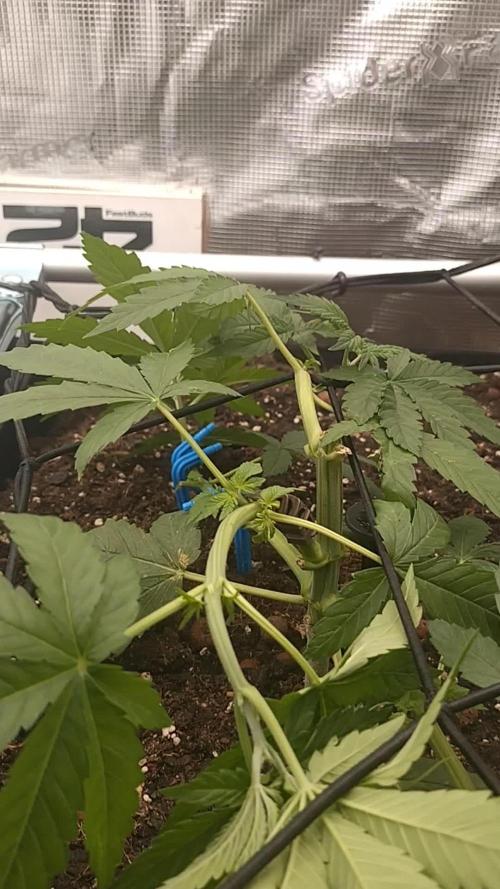
d68 Llevamos todo el mes de abril con lluvias y las plantas no reciben las horas de sol que quieren, por desgracia, la planta de LST ha sacado unos pistilos y para que no continúe con la floración le tendré que hacer una poda apical. El resto de plantas parece estar bien respecto a esto, pero voy a estar observando a Mimosa Evo, puede que le pase lo mismo que a la LSD. d69 Le he hecho la poda apical por la mañana a la LSD. He realizado poda apical a Mimosa Evo. He regado con 8L de agua a estas 4 plantas y 2 más, he utilizado la mezcla de arriba. d71 Parece que crecen bien, todavía estoy dudoso porque LSD parrce que quiere sacar flores, la dejare una semana a ver como progresa, Meganuska necesita agua, esta muy liviana la maceta será la única que se riege hasta la proxima semana. Estan empezando a llegar los insectos, la semana que viene empezare con los preventivos.
Likes
92
Share
Week 5 Veg Report: SCROG Netting, Massive Leafs & Precise Data Mastery! 🌱 Girls Growing Stronger Than Ever! 🌱 This week has been truly epic in the grow room—so much so that it’s time to bring in the SCROG net! With the canopy expanding and the younger ones still working to catch up, the SCROG net will help me achieve that perfect, even canopy. A well-placed SCROG not only ensures better light penetration but also gives the smaller plants a chance to spread out and thrive alongside their bigger sisters. Now, let’s dive deep into the SCROG method. The Screen of Green (SCROG) technique is a grower’s secret weapon for maximizing space, light efficiency, and yields. The concept is simple but powerful—train the plants to grow horizontally along the net, forcing them to expose multiple budding sites instead of just a single cola. This way, the canopy spreads evenly, improving light distribution and air circulation throughout the tent. As the plants grow, I’ll gently weave their branches through the screen, ensuring they fill every square inch of space. The end goal? A sea of buds all basking in equal light! 💪 Huge Leafs Everywhere! 🌿 One thing that’s really catching my eye this week is the size of the leaves—they’re HUGE! Honestly, they’re so big I couldn’t resist a little fun, so I made myself some fashion accessories: leaf earrings and a cap from the Super Sativa Seed Club Green Papaya! 😂 And, of course, I captured the moment. But seriously, large leaves at this stage are a great sign of healthy, robust plants. These “solar panels” are hard at work soaking up all the light, driving photosynthesis, and fueling growth. So, what does it mean when your plants are showing off big, luscious leaves? It’s a clear indication that they’re happy, healthy, and thriving in their environment—big leaves mean lots of energy being produced and stored for future bud growth. Exactly what we want! 💧 Precision Feeding with Aptus Nutrients 💧 This week, I took a deep dive into my Aptus nutrient lineup and shared a video explaining how each product affects the water’s pH and TDS. Using the AMP-3 Precision Meter, I’m getting real-time water readings and keeping everything dialed in perfectly. Let’s break it down: • pH: 5.83 • TDS in solution: 445 ppm • Water temperature: 25.2°C The Aptus products are incredible for balancing nutrients without throwing off the pH or TDS too much. I’m fine-tuning my feedings based on these readings to make sure the girls are getting exactly what they need. The precision I’m able to achieve with the AMP-3 is mind-blowing—I get immediate feedback on pH, temperature, and EC, allowing me to make real-time adjustments and ensure the perfect environment for nutrient uptake. 📊 Environmental Mastery Thanks to TrolMaster 📊 Speaking of control—let’s talk about the TrolMaster system! Between the DSH-2U Humidity Station and all the other sensors, I’ve created the perfect environment for my plants. Here’s where we’re at this week: • Temperature: 26.2°C • RH: 70.6% • CO2 levels: 775 ppm • VPD: 1.0 kPa • PPFD: 423 Thanks to TrolMaster, I can monitor and adjust these metrics in real time, and the best part? I can do it all through the TM+ Pro app, even while I’m lounging in my green papaya leaf hat! 😆 Whether I’m checking the CO2 levels, adjusting the lights, or fine-tuning the humidity, it’s all in my hands with just a tap of my phone. Talk about convenience! 🌱 P.S. – Inline Sensors: Heavy-Duty Precision 🌱 Now, let’s talk about the heavy-duty players in this game—the (PCT-2) Heavy Duty Inline EC/Temp Sensor and the (PPH-2) Heavy Duty Inline pH Sensor. These bad boys are connected directly to the AMP-3 Precision Meter, and they’ve been absolutely crucial in giving me the most accurate readings on my water and nutrient solution. The PCT-2 keeps me informed about the electrical conductivity and temperature of my solution, which is key for monitoring how well my plants are absorbing nutrients. Too high or too low, and we’re asking for trouble, but this sensor ensures I’m always in that perfect range. The PPH-2, on the other hand, is all about maintaining the perfect pH balance. A fluctuating pH can mean nutrient lockout or deficiencies, but thanks to this sensor, I get a constant read on my pH levels, so the plants are always in their sweet spot for optimal nutrient absorption. Together, these inline sensors allow me to run a super-tight ship—every drop of water and nutrient is dialed in to perfection, keeping the plants happy and healthy! Shout Outs! As always, huge thanks to TrolMaster and ThinkGrow LED for the amazing gear, to Aptus Holland for their top-notch nutrients and Pro-Mix for the best soil i have used so far. Big love to the seed banks, the amazing Grow Diaries community, and all my followers—you guys make this journey so much more exciting. Don’t forget to catch up on my social media, Instagram, and YouTube for real-time updates and exclusive content! Stay tuned for more—next week is going to be epic! DogDoctorOfficial Discount Codes so you can save big on your next check out 💚💚💚 Kannabia - DOGDOCTOR 30% off SeedsmanSeeds - DOGDOCTOR 10% off CannaKan- DOGDOCTOR 15% off terpyz.eu - DOCTOR 15% off The Neutralizer - PORKIT5-DOG 15% off Growers Love to you all 💚💚💚
Processing
Likes
8
Share
Esos fumetillas, que actualizo esas bombas de candy caramelo 💣 del banco Zambezaseeds. Y es que ya no les queda nada, estoy pensando en cortarlas con varios días de diferencia, pero ya veremos eso aún está por decidir. La cuestión es que mirar lo sanas que han llegado hasta el final y a sido Gracias al led que me mando mars hydro. Esta semana no se echo nada de productos y hasta el corte es lo que seguiré haciendo, con cada riego se alimente la planta con nutrientes o no se tiene que calibrar el ph, mantener la humedad por debajo del 50% Y la temperatura mantenerla entre 22/26 grados. La flor no es muy grande pero está compacta, tiene bien de resina, el olor es un olor dulce como a chicle de fresa. Muy peculiar y llamativo. Hasta aquí todo lo de esta semana, disfruten los vídeos y muy buenos humos gente
Likes
29
Share
@THCeitor
Follow
Ya en la cuarta semana podemos ver mayor cantidad de pistilos sobre todo en la planta mas pequeña y la que de seguro estará lista antes para cosechar, la R.S.Banana #2. La R.S.Banana #1 muestra un crecimiento mas vigoroso con un tallo muy ancho y aunque ya muestra algunos pistilos, esta tardará mas que la R.S.B.#2 pero será mas productora. En relación al LST es una tarea que se realiza a diario.
Likes
39
Share
9/21: They're doing great except for the last seedling to emerge (a Lemon Pie). She is suddenly droopy like she's overwatered, but that's not the case..root issues I suspect. A few signs of deficiencies on other plants, but I fed them today and upped the nute dosages a bit. I also prayed and sprayed them with Boom Boom Spray... 9/22: Good growth. I sprayed them with Microlife Super Seaweed today. The sick Lemon Pie's new growth is perky, but she's so limp looking otherwise... 9/23: I transplanted the sick Lemon Pie into a 3 gallon pot and loosened up the soil in her rootball a bit while doing so. Fed them all some ONE with little Boomerang today. 9/25: I harvested enough plants that I was able to swap the seedlings into the closet and the remaining photos into the tiny tent. I set the lighting timer to give them 4 hours of dark a night. 9/26: I potted up the other 17 Fastbuds plants today and watered them in with a full dose of ONE, some boomerang, and some Microlife Super Seaweed. 9/27: They seemed to take right off once they got some room for their roots to stretch out. Several of them started flowering. The sick Lemon Pie is looking much better now. That old growth is kinda petrified, but I'll leave it until she's got more new upper growth. Thirsty girls. I'll have to feed again tomorrow.
Likes
223
Share
💩Holy Crap We Are Back At It And Loving It💩 Growmies we are at DAY 14 and all three are doing great👌 So I'm starting to pull some of them over and doing some light LST training 🙃 Nutrients are now going to feed NutriNPK Grow 28-14-14 Lights being readjusted and chart updated .........👍rain water to be used entire growth👈 👉I used NutriNPK for nutrients for my grows and welcome anyone to give them a try .👈 👉 www.nutrinpk.com 👈 NutriNPK Cal MAG 14-0-14 NutriNPK Grow 28-14-14 NutriNPK Bloom 8-20-30 NutriNPK Bloom Booster 0-52-34 I GOT MULTIPLE DIARIES ON THE GO 😱 please check them out 😎 👉THANKS FOR TAKING THE TIME TO GO OVER MY DIARIES 👈
Likes
57
Share
2/26: Harvested both Black Jacks and both Gorilla Girls tonight. They got a rough live trim, then chopped, washed, and hung to drip dry. Big, heavy, frosty buds on all 4 of them!👍 3/2: Still drying in the closet...amazing aromas!
Likes
5
Share
This week went by quickly. They're doin their Pre-Flower stretch and getting big quickly!! I added my Pre-Flower mix to them this week. My Nutrient Pre-Flower Mix consists of H20, Coconut, Bananas, Pineapple, Sweet Potatoes, Kelp, Alfalfa Meal, All Organic Non-Pasturized Whole Milk, Epsom Salts, Black Strap Molasses, and L.A.B. or Lactic Acid Bacteria. First, I boiled the coconut, pineapple, sweet potatoes, the bananas, and left the skins on as well except the coconut of course! That I had to split in half and make sure to keep the water inside to add to the boil. After boiling everything I then let it cool and then added it to a blender to blend little by little. After blending I left separate and placed into the fridge. Then I took 1 Tbsp of Alfalfa Meal and 2 Tbsp of Kelp, 500mL of the milk, 2 Tbsp of Epsom Salts, and mixed them in a 750 mL bottle. Then I took 1L of the mix and added 2 Tbsp of L.A.B. and 2 Tbsp of Black Strap Molasses and then shook the bottle well! Then I took the 750mL bottle and the 1L bottle and fed that to the plants adding 250 mL of pH H2O to the plant as well to flush the ingredients all into the plant with the H20. I wanted to also note that I choose to slowly defoliate so that the plant doesn't go into shock and also fan leaves collect light in all spectrums so taking too many off at a time could hurt or slow the growth of your plant! The amount of light your plant takes in daily is called DLI or Daily Light Index. Overall, they're really growing and have a ton of us sites developing!
Likes
21
Share
9. Woche Die beiden sind zu kleinen Büschen geworden und messen 65 cm 📏 Ich habe ein wenig entlaubt und jeweils die höchsten Triebe etwas runter gebunden. Ein paar Tage dürfen sie noch wachsen und dann wird geblüht 😁 Happy Growing 2026 !!! Update : am Tag 60 wurde auf 12 h umgestellt
Likes
20
Share
Likes
27
Share
They grow up so fast! ;') Watered every ~3 days (when dry) Pour in water quickly/gently so that the soil is covered by 1cm of water. Not long now, maybe a week, then cloning!
Likes
7
Share
Plant continues to grown, seeing more and more trichomes on the leaves. Seeing photos from other White Diesel Haze Automatic growers I was expecting more frosting. It's possible the light is too close to the top of the highest stems but I cannot move it any higher. pH was high so I added some pH min from Plagron to the water.
Likes
63
Share
@Ferenc
Follow
Day 80, 22nd of October 2020: 3rd week of flowering! Happiness she needs a lot of boost hard to keep up. She loves fertilization too much..... I mean before always craving for nitrogen now qould need more potassium and phosphorus hard to keep up. I also detect deficiency based on the leaves getting lighter and brown spots but I do feed her as much as I can really. This week i have relised the first nice trichomes started "sitting" on the leaves as well and the pistils coming out nicely pre flowers forming. Let's go.
Likes
20
Share
Starting to get a smell and buds are starting to stack. Did one more top dress with the power bloom 2-8-4. Leaves slightly curling so I’ve been adding just a little more nitrogen through the Buddha grow. Other than that, stems starting to sway so she’s gonna get heavy soon. Sugar leaves are smelling identical to fruit loops or fruity pebbles 😊
Likes
7
Share
Day 36 she keeps stretching and looks very happy i'm also very happy because soil PH is finally good, now it's 6.5PH after watering with 5.2 PH'ed water(with nutes in it) for the last several waterings. Light is 30cm away from the canopy ~850 PPFD Cut some leaves from center of the canopy for better air circulation and light penetration. Day 38 : watered with 2.5 L of water with nutes and 5.6 PH water, runoff water PH is now perfect 6.5 Day 39: She's been stretching very well, can't wait to deflate already(maybe tomorrow) Day 40: deefoliation day finally has come! And i'm so happy how she turned out after all. I did some LST to even out canopy for better light penetration and air movement! Note: she uses much Calcium - Magnesium (cal-mag) soo you definitely need to add it in your water.
Likes
55
Share
2nd net is up. Early bud formations are promising. holding up to the extremes pretty well, some leaves taking minor damage, but overall, she is holding up, gave her 1 night at 50F see how she would react, stressful. Not advised as it messes with her metabolism, but I want to see if it triggers any anthocyanin response. Love to see her purp up but no signs yet. Remember, For every molecule of glucose produced during photosynthesis, a plant needs to split six molecules of water. This process provides the hydrogen needed for synthesizing glucose and other organic compounds, while oxygen is released as a byproduct. Homework. If Rubisco activity is impaired and it cannot properly function or regenerate its substrate, the plant's leaves are likely to turn a pale green or lime green, a condition known as chlorosis. Essentially, Rubisco activity is highly regulated and susceptible to various environmental and metabolic factors that can cause it to become inhibited, leading to an apparent failure in RuBP regeneration due to a lack of consumption. Rubisco regeneration is intrinsically linked to nitrogen supply because Rubisco is a major sink for nitrogen in plants, typically accounting for 15% to over 25% of total leaf nitrogen. The regeneration phase itself consumes nitrogen through the synthesis of the Rubisco enzyme and associated proteins (like Rubisco activase), and overall nitrogen status heavily influences the efficiency of RuBP regeneration. RuBisCO is a very large enzyme that constitutes a significant proportion (up to 50%) of leaf soluble protein and requires large investments in nitrogen. Insufficient nitrogen supply limits the plant's ability to produce adequate amounts of RuBisCO, thereby limiting the overall capacity for photosynthesis and carbon fixation. Maintaining the optimal, slightly alkaline pH is crucial for the proper function and regeneration of Rubisco. Deviations in either direction (too high or too low) disrupt the enzyme's structure, activation state, and interaction with its substrates, leading to decreased activity and impaired RuBP regeneration. (Lime/yellowing) Structural Component: Nitrogen is an essential building block for all proteins, and the sheer abundance of the Rubisco protein makes it the single largest storage of nitrogen in the leaf. Synthesis and Activity: Adequate nitrogen supply is crucial for the synthesis and maintenance of sufficient Rubisco enzyme and Rubisco activase (Rca), the regulatory protein responsible for maintaining Rubisco's active state. Nitrogen deficiency leads to a decrease in the content and activity of both Rubisco and Rca, which in turn limits the maximum carboxylation rate, Vmax, and the rate of RuBP regeneration Jmax, thus reducing overall photosynthetic capacity. Nitrogen Storage and Remobilization: Rubisco can act as a temporary nitrogen storage protein, which is degraded to remobilize nitrogen to other growing parts of the plant, especially under conditions of nitrogen deficiency or senescence. Nitrogen Use Efficiency (NUE): The allocation of nitrogen to Rubisco is a key determinant of a plant's photosynthetic nitrogen use efficiency (PNUE). In high-nitrogen conditions, plants may accumulate a surplus of Rubisco, which may not be fully activated, leading to a lower PNUE. Optimizing the amount and activity of Rubisco relative to nitrogen availability is a target for improving crop NUE. Photorespiration and Nitrogen Metabolism: Nitrogen metabolism is also linked to the photorespiration pathway (which competes with carboxylation at the Rubisco active site), particularly in the reassimilation of ammonia released during the process. To increase RuBisCO regeneration, which refers to the process of forming the CO2 acceptor molecule Ribulose-1,5-bisphosphate (RuBP) during photosynthesis, the primary methods involve optimizing the levels and activity of Rubisco activase (Rca) and enhancing the performance of other Calvin-Benson-Bassham (CBB) cycle enzymes. Biochemical and Environmental Approaches: Optimize Rubisco Activase (Rca) activity: Rca is a crucial chaperone protein that removes inhibitory sugar phosphates, such as CA1P (2-carboxy-D-arabinitol 1-phosphate), from the Rubisco active site, thus maintaining its catalytic competence. •Ensure optimal light conditions: Rca is light-activated via the chloroplast's redox status. Adequate light intensity ensures Rca can effectively maintain Rubisco in its active, carbamylated state. •Maintain optimal temperature: Rca is highly temperature-sensitive and can become unstable at moderately high temperatures (e.g., above 35°C/95F° in many C3 plants), which decreases its ability to activate Rubisco. Maintaining temperatures within the optimal range for a specific plant species is important. •Optimize Mg2+ concentration: Mg2+ is a key cofactor for both Rubisco carbamylation and Rca activity. In the light, Mg2+ concentration in the chloroplast stroma increases, promoting activation. •Manage ATP/ADP ratio: Rca activity depends on ATP hydrolysis and is inhibited by ADP. Conditions that maintain a high ATP/ADP ratio in the chloroplast stroma favor Rca activity. Enhance Calvin-Benson-Bassham (CBB) cycle enzyme activity: The overall rate of RuBP regeneration can be limited by other enzymes in the cycle. •Increase SBPase activity: Sedoheptulose-1,7-bisphosphatase (SBPase) is a key regulatory enzyme in the regeneration pathway, and increasing its activity can enhance RuBP regeneration and overall photosynthesis. •Optimize other enzymes: Overexpression of other CBB cycle enzymes such as fructose-1,6-bisphosphate aldolase (FBA) and triose phosphate isomerase (TPI) can also help to balance the metabolic flux and improve RuBP regeneration capacity. Magnesium ions, Mg2+, are specifically required for Rubisco activation because the cation plays a critical structural and chemical role in forming the active site: A specific lysine residue in the active site must be carbamylated by a CO2 molecule to activate the enzyme. The resulting negatively charged carbamyl group then facilitates the binding of the positively charged Mg2+ion. While other divalent metal ions like Mn2+ can bind to Rubisco, they alter the enzyme's substrate specificity and lead to dramatically lower activity or a higher rate of the non-productive oxygenation reaction compared to Mg2+, making them biologically unfavorable in the context of efficient carbon fixation. The concentration of Mg2+ in the chloroplast stroma naturally increases in the light due to ion potential balancing during ATP synthesis, providing a physiological mechanism to ensure the enzyme is activated when photosynthesis is possible. At the center of the porphyrin ring, nestled within its nitrogen atoms, is a Magnesium ion (Mg2+). This magnesium ion is crucial for the function of chlorophyll, and without it, the pigment cannot effectively capture and transfer light energy. Mg acts as a cofactor: Mg2+ binds to Rubisco after an activator CO2 molecule, forming a catalytically competent complex (Enzyme-CO2-Mg2+). High light + CO2) increases demand: Under high light (60 DLI is a very high intensity, potentially saturating) and high CO2, the plant's capacity for photosynthesis is high, and thus the demand for activated Rubisco and the necessary Mg2+ cofactor increases. Mg deficiency becomes limiting: If Mg2+ is deficient under these conditions, the higher levels of Rubisco and Rubisco activase produced cannot be fully activated, leading to lower photosynthetic rates and potential photo-oxidative damage. Optimal range: Studies show that adequate Mg2+ application can enhance Rubisco activation and stabilize net photosynthetic rates under stress conditions, but the required concentration is specific to the experimental setup. Monitoring is key: The most effective approach in a controlled environment is to monitor the plant's physiological responses e.g., leaf Mg2+ concentration, photosynthetic rate, Rubisco activation state, and adjust the nutrient solution/fertilizer to maintain adequate levels, rather than supplementing a fixed "extra" amount. In practice, this means ensuring that Mg2+ is not a limiting factor in the plant's standard nutrient solution when pushing the limits with high light and CO2. Applying Mg2+ through foliar spray is beneficial to Rubisco regeneration, particularly in alleviating the negative effects of magnesium (Mg) deficiency and high-temperature stress (HTS). While Mg can be leached from soil, within the plant it is considered a mobile nutrient, particularly in the phloem. Foliar-applied Mg is quickly absorbed by the leaves and can be translocate to other plant parts, including new growth and sink organs. Foliar application of: NATURES VERY OWN MgSO4 @ 15.0g L-1 in a spray bottle. For those high-intensity workouts when 1 meal a day is just not enough! Foliar sprays are often recommended as a rapid rescue measure for existing deficiencies or as a supplement during critical growth stages, when demand for Mg is high. Application in the early morning or late evening can improve absorption and prevent leaf burn. The plant was getting a little limey yellow in the centre. Shortly thereafter, she was back in business, green mostly regenerated. The starting point [of creativity] is curiosity: pondering why the default exists in the first place. We’re driven to question defaults when we experience vuja de, the opposite of déjà vu. Déjà vu occurs when we encounter something new, but it feels as if we’ve seen it before. Vuja de is the reverse—we face something familiar, but we see it with a fresh perspective that enables us to gain new insights into old problems. Confidence is evidence... nothing more. You are confident because you have driven 10,000 times, you are confident because you have spoken 10,000 times. People think confidence is a feeling, but it's not. If you want more confidence, then you need to create evidence, take more shots, collect more data, build more experiences, take more risks; fail, confidence doesn't come first; it is the reward you get for doing the work. no one else wants to do.
Likes
23
Share
the past few weeks the girl scouts have been irrigated and fertilized but the little land used has made them dwarf, I performed lollipopping due to a redness that appeared on the leaves of one in particular now it is the most luxuriant. the skunk has really grown up in the background and the little shade has earned it its luxuriance