


Likes
Comments
Share


@Fullmeltalchemist
Follow
D56 - 11.13 - Looking great. The buds on the dwarf cheese is continue to swell and frost over while the other on is spitting out long white hairs and getting juicy! Not sure how long this dwarf is going to take to finish, but maybe 2-3 more weeks?
D60 - 11.17 - :)


Likes
15
Share


@RDWCGrowing
Follow
4/6/2024 - Vegetation Week 8 Day 1- Last week in VEG, They are all looking amazing and no worry about stretch when I flip Next Saturday they are indica and I have more than 50% of distance from the top of the plant to the lights with a little more I can raise the lights if necessary. So going to really just enjoy this last week of VEG, and get my Cloning equipment ready. I will be taking 2 cuts for each this is also a PHENO hunt for HWG and he not only has the prize for the winner but he also has an additional bounty on a cut of the winner. I did have to take some from around the edges to keep them from touching.
4/7/2024 - Vegetation Week 8 Day 2- Didn't do anything today but watch them grow.. They will be getting a really good flip trim and clean up for clone material on Friday/ Saturday.
4/8/2024 - Vegetation Week 8 Day 3- Couldn't even get a picture of the #1 at first too much Foliage throughout.. So I had to clean that up and make sure they all still have some separation before flip.
4/9/2024 - Vegetation Week 8 Day 4- Huston we almost had an issue.. I looked at my Res and she was in desperate need of 10 gallons to get her through until next water change on Saturday. So I added 10 gallons and the Nutes.
I added 10 Gallons of Water
I added the following Nutes:
CalMag= 1.00Mil/Gal= 10Mil
FloraMicro = 5.4Mil/Gal= 54Mil
FloraGro= 4.2Mil/Gal= 42Mil
FLoraBloom= 4.6Mil/Gal= 46Mil
4/10/2024 - Vegetation Week 8 Day 5- Had to giver them a huge clean up today I couldn't even see the numbers in the first pic. I am also worried that #1 and #3 really, really are getting huge over the last few days.. starting to think I should have flipped them this past Saturday.. The interesting things is even though this is an Indica Strain, I might have to super crop just to keep them off the lights.
The joys and sorrows of RDWC and timing.
4/11/2024 - Vegetation Week 8 Day 6- Even though Flipping in Two days almost wish I would have gone at Week 7. I am really worried about #3, #1 and #2 are huge and when I put them in flower they are going to stretch out
4/12/2024 - Vegetation Week 8 Day 7- Day of Work.. Lots of Work.. I gave all three a Cloning/Flower cleaning.. all three got cleaned up top Inside and bottom, I took 2 cuts of each to see which one come out on top then I will kill off the other cuts once I have a winner in flower. I clean up this thoroughly before I flip because it reduces the work load on the next major clean up I do on Week 4 of Flower.and they are so much taller that it is going to be a pain in the ass to maintain canopy space for #3, we will see how it goes and adjust as necessary..
Likes
3
Share


@GreenSoul_ZA
Follow
The DIY Screen is filling up very nicely by letting it Veg an extra week to try maximise & even the canopy out. Pruning every other day as the growth changes daily. I will be flipping it into flowering within the next few days. I cannot wait! The mother plant where this original clone came from is in its last few weeks of flowering & from what i can see, this is going to be an awesome, fun grow.


Likes
15
Share


@Fibro_Witch
Follow
Really great week for these girls!
I'm very happy with the amount of early flower stretch I got out of the 2 larger girls. While the 'Little One' won't amount to much, the other 2 I'm really excited for the finish.
I made a short video this morning to give ya'll a closer look.
They got one feeding consisting of the Hydrolyzed Fish/Rose&Flowering/Molasses and then another feeding of just the Fish/Flowering this week.

Processing
Likes
Comments
Share


@MOTB666
Follow
Girls still growing strong noticed some tips are starting to turn yellow raised light a couple more inches
Nutrient chamge 7/19 made it stronger since I broke my ppm reader and just gonna top off with calimag ph water throughout the week
More lst 7/21
Noticed the smell is definitely getting stronger and more of a dank aroma to it

Likes
13
Share


@Aircoholic
Follow
Girl Scout Cookies Auto was suddenly ready to get chopped - I would've like to see a few more amber trichomes, but the fan leaves started yellowing faster, and more sugar leaves got crispy tips. Also, the smell got pretty strong over the last week or so. It was a very nice grow, and I'm curious on the yield and effect after drying and curing.
Yuhbar Auto still needs a little more time, and will enjoy a few more days or weeks under the (artificial) sun, giving the trichomes more time to ripen.
Likes
7
Share


@Holy_dog_farm
Follow
3 weeks curing and i think its done now very strong and sweet smell.
Really enjoy my first autoFlowering harvest with this strain.
Likes
Comments
Share


@420Hunter
Follow
Ernte nach 64Tagen. Für den falschen ph wert ganz akzeptabel. Auch erst mein 1ter richtiger grow. Hat spaß gemacht. Nächstes mal wird einiges besser. Wenn die blpten fertig sind gibts noch mehr bilder.
Likes
44
Share


@MadeInGermany
Follow
Info :
Unfortunately, I had to find out that my account is used for fake pages in social media.
I am only active here on growdiaries.
I am not on facebook instagram twitter etc All accounts except this one are fake.
Flowering day 9
since time change to 12/12 hrs.
Hi guys :-) .
Just unbelievable how the lady goes off 😊👍.
She has started the stretch and is slowly starting to form her first pistils.
I completely remixed the water this time not only with Aqua Vega but also with some Aqua Flores.
The individual shoots were woven into the net, which I will continue to do for the next 1-2 weeks.
Next week all shoots under the net will be removed so that the upper ones get all the energy and not the lower ones that are in the dark.
The entire plant was checked for health.
The tent was cleaned as well as all the pumps and the heating rod.
I wish you all a nice week.
Stay healthy 🙏🏻
You can buy this Strain at
www.Zamnesia.com
Type:
Runtz
☝️🏼
Genetics:
Zkittlez
X
Gelato
👍
Vega lamp: 2 x Todogrow LED CXB3590 COB 55 W
1 x Sanlight S2W 62 W
💡
Flower lamp : 2 x Todogrow LED CXB3590 COB 55 W
1 x Sanlight S2W 62 W
💡 ☝️
Grow Aero System : Growtool 0.8
☝️
Fertilizer:
Canna Aqua Vega A + B , Canna Aqua Flores A + B , Rizotonic, Cannazym, CANNA Boost, Pk 13/14, Canna Cal / Mag, Canna Ph - Grow, Canna Ph-Bloom
☝️🌱
Water:
Osmosis water mixed with normal water (24 hours stale that the chlorine evaporates) to 0.2 EG. Add Cal / Mag to 0.4 Ec Ph with ph- to 5.2 - 5.8
💦 💧

Likes
6
Share


@rvabudman
Follow
Santa has been working hard so he can give out lots of smelly xmas presents. He has also been working on taking better pics of the buds.
Ps. My tent is in my closet in my office (I have been WFH for 2 years). Nothing better on a stressful day than opening up the tent and staring into the green, my type of therapy. Has helped me get through my last semester of gradschool while also working full time.
Likes
33
Share


@Ganjagrandaddy
Follow
SHE IS OUT AND HUNG. After what seems like an eternity , she is finally hanging to dry. This has been a very long drawn out diary and i salute anyone still with me here.lol
She smells sweet and is sticky icky when handled. Another 5 days i think before she is done and harvested finally.

Likes
6
Share


@Black_Venom
Follow
Second week of rinsing.
The trichomes have finished developing. And I like the appearance of the plant.
I place the plant in the dark for around 5 days. Period during which there will be no watering to allow the soil to dry and be able to Cut.
See you in a few days!

Likes
43
Share


@TheCannaProphet
Follow
~ FastBuds PAPAYA SHERBET Photoperiod~
Well here we go on another journey together through 'Canna-land' and this one's kinda special... forget that, it's VERY special because this is FastBuds newest surprise for the community, a FEMINIZED PHOTOPERIOD STRAIN!🤯
I was fortunate enough to score these seeds, of which only 1000 were available and can't wait to see what this strain can do! This Papaya Sherbet, according to FastBuds, is a hybrid with a 9-10 weeks flowering period. For a more detailed and accurate description of this strain the following from FastBuds says it best:
"Combining the massive stature of Papaya (Oni Selection) with the strength and resilience of one of our best keeper cuts (Sunset Sherbet), this strain develops into a big, expansive bush adorned with numerous bud sites that later transform into a generous harvest of medium-sized buds. Papaya Sherbet flowers deliver a signature flavor of premium cannabis with subtle citrus undertones that emerge upon inhaling. During growth, her aroma makes for a sweet yet pleasantly bitter fragrance, giving you an idea of what the smoke will taste like. Notably stress-resistant, Papaya Sherbet is a great choice for growers working in challenging environments. She is very forgiving and rebounds quickly from any adversity, allowing growers the freedom to experiment with confidence that she will take everything like a champion she is. This strain embodies resilience, flavor, and abundant yields in every grow cycle."
Sounds like an epic strain and I personally cannot wait for this lady to strut her stuff!😍
________________________________________________________________________________________________________________________________________________________________________________________________________________________________________________________________________________________________________________________
The Setup:
This is going to be an outdoor grow, but I have started the Papaya Sherbet photoperiod indoors as our weather is still a bit too chilly to put a newly sprouted seedling outside (nighttime temp's dipping regularly into the 40's℉).
The plan is simple... let her grow inside under a 19/5 light schedule until the nighttime temperatures are in the mid 50's℉, which shouldn't be long. After which, she'll be moved outside and transplanted into the soil which I have already setup and inoculated with beneficial microbes from BioTabs and slow release dry amendments from Gaia Green. Once she's established herself outside she'll be given periodic top dressings of Gaia Green 4-4-4 and 2-8-4 along with worm castings and Compost Tea's. Her grow area is approx. 5'x5' and I have posts and a trellis net set up already for when she gets bigger to aid in training her. Let the fun begin!🤪💚
________________________________________________________________________________________________________________________________________________________________________________________________________________________________________________________________________________________________________________________
Weekly Updates:
9/4- The 4th week of flower is here and the FastBuds Papaya Sherbet photoperiod is looking fantastic! She's loaded with flowers that are all beginning to get frosty!
9/6- My daily watering campaign continues with me giving the Papaya Sherbet approximately 5 gallons of well water from the garden hose.
The flowers on the Papaya Sherbet are stacking away and the frost continues to accumulate!
9/8- Today, before watering the Papaya Sherbet, I did some needed plant maintenance, removing a bunch of old dead leaves, along with a handful of shade leaves that were yellow.
9/10- Well with four weeks of flower behind her now, the Papaya Sherbet photo is almost halfway through with another 5-6 weeks to go. I only hope and pray🙏 that the weather cooperates and stays cool and dry!
Thank you for checking out my diary, your positive comments and support make it all worthwhile! 💚Growers Love!💚😎🙏
Likes
20
Share


@m0use
Follow
Ok, so first week is finally here.
First off I want to extend a big thank you to the brands Seedsman, MSNL, Exotic Seeds for sending CBG seeds and a big sorry from me for not being able to germinate them.
I have made notes that all CBG seeds need a bit of special treatment, Living soils are not great unless they are aged well, and better to just start them in perlite, compost and coir/peat. stupid simple. Now the other none CBG seeds did fine in living soil, same with the herbs but some of the herbs also struggled and has low germination rates like the chives. No idea of the chive seed age as I have not grown them in years so this could be part of it.
In better news some of CBG seeds have been replaced with a CBDv and THCv and regular CBD
The THCv is a GTR seed vs a Kannabia THCv Seed, curious how these two will compare. Both are a 1:1 ratio of THC : THCv
The CBDv is from GTR and the CBD is from CANUK, they sent it alongside the CBG as a "try this out as well" PS still rocking the hoodie, its nice and thick perfect for this time of year.
SO onto diary updates, The seeds got their first transplant into smaller square pots at 3.5" vs mini yogurt cups, now I will wait for them to acclimatize into its new size and then transfer up to 1Gal when the time is right.
Made a little video of transplanting them and took some extra photos of the herbs that are going strong. Also took a photo of 12hrs after transplant the the plants are looking nice still. I over watered them and let them drain to prevent a spike in EC in the soil. this way the soil can breakdown a bit more slowly and prevent any burning and such.
The one THCv seedling I plucked out of one pot is going strong with the cilantro. I did this so their would only be one in the other pot, Will gift this to my buddies who need some plants. Also have some leftover CBDv CBD seeds that I started out of caution, they will be doing the same thing, going to buddies. I'm hoping my one guy takes em all as he was intrested in some of the different cannabinoids like THCv and CBDv and CBG
The transplanted medium is amended with lots of stuff and Acti-Sol, the plants seem to do really well on this once they are established. I find topdressing with Acti-Sol is hard and does not work well so it needs to be added into the medium/pot before hand. Outdoors is a bit easier as the roots don't fill the pot to the brim, so topdressing is much easier. Once transplanting is over and they are in their final pot then they will get the liquid feed from the same company, Acadie :) Also first time trying out a Si additive into the soil. Using DE or diatomaceous earth, its now super available but should do the trick. I read studies about it on how adding it into the soil did increase SI content in the plant despite it not being readily available. The mineral wollastonite is a better option but I don't have any on hand. Weird that it comes from a Canadian mine as well.
I think that's all, will comeback and update as needed. Fertilizer is going to be added in ml for the whole container not doing the math for what it is per L.


Likes
4
Share

Likes
11
Share

@birdmountain
Follow
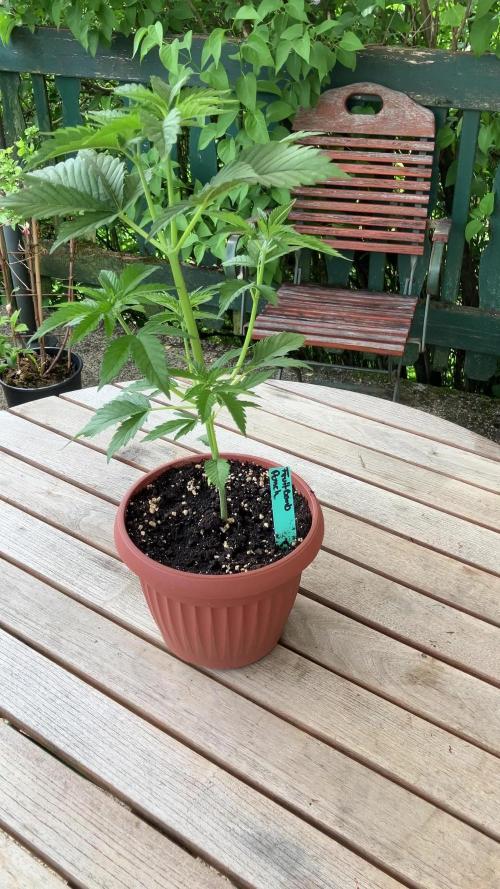
Sie entwickelt sich sehr gut. Vom Topping hat sie sich erholt und ist insgesamt kräftiger geworden. Kommende Woche nach den Eisheiligen wird sie noch einmal verpflanzt in ihren endgültigen Topf. Sie zeigt sehr breite, indicalastige Blätter, meist verändert sich das in der Blütezeit. Ansonsten ist sie gesund und zeigt keine Mangelerscheinungen, wird allerdings kommende Woche vor dem Umpflanzen mit einer Portiopn Vinasse und Seetang auf das Umpopfen vorbereitet werden.

Likes
2
Share


@Saintvicious
Follow
Leaf scaring getting worse but seems to have stopped progressing. Buds look amazing and can't complain about tricome production.
Likes
23
Share


@PapasGrow
Follow
Used 300 watts, produced over 400 grams of dry, extremely dank cookies.
Thanks to top quality genetics, lights and nutrients.

Likes
21
Share


@Shaunofthedank
Follow
Plants responded well to topping/fimming. They all have 4/6 main stems. Training them to get a bit of a canopy going. Cookies kush is def a keeper. Gonna try clone it. My clone games weak though.


