


Likes
Comments
Share


@Grams_House
Follow
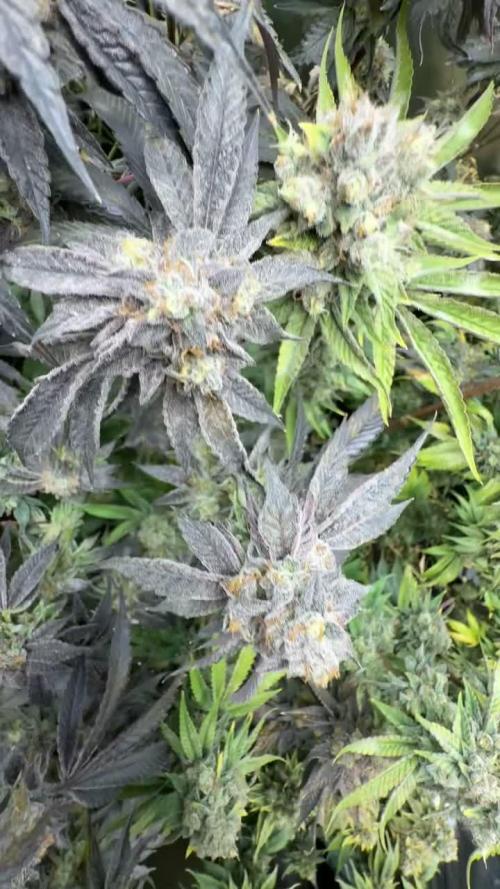
They were heavy when I took them out to hang dry. Not sure what I would yield at all, I will definitely get a dry weight.

Likes
25
Share


@Ultraviolet
Follow
ANTHOCYANIN production is primarily controlled by the Cryptochrome (CR1) Photoreceptor ( !! UV and Blue Spectrums are primary drivers in the production of the pigment that replaces chlorophyll, isn't that awesome!
1. Diverse photoreceptors in plants
Many civilizations, including the sun god of ancient Egypt, thought that the blessings of sunlight were the source of life. In fact, the survival of all life, including humans, is supported by the photosynthesis of plants that capture solar energy. Plants that perform photosynthesis have no means of transportation except for some algae. Therefore, it is necessary to monitor various changes in the external environment and respond appropriately to the place to survive. Among various environmental information, light is especially important information for plants that perform photosynthesis.
In the process of evolution, plants acquired phytochrome, which mainly receives light in the red light region, and multiple blue light receptors, including his hytropin and phototropin, in order to sense the light environment. .. In addition to these, an ultraviolet light receptor named UVR8 was recently discovered. The latest image of the molecular structure and function of these various plant photoreceptors (Fig. 1), focusing on phytochrome and phototropin.
Figure 1
Ultraviolet-visible absorption spectra of phytochrome, cryptochrome, phototropin, and UVR8. The dashed line represents each bioactive absorption spectrum.
2. Phytochrome; red-far red photoreversible molecular switch
What is phytochrome?
Phytochrome is a photochromic photoreceptor, and has two absorption types, a red light absorption type Pr (absorption maximum wavelength of about 665 nm) and a far-red light absorption type Pfr (730 nm). Reversible light conversion between the two by red light and far-red light, respectively(Fig. 1A, solid line and broken line). In general, Pfr is the active form that causes a physiological response. With some exceptions, phytochrome can be said to function as a photoreversible molecular switch. The background of the discovery is as follows. There are some types of plants that require light for germination (light seed germination). From that study, it was found that germination was induced by red light, the effect was inhibited by subsequent far-red light irradiation, and this could be repeated, and the existence of photoreceptors that reversibly photoconvert was predicted. In 1959, its existence was confirmed by the absorption spectrum measurement of the yellow sprout tissue, and it was named phytochrome. Why does the plant have a sensor to distinguish between such red light and far-red light? There is no big difference between the red and far-red light regions in the open-field spectrum of sunlight, but the proportion of red light is greatly reduced due to the absorption of chloroplasts in the shade of plants. Similar changes in light quality occur in the evening sunlight. Plants perceive this difference in light quality as the ratio of Pr and Pfr, recognize the light environment, and respond to it.
Subsequent studies have revealed that it is responsible for various photomorphogenic reactions such as photoperiodic flowering induction, shade repellent, and deyellowing (greening). Furthermore, with the introduction of the model plant Arabidopsis thaliana (At) and the development of molecular biological analysis methods, research has progressed dramatically, and his five types of phytochromes (phyA-E) are present in Arabidopsis thaliana. all right. With the progress of the genome project, Fi’s tochrome-like photoreceptors were found in cyanobacteria, a photosynthetic prokaryotes other than plants. Furthermore, in non-photosynthetic bacteria, a homologue molecule called bacteriophytochrome photoreceptor (BphP) was found in Pseudomonas aeruginosa (Pa) and radiation-resistant bacteria (Deinococcus radiodurans, Dr).
Domain structure of phytochrome molecule
Phytochrome molecule can be roughly divided into N-terminal side and C-terminal side region. PAS (Per / Arndt / Sim: blue), GAF (cGMP phosphodiesterase / adenylyl cyclase / FhlA: green), PHY (phyto-chrome: purple) 3 in the N-terminal region of plant phytochrome (Fig. 2A) There are two domains and an N-terminal extension region (NTE: dark blue), and phytochromobilin (PΦB), which is one of the ring-opening tetrapyrroles, is thioether-bonded to the system stored in GAF as a chromophore. ing. PAS is a domain involved in the interaction between signal transduction-related proteins, and PHY is a phytochrome-specific domain. There are two PASs and her histidine kinase-related (HKR) domain (red) in the C-terminal region, but the histidine essential for kinase activity is not conserved.
3. Phototropin; photosynthetic efficiency optimized blue light receptor
What is phototropin?
Charles Darwin, who is famous for his theory of evolution, wrote in his book “The power of move-ment in plants” published in 1882 that plants bend toward blue light. Approximately 100 years later, the protein nph1 (nonphoto-tropic hypocotyl 1) encoded by one of the causative genes of Arabidopsis mutants causing phototropic abnormalities was identified as a blue photoreceptor. Later, another isotype npl1 was found and renamed phototropin 1 (phot1) and 2 (phot2), respectively. In addition to phototropism, phototropin is damaged by chloroplast photolocalization (chloroplasts move through the epidermal cells of the leaves and gather on the cell surface under appropriate light intensity for photosynthesis. As a photoreceptor for reactions such as escaping to the side of cells under dangerous strong light) and stomata (reactions that open stomata to optimize the uptake of carbon dioxide, which is the rate-determining process of photosynthetic reactions). It became clear that it worked. In this way, phototropin can be said to be a blue light receptor responsible for optimizing photosynthetic efficiency.
Domain structure and LOV photoreaction of phototropin molecule
Phototropin molecule has two photoreceptive domains (LOV1 and LOV2) called LOV (Light-Oxygen-Voltage sensing) on the N-terminal side, and serine / on the C-terminal side. It is a protein kinase that forms threonine kinase (STK) (Fig. 4Aa) and whose activity is regulated by light. LOV is one molecule as a chromophore, he binds FMN (flavin mononucleotide) non-covalently. The LOV forms an α/βfold, and the FMN is located on a β-sheet consisting of five antiparallel β-strands (Fig. 4B). The FMN in the ground state LOV shows the absorption spectrum of a typical oxidized flavin protein with a triplet oscillation structure and an absorption maximum wavelength of 450 nm, and is called D450 (Fig. 1C and Fig. 4E). After being excited to the singlet excited state by blue light, the FMN shifts to the triplet excited state (L660t *) due to intersystem crossing, and then the C4 (Fig. 4C) of the isoaroxazine ring of the FMN is conserved in the vicinity. It forms a transient accretionary prism with the tain (red part in Fig. 4B Eα) (S390I). When this cysteine is replaced with alanine (C / A substitution), the addition reaction does not occur. The effect of adduct formation propagates to the protein moiety, causing kinase activation (S390II). After that, the formed cysteine-flavin adduct spontaneously dissociates and returns to the original D450 (Fig. 4E, dark regression reaction).
Phototropin kinase activity control mechanism by LOV2
Why does phototropin have two LOVs? Atphot1 was found as a protein that is rapidly autophosphorylated when irradiated with blue light.
The effect of the above C / A substitution on this self-phosphorylation reaction and phototropism was investigated, and LOV2 is the main photomolecular switch in both self-phosphorylation and phototropism. It turns out that it functions as. After that, from experiments using artificial substrates, STK has a constitutive activity, LOV2 functions as an inhibitory domain of this activity, and the inhibition is eliminated by photoreaction, while LOV1 is kinase light. It was shown to modify the photosensitivity of the activation reaction. In addition to this, LOV1 was found to act as a dimerization site from the crystal structure and his SAXS. What kind of molecular mechanism does LOV2 use to photoregulate kinase activity? The following two modules play important roles in this intramolecular signal transduction.
Figure 4
(A) Domain structure of LOV photoreceptors. a: Phototropin b: Neochrome c: FKF1 family protein d: Aureochrome (B) Crystal structure of auto barley phot1 LOV2. (C) Structure of FMN isoaroxazine ring. (D) Schematic diagram of the functional domain and module of Arabidopsis thaliana phot1. L, A’α, and Jα represent linker, A’α helix, and Jα helix, respectively. (E) LOV photoreaction. (F) Molecular structure model (mesh) of the LOV2-STK sample (black line) containing A’α of phot2 obtained based on SAXS under dark (top) and under bright (bottom). The yellow, red, and green space-filled models represent the crystal structures of LOV2-Jα, protein kinase A N-lobe, and C-robe, respectively, and black represents FMN. See the text for details.
1) Jα. LOV2 C of oat phot1-to α immediately after the terminus
Rix (Jα) is present (Fig. 4D), which interacts with the β-sheet (Fig. 4B) that forms the FMN-bound scaffold of LOV2 in the dark, but unfolds and dissociates from the β-sheet with photoreaction. It was shown by NMR that it does. According to the crystal structure of LOV2-Jα, this Jα is located on the back surface of the β sheet and mainly has a hydrophobic interaction. The formation of S390II causes twisting of the isoaroxazine ring and protonation of N5 (Fig. 4C).
As a result, the glutamine side chain present on his Iβ strand (Fig. 4B) in the β-sheet rotates to form a hydrogen bond with this protonated N5. Jα interacts with this his Iβ strand, and these changes are thought to cause the unfold-ing of Jα and dissociation from the β-sheet described above. Experiments such as amino acid substitution of Iβ strands revealed that kinases exhibit constitutive activity when this interaction is eliminated, and that Jα plays an important role in photoactivation of kinases.
2) A’α / Aβ gap.
Recently, several results have been reported showing the involvement of amino acids near the A’α helix (Fig. 4D) located upstream of the N-terminal of LOV2 in kinase photoactivation. Therefore, he investigated the role of this A’α and its neighboring amino acids in kinase photoactivation, photoreaction, and Jα structural change for Atphot1. The LOV2-STK polypeptide (Fig. 4D, underlined in black) was used as a photocontrollable kinase for kinase activity analysis. As a result, it was found that the photoactivation of the kinase was abolished when amino acid substitution was introduced into the A’α / Aβ gap between A’α and Aβ of the LOV2 core. Interestingly, he had no effect on the structural changes in Jα examined on the peptide map due to the photoreaction of LOV2 or trypsin degradation. Therefore, the A’α / Aβ gap is considered to play an important role in intramolecular signal transduction after Jα.
Structural changes detected by SAXS
Structural changes of Jα have been detected by various biophysical methods other than NMR, but structural information on samples including up to STK is reported only by his results to his SAXS. Not. The SAXS measurement of the Atphot2 LOV2-STK polypeptide showed that the radius of inertia increased from 32.4 Å to 34.8 Å, and the molecular model (Fig. 4F) obtained by the ab initio modeling software GASBOR is that of LOV2 and STK. It was shown that the N lobes and C lobes lined up in tandem, and the relative position of LOV2 with respect to STK shifted by about 13 Å under light irradiation. The difference in the molecular model between the two is considered to reflect the structural changes that occur in the Jα and A’α / Aβ gaps mentioned above.
Two phototropins with different photosensitivity
In the phototropic reaction of Arabidopsis Arabidopsis, Arabidopsis responds to a very wide range of light intensities from 10–4 to 102 μmol photon / sec / m2. At that time, phot1 functions as an optical sensor in a wide range from low light to strong light, while phot2 reacts with light stronger than 1 μmol photon / sec / m2. What is the origin of these differences? As is well known, animal photoreceptors have a high photosensitivity due to the abundance of rhodopsin and the presence of biochemical amplification mechanisms. The exact abundance of phot1 and phot2 in vivo is unknown, but interesting results have been obtained in terms of amplification.
The light intensity dependence of the photoactivation of the LOV2-STK polypeptide used in the above kinase analysis was investigated.
It was found that phot1 was about 10 times more photosensitive than phot2. On the other hand, when the photochemical reactions of both were examined, it was found that the rate of the dark return reaction of phot1 was about 10 times slower than that of phot2. This result indicates that the longer the lifetime of S390II, which is in the kinase-activated state, the higher the photosensitivity of kinase activation. This correlation was further confirmed by extending the lifespan of her S390II with amino acid substitutions. This alone cannot explain the widespread differences in photosensitivity between phot1 and phot2, but it may explain some of them. Furthermore, it is necessary to investigate in detail protein modifications such as phosphorylation and the effects of phot interacting factors on photosensitivity.
Other LOV photoreceptors Among fern plants and green algae, phytochrome ɾphotosensory module (PSM) on the N-terminal side and chimera photoreceptor with full-length phototropin on the C-terminal side, neochrome (Fig. There are types with 4Ab). It has been reported that some neochromes play a role in chloroplast photolocalization as a red light receiver. It is considered that fern plants have such a chimera photoreceptor in order to survive in a habitat such as undergrowth in a jungle where only red light reaches.
In addition to this, plants have only one LOV domain, and three proteins involved in the degradation of photomorphogenesis-related proteins, FKF1 (Flavin-binding, Kelch repeat, F-box 1, ZTL (ZEITLUPE)), LKP2 ( There are LOV Kelch Protein2) (Fig. 4Ac) and aureochrome (Fig. 4Ad), which has a bZip domain on the N-terminal side of LOV and functions as a gene transcription factor.
4. Cryptochrome and UVR8
Cryptochrome is one of the blue photoreceptors and forms a superfamily with the DNA photoreceptor photolyase. It has FAD (flavin adenine dinucle-otide) as a chromophore and tetrahydrofolic acid, which is a condensing pigment. The ground state of FAD is considered to be the oxidized type, and the radical type (broken line in Fig. 1B) generated by blue light irradiation is considered to be the signaling state. The radical type also absorbs in the green to orange light region, and may widen the wavelength region of the plant morphogenesis reaction spectrum. Cryptochrome uses blue light to control physiological functions similar to phytochrome.
It was identified as a photoreceptor from one of the causative genes of UVR8 Arabidopsis thaliana, and the chromophore is absorbed in the UVB region by a Trp triad consisting of three tryptophans (Fig. 1D). It is involved in the biosynthesis of flavonoids and anthocyanins that function as UV scavengers in plants.
Conclusion
It is thought that plants have acquired various photoreceptors necessary for their survival during a long evolutionary process. The photoreceptors that cover the existing far-red light to UVB mentioned here are considered to be some of them. More and more diverse photoreceptor genes are conserved in cyanobacteria and marine plankton. By examining these, it is thought that the understanding of plant photoreceptors will be further deepened.

Likes
16
Share




Likes
42
Share


Likes
10
Share


@KINGT88
Follow
Week one Seeds Soaked For about 18 taproot exposed planted the seeds in Jiffy Pods That planted the pods into SoHum Living Soil in 5 Gallon bags. I'm not going to use much chemicals because it started burning my last grow so just water, airflow and lights. If anyone has a suggestion on anything they see please let me know, still a newbie. Thank you Growmiessssssssssss
Likes
11
Share


@Sauce_XL
Follow
2.3.2024: More of the same. "Plants" are getting bushier. 2 Nodes with the 3rd coming through. Look healthy. Top soil is dry but a few millimeters below is still moist. Once the 3rd node fully develops i'm considering topping but we'll see. Definitely can tell the Crystal Meth has a different structure then the Emerald Fire OG. I'll add pics at some point today.
2.4.2024: Watered 32oz at 6.3ph. No run off.
2.5.2024: No water today. Plant is still super moist. Temp hovers around 77-79 and RH has been struggling to stay at or above 60%, even with the humidifier on and the inline fan speed at 2. I've increased the humidity output with the goal of getting it to the 60%-65% range. Leaves are getting bigger and everything is nice and green. Just raised light to 14 inches from soil and increased power to 50%
2.6.2024: Moving along nicely. Plant is filling out better then the FastBuds see right next to it. Nodes are well spaced when compared to its tent mate. Perhaps thats just the difference in genetics? Raised the light again to 16 inches from soil with the hope of inducing some vertical growth.
2.7.2024: No change to current state. I couldn't help myself so i clipped the single leaves on the bottom of the plant. Probably a big mistake but it'll be a learning lesson if it comes back to bite me. Not much change in vertical growth so i'm thinking about raising the light an inch or two to see if that will help them stretch. Watered 64oz of 6.3ph. Small bit of run off, ph also at 6.3.
2.8.2024: Day 20 from seed. At the moment, the very small haircut i gave the plant didn't seem to have any adverse affect. Lamp at 14 inches from top of the plant, still at 50% power(75watts). Plant doing very well.
2.9.2025: Day 21, end of week 3. Plant is perfect. No issues whatsoever.

Likes
27
Share


@Stickybudz420
Follow
Good week this week plenty of bud sites an still another 4 weeks at the least for her to get nice an frosty an hopefully super fat 🤤🤩🌲🌳Happy growing 👊 ps sorry my camera 📷 is 💩

Likes
1
Share

@Hitthejuan
Follow
6-14-2026 Velvet Moon
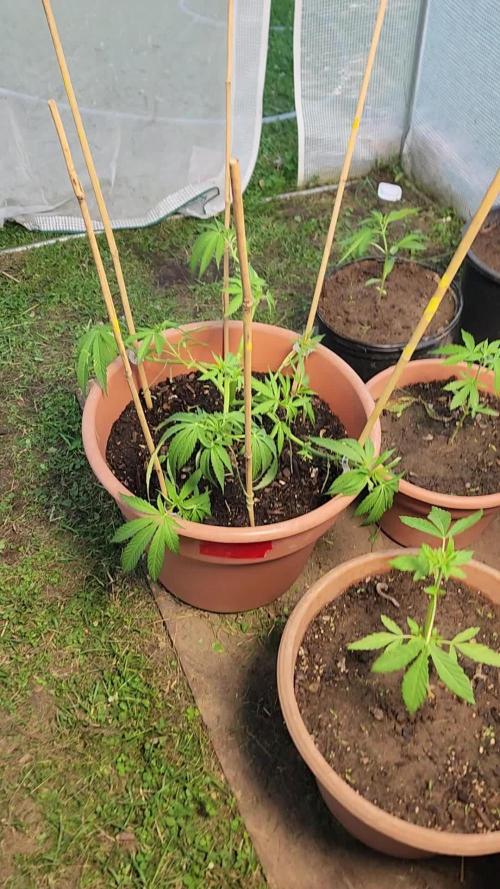
Plants doing really well after topping. The first time i topping the plant didnt get stress out. Im going to top one more time this week. Hopefully it doesn't get shocked or stressed out this time. took the bottom two stims of and clone them. Might take a couple more clones and then letting it go. Plants over a foot tall now and about a little over a foot wide. Getting about 3 to 4 cups of water per day depending on the soil. Around 15 to 16 hr of sunlight. has a nice strong smell to it now and getting stronger.
Likes
3
Share

@MyLittleGarden
Follow
Blütewoche 9 – Ernte in Sicht?
Zeitraum: 17. Juli bis 24. Juli
Blütetag: 56 bis 63
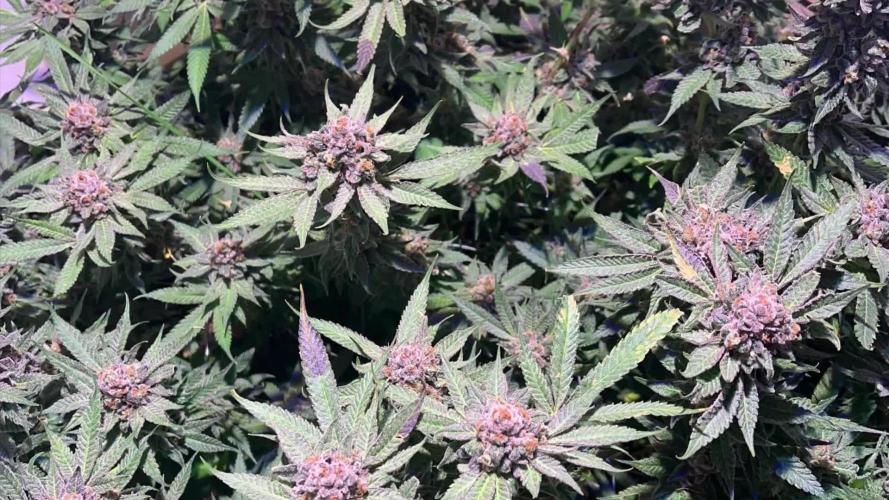
So langsam geht's wirklich dem Ende entgegen, die neunte Blütewoche ist rum, und die Lady sieht einfach nur fantastisch aus! Die Buds sind richtig schön ausgereift, dick, harzig und verströmen einen herrlich fruchtig-süßen Duft. Es kribbelt schon in den Fingern – ich denke, bald ist es soweit.
Ich hab mir diese Woche regelmäßig die Trichome unter die Lupe genommen. Einige sind noch glasig, viele schon schön milchig, und vereinzelt zeigen sich auch die bernsteinfarbenen. Es sieht also sehr vielversprechend aus, aber ich warte vielleicht noch ein bis zwei Tage, um noch etwas mehr Reife rauszuholen. Heute checke ich sie nochmal gründlich und entscheide dann, ob geerntet wird oder ob ich ihr noch ein kleines bisschen Zeit gebe.
Was ich in der letzten Woche gemacht habe. Ich habe den Lichtzyklus nochmal angepasst. Vom 18. bis zum 21. Juli lief sie unter 11/13, danach hab ich auf 10/14 runtergeschaltet. Damit wollte ich ihr ganz klar signalisieren: „Es ist Zeit, fertig zu werden.“ Zusätzlich habe ich die Lampe nochmal um 10 cm höher gehängt, um die Lichtintensität etwas zu reduzieren und den Stress zum Ende hin minimal zu halten.
Gegossen habe ich übrigens nicht mehr. Man merkt deutlich, dass sie in der Endphase nicht mehr so viel Durst hat – das Substrat bleibt deutlich länger feucht.
Etwas Sorge hat mir die Luftfeuchtigkeit gemacht. Die war wetterbedingt ein wenig erhöht, lag aber mit 56–66 % noch im vertretbaren Bereich. Die Temperaturen waren nachts bei 22–25 °C, tagsüber bei 28–30 °C, also alles im grünen Bereich. Bisher sieht alles gut aus, keine Spur von Schimmel. Die Pflanze kommt mit den Bedingungen gut klar.
Jetzt steht also die finale Phase an. Die Ernte und das Trocknen. Auch das wird nochmal spannend, aber wenn das Wetter halbwegs stabil bleibt, sollte es gute Bedingungen dafür geben.
Das nächste Update kommt dann nach der Ernte, wenn die Buds getrocknet sind und ich ein erstes Fazit ziehen kann. Ich freu mich drauf!

Likes
5
Share


@CanarianGrow92
Follow
Reviewing the plants i noted some small dots on the leaves which looked like typical bites from mites, so i sprayed some spidermite and we placed around 6 spical ulti-mite bags to prevent any further damage, lets hope it dont get worse but i think I've detected them just on time 😁
For the rest the plants are looking good, the buds are getting bigger and more thc is being produced 😁 we still have around 4 weeks to go 😅

Likes
38
Share

@Natrona
Follow
White Widow X Crystal Meth - SeedSupreme Outside Grow 2026
6/28-7/4 W9 F5
Hello Friends,
We have had several thunderstorms this week due to the heat. We are under a heat advisory with temperatures reaching 100 with a heat index to 110 most of the week.
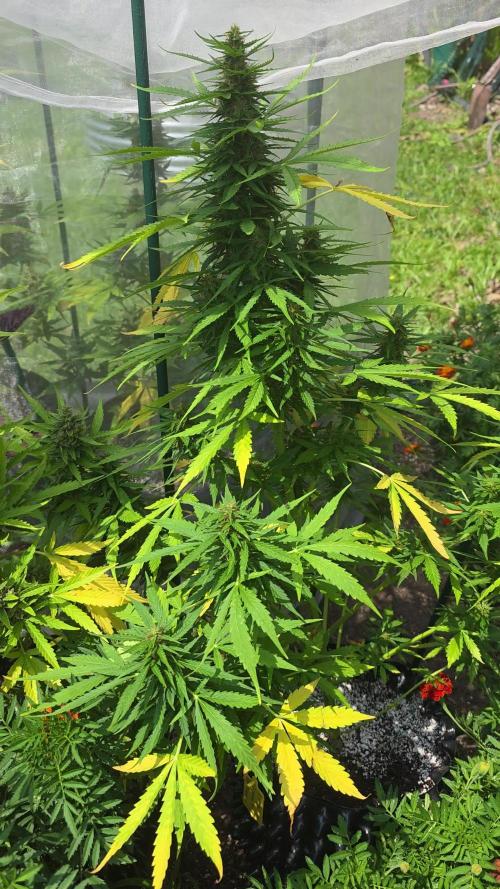
I had a scare this week when I looked out the window. She was extremely droopy. The other 3 outside plants were upright and other than a few yellowing leaves, fine. I determined that her big leaves acted like an umbrella and deflected the rain around the pot rather than into it. The Seed Supreme indicated that the plant is bushy and may benefit from the occasional prune to ensure good air circulation. I defoliated all the yellow wilted large fan leaves and probably should have defoliated earlier than now. Further inspection found a limb broken by the torrential rain which I mended with electrical tape. I hope it heals together since it was only holding on by a thread. Since she is using up the nutrients in Grow Dots I top dressed with azomite and rose and flower fertilizer and watered well.
The pistils are all turning brown and the trichomes are just starting to form. So far, no pests (using mesh bag) and no mold issues. WWxCM has slowed her growth at 32 inches tall. Next week the weather looks the same. Hot and humid.
That’s all for this week.
Remember to check out SeedSupreme current sales.
Use my code Natrona20 for a discount on seeds.
https://www.seedsupreme.com/?a_aid=Natrona
July is a big sale month so check it out:
• Jul 1–7: Freedom BOGO | BOGO All Seeds Sitewide + free seeds on every order +
• Jul 8–10: 710 THCa Flash | 25% off All THCa Flower & Concentrates (3-day window)
• Jul 15–21: Mix Pack Madness | 30% off All Mix Packs + BOGO All Autos
• Jul 22–28: Strain Spotlight | 50% off 1 featured strain (limited stock, first come first served)
Stay green, growers love 💚🌿
💫Natrona💫
Likes
Comments
Share


@BalconyBoy
Follow
07.07.25 The Auto Amnesia ist taking up shape nicely. Some yellowing leafes but not many, no pests taking a hold so far on this strain, few thrips bites only.
The Lemon Kix has some leafes with powdery mildew which I'll keep watching and spraying with H2O2 solution every now and then. Maybe 4 weeks left for this one.
The cream cookies I replaced in a mini pot is about 10-14 days from finishing. Half of the trichomes appear cloudy but very few amber still. Sadly this one's has quite some pests for its size, which means it will end up in the rosin press if the ladybugs don't clean it up before harvest.

Likes
7
Share


@hitzaza
Follow
In this week Ive been on vacation so I have just few photos. But when I came home the smell is incredibly strong.
Likes
2
Share


@xTaps
Follow
Gave just some water, no nutrients. Dimmed the light down to 65%, I think the green gelato got some light stress.

Likes
22
Share


@Luv2Grow
Follow
Day 43 - First day of week 7 today and she looks really good just not sure if she’s really starting to flower yet. I’m hoping this is just typical of the GC strain.
Day 44 - No major changes, she’s growing and I’m loving the looks of her. Will continue uploading daily pictures.
Day 45 - She’s looking really good and budding more and more each day. Gave her straight pH’d water today and tomorrow and will give her another feeding on Saturday. She’s drinking almost a gallon of water a day.
Day 46 - Things are looking good with this girl. Bud sites are growing daily and this thing is a beauty. Gave her another feeding of just pH’d water and will “feed” her tomorrow.
Day 47 - ALL is looking good and she’s looking purdy. Gave her a feeding with the foxfarm nutes today. Did a true measurement to the biggest branch and she’s at 25.5”. Will continue to measure each day to see how much she’s growing in a 24 hour period.
Day 48 - Looking gorgeous and still stretching. Grew another two inches and is sitting at 27.5” right now. She’s really starting to fill in now and looking forward to the next few weeks.
Day 49 - The way thing thing is growing, she’s gonna be a beast. Gave her straight pH’d water tonight and will give her a feeding tomorrow. Looks like she finally stopped stretching, sitting at 27.5” still so hopefully she’ll start putting on the weight.
Likes
57
Share


@SmokieMcPot
Follow
what do they say about different strains on the same RES, in the same pot??? welp, here goes nothing...
Last time I saw this waterfarm I was still a teenager. Ran it in a closet with two 4ft flouro shop lights either side going vertically upward like the letter "A". Had two BIG ASS plants roughly 4ft tall in it side by side going STRONG! Healthy asf, huge ass healthy leaves, some 13 fingered. Flipped em and turned out BOTH were male... Been toying with the idea of doing it again... So what the hell... Here goes, 2 Girls 1 Cup or "pot"... One Herbies Godzilla Cookies Auto and one Fastbuds Wedding Glue Auto.
Current setup:
-36x36x60 tent
-"1000w" led light (130w from the wall)
-4in extraction fan/scrubber
-20+ yr old GHE Waterfarm fitted with ice probe w/ controller and PLENTY of insulation around RES.
-Multiple circulation fans
-Taotronics humidifier
Stay tuned to watch me fuck this up too 🤣
*Sow'd em both in organic peat pellets after a 24hr soak. Getting them acclimated to their new home early. Doing environment tests and dialing it in with the new to me ice probe, and the change to hydro versus soil plants that were in there. Will be more moisture in the air until a canopy covers my balls with the evaporation from the light.
**lookey lookey, BOTH have come to life and are making way to the surface. Not long and they'll be in their new "cup". Last update on germination week as once they pop we start counting I suppose.
Processing
Likes
4
Share


@Big0zGrower420
Follow
Day 49!
Starting to give her just plain water for 2 weeks of flushing. Getting really excited to harvest and then get going on another grow.
See you next week.

Likes
19
Share


@BB_UK
Follow
These 2 are doing amazingly! The synthetic one is close behind as she’s 3 days younger! But the Zamnesia nutrient one is showing so Much vigor! These are going to veg for a while until my others are done and then I’ll switch over into the flower tent when my others are done!

Likes
39
Share


@GrowWiththeBro
Follow
Starting the week with a feed. Not much to comment on.
Fed at the end of the week. Just TPS and Bloom.


