
Likes
75
Share
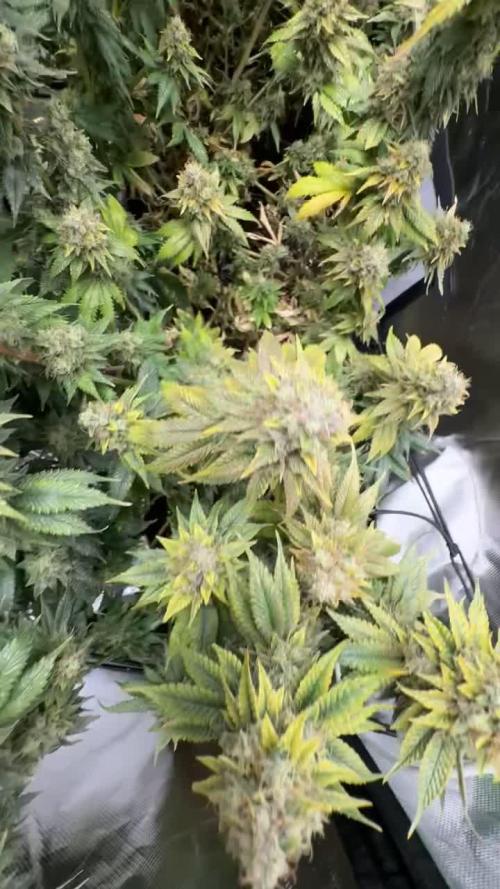
Это всегда было приключением. Этот сорт выращивался и в ауте и помещениях, но никогда он не был таким маленьким, как в этом случае) Очень интересное путешествие, но и очень быстрое. Я не прилагал усилий, растение само росло, справлялось с высокой температурой и стабильно росло. Хорошие показатели в скорости цветения! Даже в партизанском выращивании, ей понадобится не больше месяца для наращивания своих цветов и ещё один месяц для их доращивания и созревания. Этот сорт быстр и неприхотлив. Могу рекомендовать его новичкам, желающим получить свой первый опыт выращивания на открытом воздухе.
Likes
101
Share
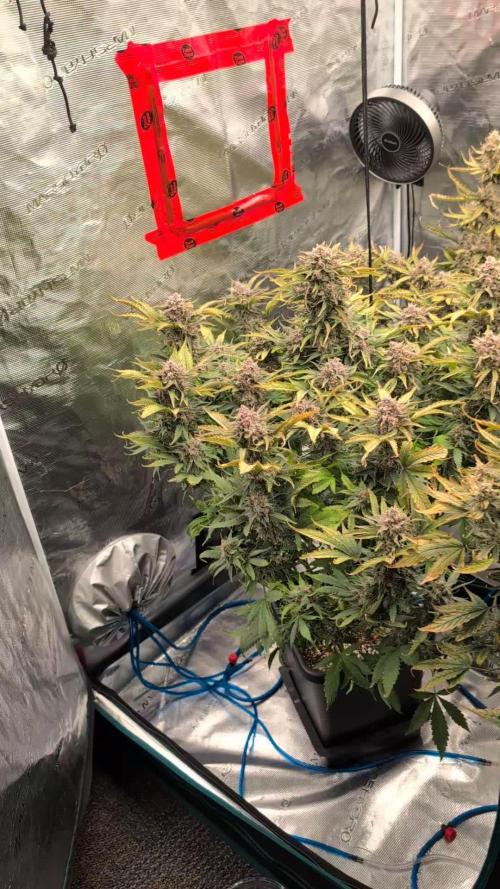
March, 20th If i open the Floweringtent, it smells like Hops, Iam not sure wich Plant it is Thr purple Queen has asoft smell delicious Flowers are stacking and The Girls look happy and green The branches are filled with Flowers... wonderful one one Plant in the Tent i discovered Spidermites,,,,,,,,,aaargh I ordered predators But the purple Queens are clean no insects on them. As i discoverd very early,,, iamsure i can fight the Pest in the tent
Likes
3
Share
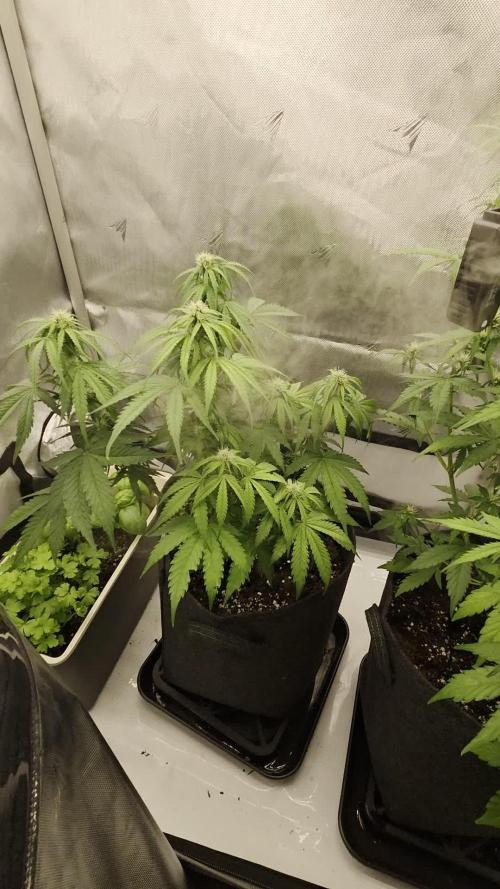
привет садоводы растение после пересадки чувствует себя хорошо расправилось и стало побольше скоро перевожу на цветение
Likes
4
Share
Welcome to Veg Week 4 of Divine Seeds Auto Black Op1um I'm excited to share my grow journey with you all as part of the Divine Seeds Autoflowering Competition 2025. It's going to be an incredible ride, full of learning, growing, and connecting with fellow growers from all around the world! For this competition, I’ve chosen the Feminized Automatic strain: Black Op1um Here’s what I’m working with: • 🌱 Tent: 120x60x80 • 🧑‍🌾 Breeder Company: Divine Seeds • 💧 Humidity Range: 50 • ⏳ Flowering Time: 8W-10W • Strain Info: 21-23%THC • 🌡️ Temperature: 26 • 🍵 Pot Size: 0.5l • Nutrient Brand: Narcos • ⚡ Lights : 200W x 2 A huge thank you to Divine Seeds for allowing me to be a part of this amazing competition and Sponsoring the Strains. Big thanks for supporting the grower community worldwide! Your genetics and passion speak for themselves! I would truly appreciate every bit of feedback, help, questions, or discussions – and of course, your likes and interactions mean the world to me as I try to stand out in this exciting competition! Let’s grow together – and don’t forget to stop by again to see the latest updates! Happy growing! Stay lifted and stay curious! Peace & Buds!
Likes
2
Share
@Yeyup
Follow
These videos where took just before I harvested on the 14th of June making it around 11 weeks 5 days ish seed to harvest.
Likes
132
Share
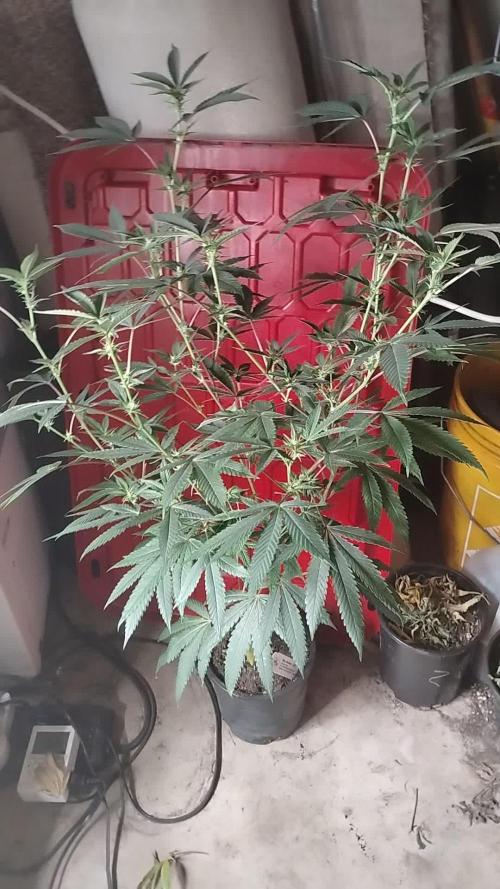
She is growing beast mode I'm proud of her.. I was able to top al outside branches today again , basically the ones who were sticking out the most.. Still only water for now💦💦
Processing
Likes
6
Share
Likes
56
Share
What's in the soil? What's not in the soil would be an easier question to answer. 16-18 DLI @ the minute. +++ as she grows. Probably not recommended, but to get to where it needs to be, I need to start now. Vegetative @1400ppm 0.8–1.2 kPa 80–86°F (26.7–30°C) 65–75%, LST Day 10, Fim'd Day 11 CEC (Cation Exchange Capacity): This is a measure of a soil's ability to hold and exchange positively charged nutrients, like calcium, magnesium, and potassium. Soils with high CEC (more clay and organic matter) have more negative charges that attract and hold these essential nutrients, preventing them from leaching away. Biochar is highly efficient at increasing cation exchange capacity (CEC) compared to many other amendments. Biochar's high CEC potential stems from its negatively charged functional groups, and studies show it can increase CEC by over 90%. Amendments like compost also increase CEC but are often more prone to rapid biodegradation, which can make biochar's effect more long-lasting. biochar acts as a long-lasting Cation Exchange Capacity (CEC) enhancer because its porous, carbon-rich structure provides sites for nutrients to bind to, effectively improving nutrient retention in soil without relying on the short-term benefits of fresh organic matter like compost or manure. Biochar's stability means these benefits last much longer than those from traditional organic amendments, making it a sustainable way to improve soil fertility, water retention, and structure over time. Needs to be charged first, similar to Coco, or it will immobilize cations, but at a much higher ratio. a high cation exchange capacity (CEC) results in a high buffer protection, meaning the soil can better resist changes in pH and nutrient availability. This is because a high CEC soil has more negatively charged sites to hold onto essential positively charged nutrients, like calcium and magnesium, and to buffer against acid ions, such as hydrogen. EC (Electrical Conductivity): This measures the amount of soluble salts in the soil. High EC levels indicate a high concentration of dissolved salts and can be a sign of potential salinity issues that can harm plants. The stored cations associated with a medium's cation exchange capacity (CEC) do not directly contribute to a real-time electrical conductivity (EC) reading. A real-time EC measurement reflects only the concentration of free, dissolved salt ions in the water solution within the medium. 98% of a plants nutrients comes directly from the water solution. 2% come directly from soil particles. CEC is a mediums storage capacity for cations. These stored cations do not contribute to a mediums EC directly. Electrical Conductivity (EC) does not measure salt ions adsorbed (stored) onto a Cation Exchange Capacity (CEC) site, as EC measures the conductivity of ions in solution within a soil or water sample, not those held on soil particles. A medium releases stored cations to water by ion exchange, where a new, more desirable ion from the water solution temporarily displaces the stored cation from the medium's surface, a process also seen in plants absorbing nutrients via mass flow. For example, in water softeners, sodium ions are released from resin beads to bond with the medium's surface, displacing calcium and magnesium ions which then enter the water. This same principle applies when plants take up nutrients from the soil solution: the cations are released from the soil particles into the water in response to a concentration equilibrium, and then moved to the root surface via mass flow. An example of ion exchange within the context of Cation Exchange Capacity (CEC) is a soil particle with a negative charge attracting and holding positively charged nutrient ions, like potassium (K+) or calcium (Ca2+), and then exchanging them for other positive ions present in the soil solution. For instance, a negatively charged clay particle in soil can hold a K+ ion and later release it to a plant's roots when a different cation, such as calcium (Ca2+), is abundant and replaces the potassium. This process of holding and swapping positively charged ions is fundamental to soil fertility, as it provides plants with essential nutrients. Negative charges on soil particles: Soil particles, particularly clay and organic matter, have negatively charged surfaces due to their chemical structure. Attraction of cations: These negative charges attract and hold positively charged ions, or cations, such as: Potassium (K+) Calcium (Ca2+) Magnesium (Mg2+) Sodium (Na+) Ammonium (NH4+) Plant roots excrete hydrogen ions (H+) through the action of proton pumps embedded in the root cell membranes, which use ATP (energy) to actively transport H+ ions from inside the root cell into the surrounding soil. This process lowers the pH of the soil, which helps to make certain mineral nutrients, such as iron, more available for uptake by the plant. Mechanism of H+ Excretion Proton Pumps: Root cells contain specialized proteins called proton pumps (H+-ATPases) in their cell membranes. Active Transport: These proton pumps use energy from ATP to actively move H+ ions from the cytoplasm of the root cell into the soil, against their concentration gradient. Role in pH Regulation: This active excretion of H+ is a major way plants regulate their internal cytoplasmic pH. Nutrient Availability: The resulting decrease in soil pH makes certain essential mineral nutrients, like iron, more soluble and available for the root cells to absorb. Ion Exchange: The H+ ions also displace positively charged mineral cations from the soil particles, making them available for uptake. Iron Uptake: In response to iron deficiency stress, plants enhance H+ excretion and reductant release to lower the pH and convert Fe3+ to the more available form Fe2+. The altered pH can influence the activity and composition of beneficial microbes in the soil. The H+ gradient created by the proton pumps can also be used for other vital cell functions, such as ATP synthesis and the transport of other solutes. The hydrogen ions (H+) excreted during photosynthesis come from the splitting of water molecules. This splitting, called photolysis, occurs in Photosystem II to replace the electrons used in the light-dependent reactions. The released hydrogen ions are then pumped into the thylakoid lumen, creating a proton gradient that drives ATP synthesis. Plants release hydrogen ions (H+) from their roots into the soil, a process that occurs in conjunction with nutrient uptake and photosynthesis. These H+ ions compete with mineral cations for the negatively charged sites on soil particles, a phenomenon known as cation exchange. By displacing beneficial mineral cations, the excreted H+ ions make these nutrients available for the plant to absorb, which can also lower the soil pH and indirectly affect its Cation Exchange Capacity (CEC) by altering the pool of exchangeable cations in the soil solution. Plants use proton (H+) exudation, driven by the H+-ATPase enzyme, to release H+ ions into the soil, creating a more acidic rhizosphere, which enhances nutrient availability and influences nutrient cycling processes. This acidification mobilizes insoluble nutrients like iron (Fe) by breaking them down, while also facilitating the activity of beneficial microbes involved in the nutrient cycle. Therefore, H+ exudation is a critical plant strategy for nutrient acquisition and management, allowing plants to improve their access to essential elements from the soil. A lack of water splitting during photosynthesis can affect iron uptake because the resulting energy imbalance disrupts the plant's ability to produce ATP and NADPH, which are crucial for overall photosynthetic energy conversion and can trigger a deficiency in iron homeostasis pathways. While photosynthesis uses hydrogen ions produced from water splitting for the Calvin cycle, not to create a hydrogen gas deficiency, the overall process is sensitive to nutrient availability, and iron is essential for chloroplast function. In photosynthesis, water is split to provide electrons to replace those lost in Photosystem II, which is triggered by light absorption. These electrons then travel along a transport chain to generate ATP (energy currency) and NADPH (reducing power). Carbon Fixation: The generated ATP and NADPH are then used to convert carbon dioxide into carbohydrates in the Calvin cycle. Impaired water splitting (via water in or out) breaks the chain reaction of photosynthesis. This leads to an imbalance in ATP and NADPH levels, which disrupts the Calvin cycle and overall energy production in the plant. Plants require a sufficient supply of essential mineral elements like iron for photosynthesis. Iron is vital for chlorophyll formation and plays a crucial role in electron transport within the chloroplasts. The complex relationship between nutrient status and photosynthesis is evident when iron deficiency can be reverted by depleting other micronutrients like manganese. This highlights how nutrient homeostasis influences photosynthetic function. A lack of adequate energy and reducing power from photosynthesis, which is directly linked to water splitting, can trigger complex adaptive responses in the plant's iron uptake and distribution systems. Plants possess receptors called transceptors that can directly detect specific nutrient concentrations in the soil or within the plant's tissues. These receptors trigger signaling pathways, sometimes involving calcium influx or changes in protein complex activity, that then influence nutrient uptake by the roots. Plants use this information to make long-term adjustments, such as Increasing root biomass to explore more soil for nutrients. Modifying metabolic pathways to make better use of available resources. Adjusting the rate of nutrient transport into the roots. That's why I keep a high EC. Abundance resonates Abundance.
Likes
13
Share
*english version below* HydroLab – Woche „0“: Der Startschuss zur Blütephase „Bitte anschnallen – die Versuchspflanzen betreten jetzt die reproduktive Phase.“ Willkommen zurück im HydroLab, wo Photosynthese auf Wissenschaft trifft und die Pflanzen mittlerweile besser trainiert sind als mein Rücken. Diese Woche war ein echter System-Meilenstein: Letzte Vegi-Woche, Lichtwechsel, Wasserrevolution, Myko-Spa und Stretchvorbereitungen. 🌞 Licht: Die Blaulichter gehen, die Rotlicht-Ära beginnt Seit Donnerstag herrscht im Zelt 12/12 – offiziell Blütezeit. Die blauen Add-Lites wurden verfahrenstechnisch termininiert und durch rote ersetzt. Die neuen IR-AddLites haben außerdem eine Schlüsselfunktion: Sie laufen in den letzten 15 Minuten wie ein botanisches Sonnenuntergangs-Erlebnis für fortgeschrittene Pflanzenpsychologie. Kurz gesagt: 👉 Die Mädels werden jetzt schlafen geschickt wie Royalität. 💧 Wasserchemie: Die Vollentsalzungsanlage ist online Mission abgeschlossen: Die VE-Anlage wurde installiert, kalibriert und erfolgreich mit Triumphmusik eingeschaltet. Seitdem fließt durch das System: ➡️ EC-neutrales Laborwasser ➡️ pH-Perfect arbeitet wie befreit ➡️ Keine Ca/Mg-Überschüsse, keine Schwankungen Das HydroLab ist nun offiziell ISO-zertifiziert für Wasserreinheit, die selbst Kaffee-Nerds neidisch machen würde. Nährstoffversorgung aufgestockt – die Blüte beginnt ernst zu werden Der EC wurde moderat auf 1,5 angehoben, passend zum Stretch-Start. Zusätzlich zu Micro/Grow/Bloom, B52, Bud Candy und Great White gab es diese Woche:🔥 Bud Blood von Advanced Nutrients Ein kaliumreicher Booster, der laut Hersteller „die Blüte früh zündet“. Im Labor beschreiben wir es anders: 👉 „Molekulare Überzeugungsarbeit, damit die Pflanzen endlich tun, was wir wollen.“ Und es funktioniert. Die ersten Vorblüten sind bereits in der Planungsschleife. 🌱 Wurzelstatus – Mykos am Werk Die Wurzeln sehen aus wie: wuschelig cremig üppig voller Mykorrhiza Ein gesundes Myko-Netz ist immer ein gutes Zeichen – gerade beim Living-RDWC, wo die symbiotischen Organismen jetzt richtig Gas geben. 🕸️ Training: Zweites Netz installiert Das zweite Scrog-Netz wurde feierlich eingezogen. Da wir es hier mit einem fast rein sativischen Stretch-Monster zu tun haben, wird das Netz bald nicht nur genutzt, sondern ausgereizt. Die Spitzen schießen bereits motiviert durch das Gitter. Man könnte sagen: 👉 „Das botanische Volleyballfeld ist eröffnet.“ 🎬 Fazit der Woche Vegi erfolgreich beendet Blüte eingeleitet Licht optimiert Wasser perfektioniert Nährstoffe erweitert Wurzeln traumhaft Stretch: „Hold my beer…“ Das HydroLab ist startklar für eine der spannendsten Phasen überhaupt. Wenn diese SLH so weiter macht, wird das Netz in wenigen Tagen aussehen wie ein explodierter Kräuterteppich. ----------------------------------------------- HydroLab – Week 0: Initiating Bloom Protocol “Please fasten your lab coats — the test subjects have entered reproductive mode.” Welcome back to the HydroLab, where plants are trained with more precision than Olympic athletes and the line between botany and madness gets thinner by the day. This week marks a major milestone: the final veg week, the light flip, a water revolution, microbial spa treatments, and preparations for the incoming stretch. 🌞 Lighting Update: Goodbye Blue, Hello Bloom Mode As of Thursday, the system is officially running 12/12 — bloom phase initiated. The blue add-on lights have been politely removed from service, replaced with red spectrum units. Also new: IR AddLites, running during the final 15 minutes of the day to simulate a luxurious sunset for plants that take their circadian rhythm very seriously. In short: 👉 The ladies are now being tucked in like royalty. 💧 Water Chemistry Upgrade: The Deionization Unit Is Online This week, the HydroLab achieved a new level of hydration enlightenment: The deionized water system is fully installed and operational. It now feeds the entire RDWC with: EC-neutral lab-grade water perfectly predictable pH behavior zero unwanted minerals zero drift chaos The HydroLab is now officially certified for water purity that would make a barista weep. Nutrient Program Enhanced — Bloom Mode Engaged The EC was raised moderately to 1.5, just enough to fuel the stretch without cooking the roots. On top of the standard AN trio (Micro / Grow / Bloom) plus B52, Bud Candy, and Great White, the lineup now includes: 🔥 Advanced Nutrients – Bud Blood A bloom initiator designed to say: “Stop messing around and start flowering.” Laboratory interpretation: 👉 “Early-phase hormonal persuasion via potassium-rich diplomacy.” Early pistils are already in preflight mode. 🌱 Root Status Report – Mykos Doing Myko Things The roots look glorious: fluffy creamy vigorous thoroughly colonized by mycorrhiza Living RDWC in full effect — the symbiotic crew is thriving. 🕸️ Training Update: Second Scrog Net Installed The second screen is now in place. Given how sativa-dominant this strain is, the stretch is expected to fill the remaining space very quickly. The tops are already pushing upward with purpose. It looks less like a canopy and more like we’re preparing a botanical trampoline. 🎬 Weekly Conclusion Veg phase complete Bloom officially initiated Lighting optimized Water chemistry perfected Nutrients upgraded Roots looking elite Stretch incoming The HydroLab is entering one of the most exciting phases of the run. If this Super Lemon Haze keeps going like this, the scrog will look like an exploding herbal carpet within days.
Likes
Comments
Share
Likes
89
Share
Hello friends! Our Poisonous friend moved to live, in more polka dots!) 5 liters .. I hope she will start to grow actively! and will be ready for the next transplant into a 40 liter pot in a couple of weeks .. as I said earlier .. I have big and interesting plans for this girl .. so don't miss the new diary ..
Likes
10
Share
Hey everyone Slow and steady, she is getting a little thicker but not sure overall what she is going to produce. I’m just happy she grew and has been healthy besides the stress in the beginning.
Likes
8
Share
Flowering week 5 ---> Indoor plant: This week flowers become huge and bigger with a very strong smell.💪 I wait more long possible during this flowering beacuse the lower flowers are very fluffy and I want to harvest great buds as much as possible . I watering the plant with 4lt of water (pH 6.5) and half tab of EASY BLOOM BOOSTER TABLET from Royal Queen Seeds every four days I removed the yellowing leaves. Temperature grow box---> 22-26 °C Umidity grow box ---> 45 - 55 % Outdoor plants: They making many strong smell flowers. The calyx are big but they not form a big cola. My idea for this plants is to harvest them when the indoor plant is ready. I want to use them with the trimmg of the indoor plant too make some good hash.😋 I watering the ladies every time they dry out with 2 lt of 6.5 pH water and 5ml/L Atami 1 Component for each plant(two time this week). I will stop using fertilizers when there is one week left before harvest.
Likes
84
Share
@Natrona
Follow
Divine Seeds Auto Contest Candy Outside Grow 👉Sponsored Grow👈 W11F7 8/10-16 This week’s weather has been a mix of rain, clouds and thunderstorms. Temperatures were mostly in the mid to upper 80s during the day and low 70s at night. I watered 2 times with compost tea adding green sensation on the last watering. Information from Divine Seeds indicates that Auto Candy grown outside can reach 120 cm. that is 47 inches. My candy is 41 and falls within the range. My auto cady is a tall lanky girl. She has one main stalk and 4 short branches. The bud structure sits close to the stalk and small clusters of calyxes and smells sweet and syrupy and already sticky. Auto Candy is fattening up her buds. The structure shows minimal hairs and sugar leaves and mostly calyxes. I check all my outside plants daily in the morning. If it rained that night, I give each stem a good shake to help dry them out. So far so good, no mold or other fungus or bug issues. The pics show the trichomes starting to fill out even without a magnifier. I am getting excited to see the full development of buds, colors and smells. Let’s go! Thank you all for your continued support and encouragement. Your likes and comments motivate me to keep sharing my journey. Let’s continue to learn to grow together! Stay green, growers love 💚🌿, 💫Natrona💫
Likes
11
Share
@TgOgFaRms
Follow
I'm excited to report that the flowering phase has officially begun, with only T-55 days/60 days left to go! 🌸🌿 Currently, my lights are set to 50% intensity, but I plan to gradually increase them to 75% over the next few days. 💡✨ I'm happy to say that everything is looking great in the grow room, as I've managed to dial in all the necessary parameters. I will continue to tuck the tops for the next two weeks to ensure optimal growth and yield. 🌱👌 As for my latest consideration, I'm thinking about purchasing exhale CO2 bags. I've never used CO2 before, but I'm eager to give them a try and see how they affect my ladies. 🛍️🌿💨 Stay tuned for more updates as my grow progresses, and feel free to share any tips or suggestions in the comments below! 😎📝💚 Best regards, Day 6 of Flower: Unexpected Setback 😔🌸 Today, I received some unfortunate news that has left me feeling quite disheartened. One of my fellow growers, who is cultivating the same strains from the same pack as I am, encountered a distressing situation. One of his Queens unexpectedly hermaphrodited during week 3 of flowering. This revelation has placed me in a difficult predicament, causing me to question whether I should continue with the identical strains or abandon them altogether. 🚫⚡️🤔 Currently, there are four of us involved in this collective venture. Two of us, including myself, are in the initial week of flower, while the remaining two are at week 3 and 4 respectively. Fortunately, the last individual seems to be progressing smoothly with their plants, as everything appears to be thriving in their garden. 🌿👥💚🌱 Let's see how this situation unfolds and continue supporting one another through the challenges of our growing journey. Stay tuned for more updates! 🌸🌿🌱 Best regards,
Processing
Likes
16
Share
@osmrducks
Follow
Day 29: The girls are looking great. I upped the nutes yesterday, as I have been giving them barely any at all. Will up them once again on next feeding. Looking like tomorrow. The main branch that I snapped off did not make it. Lesson learned on that one. Day 30: Removed all other lights and added the HLG 550 V2 RSpec. Did some defoliation on the girls along with another feeding. Will do straight PH'd water next go. The girls are looking strong and healthy. 💪 Just on the small side. Still having to leave the tent wide open to subside temps and humidity. Day 31: Nothing new to report. Looking very short and stubby and healthy!! Day 32: Looking like they had some good stretching going on over the 3-day weekend. Will be needing fed tomorrow after work. May water a little less this time, as it is taking 2-3 days for them to dry out. Day 33: Great stretch and bloom on the girls today! They are looking super healthy and strong! 💪 No smell yet. Day 34: Girls are looking decent. Noticed some rusty looking splotches on the leaves. I'm thinking possibly Cal-Mag deficiency? Not sure. Day 35: Not looking too happy today. I let them dry completely and watered with only Cal-Mag. Hoping the patchiness clears up for them!
Likes
29
Share
@Chubbs
Follow
What up family. These girls are super close with some being done and will get pulled out to get harvested in the next day or so. I flowers are super dense covered in trichs. The smell is pungent & sweet. Over all a fast strain to grow producing beautiful flowers.
Likes
13
Share
@NSABND
Follow
Let´s start Day 43 😎 some sun and cloudy with rain again 😳 Day44 cloudy and rain and cold 😡 Day45 rain and cloudy 😡 temp 16C/60F .. WTF it´s summer 😡😖😱 Day46 no rain litle bit sun and cloudy 22C/71F still not a real summer 😩 Day47 starts with rain and cloudy weather 😩 then came the sun finally 👌 Day48 the summer comes back again.... sunny day 🙏👍