Likes
Comments
Share


@Roberts
Follow
Quebec blast is growing good. Still struggling with nitrogen toxicity. I changed solution, and lowered to a 200 ppm. Excellent growth still. I applied lst, and defoliation today. She is growing in New Level Hydro bucket, under the Spider Farmer SE5000. Thank you Spider Farmer, New Level Hydro, and Quebec seeds.🌱🤜🤛🌱
Thank you grow diaries community for the 👇likes👇, follows, comments, and subscriptions on my YouTube channel👇. ❄️🌱🍻 Happy Growing 🌱🌱🌱
https://youtube.com/channel/UCAhN7yRzWLpcaRHhMIQ7X4g
SE5000
https://amzn.to/3qFpAML
Spider Farmer Official Website Links:
US&Worldwide: https://www.spider-farmer.com
UK: https://spiderfarmer.co.uk
CA: https://spiderfarmer.ca
EU: https://spiderfarmer.eu
AU: https://spiderfarmer.com.au
Coupon Code: saveurcash
Www.newlevelhydro.com
Www.hygrozyme.com

Likes
14
Share


@ClydeGrows
Follow
No training yet whatsoever, and probably will not based on how she's growing- very vertically, no wayward side branches or stems. This is my preference for this plant as it has considerably less root growth space and I have no experience with micro grows!
Have watered with pH between 6-7 (7, 6, 6.5 usually- allowing a range over the week). Watered with molasses and epsom one water, then plain, then a light feed with Cronk bloom nutrients (an auto-specific nutrient blend) when it started preflower.
The plant beside it in the tent is exactly the same cultivar (Seedsman Critical +2.0), which was growing identically until about 1.5 weeks ago, when the difference in their environments became clear. Obviously the Monster is less monstrous :P
Thanks for looking and happy growing everyone!

Likes
35
Share


@TickleToast
Follow
One gal hermed :(
Guessing as a result of the crushed tubing a few weeks back + defoliation. However, there has been some other wonkiness this grow such as no auxiliary buds on one, and 15-point leaves on another! So perhaps this is just a weaker strain not suited for training?🤷♂️
Checked all the other plants and no pollen sacks just yet - fingers crossed! (I sprayed down the whole tent with water as a just-in-case measure)
Last big defoliation this grow!
~~~~~~~~~~
Aside from that, everything's looking good. Smaller gals are stretching considerably, two big gals have slowed down to a crawl.
The tall gals are about 12'' from lamp, the others 15" - if things don't slow down I may have to consider some HST (nooooot my preference, all things considered - I'll end up with seeds, guaranteed). Or, if I don't see any significant burn, maybe I let them go and just harvest the top portions early? We'll see!
More and more hairs every day, buds are getting bigger!
~~~~~~~~~~
OK! - Its the strain! Has to be.
Woke up this morning and one of the big gals had fully open pollen-sacks :(((( Picked off every one I could find with tweezers
This gal did not have crushed tubing issues, and everything tracked fine. This leads me to believe that these plants just aren't meant for stress training. This day and age - the breeder will usually give you info on the subject - I can't find this online ANYwhere. I know who the breeder is - (big big name-sticker was on the bag) so this comes as quite a surprise to me...but at the same time - you can't find them on the website. Feels like it was given up on, and I snagged some of them on sale, from a distributor who had some left? Best guess.
(gal starting putting out foxtails a cpl weeks later - 10'' from lamp)
~~~~~~~~~~
Thought maybe the three smaller gals could use a trellis - unfortunately I did not train them well enough - they are a little too cramped/bushy. I will have to use the Bamboo support system from here on and the trellis would clip bud-sights. So worse case, I'll use zip ties / rope to keep them supported. If its anything like my first grow - the mainline/manafold will do most the work anyhow.
Likes
3
Share

@SkullRipper
Follow
Hi legends,
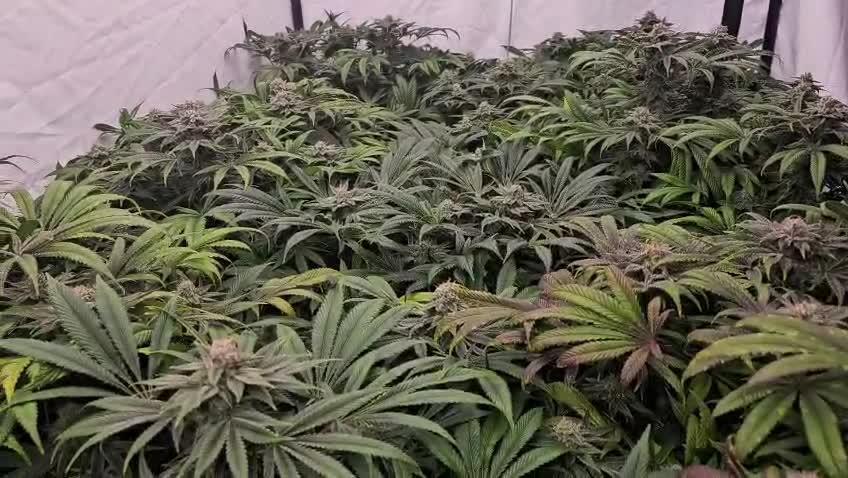
Day 47 of week 7
This week has seen a massive difference, 3 of the plants have started turning purple which I find strange as all the cutting were taken from the same mother plant. we also have a leaf with seed pod the same as Bnc grower, not sure what causes this anyone? but my guess is that she just wants to get germinated any way she can..
Have started to flush with pre RO water at ph 6.3, this is near impossible to ph with a meter at 0 CF, So I have to PH the water with PH 6. 7.6 colour chart.
Also this week the buds are much more resinous and the aromas are fantastic, especially fruity with a very distinct peach smell.
I also noted that IMO many smaller buds have not been receiving enough light and therefore not ripening as well, these will be used for making hash
looking at the trichomes most still clear but on the purple plant they are mostly cloudy.
Ttfn Greenies 😍

Likes
19
Share


@Naturalist
Follow
Fed today, average runoff PPM 3581
Not a lot to report, buds are getting sticky about a month to go...


Likes
11
Share

@trelopoulos
Follow
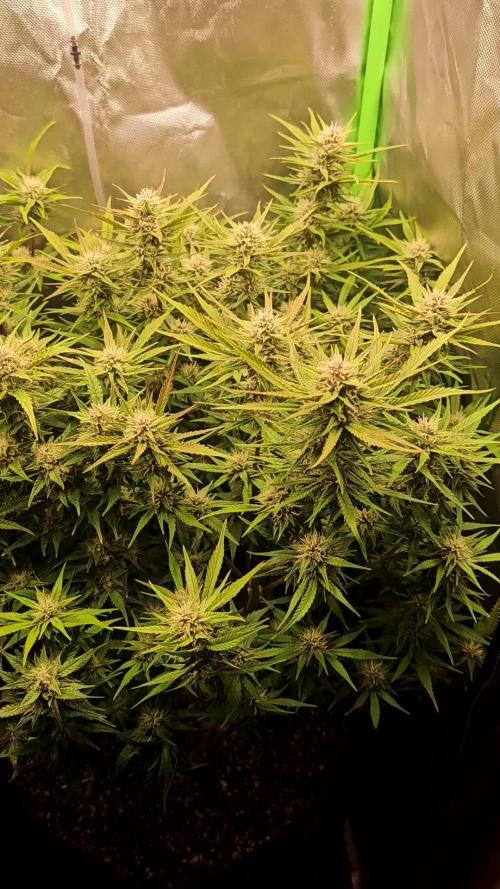
Those yummy buds getting bigger evey day and smell delicious 🤤 cant wait to smoke them🙏😵💫😜

Likes
11
Share

@Chubbs
Follow
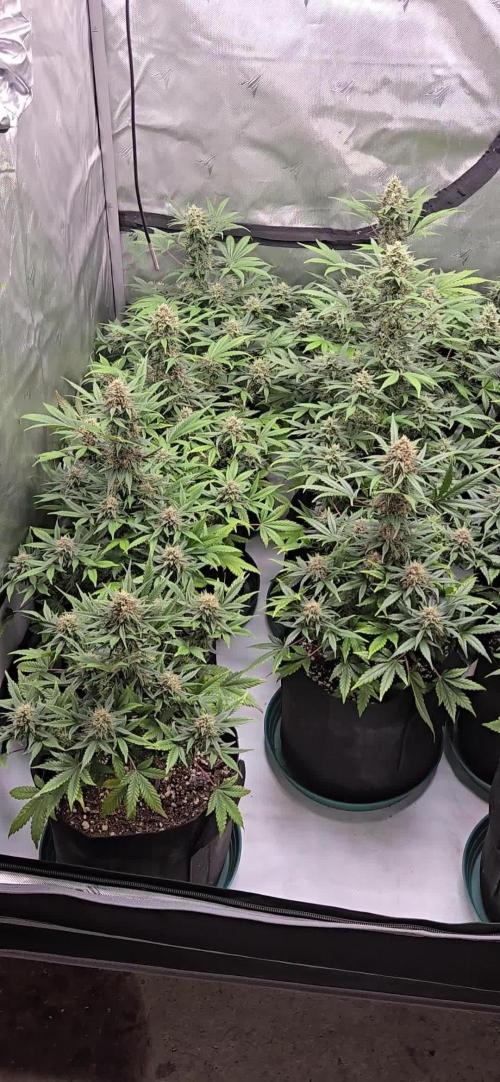
What up Fam, weekly update on these lovely ladies, going into week 9. They've handled this heat wave we're having like the Champs they are, not even skipping a beat Growing. The tent is definitely smelling mesmerizing and the flowers are looking spot on. All in all Happy Growing
Likes
9
Share


@my420experiment
Follow
Realized when I setup the soil that I forgot to give it a good soak and allow to sit for 24 hours.
It's just straight out of the bag and I feel like I'm not watering them enough.

Likes
1
Share

@Growfather1
Follow
Hello everyone,
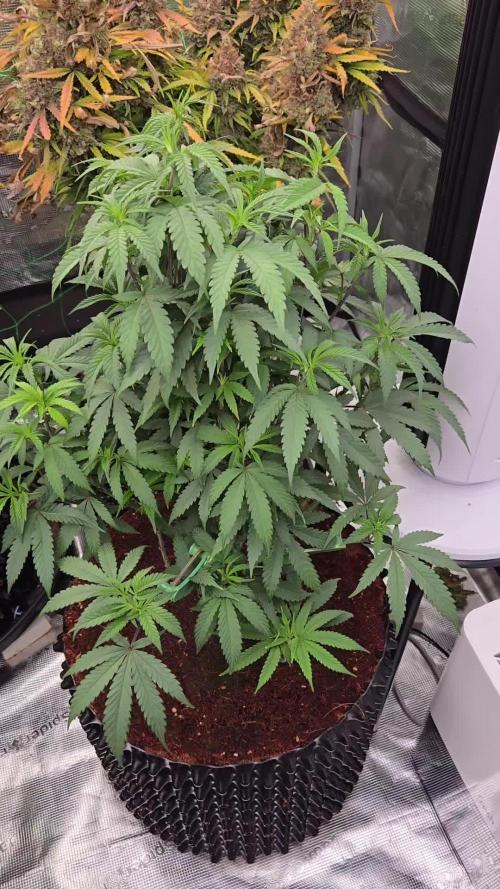
The 3 mac1 f1 hybrids are in good health and will go into flower in week 11 so they have 3 weeks to develop more roots and grow higher.
This week i had no time to trim them and will do that tomorrow.
Thanks for stopping by and have a nice day.
Best regards,
Growfather


Likes
10
Share

@Naturalist
Follow
Defoliated on day 82.
Flowers are starting to get sticky on sugar leaves & the pine smell is picking up but not as strong as expected the Gelato buds are starting to amber up.
Think I'm going to up the Foliage Pro a ml as is see some yellowing since I switched up the ratio.

Likes
7
Share


@StonedandSteady
Follow
9th W/Flower: 9th Feed of #HumboldtCountysOwn Packed, Stacked Up and Lights Upgrading under way! Cloned with my Steady's Saliva!!!
9th w/ Flower: Budz getting Outstandingly Huge, Plump, Dense, Juicy and Everything is Supreme, Savory, Stinky, Sweet, Swelling Out, Skunky and Gasy at thier 9th week of Flower!
9th Week of Flower: 9th Flower Feed of #HumboldtCountysOwn and the Ladies Love the Bloom portion of Nutrients! They're Stacking Up Great and Filling Out thier Mighty Branches with Giant Gorgeous Budz! 5 Confirmed Females!!!
It's been a few days since I gave this Lady her 9th Feed of #HumboldtCountysOwn Nutrients and she looks Fantastically Divine!!! We'll definitely Grow back to everything here soon! 11th w/ Veg and Flowers Update #Pre-Sexed🚺 #SuperCropped #Defoliated #Lollipoped
Good Day and Happy Growing Everyone! These Ladies were Growing into thier 11th Week of Veg and Looking Totally Tight and Phenomenally *Femed* from the Right!
#Pre-Sexed 4/9/21 #Opium/#PabloEscobar *Fems* breed by Team #DivineSeeds #DivineSeedsSquad #DivineSeedsBreedingCompany and #SuperCropping continued! I'm Very Excited and Extremely Gracious!!!
Heck Yeah Growmies and Growmets!!! Check Out these Confirmed Females with thier Wild Pistol Hairs popping and I'm still Training and Widening them Out with #SuperCropping Everything looks Expanded and Growing Great!
After #SuperCropping the plant will Grow Bushier, Produce More Buds, and possibly even Produce More THC! This is how the plant naturally responses to danger and protects itself! Growers take advantage of this technique to get Bigger Yields and More Potent Buds than would be produced otherwise!
Getting Trained out into thier 11th Week of Veg and Looking Mighty Fine!!! Thier getting Humongous and Hearty in thier 10 gallon Grow Bag from Broski #www.as420.ca These Cannabis plants are Camping out in the Closet for a week or so! Lol
This is my 2nd run using the Osree.Light QB1000w and Everything is Mesmerizing!!!
My #Opium and #PabloEscobar *Fems* from #DivineSeeds Regs: SalamiLegF3's×2 and FireAlienRomulan look$ Outstandingly Awesome and Growing Up Phenomenally Fine into thier 11th week of Veg in our 2- 10 gallon The Grow Bags from Broski #www.as420.ca and also 2- 5 gallons as Well! Our others are Super and Breed by #thehumancannabiniod #AlienBloodGenetix #TNBNaturals #Foop
Yo!!! Thanks Again for All the Love and Support my fellow Growmies and Growmets!!! These Magnificent and Magical Ladies were Growing in our 48×24×60 ViparSpectra Official Club 🌿 ®️ Grow Tent and under our #Osree QB1000w and #GrowStarStore Kokokala QB1000w and our Purple Rose Cutting×2, Aloe Vera Cutting, Maters×3, Morel Mushroom, Lavender×3, Sunflowers×5 and The 5 Brand New and Fresh Starts are Wonderful with a Huge Hint of Fantastical Fire is my #SalamiLegF3×2 by Broski #thehumancannabiniod #DankFlowGenetics #EastCoastSeedBank #FireAlienRomulan by Broski #AlienBloodGenetix my #PabloEscobar and #Opium by Team #DivineSeeds #DivineSeedsBreedingCompany We Grow with #Growatt 600w with #FoopOrangicBioSciences and #TNBNaturals The Enhancer Co2 Despersal canister and ph'd them w/ Declorinated watering w/ TNB ph Up and Down! Totally Top Quality Topz all Around! Thanks Again #GallowGlas420 #HarleyGrower #thehumancannabiniod #AlienBloodGenetix #TNBNATURALS #FoopOrangicBioSciences #www.as420.ca #divineseeds #divineseedssquad #divineseedsbreedingcompany #BioFlux Family's and Teams!!! Your Genetics are Merry Magnificent, Mega Marvelous and Mighty Medical! Love um!!! I really Can't stress enough how Thankful and Grateful I am of All of you and what you've Shared with Us! Means the World!!! It's definitely a Pleasure being able to Grow with these Phenomenal Grow Lights! Please Enjoy! BudBrothers4-Life! Cheers Famz!!! Much Props and Much Topz!💯🔥 #Osree #GrowStarStore #Growatt #TNBNaturals #TNBTeam #FoopOrangics #GrowYourOwn #Bliss
HumboldtCounty'sOwn:
Email: info@humboldtbottling.com
Phone: (707) 725-4119
Toll free: (866) 872-9434
Humboldt Bottling
Po Box 429 · Fortuna, CA 95540
HumboldtCounty'sOwn Website Link: https://humboldtcountysown.com/
HumboldtCounty'sOwn Instagram Link: https://instagram.com/humboldtcountysown?igshid=1qj809qkkwych
https://instagram.com/osree.light?igshid=1vrsbdyhzg2h8
https://instagram.com/growstarstore?igshid=2yjn0r00r6ru
https://instagram.com/divine.seeds?igshid=1r90iwe9xiwz8
https://instagram.com/thehumancannabinoid?igshid=17k159pumklkq
https://www.instagram.com/alienblood_genetix_official/
https://instagram.com/as420.ca?igshid=1f116alw054wp
The Grow Bags: https://www.as420

Processing
Likes
10
Share


@CanadianFillmore
Follow
Start of week 5! Plants are doing great! Still some P & K deficiencies showing, but overall the bud development is phenomenal on the blueberries and is coming along nicely on the super lemon haze. I am still feeding an extra 2 liters to the Slh, this time at full dosage of part A & B, this seems to have helped with this past week (4). The blueberry are super sticky and smell amazing!

Likes
152
Share

@Roberts
Follow
Grew great for a bonsai grow. Just harvested today after a flush and 48 hours of darkness. Now to let it dry. Thanks again AMS it made a beautiful bouquet of buds. 🤜🤛🌱🌱🌱
Www.amsterdammarijuanaseeds.com
Thank you grow diaries community for the 👇likes👇, follows, comments, and subscriptions on my YouTube channel👇. ❄️🌱🍻
Happy Growing 🌱🌱🌱
https://youtube.com/channel/UCAhN7yRzWLpcaRHhMIQ7X4g

Likes
22
Share


@Chumpkilla
Follow
*Here is a link to video on the Harvest. https://youtu.be/aZUOrljaioc
9/23/23 - Day 114 - Today was going to be the Chop, but I will wait one more day. I was not able to dedicate the full time I needed to make this happen today, so I decided I would give it one more day.
One thing I am noticing is the color of the leaves. I've always wanted to grow a strain that has purple in it, and it looks like this plant turned super purple. I couldn't tell because of the lights.
9/24/23 - Day 115 - I'm 2hrs away from chopping. With the Leaf box, you have to stay on your timeline, No rushing it, and no waiting. Always right on time. I started the grow at 3 pm 115 days ago so from 3 pm - 3 pm is a full 24/hrs. I'll update after 3 p.m. I already have my tripod, tools, cleaning materials, etc., up and ready. We will drain the water, ill then remove the roots and clean out the tub. Then, I'll start to remove the branches one at a time. Once they are removed, I will then get the hanging supports in place. Then I will hang them upside down and hope there is enough room. :)
I've noticed I have a lot of views on this grow. One thing I feel I should do a better job of (based on all the messages I received) is documenting the process that I follow throughout the grow. So I'll start my next grow in November. I'll document it with better "this is how I do this in Leaf" type details. 2 hours and counting! See you at 3 PM!
9/24/23 - I started at 3 p.m. and finally finished around 9 p.m. Holy shit, am I tired...... I have a lot of pictures and videos to upload. I'll add some photos tonight with some videos to follow tomorrow. I don't know how much I have yet, I need to wait until I can jar them to weigh them. I was able to get all the buds off and hung. With a couple of bags of A/B stock (Snicklefritz) of leftovers that I didn't want to hang. In just the Snicklefritz, I had 219g of wet buds. Ill know the full dry amount in a couple of days.
I was REALLY happy with the amount of buds. There were more than 75 branches of bud to hang/dry. Its the most weed I have grown ever.
Now that the buds are all back in the box. The Leaf box will handle all of the drying process. It will maintain temperature as well as humidity. I now wait and check daily to check for dryness.
Here is a link to video on the Harvest. https://youtu.be/aZUOrljaioc
9/26/23 - The buds are way more dry today. Im getting some really nice citrus smell from them. I think one more day should work before I start putting them in jars. I already trimmed them. Its a prefrence on trimming before/after drying. Becuase I had so much I wanted to make sure there was enough air space. This is my first grow in this box so this will be floor, theres no where to go but up from here. Im hoping to finish out this journal in September with a final weight.

Likes
5
Share


@Samsemilla
Follow
Die Blüten werden schön schwer und bunt.
Das Wetter stellt sie auf die Probe und fordert Opfer.
Likes
116
Share


@bioaccessory
Follow
Медленно, но уверенно мы движемся к финишу. Шишки стали еще больше 😇
Наконец-то к концу грова доставили мой досвет, видимо буду мастерить уже к следующему грову.
14/05 Немного обрезал веерные листья. Верхние самые большие желтеют, дело идет к завершению.
Спасибо, что заглянули, и будьте здоровы! 🙏
Продолжение следует ...😶

Likes
8
Share


@Mennowitsch93
Follow
Kräftig Knospen Material gebildet und Gewicht zu gelegt das die Triebe nach oben schon seitlich runter hängen anfangen. die anderen legen auch gut an blüten ständen zu. Und können sich vom dauer Wachstums Licht ein wenig erholen. Dieser grow ist ein reines Experiment in Gemeinschaft. Was kann ich dieser Sorte ab. Und welche Technik ist bei SoG die richtige für diese Sorte. Oder doch eher topping oder ganz in Ruhe lassen
Likes
14
Share


@Dernert420
Follow
BW 7, Leute.
BW 6 war unspannend. Die Blüten sind schön entwickelt. Die Härchen fangen an sich zu verfärben.
Grob geschätzt vielleicht noch 2 Wochen? Wir werden sehen.