


Likes
Comments
Share


@Aranseed
Follow
Esta semana ya estamos casi terminando, al menos nuestra auto gelato estará lista para el corte posiblemente en unos 10 días mas. Si bien no engordo mucho por el ciclo 12/12 (es lo que esperábamos y el por que no sale nada rentable poner autos 12/12) aun así promete dar una producción interesante y bastante fuerte por la cantidad de cristales que esta mostrando. Respecto a nuestra sublimator y Amnesia Molotov, están prácticamente bañadas en tricomas, con un olor dulce muy intenso y que al parecer tienen mucho mas por engordar y crecer, por lo que todo indica que tendremos una producción bien generosa de ellas. ya la próxima semana posiblemente estemos compartiendo la cosecha de nuestra automática y mostraremos que tal fue el resultado de esta niña sin darle todas las horas de luz que necesitábamos (insisto, no buscabamos el mejor resultado, buscabamos mostrar por que es mala idea poner automáticas y feminizadas juntas al mismo tiempo que aun que parezca loco, es de las preguntas mas recurrentes que me llegan).


Likes
3
Share

@GrowRoom39
Follow
15.09.2026
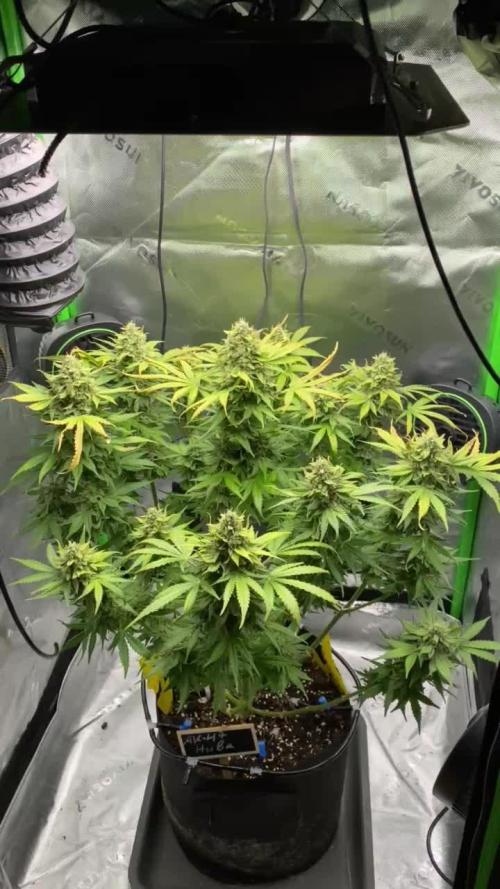
Update: Woche 10 ist gut gestartet & die AK-47 Auto von @HubaBreedingLab_85 macht sich weiterhin prächtig. Die Verfärbungen an den Blättern haben sich bisher noch nicht verbessert, deshalb behalte ich das Ganze weiterhin genau im Auge. Besonders interessant wird jetzt der Geruch – ich bin aus Versehen gegen einen der Buds gekommen & direkt kam mir ein richtig fruchtig-süßes Aroma entgegen. Die Terpene gefallen mir bisher echt richtig gut und ich bin gespannt, wie sich das Aroma bis zum Ende noch entwickelt. Jetzt dürfen die Buds in den nächsten Tagen gerne weiter an Masse zulegen :D.
19.09.2026
Update: Woche 10 neigt sich dem Ende & die AK-47 Auto von @HubaBreedingLab_85 zeigt weiterhin Verfärbungen an den Blättern, die mittlerweile etwas intensiver werden. Ich habe schon eine kleine Vermutung, woher das Ganze kommen könnte, möchte aber erstmal noch etwas abwarten & beobachten, wie es sich weiterentwickelt. Die Buds scheint das aktuell nicht groß zu stören, denn die legen trotzdem weiter an Masse zu. Nährstoffe gibt es momentan keine und die Kleine bekommt aktuell nur pH-reguliertes Wasser. Mal schauen, was Woche 11 bringt :D.
#HubaSeedBank #HubaSeeds #HubaGrow #HubaBreedingLab #HungarianBreeders #AK47Auto #Autoflower #CannabisCommunity

Likes
46
Share


@The_Bearded_Grower
Follow
welcome to 📅 Day 8 of flower 7/12/2021 they are growing very well and are drinking lots 10 gal a week I'm hoping that they stop the stretch and start to fatted up as I am running out of space lol. next update on thurs till then happy growing and as always keep your stick on the ice 🏒
I would like to say a few words about Mars Hydro. the TS 1000 is a great light and I love the fact that the power supply is capable of being separated from the light and located outside of the tent to keep the heat down. I also like the fact that you can control the light intensity and daisy chain with another light witch is what I plan on doing.

Likes
8
Share


@GreenForce
Follow
Hey Growers,
Day 1 of Week 10
Two ladys harvested today you can see in fotos how they look in my opinion Amazing Hahah (but im the father lol).
Purple one its like a mix of exótic fruits
The orange one its like a a cream of a fruit.
Both seens very sweet!!
Soon i Will share strains!!
The another two ladys more sativas i think , looks like they need around more 10 days lets us see.
The taller one smeels like gasy citrus, And the another one its a mix of strwaberry And another touch that I dont discover yet.
Thank you all.
Nice week 4 everybody!!
_GrF_
Likes
9
Share


@Growing_Spartan
Follow
Here’s the update:
She’s in week 8 of flower so far and a lot has happened since the last post. Since may 20th 2025, I noticed a small deficiency in the plant but couldn’t quite pin it down as to what it was, fast forward 10 days and I notice that she was getting more deficient and started to show more signs of what it was and once it was clear I ruled it out as a magnesium deficiency since I lacked any in my pot.
I since grabbed some dolomite lime from Down To Earth (OMRI) and sprinkled 5 tablespoons into the top soil and watered with PH’d and dechlorinated water and worked it into the soil with the watering. It’s too soon to say it has any effects so far but I’m hoping my rookie mistake can be fixed.
I do understand I am pretty late into flower for a top dress but the flowers look young still and could go for some more time but if I’m wrong please guide me the right way haha, also I did the top dress on June 4th 2025.
First day of flower flip : April 11th 2025
Current date : June 5th 2025

Likes
13
Share

@greenkeepers
Follow
Week 4 – Flowering (Day 22–28) 🌸🌱
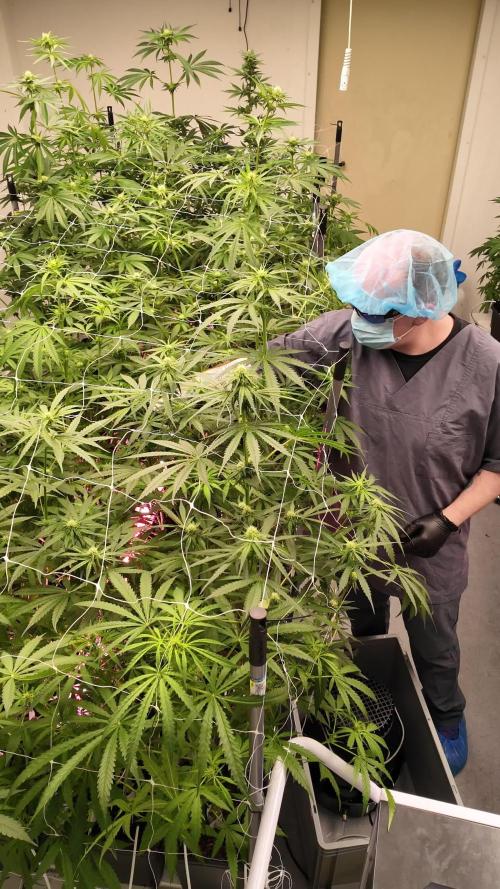
At the end of Week 3 (Day 21) we carried out a deeper round of defoliation and some lollipopping. By now the stretch is coming to an end, with the plants settling close to their final height.
We’ve also stopped foliar feeding, since every single plant is now covered in developing buds. To keep everything protected, we refreshed the beneficial insects, better be safe than sorry, how we say in German, sicher ist sicher.
Already in this early stage of flowering, we can clearly spot differences in structure, bud formation and even the first aromas. Some phenos are showing exceptional promise — those will be the ones we’ll highlight more in the coming updates.
🔎 Pheno notes so far:
SD1-1 – balanced structure, even bud distribution.
SD1-33 – tall central cola with healthy branching.
SD2-13 – compact structure, promising stacking.
Sativa Dream expresses an old-school sweet Afghan aroma with a citric twist, setting it apart from the rest of the room.



Likes
8
Share


@420DeepGrow
Follow
📆 Semana 5:
Formación de Cálices
Las Auto Pablo Escobar avanzan decididas en floración. 🌸
Los pistilos se multiplican y empiezan a formar cálices visibles, dándole volumen a los primeros racimos florales. La planta aún estira un poco, pero con gracia y sin desmadre.
El color se mantiene vibrante, con hojas sanas y erguidas. Se percibe una mayor demanda de agua, reflejo de su metabolismo en plena marcha.
💧 Riegos frecuentes, sin exceso. Se ajusta el ritmo para mantener el sustrato activo pero aireado.
☀️ Clima estable, sin sobresaltos. Las condiciones de luz y ventilación se mantienen óptimas, y el entorno favorece una floración tranquila y continua.

Likes
1
Share


@Osavv_OTGUK
Follow
I was using a very cheap light at this stage which was averaging 80 ppfd which was crap. I was feeding tap water leaving it for 24 hours. At that time I was feeding them bottled water with 7.5 ph water 2 off them are bag seeds so I don’t know the gender
Likes
6
Share


@greenbeans420
Follow
Tent has been modified for cooler temps. Temp is now around 75* with lights on. Lights 100% on and slightly lowered now they can handle it with lil to no heat. Molasses added to every feed along with Biologics. Plants may need one last feeding as leaves are starting to barely droop. Might leave alone if the plants are okay and start to get ready for their flush in a couple weeks. Maybe a tablespoon of fertilizer won’t hurt and go extra hard when it’s time to flush. Overall happy grow!
Gnats have infested the tent so tents been sprayed with neen oil when lights are off and tent is officially sealed and closed for good.
Likes
74
Share


@Rasta_Faraev
Follow
28.09.21 Всем привет, друзья. Банана прожила очередную неделю, и приближается к первому месячному юбилею. Тренировки проходят на ура, но ввиду коротких и жирных междоузлей , приходится тратить много времени на разведение листиков и веток. Chempie в этом плане проще, так как сативодоминантна. А так, все хорошо, как обычно буду дополнять в течение недели, ну и про видео LST я не забыл😊🙏всем спасибо, всех жду в гости🤜🤛
30.09.21. Очередная тренировка и полив, развитие бурное, растения выглядят здоровыми, в целом интересного не так уж и много, пока...)) скоро пойдёт жара, следите, друзья🙏
03.09.21.тренировка, выжидание, полив, все в штатном режиме. Надломил одну ветку у chempie при LST, закрепил при помощи скобки, см фото.


Likes
15
Share


@emeraldlabs
Follow
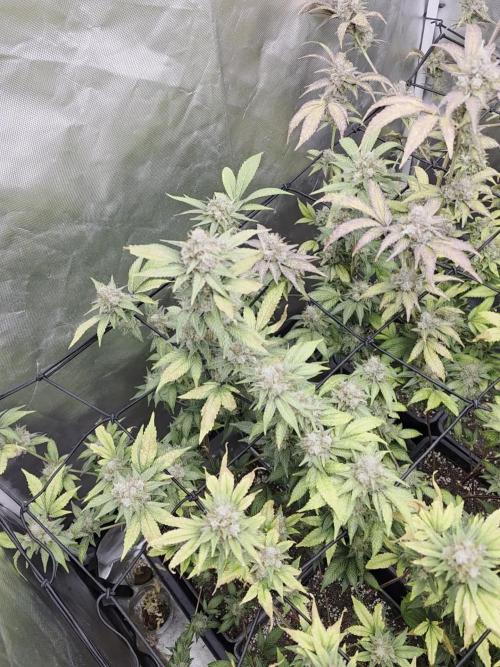
Everything is going well; colas are packing on weight. Will try to get some trichrome pics next week.
Photos/video taken 105 days after breaking soil, day 42 of flower.


Likes
2
Share

@Antarctic
Follow
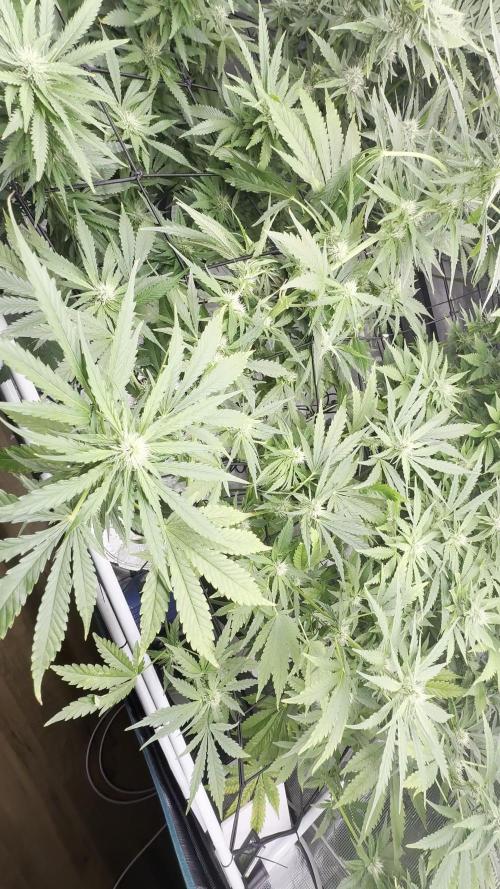
Week 14 (Plant Week 14) = Flower Week 5
Humidity management became more serious, so I installed a dehumidifier.
I focused on keeping the tent dry and stable, so everything runs properly (less risk of mold).
Defoliation continued gradually across Week 13 into Week 14: small cuts consistently over time instead of one heavy session.
Today (end of Week 14)
I did the final defoliation session.
This is the last major trim; I’m not planning to remove more leaves going forward.
Buds now have a stronger smell, and the resin is very sticky during handling.
If you want it even tighter, here’s a one-paragraph version you can use as a caption:
Caption version:
“Flower Week 3–4: Started gradual defoliation and canopy control. Plants kept stretching longer than expected, so I added new tie-down points and continued LST. Reduced light to ~60% after heavier trimming to reduce stress. Humidity was high, so I installed a dehumidifier in Week 4 and focused on keeping the tent dry and stable. Today I finished the final defoliation; buds are now noticeably more aromatic and extremely sticky/resinous.”
Processing
Likes
33
Share


@BADKUSS
Follow
Hello everyone ,
Here is the phase of completed stretch, and the fertilizer fertilizer contribution are 100%, flowering starts very well and the appearance of the first pistil are visible everywhere.
For the height of the plants I find it reasonable and thus keeping all this world a good size the luminous penetration will be excellent ... until now hene no sign of problem for my plants I think that the flowering will follow its rhythm .. to see in the coming weeks ...
now place to photos ...

Likes
9
Share


Likes
10
Share


@Ultraviolet
Follow
Voltage, also known as electric pressure, electric tension, or (electric) potential difference, is the difference in electric potential between two points. In a static electric field, it corresponds to the work needed per unit of charge to move a test charge between the two points. In the International System of Units (SI), the derived unit for voltage is named volt.
The voltage between points can be caused by the build-up of electric charge (e.g., a capacitor), and from an electromotive force (e.g., electromagnetic induction in generators, inductors, and transformers). On a macroscopic scale, a potential difference can be caused by electrochemical processes (e.g., cells and batteries), the pressure-induced piezoelectric effect, and the thermoelectric effect. Since it is the difference in electric potential, it is a physical scalar quantity.
A voltmeter can be used to measure the voltage between two points in a system. Often a common reference potential such as the ground of the system is used as one of the points. A voltage can represent either a source of energy or the loss, dissipation, or storage of energy.
Dropping the temps will slightly raise the humidity, air holds less % water the colder it is. Lights on 25-35rh% the same water content will spike to 50rh% + at night just by dropping the temps.
At night all the juice photosynthesis has been storing up is mashed and mixed up to make all the goodies we need for bud, water is used to transport all these things everywhere, like little solvent transport devices, once a nutrient/protein has been delivered to destination the plant needs to get rid of all this excess water molecules it was using to transport. The only solution at night is to spit it back out into the air at night. During the peak of flower, this can catch a grower unaware, with a 4x4 full tent it can be a challenge to control all that moisture exhaust overnight especially if you're really pushing the limits.
We live in a water world, above or below, our misconception is we live on dry land, we don't live in less watery conditions than above or below. We fit into a very narrow band of moisture that just so happens to be full of lots of air and everything else required for life.
Got my first full whiff of the smell of purple lemonade, always surprises me how accurately the smell fits names, the dominant terpenes in the Purple Lemonade weed strain are carene, linalool, limonene, and myrcene. Carene gives this strain its sweet, citrus flavor and some woody notes, whereas the linalool I recognize so well from Granddaddy Purp. Myrcene has been shown to have sedative qualities while bringing musky, earthy elements to the flavor profile.
Trichome production started to ramp up, and the plant that grew taller/closer to UV showed noticeably thicker coatings. The taller plant shows slight yellowing of lower leaves, and the smaller plant is green and lush but the buds are slightly less progressed, interesting.
I super-cropped the main stem of the tall one just over a week ago (clean). I expected it to be the one slightly behind in development.
The plant has roughly 10-15% "Total resources" that it keeps in case emergencies arise. Reserves if you will.
My rationale behind breaking anything goes hand in hand with slowing things down as production is lost due to the time it takes to repair damage.
I recall watching a YouTube video, where a curly hair gentleman would super crop in a manner to damage but not disrupt using a twisting method, using fingers and thumbs placing them close together one goes clockwise other counter clock this varies a lot depending on the thickness of stem but what you wait for is a tiny snap, it may take several rolls to weaken if walls are tough I found. No snapping or bending of the stem, you want just to fracture it but not puncture this way the xylem and phloem channels remain flowing,the damage is repaired almost instantly and the 10-15% is dispatched with very little repair time. Everything in the general vicinity of the stress will now grow stronger so as to prevent further similar damage.
This is why I had expected the tall one to lag behind in development once I had cropped it but low and behold it worked and the tall one has slightly more developed buds.
The effects of birdsong on plant life may at first glance be far-fetched. Nigh on ten years ago an article appeared in Nexus Magazine on the discovery or invention of a method of growing plants using bird sounds. Christopher Bird and Peter Tompkins describe the development of Dan Carlson’s Sonic Bloom in their book The Secret Life of Plants. Many others have, it seems, recognized the role of birdsong in the growth of plants, and influenced or directly helped Carlson to develop his invention.
Dan Carlson’s desire to see that no one need be hungry through shortage of food sought to understand the optimum growth of plants. He discovered that plants also feed from ‘the top down’ as well as the roots. Underneath all leaves are pores called stomata which open to take in nutrients and moisture from the air. Carlson’s observation that the more bird life there is on the farm, the more abundant is plant life, has been echoed by farmers throughout history, except in modern times. Where there is little bird life, plants are stunted, and dwarfed. Nature has the birds sing at dawn and dusk, which dilates the stomata, and so feeds the plants. One can immediately see the importance of trees.
The development of Sonic Bloom was to create birdsong, which is played to the plants, while a foliar nutrient is sprayed onto the plants at the same time as they are being stimulated by the sound, to enhance their growth. This method produced fantastic results in the amount of abundantly nutritious produce from one plant, often in poor soils and in drought conditions. Carlson showed that the breathing leaves of plants are the source of the nutrient intake for growth. This of course is also true for humans—the breath is food. We shall discourse on this on another occasion. Plants transfer nutrients to the soil via this breathing, and Carlson showed that his plants improved the soil and helped earthworms proliferate.
The secret of Sonic Bloom was the development of the music of the same frequency as the dawn chorus of the birds. With the help of a Minneapolis music teacher, Michael Holtz, a cassette was prepared. It seems that both birds and plants found Indian melodies called ragas delightfully suitable. This is actually quite profound, although the American farmers, especially women, who had to endure this music whilst it was played to the plants, found it irritating. Holtz found the “Spring” movement of Vivaldi’s The Four Seasons appropriate and concludes: “I realized that Vivaldi, in his day, must have known all about birdsong, which he tried to imitate in his long violin passages.
Holtz, it is related by the authors Bird and Tompkins, also realized that the violin music dominant in “Spring” reflected Johann Sebastian Bach’s violin sonatas broadcast by the Ottawa University researchers to a wheat field, which had obtained remarkable crops with 66 percent greater yield than average, with larger and heavier seeds. Accordingly, Holtz selected Bach’s E-major concerto for violin for inclusion on the tape. “I chose that particular concerto,” explained Holtz, “because it has many repetitions but varying notes. Bach was such a musical genius he could change his harmonic rhythm at nearly every other beat, with his chords going from E to B to G-sharp and so on, whereas Vivaldi would frequently keep to one chord for as long as four measures. That is why Bach is considered the greatest composer that ever lived. I chose Bach’s string concerto, rather than his more popular organ music, because the timbre of the violin, and its harmonic structure, is far richer than that of the organ.
Birdsong has long been loved but also studied with reference to the musical scale and harmonics. As Holtz deepened his study he said, “I began to feel that God had created the birds for more than just freely flying about and warbling. Their very singing must somehow be intimately linked to the mysteries of seed germination and plant growth.
The spring season down on the farms is much more silent than ever before. DDT killed off many birds and others never seem to have taken their place. Who knows what magical effect a bird like the wood thrush might have on its environment, singing three separate notes all at the same time, warbling two of them and sustaining the others.
Tree and bird life are essential to Earth's existence, which Carlson, Holtz, and others have shown, but indeed others see and feel. “Plants”, says Steiner, “can only be understood when considered in connection with all that is circling, weaving, and living around them. In spring and autumn, when swallows produce vibrations as they flock in a body of air, causing currents with their wing beats, these and birdsong, have a powerful effect on the flowering and fruiting of plants. Remove the winged creatures, Steiner warns, and there would be stunting of vegetation. Nothing more needs to be added here.
It has been said that you cannot hurt the humblest creature or disturb the smallest pebble without your action having a reaction upon something else...You cannot think of an evil thought, no matter how private, without it having an effect upon somebody else. Whatsoever you do in life sets up some form of resonance.
When I say the morning chorus of the birds awakens the earth I mean that the characteristic song of the birds sets in motion a series of vibrations which react upon other forms of life. Remember, the soil of the earth is full of living microorganisms. The plants are also living organisms. You, yourselves, are living organisms. Now, this is the beauty and wonder of it all—when one aspect of nature has been moved into a state of resonance it immediately relays its vibrational motion to something else.
So when I say the dawn chorus awakens the earth I literally mean what I say. I do not suggest that the earth would come to a standstill without the bird song, but I do mean that life on earth would be sluggish and ineffectual without that first instigating outburst of vibrational power poured forth at just the right pitch and tone to set off a chain effect.
I know some of you will say, what happens in those parts of the world where there are no birds? Well, what does happen? Very little, I assure you. The hot deserts and the polar regions where there are few, if any, birds are not renowned for their wonders of nature. It is as though they are asleep. Nothing grows, few things live. Little resonates and there is a great stillness over everything.
You see, that outburst of sound just before dawn is like the little lever that works the bigger lever which turns the wheel which moves the machine…and so on. Never underestimate small things.
Animals are blessed with instantaneous and unthought-out wisdom. They are in direct contact with God and they act and live as though they are fully aware of it. Men are also in contact with God, but most of them act as though they have never heard of God because they are largely veiled from their divine center by their own thinking minds of which they are so proud.

Likes
Comments
Share

@DogDoctorOfficial
Follow
Folder 10 – Frosted Guava Auto B
Week 4 | Vegetation – The Quiet Climber
Welcome back to The 8×8 Adventure, a project where twelve unique cultivars are being grown side by side inside the same environment, allowing every genetic to express its own personality under identical conditions.
Each plant is documented individually because no two phenotypes tell the same story. Even when they share the same genetics, subtle differences in structure, vigor and flowering behaviour make every diary unique.
Frosted Guava Auto B is proving exactly that.
Although she shares the tent with her sister, she has developed her own character. Slightly taller, equally healthy, and every bit as determined, she’s entering the next chapter of her life with confidence. Our 12/12-from-seed journey continues, and this week marks another exciting milestone as the first signs of flowering begin to appear.
⸻
🌱 Week 4 – A Compact Plant With Her Own Personality
While Plant B has stretched just a little more than her sister, she remains a very compact autoflower compared to many of the other cultivars sharing this 8×8 room.
Instead of investing her energy into vertical growth, she has focused on producing tight internodal spacing, sturdy branches and a surprisingly balanced structure. Looking around the room, it’s already clear that Frosted Guava is unlikely to become one of the tallest ladies of the garden—but height has never been the goal.
Sometimes the smallest plants surprise us with the biggest harvests.
Her canopy is filling beautifully, each node producing healthy new growth that will soon become flowering sites. Every day she looks more organized, more symmetrical and more prepared for what comes next.
⸻
🌿 Gentle Training, Natural Development
Just like her sister, Plant B has only received gentle Low Stress Training throughout her early life.
Rather than forcing the plant into shape, I’ve focused on carefully bending large fan leaves, tucking foliage away from developing shoots and allowing natural light penetration into the centre of the canopy.
This subtle approach has encouraged multiple branches to grow evenly without creating unnecessary stress. The result is a plant that still looks completely natural while developing a much more open canopy.
Sometimes patience is the best training technique.
⸻
🌸 Pre-Flower Has Officially Begun
This week brings one of my favourite moments of every grow.
Tiny white pistils have started appearing throughout the upper nodes, confirming that Frosted Guava Auto B has officially entered the pre-flowering stage.
One of the most fascinating aspects of this 12/12-from-seed experiment is watching these autoflowers transition into bloom without hesitation. Rather than waiting for a long vegetative period, they simply follow their own internal clock.
Despite her compact size, she’s wasting no time. The foundation has been built, and now the real show is about to begin.
Over the coming weeks, I’ll be watching closely to see whether she delivers a modest stretch or stays true to her compact structure while focusing her energy on dense flower production.
Either way, she’s looking incredibly promising.
⸻
🌡️ Environmental Conditions
The room continues to provide a stable environment for all twelve cultivars despite the warmer summer temperatures.
Environment
• 🌡️ Day Temperature: 33°C
• 🌙 Night Temperature: 25°C
• 💧 Relative Humidity: 63%
• ? Substrate Temperature: 21°C
• 💦 Nutrient Solution Temperature: 26°C
• ⚗️ pH: 6.1
• ⚡ EC: 1.35 mS/cm
• ☁️ CO₂: 639 ppm
• 💧 Water Consumption: 1.1 litres per plant per day
Even with daytime temperatures reaching 33°C, Plant B continues showing excellent colour, strong leaf posture and vigorous growth, demonstrating how well she’s adapting to the environment.
⸻
Feeding Schedule
This week’s feeding remained simple and consistent, allowing the plant to continue building healthy vegetative growth before fully committing to flowering.
Per litre
• Terra Grow — 1.8 ml
• Power Roots — 1 ml
• Pure Zym — 1 ml
• Sugar Royal — 1 ml
Adjusted using:
• pH Plus — 0.03 ml
• Lemon Kick — 0.03 ml
The Plagron feeding programme continues delivering exactly what these plants need at this stage—healthy roots, lush green foliage and vigorous, stress-free development.
⸻
💡 Lighting
The entire 8×8 garden continues to thrive beneath the outstanding Future of Grow LED fixtures.
Uniform light distribution across the canopy has helped every cultivar develop evenly, while allowing each phenotype to express its own natural growth pattern.
It’s fascinating walking through the room and seeing twelve completely different personalities growing under exactly the same environmental conditions. Frosted Guava Auto B is a perfect example of how genetics shape the plant just as much as the environment.
⸻
🌱 Looking Ahead
Week four closes with Plant B looking healthy, balanced and full of potential.
She’s entering flower with strong branching, vibrant foliage and a structure that promises excellent light penetration throughout the canopy.
While some cultivars in the room are already showing more vertical ambition, Frosted Guava B seems determined to stay compact and focus her energy where it matters most.
The coming weeks will reveal whether this translates into dense, resin-packed flowers—but for now, she’s ticking every box.
The journey is only getting started.
⸻
🙏 Thank You
As always, thank you to everyone following The 8×8 Adventure. Sharing this project with growers from around the world is one of the most rewarding parts of the journey, and I truly appreciate every comment, question and piece of advice along the way.
A special thank you to Zamnesia for providing these exciting Frosted Guava Auto genetics, to Plagron for the trusted substrates and nutrient line that continue supporting healthy, vigorous growth, and to Future of Grow LED for delivering exceptional lighting that allows every phenotype in this room to perform at its very best.
Finally, thank you to GrowDiaries for giving this amazing community a place to learn, share experiences and celebrate our passion for growing together.
See you all next week, when Frosted Guava Auto B takes another step into flowering.
Until then…
Growers Love and happy growing! 🌱💚

Likes
5
Share


@Brosciencegrowmie
Follow
Plant did great. The final product looks great and smells good too. Very easy going grow with great results.
Likes
4
Share

@UncleJono
Follow
Hey Growmies, here is my log for the past week: flower week 1!
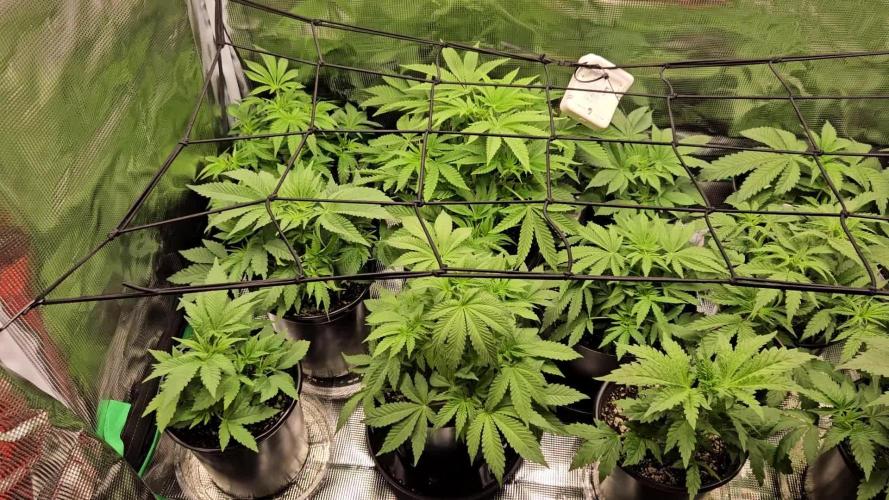
I have started feeding the plants 100% solution with a touch of cal mag and armor si during stretch. The ph does not need much adjusting now - falling within 5.8 to 6.0 easily. EC is in the high 1.8's but typically under 2.0
The plants had 4-6 inches of headroom beneath the scrog last monday - GDP and Bag Seed are now touching the screen today. The others are not far behind so I think the stretch is going week.
I did some defol the first two days of week 1 but am now resisting the urge until stretch is complete.
Plants were fed a light microbe mix with diluted jacks solution to close out week 1.
Upgrades to my setup this week include a new tent and t5 lights for seedlings and clones - I now have a two tent setup! There are currently some seedlings in the tent me and fiancé started
- if you guys want to see, I can start a new journal or include some updates on this one.
See you guys next week!
