




Likes
13
Share


@GardenOfSixx
Follow
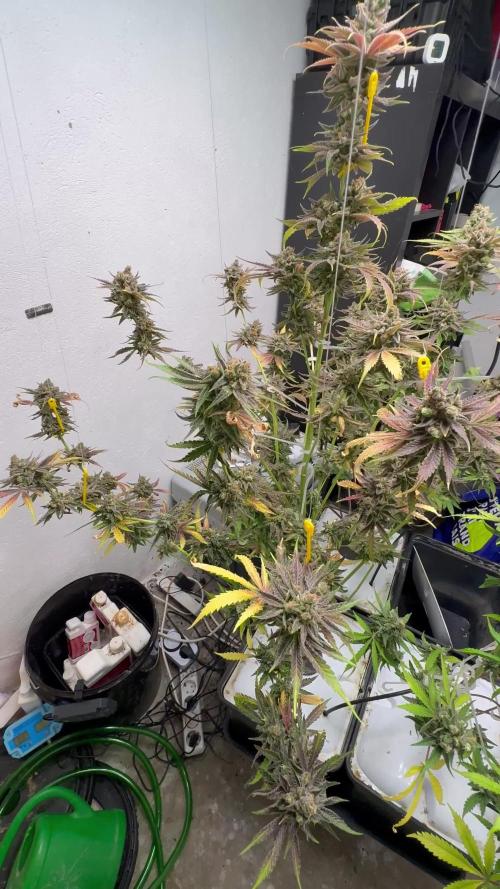
Fed my girl her last flowering compost tea about 3 days ago. She is absolutely beautiful. Loving her environment and thriving. Bud production looks lovely and even producing tricomes already. I'm very please with this week. Will water with recharge on day 21 and then one last defoliation. Very easy going plant.

Likes
9
Share


@PlumpPelican
Follow
End of 10 weeks of flowering (recommended flowering time for this strain).
Buds have ripened but are not quite finished yet...
Will give them a few more days to finish off.
Getting very close!

Likes
18
Share


@MadeInGermany
Follow
Flowering day 19
since the time
change to 12/12.
Hey all together 😀.
This week she has developed beautifully ☺️.
I poured it 3 times with 1.2 l this week.
Tomorrow I will add the 2 g GHSC Powder Feeding Bio Bloom because the first blossoms are coming :-).
I checked all the leaves thoroughly for pests or diseases and everything is fine ☺️.
Next week I'll look at your roots as soon as the coconut is completely rooted.
As every week, the tent was cleaned and the entire technology checked.
The humidifier was also refilled every day 👍.
In the next few days I will remove the bottom shoots so that the energy doesn't end up being wasted in the small popcorn buds.
I wish you a lot of fun with the update.
Stay healthy 🙏🏻 and let it grow 🍀
You can buy this Strain at :
https://sweetseeds.es/de/red-mandarine-f1-fast-version/
Type:
Red Mandarine F1 Fast Version
☝️🏼
Genetics:
Red Poison Auto®️ (SWS39)
X
Tangie (California Orange x Hybrid Skunk)
👍
Vega lamp:
2 x Todogrow Led
Quantum Board 100 W
💡
Bloom Lamp :
2 x Todogrow Led
Cxb 3590 COB 3500 K 205W
💡💡☝️🏼
Soil :
Canna Coco Professional +
☝️🏼
Fertilizer:
Green House Powder Feeding
☝️🏼🌱
Water:
Osmosis water mixed with normal water (24 hours stale that the chlorine evaporates) to 0.2 EC. Add Cal / Mag to 0.4 Ec Ph with Organic Ph - to 5.5 - 5.8 .

Processing
Likes
3
Share


@Fergie
Follow
Hey guys so here is my blue cheese mutant . Finally bushing right out and the pre flower is well under way . Really looking forward seeing how the lady turns out as I have always had good results mutants in past .
Likes
149
Share


@CBD_Sweden
Follow
Hi all the happy people here in GrowDiaries.
This is my second cultivation ever and it will be fun to try a bigger space than my closet grow.
First, I'm just going to say I'm done with the construction of my new growroom.
I put some pictures on the construction here in week one.
The room is 2.14 meters by 1.7 meters and has a ceiling height of 2 meters.
It provides a floor area of 3.6 square meters.
I use a 54 Watt Lightwawe T5 for germination and 2 Pcs 400 Watt HPS lamps.
I have a channel fan that replaces the room air about 40 times an hour to get a comfortable theme in the room, the air enters a fresh air intake from the outside.
The air is purified through a carbon filter to then leave the room to the rest of the basement.
Then I use that heat to heat the rest of the basement.
I will use 8 pcs 15 liter Autopots to grow with and a 100 liter water tank that supplies the pots of water and nutrition.
I will grow completely organically in soil and will watercure my buds to get the best possible medicine for me.
But there are no cultivation rooms to be displayed here, so I continue with what is most important.
Today I have put my seeds in my moisture dome and hope the seeds have germinated within a few days.
I am very excited to see how the new growroom will work and how this Blue cheese Auto from Royal queen seeds will turn out.
Blue Cheese automatic cannabis seeds are a cross of Blueberry Automatic and Cheese Automatic that has been perfected over five years of breeding and careful selection. The result is a feminized, autoflowering strain with superior yield, flavor, and effects to either of its distinguished parent strains.
THC: 16%
CBD: Low
Yield Indoor : 325 - 375 gr/m2
Yield Outdoor: 60 - 110 gr/plant
Height Indoor: 40 - 70 cm
Height Outdoor: 60 - 110 cm
Flowering: 7 - 8 weeks
Harvest month: 9-10 weeks after planting
Genetic Background: Blueberry x Cheese x Ruderalis
Type: Sa 35% In 40% Ru 25%
Effect: Cerebral and uplifting
Climate: Mild
..............................................................................................................................................................................................................................................................................................................................................
2017-09-11. Kl 12.00. Week 4 starts. I have cleaned the whole room for the new week and gave the girls water and nutes. Added videos and pics. Girl nr 1 is 27 cm high and girl nr 2 is 50 cm high and nr 3 is 15 cm high.
-------------------------------------------------------------------------------
2017-09-12. Kl 10.00. New pics and video. Nr 2 has grown 5 cm in 23 h, its incredible.
---------------------------------------------------------------------------------------------
2017-09-13. Kl 22.00. Everything is great in the garden right now. Updated with new video.
----------------------------------------------------------------------------------------------------------------------------
2017-09-15. KL 10.00. New pics and videos. Girl Nr 1 is 33 cm high, Nr2 is 70 cm and girl Nr is 22 cm. Nr 2 has grown 20 cm the last 3 days. Look at the stem of girl Nr 2 😍
The girls are starting to smell a lot now. Its a intense smell in the grow room.
-----------------------------------------------------------------------------------------------------------------------------------------
2017-09-16. Kl 10.00. The girls grow like crazy, i have to defoliate about 20 leafs a day. Nr 2 is 76 cm tall now, i wonder when she slows down?. Added 2 liters of water and nutes this morning and 2 new videos.
------------------------------------------------------------------------------------------------------------------------------------------------------------------
2017-09-17. Made a time laps of the girls first 28 days.
Likes
12
Share


@PedroAndHisPlants
Follow
Day 29 (Second Grow):
"Hey everyone!
Starting a new week with some exciting plans! 🌿 We've got about one more week before we transition the plants to the flowering phase.
Just to recap last week's updates for those following along:
We’ve named all the plants in both grows. This makes it easier to identify and keep track of each one, especially if they get moved around. It should also help you all follow along more easily with the pictures we post.
We've built a SCROG (Screen of Green) net for the plants. A SCROG net helps train the plants to grow horizontally, which maximizes light exposure to all parts of the plant and promotes more even growth. We're using it to ensure all plants get plenty of light and develop a uniform canopy.
We’ve placed a hygrometer among the plants to measure the humidity between the leaves. We've noticed that the humidity sometimes exceeds 70% in those areas. We're considering whether we need more fans, an intake ventilation system, or if a dehumidifier would be a better option. We're leaning towards adding more fans to improve air circulation, but we'd love to hear your thoughts and suggestions!
Stay tuned for more updates as we continue to watch both grows progress and prepare for the flowering phase!"
Day 33 (Second Grow):
"Hey everyone!
Exciting news for our second grow: we’ve added a new member to the grow tent – a praying mantis! 🦗 Her species is Timor shield mantis, and she still needs a name.
We got her to help with pest control naturally. Praying mantises are excellent predators and can help keep unwanted insects away from our plants.
Feel free to suggest a name for her! Any tips or fun facts about keeping a mantis in the grow tent are also welcome!"
Day 34 (Second Grow):
"Hey everyone!
Big update today: we’ve switched the timer to a 12/12 light cycle to initiate the flowering phase! 🌸
Our second batch of plants, just like the first, has developed well and we believe they’re ready to start blooming. This change should encourage them to shift their energy towards producing buds.
For those following along, here’s a quick recap:
We've implemented a SCROG net to manage the canopy and ensure even light distribution.
We've introduced a Timor shield mantis for natural pest control.
The plants have responded well to all adjustments and are looking healthy.
Now that the flowering phase is starting, we’re excited to see how they develop over the next few weeks. Any tips or advice for optimizing this phase? Let us know in the comments!"


Likes
Comments
Share


@ceroporcientoalcohol
Follow
Una verdadera californiana! la verdad sin palabras al cruzarnos con esta cepa ya hace 2 años manteniendola..
Aveces afrutada,aveces muy amaderada pero siempre intensa..!
Processing
Likes
24
Share


@ElChicoDelaWeed
Follow
21 DÍAS DESDE EASY START.
Maceta RQS 10L.
-EASY BOST ORGANIC NUTRITION.(preparación del suelo con 50g en 10 litros de sustrato con perlita)
-EASY COMBO BOOSTER PACK.
-En la 3ª semana sigo regando las 4 plantas con agua mezclada con la pastilla EASY GROW BOOSTER (la dividí en 4 trozos para la semana 2,3,4 y 5 diluyendo en 1L. de agua la mezcla).
-Las 3 que están en vaso de plástico esta semana le voy añadir al vaso uno granos del EASY BOOST ORGANIC que no le mezclé cuando las planté).
Likes
11
Share


@CanadianFillmore
Follow
Fed and defoliated to start week 7. The plant looks good, the buds are on point, frosty, sticky and look as expected at this stage of the grow.

Likes
5
Share


@CalGonJim
Follow
10/20 1230AM MONDAY. 11:14 AM I found some Halloween pictures.🎃🎃
IF YOU LOSE 1 MORE DEATH STAR IM TURNING YOU INTO DARTH VAPORIZER!!
Why u do dis 2 meesa Dimi???
10/21 5am 500mg Phe. & Proline spray in 1L, then an .25pb
10/21 238PM I asked Grok about EC readings. "Good question, CalGonJim! When using an EC meter, you don’t typically subtract the baseline EC of your water from the final reading—here’s why and how to handle it properly, tailored to your grow with **Blueberry KO** and **DDA** at 02:36 PM PDT on Tuesday, October 21, 2025.
### EC Measurement Basics
- **EC Definition**: Electrical Conductivity measures the nutrient concentration in your solution, expressed in mS/cm or µS/cm. It reflects all dissolved salts, including those from water and additives.
- **Baseline Water EC**: Tap or RO water has its own EC (e.g., 0.2–0.5 mS/cm for tap, 20% means flush with pH 6 water.
4. **Adjust**: If EC exceeds 1.4 mS/cm (**BKO**) or 1.8 mS/cm (**DDA**), dilute with water or flush to avoid burn.
### Your Context
- **Current Mix**: 500 mg/L proline + 500 mg/L phenylalanine adds ~0.6–0.8 mS/cm. With your base (1.5 mL/L Grow A&B + 0.25 mL/L each additive), expect 1.6–1.8 mS/cm total. If your water’s 0.3 mS/cm, it’s still 1.6–1.8 mS/cm—don’t subtract.
- **Action**: Test your 1-liter mix now, apply, and check runoff tomorrow. If **BKO** shows stress, drop to 300 mg/L each.
No subtraction needed—just roll with the total EC and keep an eye on your plants. How’s that surprise **BKO** sprout doing with your latest drench?""
10/22 502AM I SAW A CAT!!!!! CANT DO ANTYTHING ELSE..... GOT CHURUS OUT.....TAPPING ON THE GLASS, HE WONT COME BACK....BUT LOUD AND CRAZY ALL NIGHT.....HOW CAN THE CAT NOT HEAR ME???????
10/21 1PM Effects of essential amino acid (EAA) and glutamine supplementation on skeletal muscle wasting in acute, subacute, and postacute conditions.
https://pubmed.ncbi.nlm.nih.gov/38843393/
10/25 12pm afternoon. in 1 liter: 500mg Phe., 250mg TMG Powder, 260mg Proline as root drench and spray.


Likes
2
Share


@Comfrey
Follow
Die Pflanze gedeiht. Ich bin überrascht, wie viele Blüten sie produziert hat. Die Luftfeuchtigkeit ist morgens sehr hoch aber bislang sehe ich keine Fäulnisanzeichen. Wahrscheinlich liegen wir noch etwas weg vom Taupunkt.
Wasser + Ackerschachtelhalm.
Likes
12
Share


@thonhash
Follow
En esta última semana de crecimiento hice el trasplante a definitiva de 7l y las afghan fueron trasplantadas a definitiva de 11l. Aplicamos enzynabis para una mejor recuperación de nuestras raíces.
Como podéis ver,aunque hayan sido pequeñas,si tenemos todos los parámetros en “sintonía” perfectamente aguanta una buena poda de bajos y seguir con mucha más fuerza.



Processing
Likes
54
Share


@wheedtobeus420
Follow
Into their second week of flowering and holy hell. The dark devil is going crazy !!! I can't believe at how fast it's flowering. The buds seem to double in size daily. I am going to boost the feeding to every other watering. Instead of the every third day feeding them. The dark devil i mainlined seems to be on the exact same schedule as the control plant her flowering period happened pretty quickly idk if i would mainline again.
Likes
11
Share


@Organic473
Follow
Bud weight continues in week 4 of flowering…I don’t know if it’s the location or the strain but these buds are really big for 4 weeks….can’t wait for harvest in 35 days.

Likes
15
Share


@Homestickycannabis
Follow
This past week seen some fattening of buds. Pretty much all vertical growth has stoped . Now she is focusing on putting weight on. This plant has been a absolute joy to grow to date. I've only encountered a small deff early on and that's it. What dose surprise me is the tricomes she's putting on. I have to bed honest, this is one of the most frosty plants I've grown. Sweet Seeds says it should be mature around the 60 day mark , so far it seems right on track with that mark.
Likes
43
Share


@420DeepGrow
Follow
Gracias al equipo de Kannabia Seed y XpertNutrients, sin ellos esta magia no seria posible.
🍁💐 Runtz (Auto):
Si esta cepa se ha ganado su popularidad a pulso, esta versión autofloreciente es digna heredera de sus atributos. No es de extrañar que nuestros criadores hayan acertado con su programa de reproducción, al combinar dos de las cepas más fascinantes de la actualidad: Zkittlez y Gelato.
planta resistente y robusta, de cuerpo esbelto y fuerte ramificación lateral, que se puede cultivar prácticamente en cualquier entorno; pero prefiere los veranos largos y cálidos, tal y como quiere la madre naturaleza, donde bañada por el sol se eleva hasta los 120 cm. para producir unos rendimientos muy gratificantes de 100-150 gramos por planta.
En interior, y tras solo 70 días desde la semilla, también recompensará con cosechas abundantes de hasta 500 gr./m²
Inmediatamente después de encontrarte con ella, lo primero que notarás es su aroma descaradamente afrutado, con un toque tropical cortado con reminiscencias terrosas y amaderadas, que se entremezclan de forma agradable para ofrecer un combo que hace salivar las papilas gustativas.
Ofrece un sabor confitado, refrescante y similar a sumergirse en una piscina de frutas cítricas y flores de fragancia intensa. Al inhalar, obtienes la bondad de la dulzura; al exhalar, el humo se convierte en suave y cremoso, dejando suficiente profundidad en cada bocanada para satisfacer a aquellos que buscan los matices más complejos.
⛽ XpertNutrients: es una empresa especializada en la producción y comercialización de fertilizantes líquidos 🍶y sustratos🐛, que garantizan los mejores resultados y cosechas de la más alta calidad. A través de una cuidadosa selección de materias primas y un proceso de producción avanzado, sus productos son sinónimo de resultados confiables.
🛒 Consigue aqui tus fertilizantes:
https://xpertnutrients.com/es/sobre-nosotros/#:~:text=Xpert%20Nutrients%20es%20una%20empresa,de%20la%20m%C3%A1s%20alta%20calidad.
📆 Semana 14:
Esta semana ha explotado 💣, los cogollos comienzan a tomar densidad, me hubiera gustado aplicar algo mas de nutrientes en la fase vegetativa, la próxima vez será.
A partir de ahora agua hasta el final.
Likes
36
Share

@MadeInGermany
Follow
Info:
Unfortunately, I had to find out that my account is used for fake pages in social media.
I am only active here on growdiaries.
I am not on facebook instagram twitter etc All accounts except this one are fake.
Have fun with the update.
Hey everyone ☺️.
This week she has developed beautifully ☺️.
I have already started training (topping) :-).
Otherwise the tent was cleaned and the humidifier filled up.
Until then, I wish you a lot of fun with the update.
You can buy this Strain at
https://www.barneysfarm.com/blue-cheese-34
Type:
Blue Cheese
☝️🏼
Genetics:
Blueberry
X
Original Cheese
👍
Vega lamp:
2 x Todogrow Led
Quantum Board 100 W
💡
Bloom Lamp :
2 x Todogrow Led
Cxb 3590 COB 3500 K 205W
💡💡☝️🏼
Soil :
Bio Bizz Coco
☝️🏼
Fertilizer:
Green House Powder Feeding
☝️🏼🌱
Water:
Osmosis water mixed with normal water (24 hours stale that the chlorine evaporates) to 0.2 EC. Add Cal / Mag to 0.4 Ec Ph with Organic Ph - to 5.5 - 5.8