


Likes
Comments
Share


@Taskot_Joe
Follow
Top quality strain from one of Amsterdam’s most reputable seed banks, I was lucky enough to actually visit the physical store back in 2019 and acquired the seeds myself which added to the joy of the whole grow!
💚

Likes
49
Share


@masterofsmeagol
Follow
7/11 Got half in of rain last night. Glad I didn't water. Ph of rain water is very acidic. Added supports to the blueberry cheese in the 50. I just used string and went diagonal and attached to the cage. Wrote a ton but it disappeared. Anyway looking at previous diaries I was wrong about senescence. It wad the life cycle of those earwigs that did that to my plants (see other diaries). This soil mix is amazing. These plants gave only gotten like two small feeds of big bloom. I showed my commercial buddy and I'll keep it between us what was said but it made me feel really good. I'm considering either expanding the cage in one direction with some lumber I already have or moving a couple outside tge cage. That way I have more room. He said he's seen plants structurally similar reach huge heights (14f) so I'm just trying to avoid future problems. I at least need to get the trellis on. I hope poor that's food enough. Did a real nice video this morning but nothing wanted to upload and it just uploaded the same one twice. I'll try again and hopfully it will go up. If not I'll put it up tomorrow.
7/12 Dad has surgery this morning. I did a quick video and took some pictures. I need to do some rearranging with the plants and cut a pallet to fit in the back. Then I can put a vertical trellis up. Haven't decided if I'll add on to the cage, remove a couple plants or just rearrange things but I'm leaning towards the later. They will need water again and I'm wondering if I should start nutrients but everything looks so good. By this time on past diaries I'd be losing all my leaves bu now. MI think it wad part ear wigs and part to many nutes. This soil mix is taking these plants through veg. I'll probably do a feeding soon but it will be organic and it will he small like a big bloom or ancient amber. Im leaning towards not using growbig this year as my plants seem to be doing great without it. We'll see. I'll keep this updated.
UPDATE: Went back over and gave plants a full watering. Some were slightly drooping. I was going to add nutes but decided against it as I didn't see any deficiency. So far NO Earwigs! I comed through the plants and I did find a jpn beetle which I happily killed. I mixed up 8 gallons of water and gave it to the 11 plants so it wasn't quite a gallon a plant. I need to rearrange the plants so I have room to move around. I also need to cut another pallet and use the spaces I'm not. Trellis needs to go up.
7/13 I think I've got the watering amount down. Now just to find how often which will depend on weather. I've watered very little this year. They loved that gallon. I was going to use big bloom and kelp me/you but looking at my garden I decided not too. My buddy asked what i was addingvthings for and to wait fir what i added to do what I wanted it to do. I see no nutrient deficiencies so why add anything? I think this soil mixture will get me all tgexway through veg. I dont plan on using much in fliwer either. Definitely good genetics. I really need to cut that palley and move the 1 10gallon to the far back coener. It will open thibgs up so much better. The garden looked so beautiful this morning. Getting very aromatic. I started untangling trellis netting but had to leave. I'll update what I do. Happy growing folks
UPDATE: Went back over as I had a slight intuition that I needed to check the garden. I found and killed at least 7 jpn beetles. That's what's been making holes. They tried to escape and bounced off a tarp but I got it. I went through the interiors and found two pillars. If these beetles are gonna be around I'm ordering a net. I'm also close to positive I'm going to extend my cage in the back a few feet. Things are getting unmanageable in here. My buddy said I'll be having problems soon if I don't do something. I'll document what I decide to do.
7/14 Found ONE jpn beetle in the garden this morning. I can manage those well enough. The birds help too. I check my garden multiple times a day so I manually remove many pests. However I've noticed some thrip damage on a leaf and a leafhopper damage on "A" leaf so there are "some" pests around but not enough to spray shit. A couple wasps were doing there job while I was there. Supposed to get thunder storms after three and tonight. Supposed to get over a half inch of rain tonight. I lifted the bags and decided to hold off and let mother nature take care of it as the bags weren't totally dry. Only problem I really have is space. I AM moving that 10gallon (that's the same size as some 20's) in the back. There's 27in not being used and a few feet the other way. My buddy cautioned me that I'm going to have problems since my plants are so crowded. I agree with him. I spoke with me father and we have most materials to extend my cage four feet in the back. I think that's my plan. I'll extend the structure before the stretch then I can put up the supports. We'll see how this goes.
UPDATE: Went back over to check the girls as I had a feeling I ought to. When I got there I saw that a couple of the blueberry cheese were pretty light (liftng the smart pot) but the others seemed to be fine. ONE 10th planet was light like that and the purple punch in the 10 gallon was as well. Each plant thar needed it got at least a half gallon of water. I'm waiting to see if we get the thunderstorms and the half inch of rain. I watered the MASSIVE blueberry cheese in the 50 but I only gave it 1 pitcher which is like 1/4 gallon or so. Don't know why I even gave it that. Looked fine but the soil WAS pretty dry. Next year I'm giving myself way more room. I was running trying to chase these jpn beetles. This time I have the dawn and water and a measuring cup to knock them in. This ain't my first rodeo. I did notice some bright yellow streaks on a leaf edge and I'm hoping it's not septoria. I doubt it but I have an anxiety disorder and I worry. I hope I can get the cage extended sooner rather than later. It's getting hard to move in there and more importantly I can't take any more plant pathogen problems. I'm considering starting a plant doctor regimen just to be safe.
7/15 Got a bunch of rain last night. No jpn beetles in the garden and not really much damage. I did notice this (I think it's leaf hoppers) that leave those dots close together on a leaf so it appears I've got a variety of pests. I'm considering how to approach this. I mean the damage is very minimal but I don't want it to get out of hand. Another thing I need to look out for is leaf septoria or any other fungal pathogens. I believe that has been part of my problems in the past. I think that's what caused my earlier grows to drop all their leaves so quick. I think I'm being overly cautious but its very crowded in there. With my father just getting out of surgery the girls will need to wait a little bit before before I can extend the cage. I could still cut the pallet and move the 1 10gallon and that would give more room. I rearranged a LITTLE BIT so they have a little more room but I've really got to get this cage extended.
UPDATE: IT Rained so hard I had to pull the car over. We hydroplanned the whole way home. After working ob my house I went to see what the damage would be like. NOT A SINGLE BREAK THAT I COULD SEE. I took a video but since the wifi here sucks I'll have to upload it tomorrow. Walking around in the cage even if I cant get it extended I think I'll be OK. It obviously will open me up to lots more issues but at the very least I can reorganize before I build on. The 10 gal purple punch would fit perfectly in the back and I have a pallet I can cut to fit it in place. Putting that one back and pulling the others forward will be much better than what I've got going on now. I'm also thinking about running an extension cord and putting fans under the canopy or at an angle to keep the wind moving. Just thinking outloud. However after that storm the girls looked as happy as I've ever seen them. All happy praying to the sun, thankful for the much needed rain. Mother nature does a pretty good job with out me messing with it. I've noticed a couple interior lowest leaves turn yellow and die like a nitrogen deficiency but everything else is fine. Also noticed a leaf that looked like a p deficiency but again, it was the VERY bottom leaf on ONE plant. Again the rest of everything looks fantastic. I'll keep an eye out for anymore nutrient deficiencies and if anyone that reads this sees some please let me know. I should've taken stills since they looked so good but I got it on video.
7/16 It POURED last night and throughout the day. TORRENTIAL rain. The branch breaking sheet rain that us outdoor growers learned to fear. My plants aren't trellised currently. I know what I need to do now. I have a pallet to put in the back corner and I'm moving the purple punch in the 10 there. And pulling others forward where there's more room. Then when I extend it (it's gotta be done this week) everything g will be in their proper place and I can just throw on a vertical trellis. I also noticed more (leafhopper) damage on a leaf. Different leaf of the same plant so I'm considering spraying something. I have a number of products but I was trying not to use them. Luckily I have these diaries so I can look back and see certain plants reactions to certain nutes or fungacide/insecticide/nutes and the doses used. I haven't been using much but if my plants will remain cramped I'm going to start the plant doctor. I'm seeing more pillar damage too but BT is super narrow so I'm thinking when I fo spray for pests I might use cap jack and be done with it. Then I can apply the BT in flower if it's necessary. I took a video but I have to wait until tomorrow to upload. I took a quick snapshot though.
7/17 Despite the torrential rain I don't have any breaks. I'm noticing more pest damage though. Another leaf on the same plant had those closely shaped round circles. I forget what pest it is but it's there. Caterpillars are there I'm sure so I may do a preclcentative spray. Just unsure what I'm going to use. I lost a COUPLE very bottom interior leaves that look like they just got used up. After this rain I think think the plants might benefit from a feeding. Probably next water after they dry out. I REALLY need that cage extended. I expressed that today and it should be done this week. I'm looking for pallets today. I have the little one that I can put in the back which will allow me to move the 10 gallon and move the other forward. That will help some but I need more room. I'll update as I go.
UPDATE: GOT A SMALL PALLET AND IT FIT PERFECT IN THE BACK ROW. I MOVED THE PURPLE PUNCH IN THE 10 GALLON ONTO IT. I SHIFTED A BUNCHVIF THINGS AROUND. I ROTATED ON BLUEBERRY CHEESE 180 DEGREES SO IT WOULD FIR BETTER. CROP ROTATION IS GOOD ANYWAY. I TOOK VIDEOS AND YOU CAN NOW SEE THE ROWS MUCH BETTER. 2 WITH 3 and 1 WITH 4. IT'S SIGNIFICANTLY BETTER THAN IT WAS. I CAN GET AROUND ALL SIDES OF EVERY PLANT NOW. GRANTED THE LARGE 50 IN THE BACK IS GOING TO HAVE SOME TROUBLE BUT ILL JUST STAKE IT TO THE CAGE. IT WILL GROW TOWARDS THE SUN ANYWAY. IM SUPRISED I DIDN'T LOSE A BUNCH OF LEAVES AFTER THIS RAIN. MOVING THINGS AROUND AND LOOKING ON THE INTERIOR OF PLANTS I FOUND A COUPLE LEAVES THAT HAD BEEN USED UP. I REMOVED A COUPKE LEAVES THAT HAD DONE THEIR JOB. I'LL UPDATE AS I GO ALONG.




Likes
33
Share


@LouShott
Follow
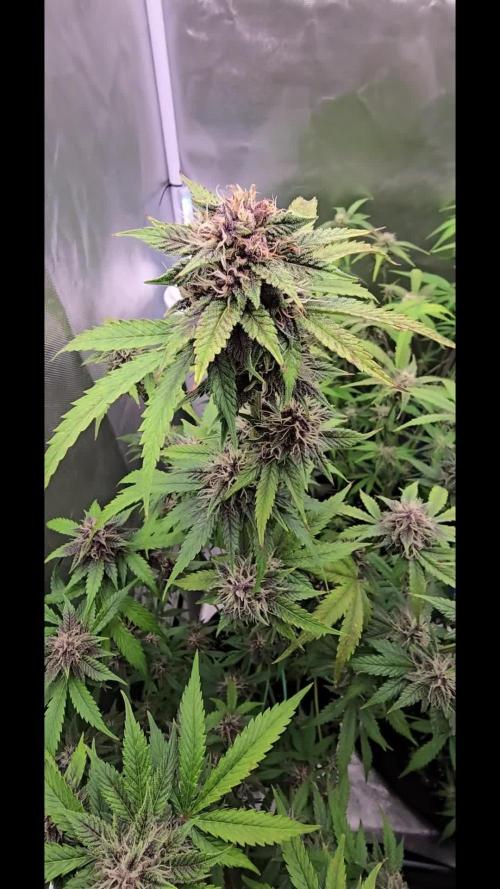
This grow has been sooooo easy apart from a slight bit of nutrient burn that you can see, she has been a pleasure to grow, she is taking longer than expected but i wouldnt have her any other way lol.
Ive noticed that the pistils really turn bright orange even red 😁- i hope she tastes and smells as citrusy as she looks😝 - also getting frosty 👍
Merry Christmas Everyone!!😉

Likes
21
Share


@Swiftgrow
Follow
Week 9 looks great, wedding cheesecake #2 got lots of main colas just slow growth compared to the other.
Sour goo poison still small compensating with nice fat buds and side growth.
West coast OG coming to the end of her cycle soon
Overall happy


Likes
19
Share


@RDWCGrowing
Follow
Week 1 Day 1 - 8/12/2023
1st Water change Day! Such a special time it is when you remove the little bit of Nutes that you gave them as an appetizer and you give them their first real meal.
Added
39 Gallons of Water to my system
SILICA= .5mil/Gal = 19.5 = 20mil
Root Drip = 1mil/Gal = 39mil
Cal Mag= .25mil/Gal = 9.75 = 10mil
FLoraMicro= 3.0mil/Gal = 114mil
FloraGro = 2.0mil/Gal = 78mil
FloraBloom = 2.0mil/Gal =78mil
ORCA= .5mil/Gal = 19.5 = 20mil
Week 1 Day 2 - 8/13/2023
Everything is looking good the roots are making thier way to the water and the new grow is looking nice and green.
Week 1 Day 3- 8/14/2023
Everything is right on track, they are looking beautiful and in the praying postition all leaves happily lifting towards the light.
Week 1 Day 4- 8/15/2023
Looking beautiful today and looked like she could use her first haircut.. gave her a TOP off. Roots are laying in the water everything is looking right on track..
Week 1 Day 5- 8/16/2023
walked in and the humidity was under 60.... ohh noooooo.. So I added 2 humidifiers to the tent and attached them to my InkBird controller which is set to 62. She had roots nicely in the water.. this grow is on!!!
Week 1 Day 6- 8/17/2023
Humidity was a little low this morning, so I refilled the humidifiers. Other than that, the temp looks great, the PH looks great, the PPM looks good the plant is in the praying position and all damage from the little drowning seems to have been fixed. Happy Happy.
Week 1 Day 7- 8/18/2023
Yay.. week 1 in the books, roots in the water growth has started first hair cut given and both side nodes are growing. Everything is looking good and on track.. A lot better than week one of the last grow when I had them drowning week 1.
Really excited on how this grow is going to come out.
Likes
8
Share

@zenderman
Follow
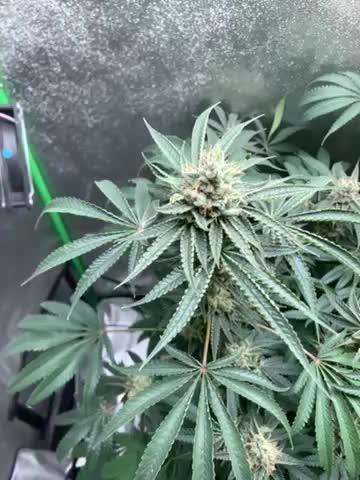
14/7/26 day 43 of flowering,beginning week 7.
second video-20 days old clone,roots forming in process,was taken bud(🌲21 days flowering).
🌱
The clone was cut and planted directly into the soil,previously watered with Terra Vega and under a transparent dome with 18 hours of light.this method means manyfolding from one bud and ideally for scrog/LST technique.🤙🏻



Likes
57
Share


@LockDownGrow
Follow
ok so everything has gone fantastic , no nutrient burns at all , and have been slowly creeping up the base nutrients , i have stopped the cal mag and now adding house and gardens bud XL at full strength these girls are now in full swing of flower and i bought a new ph stick this week ,
i have found when PHing the feed bucket that its best too have air stones in the bucket , add all nuts and then ph but do not use the feed that day as if you check the next day the ph is off again so i left it 24 hours after i add more ph down , and it seems too make the measurements alot easier and stable , i have bent down the main stems " without damaging them onto my netting too A keep the canopy all the same high so my lighting is covering all plants at the same distance and also it allowed the side stems too reach up too ,
i also was sponsored another new led light by kingbo this week so have added another 600watt led too the grow , so now have two 600's and one 900watt , and temps are still fine sitting at 24c lights on and 19-20 off , so am pleased with that , this lady is by far the bushyist plant with the most branches she also didn't stretch much and is packed with bud sites ,


Likes
18
Share


@TheCannaProphet
Follow
~ FASTBUDS TESTER #2204 ~
Well friends, here we go on another 'canna-venture' together!
The grow room has had a complete remodel and some upgrades done to it including brand spanking new 4x8 and 4x4 tents and a Trolmaster Hydro X controller along with a new Control Panel.
This tester strain is one of six tester strains that FastBuds has graciously provided me with and I'm looking forward to seeing what this girl has to offer when she's grown to her full potential!
One drawback of 'testers' is I have little to no information on it other than its number and that it's an autoflower... 🤪 But, it's ALWAYS a blast growing them for me because not knowing a lot allows me to just concentrate on the essentials: Light, Environment, Water, Nutrients and possibly a bit of LST... not complicated, just basics like keeping a constant temperature and RH in the tent at a level that gives a good VPD, watering when almost dry and maintaining proper light levels according to their stage of growth.
____________________________________________________________________________________________________________________________________________________________________________________________________________________________________________________________________________________________________________________________________________________________________________________________________________________________________________________
~THE SETUP~
~Initially seeds were lightly scuffed, then soaked for 3 hours in 78℉ distilled water after which they were transferred to moist paper towels laid out in a Jiffy Pellet plastic starter tray with lid. Underneath the tray was placed a Vivosun Heat Mat with Controller that was set to 78℉ where they stayed until their tap roots emerged.
~Planted into Jiffy Peat Pellets that were hydrated with distilled water warmed to 78℉ with a 7.0 ph.
~Once roots emerge from the Jiffy Pellet they're transferred to their fabric pots.
~Grown 100% organic in a 4g Gronest fabric pot and a 3g fabric pot by Wraxly filled with Mother Earth 70/30 Coco/Perlite medium and initially amended with Dr. Earth 4-4-4 / Earthworm Castings / Dr. Earth Flower Girl 3-9-4 and Coast of Maine Stonington Blend Organic Plant Food 5-2-4.
~19/5 light cycle for the entire run with supplemental UVA added during flower. Lights are controlled by a Trolmaster Hydro X controller set for a 15min Sunrise/Sunset simulation.
~Top dressing every 3-4 weeks with slow release dry amendments and Earthworm castings.
~Straight water ph'd @ 6.2-6.8 when needed and bi-weekly Compost Tea's.
____________________________________________________________________________________________________________________________________________________________________________________________________________________________________________________________________________________________________________________________________________________________________________________________________________________________________________________
Weekly Updates:
12/15- Here we go into the second week of veg for the FastBuds Tester #2204 girls and they're on a roll!When I checked on them today they both were still moist so I let them go until I check them tomorrow. Basically at this point in the run all I have to do is make sure they don't dry out, fill the humidifier and watch them grow!
12/17- Yesterday I watered them both and increased the amount to roughly 0.25g each of de-chlorinated water with 3ml/g of Botanicare Silica Blast (added to begin to help strengthen their branches) and then ph'd to 6.4 @ 74℉.
I've also increased the output of the HLG 650R's to 35% which equates to about 230w at the wall which, of course has raised the temp's in the tent so I've also begun to run the A/C unit in the grow room which is keeping the temp's now at 75℉ in the tent. The RH is running around 75-78% RH giving a VPD of .67-.74 which I'll take! 😁👍
Other than what I've mentioned above, all I did was fill the humidifier with distilled water and watched my girls grow! 🤩
12/19- Today I watered them each with 0.25g of de-chlorinated water to which I added 3ml/g Fish Head Farms Fish Sh!t and 1 tsp/g Unsulfured Molasses which I then ph'd to 6.3 @ 74℉. I'm now watering through the bottom, filling the drip pan and letting the plant draw up the water into itself. I am also watering from the top, but only just enough to moisten the medium.
They're really starting to take off now, a sure sign their roots are beginning to get well developed. Their 4th set of leaves have emerged and as they get bit bigger I may give topping, one or both, some consideration... we'll see!
12/21- Today I watered them both with 0.25g of straight de-chlorinated water each which was ph'd to 6.3 @ 74℉. I gave about 3/4 of it into their drip pans so they can draw it up into their medium, the rest I applied to the top of their medium just to moisten it.
They're both doing fantastic with good color and vigor! They're not very tall and judging by their leaf shape and overall structure I'd say they are definitely leaning towards the Indica side of the gene pool!
I'm holding off on deciding whether or not to top them, but will make a decision in the next couple of days!
Well there's two weeks of veg behind us now, Week Three of vegetation is beginning and they should really start to take off! 😍👍
😎💚 Thank you for checking out my passion in life! Please visit as often as you wish and I hope you enjoy this journey as much as I know I will! Grow Strong! 💪😎🤙


Likes
34
Share


@PrairieFrostGrow
Follow
*****Week 13 growth – March 6 to 12, 2021 – Week 5 flower ******
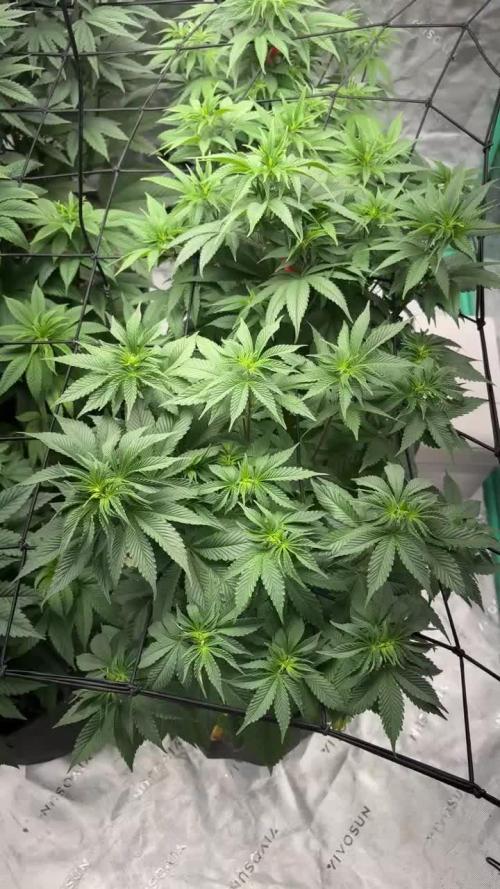
These Mimosa girls are looking very well. Pheno 1 is going to be awesome to trim......very little leaf. As she matures the second pheno is looking better all the time as well. Buds are swelling and getting taller.
Bud Fusion being introduced this week. Into the last phase of feeding during flower now. Nitrogen is continued to be reduced as its late flower. Keeping up the feeding ppm this week as we are getting to the end. May be pushing them a little more than I should but finding out how they react for next run.
Still continuing to play with the light intensity and seeing how the girls react to my environment conditions when pushed harder. Could have backed off and stayed with 100, 300, 600, 900 PAR levels at the different stages but I have trying to go a little higher in the late stages and going over 1,000 PAR.
Little more detail…..
Mar 6/21, Day 29
- Dry out day
- Changed light cycle to 11/13 today to help with light intensity and reducing DLI.
- Light power reduced to 425 watts
Mar 7/21, Day 30
- Keeping up the feeding but reducing nitrogen.
- feeding with micro – 1.5, bloom – 2.5, ult B – 0.5, carbs – 1, B Storm – 2, S Storm – 2.5, Bud Fusion 0.15gr/l, Terp – 1.5, Jet Fuel – 0.5, Rezin 1
- 1150ppm and 6.0pH
- MM1 – 4L and MM2 – 2.5L
Mar 8/21, Day 31
- Watering with 2L feed from yesterday and 16L plain water
- Over shot the pH
- 400ppm and 5.9pH
Mar 9/21, Day 32
- Feeding again with Grow – 0.5, Micro – 1, Bloom – 1.5, Carbs – 1, Magnifical – 1
- Didn’t add many of the supplements
- 875ppm and 6.0pH
- MM1 – 4L and MM2 – 2.5L
Mar 10/21, Day 33
- Middle of the week and just giving some enzymes today
- Enzymes – 1.5ml
- 300ppm and 6.1pH
- MM1 – 4L and MM2 – 3L
Mar 11/21, Day 34
- Microbes again today
- Tap water with Jet Fuel – 1ml, Terpinator – 2ml, Nature’s Candy – 1.5ml, Rezin – 1ml, Ultimate B+ - 0.5ml, Recharge – 1tsp/gal
- 800ppm and 6.0pH
- MM1 – 4L and MM2 – 3L
Mar 12/21, Day 35
- Dry out day
- Been feed a couple of times this week so work with ¾ strength next week.


Likes
13
Share


Likes
10
Share


@RookieGrower65
Follow
Day 95 harvest of last 2 of 4 plants. 10 days after first two were harvested. BB1 and GG1 seem to have denser buds than BB2 and GG2. I think the yield will be greater also. First two plants dried for 6 days at 45-50 RH and 65-70F and put into quart Mason jars with humidity meters and pouches at 62 RH. Once second two have dried, will update dry weight for all 4 plants in Harvest week.

Likes
35
Share


@DjDaveAtHome
Follow
The addition of an enzyme has produced amazing results that were shocking and worrying at first. Massive rise in EC and PH every 24 hours from 5.3 - 6.8. Research yet no sign of any harm to the plants, in fact they seem very happy! The enzymes has created an environment friendly to the beneficial microbes and fungi that has lead to a feeding frenzy (Which wouldn't have happened ad I used Hygrozyme from the start.). EC rises a point or two as the microbes and plants expel waste and create a plethora of negative charged hydrogen ions. Thus, the PH rises. Never above 6.8, strangely.
Because the microbes are eating and shitting so well, they have added a lot of chilated nutrients that are easier for the plants to uptake at a wider range of PH (Yes, some as high as 6.8). The fact that there are so many bunches of calyxes sprouting and exploding, filling in the flower space is proof enough for me.
Blueberry Headband (2) from Humboldt Seeds.
https://www.humboldtseeds.net/en/blueberry-headband/
Lighting
https://www.horticulturelightinggroup.ca/products/260w-qb-v2-led-kit
DWC Nutients
https://generalhydroponics.com/floraseries
FloraGro .5 ml/l
FloraBloom 2.5 ml/l
FloraMicro 1.5 ml/l
Cal Mag 1.5 ml/l
https://generalhydroponics.com/calimagic
Diamond Necter: N/A
https://generalhydroponics.com/diamond-nectar
SuperThrive: .5 ml/l
https://superthrive.com/
Epsom salts
Tarantula
https://www.advancednutrients.com/products/tarantula/
https://hylineproducts.com/products/hygrozyme/#one
Grozyme: 2.5 ml/ltr
Brown Slime Root Rot Organic Microbe Tea
4 liters RO or tap water
5 ml (1 tsp) organic sulphur free molasses
5 ml Alaskan Organic grow fertilizer (or something comparable)
5 ml Alaskan bloom fertilizer (or something comparable)
5 ml Seaweed or kelp fertilizer
2-4 ml Advanced Nutrients Tarantula

Likes
3
Share


@thefrozenking
Follow
Day 70!
only a few weekes left. boy are these looking good
2 plants drinking 1 1/2 gal a day
Likes
25
Share


@Dunk_Junk
Follow
Day 70 - She grew 4cm this week. Her flowers are not as developed as any of her tent mates, looks like she's going to take her time flowering. That's ok. I'm happy to wait 😀
Likes
22
Share


@Thee_HoffGuyy
Follow
It was another excellent week!! She is nearing the end of her course🙌 This is week 8 for her, This is supposed to be an 8-10 week flowering strain and I would agree. This one looks like she will go 9 to 10 weeks but if I was in a rush it could be cut now but I am in no rush so will let her go another week or two depending on how her trichs look. Soo many beautiful colors on this girl!! It's got purples, blues, oranges, greens It awesome🙌 It reeks of citrus lemon lime fruitiness with this slight chemical? like undertone Idk kinda like turpentine it hard to say but smells wicked 👍💪 I Started dropping some of the nutes this week as well getting ready for the flush So for right now It's only House&Garden Aqua Flakes A&B at 5mL/Gal, Drip Clean at 0.5mL/Gal and Last but not least HydroGaurd at 2mL/Gal. I will be doing a full water change around mid week this week, when that is done that will be the start of the flush😊 This is such and awesome Strain to grown Just amazingly beautiful even my Grandma Thinks both this and the Fruity Pebbles are some of the most beautiful plants she has ever seen😆 She doesn't smoke or anything but just loves plants especially this one and the Pebbles She wants me to make her a poster/picture thing of them for her to put up in her house I love it!!!😃 Well thanks for stopping in to see how Mattie is doing, Stop by next week to see how she is doing and if shes ready to chop!!
Happy Growing an Plentiful Harvests!!🙏🙏
