


Likes
Comments
Share


@Kloud9gardenz
Follow
Space is limited and I'm struggling with the time to keep up with these plants since things are back to normal on my parts of town. Just gonna keep about eye on em at keep defoliating. Plants flipped after 1 month veg

Likes
20
Share


@UDAAC
Follow
Well welcome to week one flower !
I am so grateful she seems happy starting to get the system balanced I’m running rdwc two five gallon buckets with a 3” flex line connecting the base to base
With ball valves to control the water height in grow bucket 320gph sub pump in the Reservoir bucket then to water chiller back to grow bucket large enough dependable oxygen pump for grow and reservoir water oxygenation I also alternate Southern Ag GFF and Hydro guard let’s go!

Likes
7
Share


@MrGrowthSpurt
Follow
Hello everyone. I can't believe that I am arleady in week 9 overall and d week 4 flowering.
All of my ladies are doing well


Likes
5
Share


@Silverback_Guerilla
Follow
12/9:
Fed today. Plants are looking much better now. I'll switch them to 12/12 and add extra reds tomorrow. Will also begin UVB stressing immediately.
12/11:
Flipped to flower.
12/12:
Fed today and sprayed with boom boom spray and axiom harpin proteins. I also added a tablespoon of Happy Frog Cavern Culture to the pots before watering it in.
Got the DIY CO2 generator going with a fresh batch of sugar and yeast.
12/16:
Fed today. The weird little lava cake just wasn't keeping up with the rest of the crop and I decided to remove her from the garden. For now, she's in my wife's office with our overwintering pepper plants, but I'll take her out to the greenhouse and hide her amidst my broccoli and cauliflower plants tomorrow and see how she does in the cold. 🙏

Likes
20
Share


@TechDCo
Follow
23/10/2024
Lights On!
I opened the tent this evening but it's her morning 🌄 however you like to picture it!
Strong smell of gas that' smells bitter like lemons, when it hits the back ya sinuses.
After a few minutes taking pictures, the undertones of the nutty earthy leaves prevails and lingers around the room it seems for much longer than the lemons.
24/10/2024
Lights On!
25/10/2024
Lights On!
26/10/2024
Lights On!
Deffo smelling very sharp lemon 🍋
27/10/2024
Lights On!
Yep, there deffo lemons I'm smelling its a Strong Lemon Toilet Fresher kinda' thing!
I'm not saying 'Lemon Toilet Freshers' are my thang! But hey, its a sharp lemon smell!
Reminds me of the smell of apple car Freshers but lemon instead! I do say; it's the kind of fresh sharp citrus smell when you open ya car door with fresh Freshers hanging! 😈 👿
Slite nute burn from the Holland nutes!
"Note to self: next time time add 0.6ml/l instead of 1ml as a low dose!
You'll get it perfect eventually 😌 I'm sure!
"Not all fat hairy girls are dumb and smelly: some maybe the lazyones, but this time of year the crazy ones and lazyones have to go shopping, nowonder its bussy this time of year: cues cues cues, like Jesus Christ put a folk in it or two! 😉KFC should do trollies for a family pack! deffo at x-mas time because the halloween treats have vanished, the snow then falls, the prices go up the portions go down (more recycled junk) you gotta blame "global warming" on some fat b!tch taking up the space!. Jokes aside: Mrs.Clause like playing with Santa's snowballs!
Sorry folks 😞 that's a backwards sexes Mrs.Santa joke 😃
.....Baha well biite mee for spreading laughs this time of year! - Like her egg yolks!
28/10/2024
Lights On!
Sorry uploaded 😔 all the photos from today! Will sort them out later! Cba one of those dayz!
I just wanted to get them off my phone!
I felt like I was going to say "get them off my chest" reading that over again quickly! - Poor English when I'm not running everything through Ai 😕 or is this actually Ai prompted to make mistakes and appear normal! Aye! Makes you question my whole existence within these entries of folklore and mystic magical characters! Baha
I think it's my eyes - I'm seeing purple 💜 👀 on her pistils!
Blink twice though and the purple hues is definitely there! Oh boy, this is going to be awesome colour show!
I reckon 10-11z give or take!
Counting time ⏲️ is a forever losing battle!
In ones mind it's a peaceful shuffle rattle!
We are just in "Crusing Shuttles"
the brain is a bubble
29/10/2024
Lights On!
Had to supercrop some branches!
Now drinking just over 8.5L/24h.
5L = Day
3.5L = Night
The last 4 days i topped up only with water to balance the nutes out; i clearly forgot to mention this! She seems a lot more relaxed and the NPKs have leveled out!
BG41 indica tent is doing okay she's drinking 4.5L/24h.
"Time for a advocaat!
I could be Dutch at heart! Well, I sure do
speak it 😏 on the double!"
"Reversed Black Joke to a WhiteWoman:
She got smacked of a black guy and never went back 😅"
You ever wonder why hospital lights frequencies make you feel sick! 😬 😫 deffo the street lamps 🔦 now! Too bright! The sun is more blue with its halos 😇



Likes
18
Share


@Staffedition
Follow
Всем привет друзья!
Решил попробывать фотопереодный поднять от Fast buds и не только, смотри профиль.
Это будет мой первый опыт с фотопереодными растенями.
Надеюсь фотопереодный покажет достойный результат!
#Smail_Seeds
Likes
93
Share


@Roberts
Follow
Auto Opium is growing good. She has put out her first pistils. So she is transitioning into flowering. She is in need of a solution change and will get it this weekend everything has been going well and Nothing to report. Thank you Divine Seeds, and Medic Grow. 🤜🏻🤛🏻🌱🌱🌱
Thank you grow diaries community for the 👇likes👇, follows, comments, and subscriptions on my YouTube channel👇. ❄️🌱🍻
Happy Growing 🌱🌱🌱
https://youtube.com/channel/UCAhN7yRzWLpcaRHhMIQ7X4g

Likes
6
Share

@Staffedition
Follow
Привет друзья.
Наше знакомства продолжается с новым сортом автоцветущих растений от Smail_Seeds сорт .TROPICANNA POISONZKITTLEZ XL AUTO Reg.
Сегодня растению 97 дня.
Шишки налились очень хорошо😀
Вы всё сами видите.
Скоро будут феминизированные
Сорт выводим сами.
Смотри мой профиль, у нас всегда есть что то интересное.
Не забудь поставить лайк❤️, если понравилась как прошла неделя
И читайте наш TELEGRAM: https://t.me/smail_seeds
#Smail_Seeds 😀
Likes
15
Share


@Bhangi_Zimidar
Follow
I cut out the nutrients and let the plant do its thing. I also noticed the plant had been pollinated and was starting to grow seeds, so I cut her at the end of this week, a week early. I left a portion of the plant to seed, but the rest was cut and hung. The branch I left is showing toxicity, proof of the intensity of nutrients this plant needed to survive. I tried to combat this with PH balancer to keep the cola productive and not toxified by the excessive nutrients needed by the rest of the plant that wasn't there. I was successful by prolonging the life closest to winter by building a heat trap, and mulching the ground beside the plant.
Likes
9
Share


@Krissci
Follow
Day 1 reported to 3gal pots....same soil so it's repotting not transplanting
Day 3-4 topped once - 2*nodes
Day 6 topped twice - 4*nodes
Likes
35
Share


@Papablob
Follow
je note une forte décoloration des feuille.. J'ai tranché pour un manque de nutriment.. On verras bien.
05/05/22 soir: Défoliation du bas. Bon.. C'est trop tard mais ca m'arrange pour arroser et observer. C'est étrange que même l'aspect de la terre en surface change a ce point.😮
Ca reverdi. Donc c'était bien un manque, plus certainement un coup de froid. On a eu une coupure d'électricité une nuit très froide.

Likes
120
Share


Likes
9
Share


@TiRobotProds
Follow
4ème semaine de floraison. Cette dame ce porte a merveille ☠️☠️💀 irrigation tous les 3 jours environ 6L, 12L/Semaine.

Processing
Likes
3
Share


Processing
Likes
Comments
Share


@Steviegrows
Follow
By end of week was watering every other day with about 300 ml/plant and adjusting PH to between 6.0-7.0. Turned on the SF-1000 QB this week.

Likes
44
Share


@Jays_Not_Here_Man
Follow
Thanks for checking out my grow! This is the 4th or 5th strain I’ve ran by 34 Street Seed Co. I have yet to be disappointed, great genetics for a fair price. This Pink Lemonade strain has tested in the 30% cannabinoid range with crazy terps, all from other Home Growers! This will be one of my submissions for the 2023- 34 Street Grow Cup, Can’t wait 🇨🇦👊❤️
I started as usual by soaking my seeds for about 6 hours in a glass of distilled water, then planted directly into the substrate about a 1/2 inch into the starter pot. I dialed my light back to about 100 watts from the wall, and raised it to about 40 inches above the pots. I covered the pots with domes, and set my humidifier to run non-stop. 30 hours later , they had all sprouted ❤️

Likes
36
Share


@MadeInGermany
Follow
Info:
Unfortunately, I had to find out that my account is used for fake pages in social media.
I am only active here on growdiaries.
I am not on facebook instagram twitter etc All accounts except this one are fake.
Have fun with the update.
Hey everyone 😃.
Every day is a joy when I take the lid down and see how the lady comes to life 😊.
She is developing great :-)
It only had to be poured once with 300 ml because it is under the hood with a very high humidity :-).
The hood was sprayed every day.
I think I'll start training this week :-).
Otherwise, as always, the humidifier was refilled and the entire tent was cleaned.
I wish you a lot of fun with the update :-).
Stay healthy 🙏🏻 and let it grow 👍.
You can buy this Strain at :
https://originalsensible.com/original-sensible-seeds-zkittlez~20503
Type:
Zkittlez
☝️🏼
Genetics:
Afghan Kush Indica x Grandaddy Purple x Grapefruit hybrid
👍
Vega lamp:
2 x Todogrow Led
Quantum Board 100 W
💡
Bloom Lamp :
2 x Todogrow Led
Cxb 3590 COB 3500 K 205W
💡💡☝️🏼
Soil :
Canna Coco Professional +
☝️🏼
Fertilizer:
Green House Powder Feeding
☝️🏼🌱
Water:
Osmosis water mixed with normal water (24 hours stale that the chlorine evaporates) to 0.2 EC. Add Cal / Mag to 0.4 Ec Ph with Organic Ph - to 5.5 - 5.8 .

Likes
Comments
Share

@Franci5
Follow
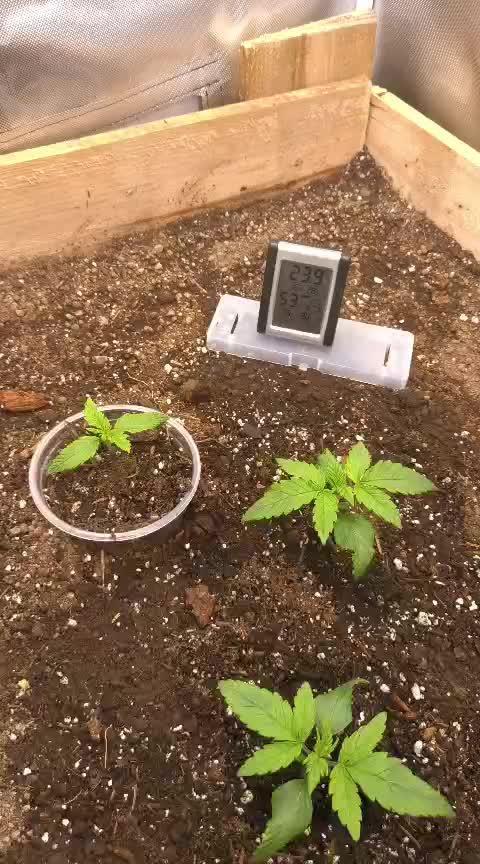
In the third week, fertilizers are added, and the plants are lightly pruned to encourage diagonal growth. I also tuck the leaves to allow light to penetrate, and transfer the plants to the growing bed.😋

Likes
3
Share

@Lvnsource
Follow
Feed Log:
#1 - D:94 - 6L - Si,[3.6ml],Algo [0ml],HakaB[4g],HakaR[5g]Ca/Mg,[0.3g/L & 0.2g/L],INPUT: [pH 7.0],[1.666 + 0.440 EC], OUTPUT: 5.4L , [1.586 EC], pH [7.1] Previous irrigation: D:92
#2 - D:94 - 5L - Si,[3.6ml],Algo [0ml],HakaB[4g],HakaR[5g]Ca/Mg,[0.3g/L & 0.2g/L],INPUT: [pH 7.0],[1.666 + 0.852 EC], OUTPUT: 0.8L , [1.630 EC], pH [7.1] Previous irrigation: D:92
———————————————————————————
Everything is running according to plan. 👍
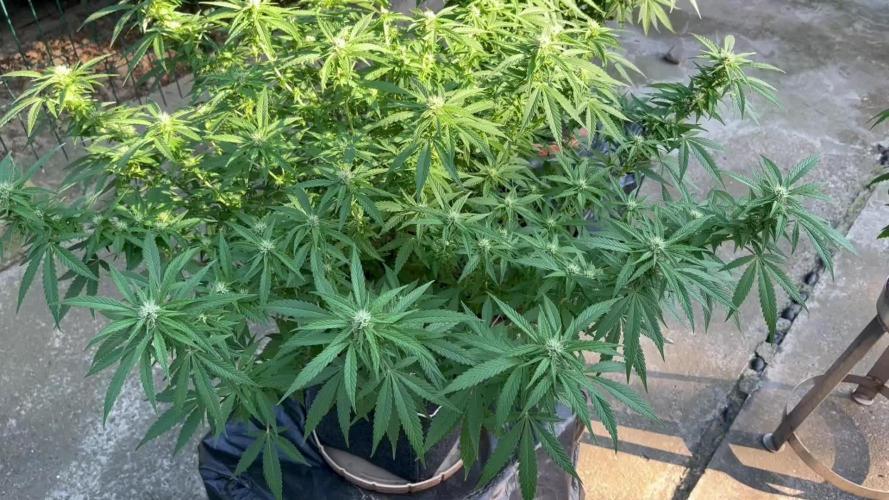
This past week, I did another round of IPM because I spotted grasshopper nymphs, which I haven't had to deal with until now; the minor thrip damage that presented itself in the earlier weeks is practically nonexistent at this point, too.
I’ve spotted a few beneficial predators here and there; wolf spiders, jumping spiders, and ladybugs. 🐞 🌱 These guys are doing most of the work for me so minimal intervention is required on my part although I will manually remove pests when around.
——————————————————————————
Other than that, I’m continuing to manage pH and EC, ensuring the fabric pots never dry back to avoid salt spikes. To ensure I keep the EC levels stable, I irrigate the plants with 1–1.5L of rainwater before I add my main nutrient mix. ☑️
The plants currently require fertigation every 2 days, but that will soon shift to daily management. I’m also maintaining my manual light dep schedule: bringing the plants into darkness after 12 hours and moving them back out in the mornings. ☀️
I’ll also perform one last prune of all the shaded bud sites. 👍

