


Likes
Comments
Share


@Wicked_Stix
Follow
This girl isn't looking super frosty but she smells like candy. Almost an identical aroma to the slurricane 7. I spread the plants out a little this week so they get better light and air flow. Other than that I haven't done anything besides keep the reservoir full. Still pumping nutrients 1 minute on 20 minutes off. They are getting .5 tsp maxibloom per gallon. Not going to run any boosters this round. They dont look like they want or need it.

Likes
15
Share


@The_Stonedbaker
Follow
Hello Everyone and welcome back!
Its been another tough week so I hope you are all hanging in there safe.
So in this week at the start I did a pretty good defoliation to allow more light penetration and to clean up the lowers on the plant. By the time I took these
pics it is hardly noticeable.
During this week I also did two waterings.
The first was 20L of water with 3tsp freeze dried coconut and 3 tbsp of microbial mass.
The 2nd was 20L of water with 1/8 tsp of sulphate of potash, 3 tsp coconut, 50ml liquid kelp and 4 grams of TM7 Ful-Humix.
After this most likely I will only use the freeze dried coconut for the remainder of flower.
Its really cool to see the flowers develop and watch them start to swell.
While they were younger I had added a few bamboo poles but I added 2 to each pot trying to stick to the outsides of the pot
as I did it to not damage the roots too much. I think they will get heavy enough to need support so I am trying to be proactive
to protect them.
The flowers have a pretty great smell happening when I open up the tent.
Strain: Moon Boots bred by Archive Seed Bank
Tent: 2' X 4' @highdrogro
Light: Scyence Dragon S Turbo 450 Watt LED
Light Cycle: 12/12
Soil: Black Swallow Living Soil, KIS organic mix
Top Dress: Insect Frass and MYGOODGREEN Bokashi pro
Air Circulation: AC Infinity Cloudline T6 Inline Duct Fan + two Air King clip fans.
7 Gallon Living Soil Bags: Grass Roots Fabric Pots
Top Dress: MYGOODGREEN Bokashi pro and 3-1-3 Insect frass

Likes
6
Share

@GnomesAndStones
Follow
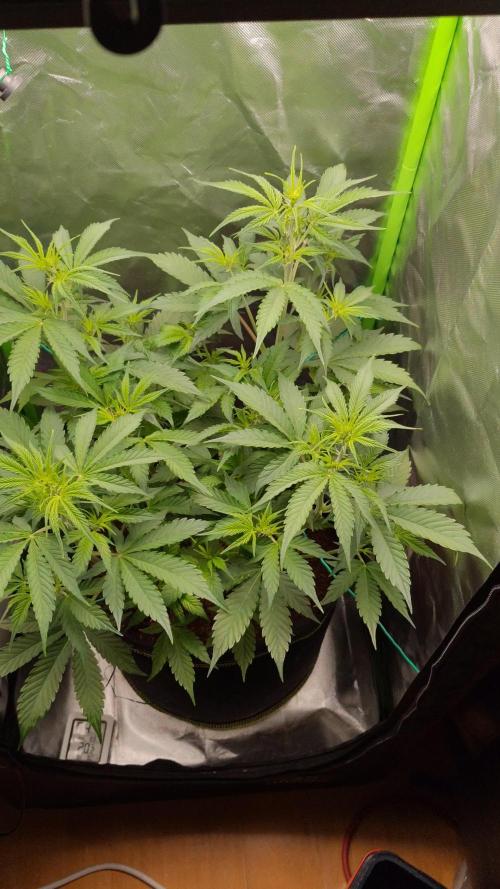
🌱 Absolutely fantastic week! The stretch really hit during this week with a height increase of 22 cm. She is drinking a lot (~1,5L per day) and is giving hints of first bud development.
I didn't do any lollipopping or removing of lower branches yet, because i am waiting for the end of her stretch, to hopefully give her one perfect treatment while letting her decide on the basic structure. There was also no defoliation to increase light on lower branches to create bigger hight differential between main and side branches to achieve bigger buds. My canopys usually end up quite uniform which might be better for yield, but i much prefer bigger buds.
Day 37
💧 Watered with 2,5 L at 1050 ppm.
Day 41
💧 She got another 3 L at 1200 ppm. Different ppm is mostly caused by added silicate, which i dont measure exactly and sometimes leave out completely.

Processing
Likes
28
Share


@Elysian_gardens710
Follow
Day 22 and 23:
Going easy breezy so far!! I released some ladybugs in my tents on these Chocolate Mint OG's 21st day. So far so good lol.
Last night when I watered I gave a little real growers recharge to help with the recent transplant (it definitely gave them a boost!)
Its mid summer here in MI and 84+ temps 😬 keeping the house and tents cool has been a challenge to say the least. Thankfully all my plants are in Veg and seem to like the heat. Except the Choc Mint.they are showing mild heat stress on the top fan leaves(at least that's my guess) Tent temps have been around 86 down to 84 daytime. I lowered them so they are 24" from the lights 🤞 hopefully that helps. Other than that, no problems. And some generally happy plants! The recharge and soil combo burned them a very little bit as well.
Day 25&26
Nothing too eventful. I watered #2 on day 25. With some real growers recharge. The stuff is awesome! No nutrients needed if you have good soil!
Day 26: snip 2 fan leaves from #2(the topped one) she was getting a little bushy. And tucked the other fans under to promote some lower branch growth. #1 I'm letting roll totally natural unless I clean up lower canopy to prevent pests.
Day 27:
Plants are doing great! #1 is really getting tall and # 2 is staying short and squat because of the training. We are letting #1 go naturally. Today's update is we added some LST wire to #2 to pull down her lowest branches
My equipment and gear:
2x4 vivosun
Es300 lighting
Vivosun oscillating tent fan
Honeywell Hurricane fan
6" exhaust outside
15,000 BTU air conditioner
8,500 BTU in tent air conditioning
Some sick ass Genetics 😁

Likes
15
Share


@BruWeed
Follow
🍀21/07 - Ya se encuentra en etapa de secado.
🍀En el lavado de raíz le agregue 30L de agua con 10ml de Top Wash, las ultimas lavadas ya el agua de la maceta salia transparente.
🍀A la hora de cortarla largaba mucho olor a dulce, los cocos todos llenos de resina y muy pegajosos.
🍀La gran mayoría de los cogollos son grandes y densos, muy poca cantidad de cocos chicos.
🍀Es una planta espectacular, no tuve ningún problema en toda su etapa, creció perfecta.
🍀La voy a dejar los días necesarios para que pueda secarse, ya compre sobres de humedad para el próximo paso que seria el curado.
🍀Dio un total de 165g, en un indoor de 60x60 y con luz led de 150w.
🍀En estos días seguiré subiendo mas imágenes de como viene.
🍀😶🌫️🇦🇷Podes seguirme Insta gram como @bruweed_arg🍀😶🌫️🇦🇷

Likes
17
Share


@Naujas
Follow
it's amazing, this growth looks much better than my first attempt, my decision was to put a smaller pot and change the light - the girl really liked it, FastBuds goriilla cookies with a small space manage perfectly:).


Processing
Likes
20
Share


@BudXs
Follow
Well, it looks as if one of the 3 plants is a male. I live in denial for one more day and then I toss it. Not sure which plant it is, as I painted over the strain names when I painted the cups grey. Smooth. So I will find out soon. Otherwise, good weather and some good growth. Roots are balled up at the bottom of the dutch bucket reservoir, Im sure, because I let the drip go dry for a day or two and the plants were droopin (coco)

Likes
10
Share


@BasedBuds_89
Follow
Great week, no problems whatsoever. Looking forward to watching the progress more


Likes
Comments
Share


@Shawnman
Follow
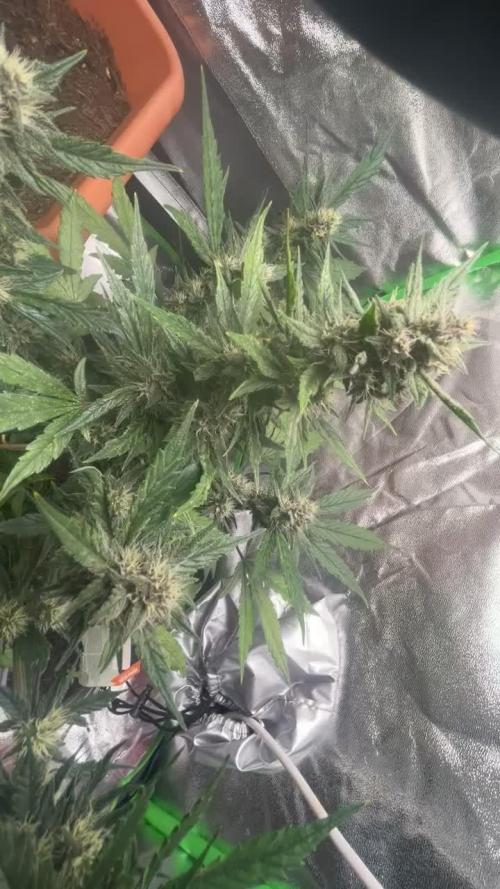
Lollipop the bottom 1/3. Plants are around 18" tall. Looking great. These girls look like they are ready to begin flower so they got flipped day 45.

Likes
21
Share


@Hellhazard
Follow
Day 56: These 3 girls are finishing out. Cyco nutrients did awesome for me!
I found a top with some bud rot beginning to start so I lopped that off. It was not much, but I got it early (learned first hand in the Gorilla Girl grow). Humidity has been higher these days.
Buds are turning slightly purple.
Decent amount of sugar on the buds now.
Trics are mostly cloudy, very few amber.
Most pistals have withered and calyx look swollen.
Smell is beginning to give a cakey-gas undertone to the up front scent of overripe cantaloupe across all 3 plants. There is a tiny bit of pine.
I need a cell with a better camera :(
Some more days of water and Flawless Finish then the chop.

Likes
48
Share


@AsNoriu
Follow
Day 50. Girls are running fine. Found some strange black curled leaves, had to apply Leaf Coat just in case. Was stupid enough to spray already flowering auto tent, all pistils went dark and girls look like shit. I know it doesn't influence final result but its a shock and all photos will look like shit from now on .... So here i did it purely for not doing later ... ;))
Blue dreams are biggest plants, Kalini Asias and Runtz end up somewhere the same, but smaller than BD.
Silica, water, feed. Thats the plan for this week.
Day 53. Girls got Silica Acid yesterday and it was too early ;))) i have to move lights, but i don't want to induce more run, inner spacing is enormous on couple last nods ... Better to use in early veg and after stretch ;)))
Video shows it all ...
Day 53. Evening. They just run to the sky, some girls are rubing LED's ;))) If i raise lights today - ill have to repeat it tomorrow, still almost 2 weeks of stretch left ... will go "slow burn" way ;))))
Happy Growing !

Likes
48
Share


@Hashy
Follow
Grow day 84 its end of week 12 and things are still ticking along nicely.
Pineapple express had a big defol during the week and trichomes getting cloudy. She is 78 days old.
Jack herer also had a big defol and is really packing on some weight. She is 78 days.
Gorilla cookies had a tiny defol and her trichomes are starting turning Amber, she isn't going to have much weight but is looking sticky. She is 84 days old.
Lemon pie is about a week behind the others in her production, She is 79days old.
On grow day 83 I switched over to 3ml/L ripen Ec 1.2 Ph 5.6
I will run this for 7 to 10 days before flushing. All 4 will have to be harvested at the same time.
Max 27. deg
Avg 22. deg
Min 17.9 deg
Max 71%
Avg 53%
Min 43.6%
Likes
5
Share

@GANJAT
Follow
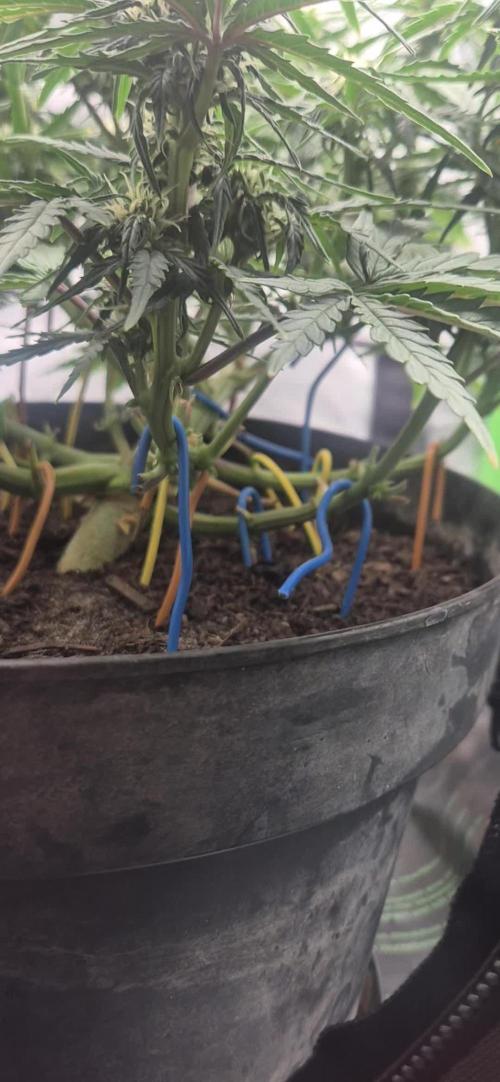
Die Pflanze gedeiht gut und mit der Entlaubung und etwas Lollipopping lege ich den Fokus auf gleichmäßig große Buds.
Die Luftfeuchtigkeit hält sich bei 40 bis 55%, je nachdem ob gegossen wurde.

Likes
1
Share


@Elguacho420
Follow
Muy Buenas a tod@s.... Tercera semana de las tropicanna poison, variedad interesante... Se la ve bien, uniforme y de buen tamaño, buen tallo x el tiempo q tiene... Va creciendo muy muy bien... La semana q viene más, ya no les falta nada para flora, los días pasan rapido...💪🏻💪🏻💪🏻 Buenos humos para tod@s💨💨💨
😎💎⚕️
🇦🇷🤝🏻🇪🇦
Likes
91
Share


@Greenwolvesfarmer
Follow
Bajando las horas de exposición de luz , pasamos a floración neta ! Al fin ! Largo trayecto con estas preciosas ! Salimos del stress 🙌🏼🔥 #480w #SAMSUNGQUANTUMBOARDS
@leds.mk
@eva_seeds
Leyendo e investigando , pasando a la realidad y al papel ideas y proyección ...
Te amo sol y tierra , nada más! Te agradezco por un día más en este bello paraíso.
.
.
.
.
.
.
.
#seguimientoMKLED #cannabisfamily #420 #420weed
#greenwolvesfarmer #weedchile #weedgrower #cultivoindoor #cultivointerior #indoorgarden #cannabischile #cannabissociety #cultivamedicina #medicinanatural #420family #420time
#chilecultiva #nomaspresosporplantar #growdiaries #growdiary #cannabisgrowers #quantumboard #samsungquantumboards
#480w #quantumboards #seguimientoMKLED #comunidadcannabica #cannabiscomunity


Likes
21
Share


@BLAZED
Follow
W19 (Harvest)
6-6
Last day before harvest.
7-6
Harvest day!
Installed a humidifier outside the tent, set to 55% aiming for a 60% humidity inside the dry tent.
21-6
After 14 days of slow drying she is ready to be trimmed.
While posting this a couple of months later i found out that i totally forgot to make pictures and video's of the trimmed buds 😅
It was a very nice daytime smoke, tasted sweet-sour.
End results:
74.26 Grams of bud
57.90 Grams of small buds and trim, in the freezer for bubble hash.
I have some trim and small buds saved up from different strains and i will be posting a diary of the full process making hash of them!
If you are interested in me making bubble hash feel free to follow me as i will make some in the next month, this way you keep notified!

Likes
32
Share


@BreakingBud
Follow
Struggled a bit with heat, had to put a fan over canopy. The hps has made a noticable difference in hardening up the buds. I rhink another 10 days to 14 days left.
Update day 49: as recommended by @B4RNS I have reduced the last week of feeding to e.c 1 prior to a week of flushing! New video added with lots of heads!