


Likes
Comments
Share


@BioBuds
Follow
It was finally time to harvest her, what good times we had with her. Amazed with how beautiful this plant is, how easy to manage and train and how rewarding Orange Hill Special is.
So we said our thanks and goodbye, thanked her for all the joy she gave while growing her. I realize more and more how I love growing them even more than the end-product.
It takes my mind of all going on for a while, in my miniature jungle world in the attic.
Im sure all of you just sometimes sit there and watch them, in wonder, dreaming away with a good buzz on, watching them wave in the wind of the fans.
So with a heavy hart I apologize, play them their last music, sit with them and feel them and smell them, watch the glistening of the cristals.
In the end we had 209 gram dried Orange Hill Special, I will know the total of the grow, in a few days, since the final big whopper still has to dry: my XtraKush, be sure to check the harvest of that one *in couple of days) and see a one-dollar seed outperform two 10 dollar seeds.
I probably go over 500 grams for the total grow, which would be 1.6 grams per watt. Big success!
Consider an SP-3000 for your next light, you won't be disappointed! Check www.mars-hydro.com for the latest discounts!
Thank you @MarsHydroLED for letting us try out your light, it made this successful grow possible!
Greetings and all the best! Thank you to our friends here, our followers and the whole Growing Diaries community for just being there.
Big Hug,
Sunshine and BioBuds



Likes
92
Share


@DogDoctorOfficial
Follow
Week 4 Veg Report - TrolMaster Chronicles 🌱
What a week it’s been in the garden! We finally transplanted the Papaya Zoap into its final Autopot, and let me tell you, this plant is something special. Though her roots weren’t quite where I wanted them to be yet, the move was needed to help her catch up with the rest of the crew. She’s already looking fantastic in her new home, and I have no doubt she’s about to explode with growth in the coming days. Sometimes, you just have to trust the process, and I’m feeling like this is one of those moments. It’s almost as if the room itself is taking on a life of its own. 🌿
In fact, I’m starting to believe that what we’re building here is something greater than ourselves—there’s this energy in the room, a feeling of everything coming together perfectly. I can’t wait to see how this journey unfolds!
Dialing in the VPD with TrolMaster’s Tech
Now, let’s talk VPD (Vapor Pressure Deficit) and how I’ve been keeping everything in check with the Tend-X and the incredible (DSH-2U) Humidity Station. VPD is crucial to plant health—it’s all about finding that perfect balance between humidity and temperature to optimize transpiration and nutrient uptake. The (DSH-2U) Humidity Station, connected directly to my humidifier, has been an absolute game-changer in this regard. With its real-time data and automation, it allows me to monitor and adjust the RH with pinpoint accuracy.
Simple yet brilliant, the (DSH-2U) Humidity Station is keeping my room at the sweet spot I need. Whether I’m tweaking the settings from my phone while I’m out and about or just fine-tuning things while relaxing at home, this machine does it all. It’s like having an extra pair of hands in the grow room—and when you’re managing something as complex as VPD, that’s invaluable!
And yes, the TM+ Pro App—let’s not forget how awesome it is. I’m adjusting my grow room from the couch, the car, or even the bathroom 😜. I’ve said it before, but this app is making growing easier than ever.
Feeding the Girls: The Perfect Blend 🌱
We’ve upped the game by adding CaMg-Boost at 0.25 ml/L to the feeding schedule. Along with the 1 ml/L of the all-in-one liquid, this brings the TDS up to 320 ppm, with a pH of 5.99 and solution temperature of 24.8°C. In the soil, readings are around 415 ppm, with temperatures hovering around 25°C The plants are absolutely thriving, and I can already see the difference this new feed is making.
I can’t help but have a bit of fun with this process—it feels like I’m spoiling them with the best of the best. And they’re rewarding me with beautiful growth and vibrant green color. You know how it is, with the right care and attention, these plants are truly becoming a masterpiece in the making. 🌱
Shoutouts 💚
Big shoutout to TrolMaster and ThinkGrow LED for the phenomenal gear that’s making this grow smoother than ever. Also, massive thanks to Aptus Holland for their top-notch nutrition, and of course, to the community here on GrowDiaries—you guys keep the energy alive! 🌱
Last but definitely not least, shoutout to all the seed banks supporting this journey. You’ve been a huge part of this process, and I couldn’t do it without you!
Remember, for exclusive behind-the-scenes content and updates in real time, head over to my Instagram and YouTube channels @DogDoctorOfficial. We’ve got tons of epic content lined up, and you won’t want to miss it!
P.S.
Let’s talk about the new Model One LED Bars—these beauties are not only powerful but super efficient. I’ve been able to dim them down, save on electricity costs, and still maintain an incredible PAR and spectrum. It’s all about fine-tuning the balance of power and performance, and these lights make it easy to get the best results while being eco-friendly. Whether you’re running them full throttle or dialing it back, you’re still getting optimal growth conditions for your plants. That’s the kind of innovation that takes your grow to the next level. 💡
Growers Love to all 🌿💚


Likes
1
Share

@BossberryFarms
Follow
Merry Christmas and Happy Holidays!!🎄
Welcome to Week 11 😍
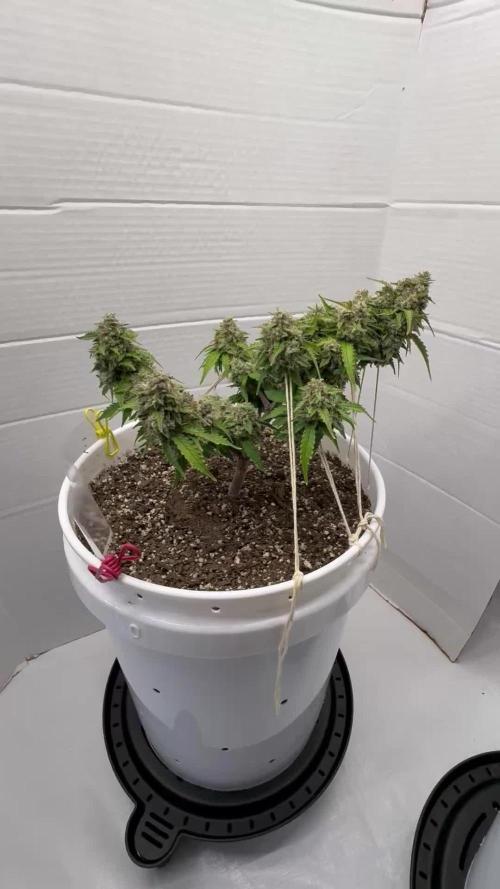
I’m just so thankful for these plants and the harvest in a couple of days (hopefully)! I had a little too much fun with the photos 😂 the joys of the simple life LOL
I’m flushing all with plain water at this point and watching closely for them to ripen. I also cut off all the tie downs.

Likes
27
Share


@Herbinski
Follow
During the past week a lot has happened.😃
First of all I chose Pheno 1 to stay and I gave Pheno 2 away to my friend.
I switched the Bilberry light to Bloom Spectrum, but kept the 18 hours light schedule the reason behind this is that because of the quick (unexpected) vertical growth I am soon planning to re pot and then switch to 12 hours. I don't want to put all that stress on her at the same time.
The switch has even more increased the growth. She is going FANTASTIC!!💪
I pruned just twó (one level) of fan leafs to give some light to the lower levels. Normally I don't do this but something compeled me this time.
I fed her twice tha past week, both times with the same nutrient proportions. I dont't have to water much as the BAC Lava Soil keeps the moisture very well.
I hope she keeps going like this!!

Likes
Comments
Share


@marcian
Follow
Semana #2
La catástrofe.
Al llegar a mi casa, encuentro este triste escenario.No cerré bien una de las entradas del indoor y una de mis gatas entraron.
Murieron tres plantas.Dos Auto Brooklyn Sunrise y una Xtrem Haze.
Sentía que este cultivo tenia que ser desechado por todos los problemas iniciales, pero decidí continuar para ver que tanto pueden aguantar las plantas y por la inversion en estas semillas.
Las sovrevivientes se veian un poco torcidas, pero veremos que tal siguen.
Por todo esto, a las sobrevivientes (3 Auto Mazar y 2 Xtrem) no les haré ningún tipo de técnica y trataré de abonar con lo mínimo un par de semanas.

Likes
3
Share


@Kelly420
Follow
She's filling in nicely , I'm having trouble deciding on when to start my flush as the buds are not quite like rocks yet. Maybe in a week, flush for two with AN flawless finish. We'll see. She looks frosty as hell though. I'm cutting the moab out this week. Blackstrap molasses this week too.
Processing
Likes
21
Share


@LittleBigTrees
Follow
Defoliated some leaves to let light in, chopped one down early as I run out of bud 🙄 it's good for less than 4 weeks flowering.
Have them rice water starch again this week in with there food.
A layer of frost is slowly forming 😎 hopefully they will fatten up nice and frost up really good to 🤞
Likes
8
Share

@Ninjabuds
Follow
Code ; NINJABUDS for a discount on ELUFAH lights
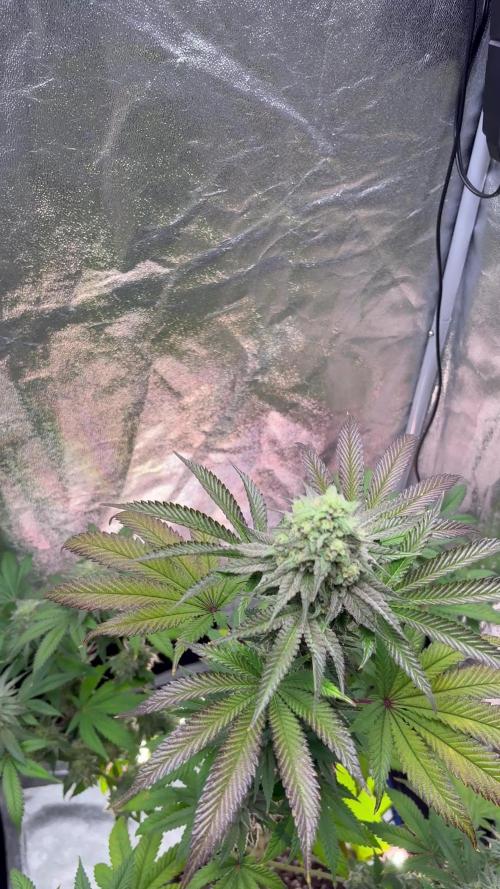
The spectrum from ELUFAH is really making the plants grow really well
My papa Payton I have growing under the ELUFAH uap-1500 along with the ELUFAH Saturn ring under canopy light. I recently put the plant back in a 2x2 I did have 2 plants but the other plant needed up being male. No need for the larger tent still.
Likes
10
Share


@CANNASIM
Follow
WEEK 1 of flower. This is insanely quick, veg for three weeks and on week 4 we are flowering strong.
It is raining a lot, so i had to use a top dressing, ingredients on the week 3, to manage the soil nutrients till the end of the cycle. About two table spoons.
Watering once a week, with the mix above, otherwise rain is taking care of them, very natural as a grow, nothing much complicated, no science fiction with fertilizer or chemistry.
I’m curious about the yield, and how much can i pull out of this way, with minimal work and a nearly inert soil. Let’s see how this experiment turns out.
Likes
45
Share


@masterofsmeagol
Follow
6/26 Rained last night. Might have showers bur the sky is clear. Real good weather coming. I need to transplant those seedlings. Plants are noticeably bigger every day. I see small spits of damage but it's isolated and in a high wind area. I'll address it and watch for nute deficiencies. Also need to transplant those seedlings. At leastcones an auto.
6/27 Rained overnight again. Looks clear today but we did get some rain yesterday. Tomorrow is all sun. I'm planning to transplant those 3 seedlings today. Also noticed some ragged holes so I've got a few pests. Looks like grasshoppers or something. With all the rain could be slugs or pillars I guess. Need to get ipm up amd running. I've got work to do. Found a plant on my gmo in the 30 bag. It got sun burnt and wind burnt but came out of it and they're all doing great. At first this one was a little behind after transplant but so were the other gmo's. Originally, it was one of my best plant prior to transplant outdoors. That one leaf I found during a thorough inspection of the garden. I'm hoping it's not tmv. Plants growing vigorously and better than but I'll keep an eye on it. I also transplanted the 3 seedlings. I added half new 707 in the 50 (prior soil was this same mix from last year) and transplanted one in that. One in a 10 gallon bag and the auto in a 5 gallon bucket. It will be interesting ingredients seeing how they turn out. All transplants went really smooth.
6/28 It's gonna be a hot one today. I haven't watered in over a week due to rain. Wind was whipping this morning! Looked like plants MIGHTVE been drooping but now that I think about it it was probably just the wind. ANYWAY I WATERED TWO AND A HALF GALLONS on the clones. That wind dries the bags out fast. Some still had some heft to them. Lately I've been going by my intuition which has seemed to be on point. All the seedling transplants look good and show no signs of stress.
6/29 The site was down so I couldn't update. Looks like it's gonna rain. It's noontime. This morning i found and killed two inch worms. There's not much damage so I'm wondering whether bt is necessary. Birds sit on the frame and dart I'm and grab them. I'll have to think on it. I also need to decide what I'm going to use for nutes this year. Don't need it yet. GMO's and sherb pie is putting out pistols everywhere. Same with the event horizon. Looks like I may have an early harvest this year. I certainly hope so. Still.....only did half what I did last year but with everything going on its all I can handle.
6/30 Site was down and it doesn't want to pet me upload my pictures
7/1 Trying to keep this updated. Need to spray bt. I'm seeing some damage. Not much but I need to get a handle on it now. Poured yesterday. Super sunny today. Plants seem to be flowering early this year while I still have a 2 seedlings that haven't shown their sex yet (they are fems but still). The clones are beginning to flower it looks like so I may have an early harvest this year.
7/2 WATERED THE GARDEN WITH 4 GALLONS. Spent some time looking over the plants and decided to hold off on the bt seeing as there isn't much damage. I spoke to a few shop owners and after seeing my garden this wad their advice as well. While watering I noticed red ants coming out of the soil of my GMO in the 30 gal. Some of these strains will be early finishers. The only time I've had stigmas like tjis was when I grew mendo breath and that was a super early harvest. Either way things are looking fantastic. The auto seedling finally showed a stigma. One seedling left (they should ALL be females) but I cant tell by the preflower yet. It looks female but I need to see that little white hair emerge to be sure.

Processing
Likes
2
Share


@Ld966
Follow
Well she seems to be getting along very well for her 4th week in flower. Nothing exciting done this week i keep feeding her about 5 litres of water with 30ml canna A and 30ml canna B with a ph of 6.3 on average water schedule about every 24hours.
Likes
14
Share


@Chubbs
Follow
What up grow Fam. These ladies did amazing this week, especially since where having our first heat wave with temps getting into the high 90's. I did switch to Bloom nutes and a pk booster this week. Also did a mild defoliation taking off the bigger fan leafs on the main stalk. All in all Happy Growing
Likes
4
Share


@gottagrowsometime
Follow
Welcome to my Wedding Cake, Freebie from Zamneisa.
0-35 Days. Week 0-5
She has a lovely shape. Grew very quickly.
Has that distinct from all the other Wedding Cakes I've seen here. Looking at other diaries. And after looking at this in my seed storage. I said let's go with it.
Possible 25% THC
all in the end of pics.
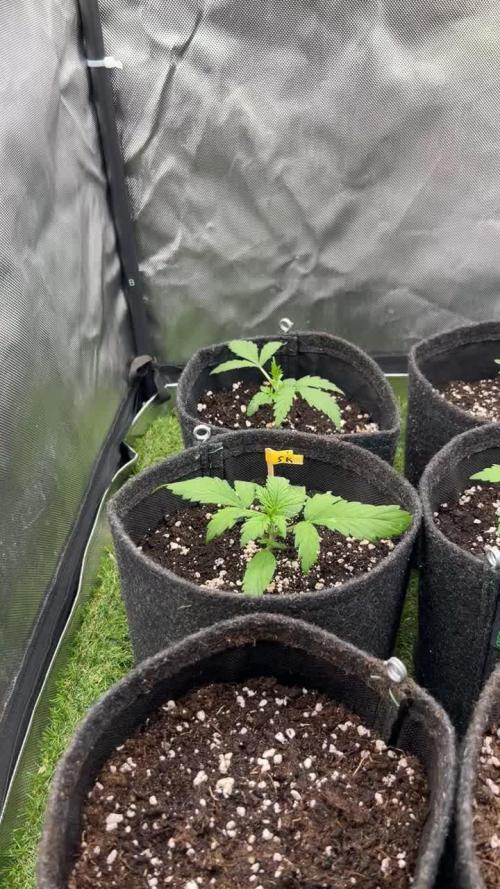
Lovely leafs, strong roots. No dying leafs. Has a lovely root ball. As she's in an 11L pot now as she was such a fast Grower out of the fems. Just behind Green House Seeds Lemon Orange. But, she's catching up. Soon I'll put her to LST, last Defoliation and will put her to the flip.
I was using power buds. And my god. So many stems with shoots. Tbh, I ended up removing a lot of those extra stems that were on my autos. It really does work. If you've the time. Which to bring all those nodes to full flower, would of added weeks to my grows. With this. She's a fem. I've removed at lot below and has long stems with a good few shoots, making for what should be some big tops (huge tops) by feeding right and with proper lighting. Also I've a trick by adding nearly 2 extra hrs during fattening with FAR RED 730NM which puts fems to sleep in 5m after 5-10m after a dose. Also have UVA for ripening.




Likes
170
Share


@Master_weeda
Follow
Bonjour à tous les padawans et maîtres jedis
Jour77 arrosage avec 30 centilitres d'eau ph6.3
Jour80 arrosage avec 40 centilitres d'eau ph6.3
Jour82 arrosage avec 30 centilitres d'eau ph6.3
Jour84 arrosage avec 25 centilitres d'eau ph6.3
J'estime à environ 10 12 jours la récolte. Comment connaître approximativement le moment d'une récolte en vue d'un rinçage ? Ou tout simplement si la plante est rincé de tout excédant d'engrais quand procédé à la récolte ?
La meilleure façon de juger de la maturité des plantes est de regarder les glandes de résine, également appelées trichomes. En utilisant un microscope idéalement avec un grossissement de 100x, vous pouvez facilement déterminer l'état des glandes en résine et éviter d'avoir à deviner. Les trichomes passent par 3 étapes différentes:
1. TRANSPARENT
Les trichomes transparents ne contiennent que des cannabinoïdes précurseurs qui ne sont pas psychoactifs. La récolte à ce stade ne vous donnera pas un produit très puissant.
2. MILKY Les
glandes en résine laiteuse contiennent du THC entièrement mûr. Pour obtenir des têtes aussi puissantes que possible, vous devez vous rapprocher le plus possible des trichomes 100% laiteux. Notez qu'il est impossible d'obtenir 100% de trichomes laiteux, car de nouvelles glandes de résine sont produites en continu. De même, même après la récolte, les trichomes continueront de se développer.
3. AMBRE
Les glandes résineuses de couleur ambre indiquent que le THC a été converti en CBN, une forme dégradée de THC. Cela signifie que votre produit a perdu une grande partie de sa puissance. Le CBN n'est souhaitable dans aucune culture, car ses effets sont plus narcotiques qu'une véritable élévation.
Personnellement j'aime bien les récoltes autour de 15 à 30% d'ambre mais c'est juste une préférence
Que la force soit avec vous 💪
Likes
12
Share

@Mr_Juice
Follow
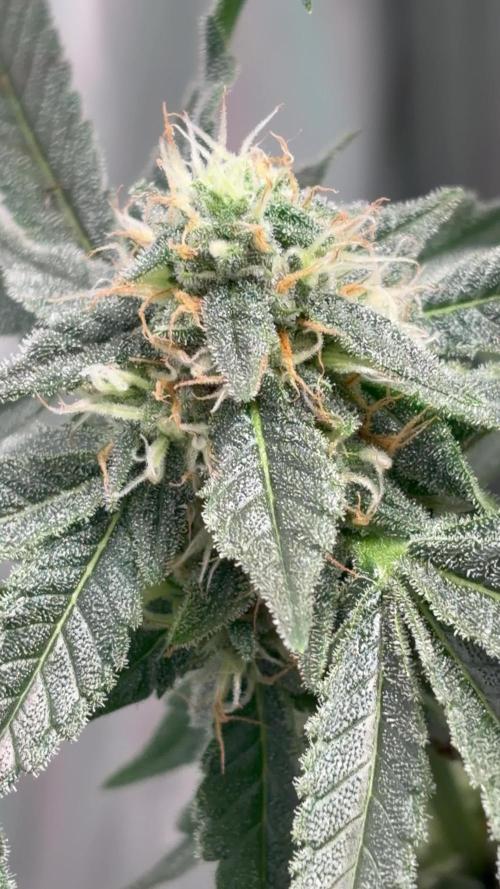
Light intensity increased to 100%… the buds are getting bigger and already look pretty frosty 😉 I added some bloom nutrients for her, but as always only a minimum since she doesn’t really need much, just a little boost 😉

Likes
246
Share


@mcflow
Follow
Im super happy with this week, buds keep growing, i cuttet off some leaves here and there but no huge amounts, only to keep it well circulated and lower the risk for mold and stuff. If it keeps growing at this rate im gonna end up with some really huge main colas
Likes
6
Share


@swaygrower
Follow
ดอกเริ่มสุก สวยงามมากๆ ตอนนี้กลิ่นสุดยอดมาก ยังให้สารอาหารได้ปกติโดยต้นไม้ไม่ได้มีอาการผิดปกติอะไร
Likes
25
Share


@Xanthur
Follow
This week, I have been trying to manage stretching. I have been trying to keep temps low for the first couple of hours of daylight, but the stretching seems to happen during the dark period.
I am pretty much completely out of screen holes for training, so I have been tying down tall shoots for training as best as I can. The canopy is only about 8" thick, but I continue to remove fan leaves to improve air flow. Some spots get condensation when the lights go out. I changed the timer on one light to go off 5 minutes after the other to give my equipment the chance to lower humidity before the temp drops. I added a couple more fans to hit some spots that weren't moving enough. It seems like removing fan leaves is one step forward, two steps back because each time I remove a lot of fan leaves, the plants come roaring back with more growth than before. I am ready for the stretch to end before my scrog becomes just a skeletal support system. I have spare nets in case they do need support.
My initial 20 gallon mix clocked in around 600 ppm, but it spiked over 900 the next day. I have been adding 5 gallons of plain water every day, and the ppm stays around 550. I guess that is the concentration they want. Funny, I thought this strain was going to devour nutrients. I have no deficiencies whatsoever.
I did have one issue after the rez change. I noticed the solution was not getting to all of the buckets. The GH Waterfarm kit I am using has 1/2" tubes which are blue and translucent. There was algae completely blocking 3 of the tubes. Fortunately, I had the foresight to install shutoff valves on the buckets, so removing and cleaning them was easy. There were some roots beginning to grow into the tubes which will become a problem in the coming weeks when they begin to clog the tubes. I don't know what I'll do since I can't lift the buckets, but I will figure something out. My opinion of this expensive bucket system is not pleasant.