




Likes
65
Share


@Mrs_Larimar
Follow
March, 11th.
The Nicole Kush Seedlings are growing vigor and nicely
I forgot to make Pics of all... But they arte to see in the Video
Tomorrow iam going to do that... Iam setting up another " Babytent" with a new Light
Stay courious
You can have a Sneak -Peak on the new Viparspectra XS-1000,
wich is going to be released on March 15th
March 13th.
Iam done with setting up
Now i have another Babytent. and Inside the New Viparspectra XS-1000
and the other Stuff to run the Envoirement
I already ca see a difference between both Tents. If you stand outside and just look with Eyesight
the Viparspectra seems to be brighter// has another color of Light.
I made a Unboxing Video for more informations.
Amazon: http://url-9.cn/0y9i
Amazon US: https://amzn.to/3e0P2bk
Amazon CA: https://amzn.to/3bTnEJC
Amazon discount Code:
it10mlarimar XS1000 10%
it15mlarimar XS1500 5%
it20mlarimar XS2000 5%
it40mlarimar XS4000 5%


Likes
15
Share


@gottagrowsometime
Follow
Welcome to my Lemon Drizzle sponsored by Spider-Farmer & Barneysfarm with their New SE brand, (upgraded 2023 Spectrum) and 1 of 5 of Barneysfarm new Releases I was given.
Veg Days 2-9 Days 8-14 Week 2
Plant grew really well in week 2. Rapid growth, holding pace with the 1st weeks explosive growth. Her roots are amazing. And it'll be getting uppotted soon. Running on a Full compliment of Natural Line Plagron with others in their line. Will be adding everything they have, in their range of course. New "Power Buds" and Green Sensation, SR, and idk why but I added Terpinator. And, its not an ideal nutrient to use in a sensitive range where PH mistakes cause big issues. She did do good this week but, this is the last of good week. As Co2 growing with young plants is new to me. My co2 is too high and lux is too low, I've taken out Runtz and put GDP auto back at floor. And I've upped the Lux and Will be lowering the light for ripening for my plant and dropping co2 back to 800.
Thanks to all who viewed. And to Bella from Spider-Farmer for the opportunity to work with them. And for the 2nd Yr in a row. Barneysfarm have let me pick 5 of their new Releases. Highly appreciated, that also goes to all who stopped by to view, like, &/r comment. Thanks and I look forward to seen your work. Either way. Thanks again for stopping by.

Likes
10
Share

@Simba732
Follow
Almost Chop Day for wa girl MS PURPLE! ✂️
The last few days were all about that flush life runoff nice and low, just how we like it ✅
She’s been an absolute tank from day one, taking almost everything thrown her way like a champ 💪🏾🔥
By the end of the week, most of the buds turned purple, most of her fan leaves faded to yellow, and after a solid trichome check..mostly milky with just the right touch of amber. Nailed it 🎯
And the smell? Straight adorable 🤗😍
I’ve got other strains on their own journeys, posted weekly in my diary feel free to take a little tour
Thanks for riding along with me on this one 🙏🏾
Right after this photo session she’s off the a better world
Happy growing 💚

Likes
4
Share


@jtgrow
Follow
Friday, September 25, 2020
Chopped to dry in closet. No trimming needed
Wednesday, September 30, 2020
Trimmed and jarred. Very little trimmings were thrown away.
My first indoor grow was a success! I don't have the largest tent so it was nice to keep it short. Not the biggest yield in the world but it was a fun experience. My only regret is not watering or feeding it enough. I'm main-lining my other auto grows so we'll see how those do.
Thanks!
-JTGROW

Likes
20
Share


@Steno
Follow
The seeds have germinated 100%, they seem healthy, two seem to push more than the others. Overall everything is going according to plan. At the end of the week I will bring the lamp a little closer.


Likes
13
Share


@GodZilla_Owner
Follow
The grow began with great anticipation for these two legendary strains: 420FastBuds Blue Dream and 420FastBuds Moby Dick. Both strains demonstrated strong initial vigor, living up to their reputations.
After planting, the seeds of both Blue Dream and Moby Dick sprouted quickly, with healthy roots emerging after just 32 hours. This rapid germination was a promising sign of the robust growth potential these strains are known for.
At the 44-hour mark, the seedlings were introduced to their first light. Both Blue Dream and Moby Dick responded well, showing strong early development. The stems appeared sturdy, and the initial leaves were vibrant and healthy.
With such a solid start, the grow journey for Blue Dream and Moby Dick is off to an excellent beginning. The fast germination and quick adaptation to light suggest these plants are well on their way to becoming the potent, resilient specimens they are famed for.
Likes
4
Share


@SmileyIndica
Follow
I’m loving the Trichome development on this, Nana glue! Probably got a couple more weeks on her .im Definitely a couple weeks plus on the Hindu.

Likes
Comments
Share

@Solitude
Follow
📓 Cultivation Diary: The 12/12 Flip & Transition Week
📅 June 5, 2026 (Veg Day 17)
Irrigation/Reservoir: Prepared a full 100L reservoir refresh.
Nutrients: Kept the feeding aggressive with a double dose of vegetative nutrition (x2 Nutrient formula) to ensure the root zones and plant tissues are fully stocked with elements before the transition.
Canopy Observation:the canopy is thick, uniform, and fully occupying the table space. The trellis net is officially filled out, and the lower branches are strong and rigid.
📅 June 6, 2026 (Day 1 of Flower / Bloom Week 1)
The Flip: Officially switched the timers to a 12/12 photoperiod (Lights ON at 6:00 PM / Lights OFF at 6:00 AM).
Schedule: First irrigation shot triggers exactly 1 hour after lights on (7:00 PM), followed by a shot every 1.5 hours.
Volume: Configured the drip stakes to run for 1 minute per shot, delivering 5 shots total per day. This provides roughly 450ml per plant per day, creating excellent target dry-backs overnight to force vigorous root searching.
📅 June 11, 2026 (Day 6 of Flower / Bloom Week 1)
Irrigation/Reservoir: Bumped reservoir capacity up to 110–120L to keep up with increased transpiration as the plants begin their post-flip stretch.
Nutrient Recipe (TargetingpH 6.0 EC 2.5
Water: 110–120L
Athena Cleanse: 120ml
Silica: 220ml (Essential for stem strength during the stretch)
CalMag: 10ml
Athena Bloom: 600ml (Adjusting base to target 1.2–1.3 EC from Bloom component)
Athena Core: 400ml
Irrigation Adjustments: Increased the shot duration slightly to 1 minute and 15 seconds to match the accelerating growth pace.
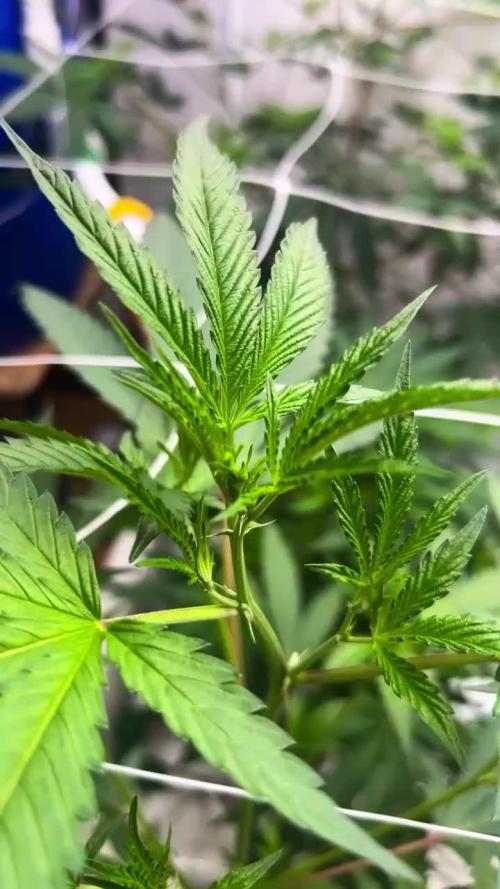
The early flowering stretch has officially begun. The tops are noticeably pushing past the trellis net layers, and the node spacing remains tight and stacked. Leaf color is an excellent dark green with healthy, bright yellow-green shoots driving upward at the growth tips. No signs of stress or stalling from the schedule shift.

Likes
9
Share


@Sauce_XL
Follow
3.23.2024: Start of week 10. Day 60 from sprout. Moving along nicely. Did some defoliation to open everything up. Main cola is legit. One of the side branches is almost as big as the main cola. Bought a loupe and trichomes are just slight turning milky but only in a few spots. Some purpling but def not to the level of some of the other pheno's i've seen which is kinda a bummer.
3.24.2024: Day 61. Fed 1/4 strength nutes. 96oz of 6.5ph. Got stoned last night and did some more defoliation.
3.25.2024: Day 62. ZZZzzzZZzzz
3.26.2024: Day 63. 96oz at 6.5ph. Runoff ppm at 730.
3.27.2024: Da 64. ZZzzzZZz
3.28.2024: Day 65. just the tiger bloom and cal mag today at 1/4 strength. 96oz at 6.49ph.
3.29.2024: Day 66. End of week 9. Trichomes starting to get milky. Maybe 70/30?
Likes
38
Share


@Tesla
Follow
Week 8 since switch to 12/12h.
The weather stays good, finally.
Pistils start to turn brown. Thricoms are 50% clear, 50% cloudy.
Going low on nutrients to avoid over fertilization (600-650 ppm)
2 or 3 weeks until harvest, I guess...
Suggestions are welcome. 👍


Likes
20
Share


@Boomdrawfyah
Follow
Dia 110 de vida y 2nda para 3ra semana de floración.
Han hecho un estiron final llegando a medir casi 3 m y han empezado a florecer se ven muy sanas sigue todo muy bien algun saltamontes sigue motdiendo las hojas nada grave.
Se avecina tiempo de tormentas y lluvias esperemos que no pase nada grave , las plantas estan preparadas para soportar lo que sea que venga aunque siempre puede haber algun imprevisto

Likes
6
Share


@Shotter
Follow
So were on day 26 of flower there looking good getting a nice smell starting to throw out trichomes
Have down loaded a thew videos of before and after removing fan leaves
Processing
Likes
11
Share


@Newbie5648
Follow
All looking great. Bud growing. 😃😃😃
Cant believe it. Going nicely. Just a very long patient wait.
Eager to finish so can start on RQS Green Gelato auto grow.
Hoping this will be complete in next 2 to 3 weeks. Than have to cure.
Lower leaves have issues. Top leaves look good.
Day 50 increased nutes to max 1.2ml each per 500ml water. Ph6.6. Watered 250ml to see any damage tomo. Run off from soil ph came to 6.4.
Day 51 watered 250ml from balance
Day 52 watered 100ml watered with nutes ph6.6
Day 53 watered 200ml from balance and lowered lights to 45cm from 80cm.
Hopefully more growth tomorrow 🙏
Processing
Likes
10
Share


@Blazeman
Follow
Temps have been low 80s all week but otherwise no other issues. So far so good. Leaves yellowing as expected in the flowering stage. Buds getting fatter 😊


Processing
Likes
68
Share


@Tazard
Follow
Beginning of the 10th week of flower. Shouldn’t be too much longer now. I will add some bud and trich pictures this week.

Likes
183
Share


@OrganicNature420
Follow
Germination date 🌱 12/07/2021
Day 120 12/11/2021
Strain 🍁 Ethos Genetics Banana Hammock R1
(Mandarin Sunset x Grapegod)
THC% • Unknown
💡 Mars Hydro FC4800
• Power draw 480W + 5%
• Max coverage 5 x 5
• LED 2070pcsSamsungLM30B1&Osram660nm
• Max Yield 2.5g / watt
• Noise level 0 DB
• Removable Driver +2m cable
• Daisy chain (multiple lights)
https://marshydroled.co.uk/products/mars-hydro-fc-4800-led-grow-light-samsunglm301b-commercial-greenhouse-medical-indoor-kit 🇬🇧
https://www.mars-hydro.com/buy-fc-4800-480w-4x4-energy-saving-full-spectrum-commercial-led-grow-light-mars-hydro-for-sale 🇺🇸
PROMO CODE • (ORG420) DISCOUNT 👍🏻 marshydroled.com
⛺ Mars Hydro 120 x 120 x 200cm
📤📥 AC infinity 6inch
💧 10lt dehumidifier
❄️ 3.1kw air con system
💉 Nutrients GreenBuzzLiquids
Organic Grow Liquid • 1-4ml until 2wk flower
Organic Bloom Liquid • 2-4ml flower stage
Organic More PK • 2-4ml +wk3 of flower
Organic Calmag • 1-2ml/lt whole grow
Fast Plants Spray • first 3days at night lights off
More Roots • 2-5ml veg +2wks flower
Fast Buds • 5ml +wk2 of veg until 1wk flower
Humic Acid Plus • 2-5ml whole grow
Growzyme • 2-5ml whole grow
Big Fruits • 2-5ml flower stage
Clean Fruits • 5ml flush 1wk
Ph powder
Root Gel
Living Organics
PROMO CODE • organicnature420 15%off ✌️🏼
https://greenbuzzliquids.com/
🥥 Growing Media • Coco Coir
Notes 📝
And we are DONE 🌱🍁.. In my opinion the worse one out of the 4 but still smells incredible and is coated in tricones. Green buzz liquids smashing it out of the park. All 4 smell different and potent 👃🏼 great nutrients 👊🏻 Organic proving why its the future of growing.
FC4800 is a beast of a light and for those wondering this out does the equivalent sf4000 from spider farmer hands down. Colours are unreal and the buds are nice and dense 💚 Marshydro gets my vote 👍🏻
Remember PROMO codes for both GreenBuzzLiquids and MarsHydro.com in the grow bio above 🖕🏼
Happy growing fam ❤️🌱🍁👍🏻
Likes
26
Share


@PedroAndHisPlants
Follow
Day 85: First Grow
We’re entering a new week, and it’s exciting to see the progress in our first grow. The plants are thriving, and the buds continue to get thicker and frostier. The formation of orange hairs is becoming more pronounced, indicating that we're on the right track.
This week, we’ve decided to order a microscope to monitor trichome development more closely. Additionally, we're considering adding CANNAZYM to our feeding regimen to support bud growth and overall plant health.
Let’s keep pushing forward and make this a successful grow!
