


Likes
2
Share


@Regulator3000
Follow
This plant was fun the whole way through. I had some issues up front and the plant got super stressed but in the long run she developed one huge bud so that's pretty exciting.

Likes
2
Share


@Enki_Weed
Follow
Heute ist ein aufregender Tag im Zelt! Meine beiden Hybriden Brain Damage und High Mars scheinen sich unter den Mars Hydro FC 1500 Lampen pudelwohl zu fühlen. Die Blätter sind sattgrün und kräftig, ein Zeichen für die optimale Nährstoffversorgung durch das Hesi Hydro Zuchtschema. Der pH-Wert liegt bei perfekten 6,2 und der EC-Wert bei 1,7. Die Temperatur im Zelt ist mit 25 Grad etwas höher als ideal, aber die Klimaanlage läuft auf Hochtouren, um sie zu senken. Auch die Luftfeuchtigkeit von 65 % ist noch etwas zu hoch, aber der Luftentfeuchter ist bereits aktiv. Die beiden Ventilatoren sorgen für eine gute Luftzirkulation im Zelt. Heute Abend wird es dann noch mal spannend, wenn der Chiller für die Wassertemperatur eintrifft. Ich bin gespannt, wie sich die beiden Damen in den nächsten Tagen entwickeln werden!
Vorschläge?

Likes
29
Share


@nijuana
Follow
I'm flushing it since 1 week , HERE WE ARE ENDLY 💚 !!!!! the 3 latest day i increase the water that I'm giving to it and the latest day I'm flushing with terra aquatica flush (3ml/l) I'm so impressed by this queen 👑 , so heavy , so powerful !!!
From the beginning to the end this is a phenomenal strain , total love !

Likes
5
Share


@Lazuli
Follow
Nothing more then low nutrient watering once a day untill i top her then we go straight to 1000ppm

Likes
9
Share


@VIPgrower
Follow
Day 37 of flowering week six lsd look good tips a little burnt but I’m not to worried keeping nutrients low about 3/4 strength 1.4 ex 770 to 800 ppm drinking lots watering about every four days feed water feed water

Likes
9
Share


@coucoulacreature
Follow
It starts to be pretty and frosty
One is beautiful, 2 are nice and one looks tired :(


Likes
67
Share


@Ageddd
Follow
Whats up GD !!!
------------- GROWTH-------------
They keep growing without problems, but added more micro vita and microbes are eating nutrients too fast, but does not matter as tomorrow im transplanting both plants. I hope taller cheese can eat more, as you can see, lower leaves are yellowing a bit.
Wether is not good... cloudy days..
Started the training season !!! :)
Used threads to bend the plants.
You have to check the roots !! This combination works flawless..
They are more stinky this week, when you touch a plant smells like lemon skunky notes ...
------------- IRRIGATION-------------
Watered both ladies, around 0.2-0.3l each one with nutrients.
------------- NUTRIENTS-------------
Deeper underground (2ml/l) + Bio-Grow (2ml/l) + Micro Vita.
New soil, mixed with Micro Vita + 1 ml/l Green Explosion + 1 ml/l Biogrow + 1ml/l Deep Underground
7l aprox pot
---------------------------------------
Good vibes !!
_24/04/2018_
Likes
19
Share


@sirstickyfingers
Follow
Day 60 flower
Man we are in the last week of flower (hopefully). Still seeing alot of clear trichomes and man Im ready to chop these girls down and put my first harvest in the books.
IM glad they are all kinda on the same level of ripeness as I think once one is done they should all be done
I gotta get a better camera and figure out how to remove that yellowing in the pics.
I am starting to see some leaves on the SD yellowing and pointing downward. From what I had found its a sign of overwatering but I doubt that as the leaves are yeallowing and getting crunchy. I did just get a moisture meter and its saying moist and wet towards the bottom so I dont think thats it.
I have top dressed in over 3 weeks since I am trying to flush, I expected yellowing as im tapering off the N but was not expecting to see them get crunchy so thats something im looking into.
**UPDATE***
5-1 CHOP Day!!! they look ready to me, I will be chopping them down today after work. I will not be posting updates during drying but will update when drying is done and an early cure
I will provide my weight, tatste effect all that good stuff next time I update so it may be a couple weeks, see ya then!!!


Likes
75
Share


@Dedon
Follow
Hi everyone !
Everything is ok, no disease, no carrency. 👌
they start to smell a little and pistils appear everywhere 😍
i change the nutrient solution and start with PK 13/14
See you next week ;)


Likes
4
Share


@GreeneScene
Follow
Decided to pop the rest of the seeds I have on hand . . 1. To weed out the duds if any, & 2. TO JUSTIFY ORDERING MORE SEEDS 😭🤕.
Hey by the way , what’s your favorite discreet seed shop/breeder ? I need new genetics & websites. Comment your suggestions below 👇 would be a excellent way to help me out .
All organic growing in case your interested .

Likes
2
Share

@FourTwenty_Plants
Follow
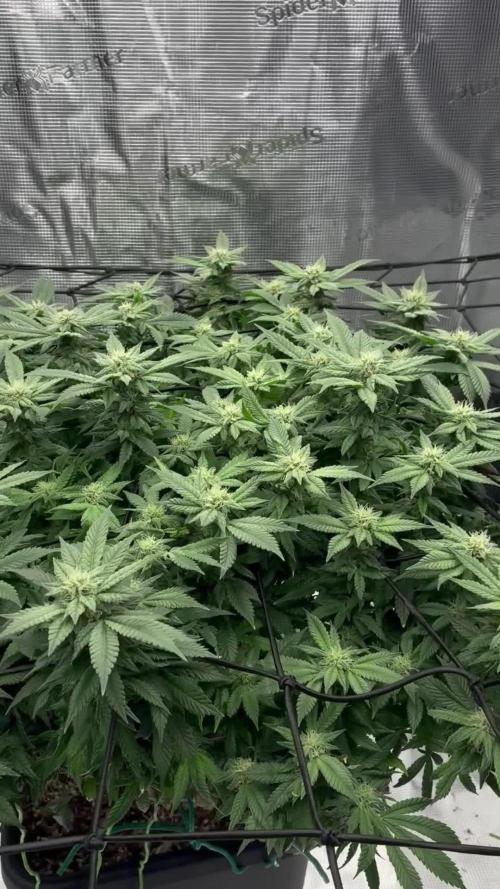
Sooo, about three and a half weeks have passed since the last update - she should be around week 3.5 of flowering by now, and goddamn, I’m stunned, bro. I had some medical PM a few months ago, and the smell already reminds me so much of it. It’s also the stickiest stuff I’ve grown so far, and she’s not even halfway through flowering yet.

Likes
21
Share


@BLAZED
Follow
W17 (23-5 tm 29-5)
23-5
Temperature: 23.9 degrees (lights on) 19.2 degrees (lights off)
Humidity: 59% (highest) 47% (lowest)
Watering: None.
24-5
Temperature: 24.5 degrees (lights on) 19.2 degrees (lights off)
Humidity: 67% (highest) 47% (lowest)
Watering: 1000 ml.
No pictures.
After some waterings without any NPK nutes, the leaves are still very green, this indicates there is still enough nutrients available in the soil.
From now on the last 1.5 weeks of flower i will only give RO water with an PH between 6.3 and 6.4
25-5
Temperature: 24.4 degrees (lights on) 20.4 degrees (lights off)
Humidity: 67% (highest) 50% (lowest)
Watering: None.
26-5
Temperature: 24.9 degrees (lights on) 19.1 degrees (lights off)
Humidity: 67% (highest) 45% (lowest)
Watering: 1000 ml.
No pictures.
27-5
Temperature: 24.2 degrees (lights on) 20.5 degrees (lights off)
Humidity: 69% (highest) 40% (lowest)
Watering: 1000 ml.
28-5
Temperature: 26.1 degrees (lights on) 20.9 degrees (lights off)
Humidity: 69% (highest) 40% (lowest)
Watering: None.
29-5
Temperature: 25.5 degrees (lights on) 20.2 degrees (lights off)
Humidity: 70% (highest) 46% (lowest)
Watering: None.
The buds are swelling nicely, are full of THC and smells very intense like candy.
I cant wait to see the end product!


Likes
45
Share


@Ultraviolet
Follow
"Mens Dei"
What can be made to expand, airy and loose, can also be made to contract, dense and tight.
Trichomes do not discriminate, although we like to think of trichomes' primary purpose as being to get us high; they are there to provide photoprotection (sunscreen). Trichomes apply themselves based on area dimensions; the more area = the more trichomes in order to protect. Different from density: Trichomes, the resinous glands on plants, are often produced in response to stress, including high light intensity. This increased production can lead to denser trichome coverage on the plant, stress, stress, stress, stress is the signal. There is a certain beauty in watching the large water-filled buds once swollen to the brim slowly shrink during drying, as the surface areas contract, the trichomes just cluster up to form denser and denser coatings, already dense from high light intensities, UVB exposure, and IPS, and every other stressor I could tweak. Trichomes, the resinous glands on cannabis plants, are often produced in response to various forms of stress. These stresses can be environmental, like excess light(HIL) or UV-B radiation, temperature fluctuations, or drought, or mechanical, such as wind, pruning, or even the weight of the plant's own buds. The plant reacts to these stressors by increasing trichome production as a defensive mechanism to protect itself and its valuable compounds like THC and CBD. In essence, cannabis plants perceive stress as a threat and respond by producing more trichomes as a way to protect themselves and their valuable compounds. Several studies have shown this. Not so much a "master" grower as a master of stress.
Psssst.
Trichomes fill with "antioxidants," including THC.
Ant"ox"idants,
The production of antioxidants in plants is intricately linked to their oxidative apparatus.
The plant has limited oxidative capacity/apparatus. During daytime photosynthesis, a large percentage of that oxidative capacity is tied up in protecting the plant.
During the night, plants alter their metabolic pathways. This leads to a far more focused production of specific antioxidants, like THC. Plants also produce antioxidants during the day to scavenge ROS made from photosynthesis. The differential ROS production by blue and IR light can have significant biological consequences. For example, high levels of ROS induced by blue light can lead to cell damage and death, while lower levels of ROS produced by IR light may be involved in beneficial cellular signaling pathways. Long nights under the IR (very low ROS), the boost in cellular respiration, and the boost in energy production. In a perfect world, I'd give the plant a shock treatment of 60DLI in 4 hours and give her the other 20 hours to perform cellular respiration under IR. The stress of those 4 hours would be rigorous and full of stress abound, 1800-2000ppm CO2 is easy for a couple of hours during daylight, it's maintaining it that's hard, but 4 hours is very doable with nothing but a little extra "carbon sugar" in your medium every other night during the first 4 weeks of flower.
In my opinion, you only need to jack CO2 for those first 4 weeks of flower to see maximal output, after that it's all about trichome preservation, everything else comes second. Without the temps to assist with metabolism, CO2 is reduced to normal levels along with temps 4-5th week of flower.
Buds are primarily composed of water. Developing flower buds, like other plant tissues, require a significant amount of water for growth and turgor pressure, which helps maintain their structure and firmness.
Turgor pressure in plant cells is primarily generated by osmosis, but transpiration plays a crucial role in maintaining it.
The optimal internal leaf surface temperature for photosynthesis at 1800-2000ppm CO2 is likely in the upper range of 97°F, meaning ambient would need to sit at 102°F-ish or thereabout for full metabolic utilization. That's putting your transpirational pulling force x5 x6 maybe x7 of what it would be if she were cruising at 68F.
"My buds won't fatten, what can I do!!"
Crank it. If your purpose was to blow up a balloon as fast as you can, as much as you can, would you use 2x force or x5 Force to do so? Bad analogy, but you get the idea. Kiss.
Optimize photosynthesis & VPD by day, cellular respiration by night.
TECHNICALLY:
"While transpiration and cellular respiration are both ongoing plant processes, they are not neatly separated into day and night. Both processes occur both day and night, though at different rates and with different emphasis. Transpiration, the release of water vapor from plant surfaces, is primarily driven by sunlight and photosynthesis during the day, but it also continues at a lower rate at night. Cellular respiration, which provides energy for the plant, occurs continuously, both day and night. "
A leaf can perform cellular respiration and photosynthesis simultaneously. During daylight hours, plant cells utilize both processes: photosynthesis to produce glucose and oxygen, and cellular respiration to break down glucose and release energy for the cell's needs. The products of photosynthesis (glucose and oxygen) are used as reactants in cellular respiration, while the products of cellular respiration (carbon dioxide and water) can be used in photosynthesis.
The limiting factor is the oxidative capacity; the less a leaf is utilizing photosynthesis, the less oxidative capacity it uses, and the more it can perform cellular respiration.
Even if a leaf is not in an optimal photosynthetic position, it can still utilize respiration to its full capacity during daylight hours. Kinda too much info to explain when some asks if they should defoliate or not, yeah add calmag or some shit.
BUT Only 10% ATP can be processed through photosynthesis and carbon capture.
90% of ATP is processed when the plant's oxidative capacity becomes available (NIGHTTIME). Cellular respiration relies on the process of oxidation to generate energy. Specifically, the final stage of cellular respiration, called oxidative phosphorylation, utilizes oxygen as the final electron acceptor to produce a substantial amount of ATP, the cell's primary energy currency.
Factors such as oxygen concentration, glucose availability and temperature will all impact the amount of aerobic respiration an organism will perform.
See you next grow, *twiddles thumbs*
Likes
101
Share


@biggreens420
Follow
Hey guys started flush on 17/11 run 8litres through her and will be watering with terpinator 2ml/l 2 litre a day for the next 10/14 days trichs are majority cloudy some ambers smell is strong skunky smell its a competition between the gorillas and her for the frostyness there both absolutely covered in trichs shes stacked to the roof should be a nice yield of quality super dense nugs shes beautiful just watching her finish ...put some better pics up thanks for reading happy growing guys


Likes
Comments
Share


@Tony2jewerlyseeds
Follow
Saludos desde México estare actualizando semana a semana genética y banco 100%recomendados germinaron 2 de 2 aguantando las lluvias intensas creciendo desde el inicio en exterior
