Check the winners The Grow Awards 2026 🏆
Likes
Comments
Share
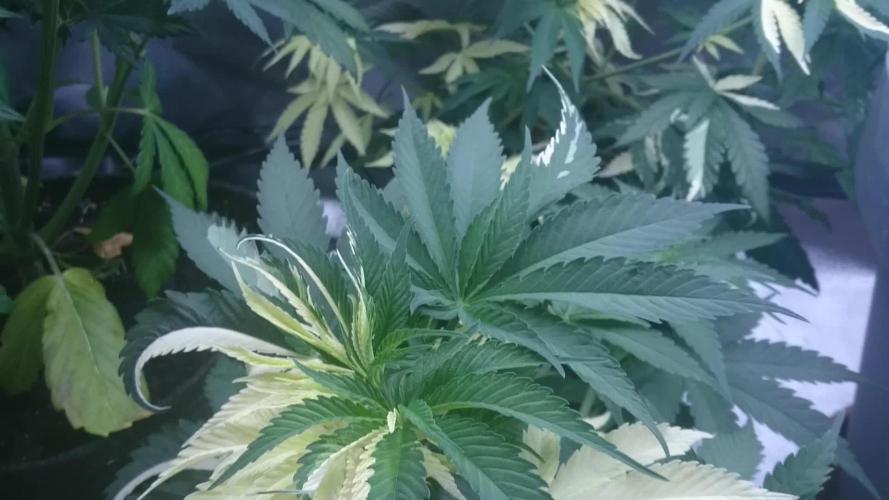
In week 9 my TRICHOME-WONDERS are doing GREAT! All plants continue to grow new flower crowns all over the plants. The branches starts to form colas now...its an impressive sight. The healthy green color and speedy devlopment tells me that the BIO-TABS nutrient tablets are still doing a FINE JOB! I love how convenient and time-saving my waterings are, since the plants ONLY GET PURE TAB-WATER. No more measuring and adjusting ph- and EC-levels feels like a LIBERATION...lol 😄 A few plants like the Strawberry-Sour-Siesel from DevilHarvestOriginal-Seeds are getting so tall, that I need to control their height. My favorite method to do this is SUPER-CROPPING! This is a method promoted by SOMA from SOMA-Seeds and works perfectly to control the height of a plant without having to top her. I pinch the main-stem of the plant (appr. 25-30 cm from the top, right above a node) all around in a circle, so hard that I can feel the fibers inside brake. Then I bend the top part of the stem downwards (ar at least 90 degrees to the side) and let it hang there. The plant will start to heal the stem where it was pinched (it will form an elbow-like shape) and turn the bent part of the stem upwards again. During this time the side-branches grow further in height and the plant will get bushier instead of taller. After the stem repaired itself, the buds on it will turn towards the lights as well and will continue to flower. This way I can control the height and still harvest the top-buds later.
Likes
24
Share
@GR0WER
Follow
New week starts. ☀️08.11.2023 All in it's best. The signs of magnesium deficiancy are seen on one 'Special Queen' plant and aren't spreading. No watering today, only 'TA Bio Bloom' spraying. ☀️10.11.2023 I've watered two of my plants with 'TA Tripart'(100% of flowering formula) + 'TA Bio Bloom' + 'TA Silicates'. Spraying with 'TA Bio Bloom' also. ☀️13.11.2023 I've watered 3 of my flowers with 100% 'TA Tripart' + 'TA Bio Bloom' + 'TA Silicates'. Sprayied them all as usual.
Processing
Likes
12
Share
@BloodBath
Follow
I will be focusing this diary on the smoothie strain but you’ll be seeing some other plants in the tent that are not the same strain. I only have room in this tent so bare with me. There are 2 Smoothie, 1 CNC, and 1 Stardawg (dog). The smoothie are the two bigger ones in the back of the tent. Now, the Smoothie from FastBuds is just killin it right now. Since I popped the beans they have done nothing but show signs of greatness. I don’t think this one is gonna slow down much either. I’m going to push these plants harder than my last harvest. I had a really really amazing harvest last time. I was even able to pull sap out of all 4 plants. 2 Zkittles and 2 LSD-25. This was all done by feeding at the right times and keeping a “moist” soil. Also I want add that I ran pretty much the entire line of Nectar for the Gods at a little less then the recommended ratios. This time I plan on going a tiny bit over the recommended ratios just to see what these plants will do. Trust me, if the plants have a bad response I will go back to the recommended ratios. The reason I want to do this is because I really think these auto strains can handle a lot more than a regular flowering cycle plant would. They can handle more stress, that’s for sure. When do you think I should add a compost tea into my regimen? Soon or wait till the plant is a little larger?
Likes
10
Share
@Arcadium
Follow
Stretch slowing down, secured the existing net for some support and to help with LST. Stretch has slowed down for sure. budlets beginning to form. Did a heavy top dress of Gaia Green, 13 TBSP Power Bloom to 7 TBSP All Purpose, mixed with a few scoops of compost. When I pulled back the mulch to top dress I snapped a few pics and videos of the soil, wow, SO much life it's incredible, one giant heap of life. I find mixing top dress with compost lets gives the roots something to adhere to, and nothing like increasing that root zone! Kept up with some light defoliation and LST with some bud clips and netting, not much else to do but wait! All the excess trim from defoliation and nearly everything you see in the background will get mulched up and added in the fall for next years crop. Circle of life yo! Had some very very minor Powdery Mildew on some fan leaves after we have some 95% humidity roll through, I had company so skipped a spraying of Lactobacillus, and it showed. If you haven't tried it, it's EASY to make and it works wonders, plants love it as a foliar spray or a root soak, I use molasses to keep it stable, so it's double good for flowering time. This will HAVE to get harvested end of September regardless, that gives me 7 weeks from now, so here's hoping for that FastBuds "Fast Flower" action.
Likes
10
Share
Wir wiederholen woche 4 des düngeschema, da sie sicherlich noch 3/4 wochen blüte brauchen wird.
Likes
9
Share
Привет друзья. Наше знакомства продолжается с новым сортом автоцветущих растений от Smail_Seeds сорт ORIGINAL AUTO CHEMZKITTLEZ F1 reg. Сегодня растению 73 дня. Растение очень хорошо развилось, ни каких сбоев в генетике не наблюдалось за весь цикл. Шишки наливаются очень хорошо😀 Так же стрессую, что бы получить пыльцу. Скоро будут феминизированные растения. Сорт выводим сами. Смотри мой профиль, у нас всегда есть что то интересное. Не забудь поставить лайк❤️, если понравилась как прошла неделя И читайте наш TELEGRAM: https://t.me/smail_seeds #Smail_Seeds 😀
Likes
32
Share
Likes
52
Share
You don't become confident by shouting affirmations in the mirror, but by having a stack of undeniable proof that you are who you say you are, outwork your self-doubt. Nitrogen fixation is a chemical process by which molecular nitrogen (N2), which has a strong triple covalent bond, is converted into ammonia (NH3) or related nitrogenous compounds, typically in soil or aquatic systems but also in industry. The nitrogen in air is molecular dinitrogen, a relatively nonreactive molecule that is metabolically useless to all but a few microorganisms. Biological nitrogen fixation or diazotrophy is an important microbe-mediated process that converts dinitrogen (N2) gas to ammonia (NH3) using the nitrogenase protein complex (Nif).[2][3] Nitrogen fixation is essential to life because fixed inorganic nitrogen compounds are required for the biosynthesis of all nitrogen-containing organic compounds, such as amino acids and proteins, nucleoside triphosphates and nucleic acids. As part of the nitrogen cycle, it is essential for agriculture and the manufacture of fertilizer. It is also, indirectly, relevant to the manufacture of all nitrogen chemical compounds, which include some explosives, pharmaceuticals, and dyes. Nitrogen fixation is carried out naturally in soil by microorganisms termed diazotrophs that include bacteria, such as Azotobacter, and archaea. Some nitrogen-fixing bacteria have symbiotic relationships with plant groups, especially legumes.[4] Looser non-symbiotic relationships between diazotrophs and plants are often referred to as associative, as seen in nitrogen fixation on rice roots. Nitrogen fixation occurs between some termites and fungi.[5] It occurs naturally in the air by means of NOx production by lightning.[6][7] All biological reactions involving the process of nitrogen fixation are catalyzed by enzymes called nitrogenases.[8] These enzymes contain iron, often with a second metal, usually molybdenum but sometimes vanadium. Green clover (Fixation) White clover (Fixation) Red Clover. (Fixation) Yellow Clover. (Fixation, deeper roots) Sweet Thai Basil. (Terpenes) Italian Basil. (Terpenes) Chamomile.(Oil production) Borage.(Pest attraction taste) Lavender.(Pest attraction smell) Marigold(Pest attraction visual) Mycorrhizae are beneficial associations between mycorrhizal fungi and a plant’s root system. Mycorrhizal fungi spores germinate in the soil, creating filaments (hyphae) that penetrate the root cells, thus establishing a symbiotic relationship. This collaboration leads to the development of both intra-radical and extra-radical networks of filaments, enabling efficient exploration of the soil for enhanced access to nutrients and water. Consequently, these vital resources are transferred to the plant, resulting in numerous benefits for crop cultivation. Various mycorrhizal products are available in diverse formulations (powder, granular, and liquid), concentrations, and qualities. Ongoing advancements in products, technologies, and research are reshaping our understanding of mycorrhizae. Despite these positive developments, certain misconceptions persist. In the following discussion, we aim to clarify the truths and dispel the myths surrounding mycorrhizae products. MYTH #1 A HIGHER NUMBER OF MYCORRHIZAE SPECIES MEANS BETTER RESULTS. Contrary to common belief, having a higher number of mycorrhizae species in a product does not translate to better results; in fact, it often yields the opposite outcome. A plant can sustain only one association with a particular mycorrhizal fungi species. Introducing multiple species creates competition among them, which is not advantageous for the plant. The initial colonizer does not ensure the highest success; instead, it gains precedence. It is recommended to select a product with a concentrated presence of a single mycorrhizae species known for its effective performance, rather than opting for a product with multiple species at lower concentrations. MYTH #2 ECTOMYCORRHIZAE ARE EFFECTIVE FOR CANNABIS PLANTS. Although ectomycorrhizae can colonize five to ten percent of plant species, cannabis is not among them. Ectomycorrhizae do not penetrate the root cells; instead, they develop around the roots and on the exterior. For cannabis plants, it is essential to seek out endomycorrhizae. Endomycorrhizae are capable of colonizing 70% to 90% of plant species, including cannabis. Unlike ectomycorrhizae, endomycorrhizae penetrate the root cells, forming structures like arbuscules for the exchange of nutrients and water with the plant. MYTH #3 WHOLE INOCULANT (PROPAGULES) PERFORM BETTER THAN ONLY VIABLE SPORES. The propagule count specified on most mycorrhizae products indicates the presence of spores (viable and unviable), hyphae, and root fragments. However, it is crucial to note that only viable spores, those with the capacity to germinate, can successfully colonize a plant’s root system. Spores are to mycorrhizal fungi what seeds are to cannabis plants—a fundamental component enabling fungi reproduction. Consequently, even if a mycorrhizal product boasts millions of propagules, its effectiveness hinges on the presence of viable spores. Without viable spores, the product will not contribute to plant development. Therefore, the genuine value of a mycorrhizal inoculant lies in the quantity of viable spores it contains, as only viable spores can efficiently initiate symbiosis. MYTH #4 ALL METHODS OF APPLICATION YIELD IDENTICAL RESULTS. To establish the symbiosis, mycorrhizal fungi spores must be close to the plant roots. The optimal recommendation is to directly apply mycorrhizal inoculant to the roots, either in powder, granular or slurry form. This method ensures maximum proximity between the spores and the roots, facilitating a rapid establishment of symbiosis. Particularly with crops like cannabis, which have a short growing cycle, employing this technique is the most effective way to obtain optimal benefits. Alternatively, techniques such as blending the inoculant with the soil are effective, but there may be a delay in the establishment of symbiosis. This is because the roots need to grow and come into contact with the dispersed spores throughout the growing media. MYTH #5 MYCORRHIZAE CAN ONLY BE GROWN ON LIVING PLANTS. While the predominant method for commercially producing mycorrhizae involves growing them on the root systems of living plants (in vivo production), it is not the exclusive nor the optimal technique. In fact, this production approach has notable drawbacks that the “root organ culture” method just does not have (in vitro production). In vitro production occurs in meticulously controlled, aseptic laboratory conditions, allowing for the consistent generation of products that are viable, highly concentrated, species-specific, and free from pathogens. Achieving such precision and quality is impossible when relying on the cultivation of mycorrhizal fungi on plants exposed to external conditions. In conclusion, it is crucial to take all these factors into consideration when choosing the appropriate product for your crop to fully harness the wide array of benefits provided by a high-quality mycorrhizal product. STRONGER PLANT – Stress resistance. FASTER GROWTH – Improve plant structure and shorter veg time. INCREASE YIELD – Overall more biomass. IMPROVED QUALITY – Increase cannabinoids and terpenes content.
Likes
51
Share
Well, it was my first diary here, and I'm really happy to had found this amazing community that is so eager to help! It gave me the opportunity to win the first giveaway in my life 😂 And it was from RQS! These seeds are in my new grow diary, and I really thankful for all the gift received! A special thank to Pol from the RQS staff! A special thanks to everyone who watched me grow here, and I hope to contribute with the community more and more!
Likes
25
Share
____________________________ ~Seedsman Fuel D.O.G.~ ____________________________ 'Fuel D.OG Feminized was bred by crossing two highly celebrated and popular strains from the USA - Chemdawg (Sour Diesel x OG Kush) and Fuel OG (Diesel x Headband). Fuel D.OG is a 70% sativa, 30% Indica plant with very good potential yields both indoors and outdoors. Resin and THC production is also at a very high level. Fuel D.OG improves on Chemdawg, being a much more robust plant with a much more intense flavor while also developing a larger calyxes than Chemdawg. Its robust appearance is typified by a thicker central stem that is so strong that it does not need to be supported during the later flowering stage in spite of the high degree of sativa stretch it undergoes once flowering has been initiated. Large spear-shaped buds surround the main stem like a crown. Outdoor cultivation produces plants that can grow up to 350 cm. tall in optimum conditions. When cultivated indoors Fuel D.OG produces yields of 450 - 600 gr/m2 in a 65 - 70 day flowering period with generous quantities of resin already noticeable in the nascent buds during the third week. Its height can be controlled indoors by switching to the flowering light-schedule once plants are established and also by the use of the SCRoG technique whereby plants are trained horizontally. Outdoors, each plant can yield 700 - 800 gr. of large, sticky buds with harvests in the northern hemisphere ready at the beginning of October. Its large trichomes, concentration of terpenes and the sheer quality of resin make this a very serious proposition for extract/concentrate makers. Fuel D.OG has more intense OG Kush flavors than the Chemdawg parent, with increased diesel emphasis and with citric, lemon and grapefruit scents. THC content is very high with low proportions of CBD. The effect experienced by consumers is one of intense relaxation evolving into a long-lasting narcotic stone that makes Fuel D.OG more suitable for evenings unless there are no important tasks to be completed.' *description credit to Seedsman Seeds __________________________________________________________________________________________________________________________________________________________________________________________________________________________________________________________________________________________________________________________________________________________________________________________________________________________________________________ -Characteristics- BREEDER/BRAND: Seedsman GENETICS: Chemdawg (Sour Diesel x OG Kush) and Fuel OG (|Diesel x Headband) VARIETY: Mostly Sativa FLOWERING TYPE: Photoperiod SEX: Feminised THC CONTENT: 20% Plus CBD CONTENT: <1% YIELD: Indoors: 450 - 600 gr/m2; Outdoors: 700 - 800 gr/plant PLANT HEIGHT: Up to 350 cm. outdoors GROWS: Greenhouse, Indoors, Outdoors FLOWERING TIME: 65 - 70 days HARVEST MONTH: Beginning October TASTE / FLAVOR: Citrus, Diesel, Grapefruit, Kush, Lemon EFFECT: Powerful, Relaxing, Sedative, Stoned __________________________________________________________________________________________________________________________________________________________________________________________________________________________________________________________________________________________________________________________________________________________________________________________________________________________________________________ THE SETUP: ~Planted into Jiffy Peat Pellets that were hydrated with de-chlorinated water with SuperThrive added then ph'd to 6.0 @ 80℉ ~Grown 100% organic in 10g fabric pots with Mother Earth 70/30 Coco/Perlite medium amended with 2tbs/g of Down To Earth 4-4-4 / 2 cups/g of Earthworm Castings / 1tbs/g of Dr. Earth Flower Girl 3-9-4, 1tbs/g of Dr. Earth Bat Guano, 3/4 cup of Down To Earth Azomite and 1 tsp/g Down To Earth Fish Bone Meal. ~24hr light cycle during Germination / 19/5 light cycle for Vegetation and 12/12 for Flower ~Straight water ph'd @ 6.2-6.8 when needed and weekly Compost Tea's. __________________________________________________________________________________________________________________________________________________________________________________________________________________________________________________________________________________________________________________________________________________________________________________________________________________________________________________ Weekly Updates: 9/20- 💥BOOM!💥 Week Six of flower is here and my girl's in high gear, stacking her flowers and pumping out trichomes! Today I watered her with 1.5g de-chlorinated water with 5ml/g of Botanicare CalMag+ added, then ph'd to 6.2 @ 72℉. I turned her pot and plucked a couple of yellow shade leaves...the basic daily maintenance. 9/22- I didn't water her yesterday as she looked great and was 'praying' hard. Today she was given 1.5g of de-chlorinated water which was ph'd to 6.2 @ 72℉ which I gave her through her drip pan (bottom chuggin) and I also gave her pot a turn. I'm keeping an eye on what appears to be a few seeds developing. I'm hoping they're just fat calyx's that haven't matured yet however there's a strong possibility that, due to a temperature fluctuation that was excessive (20℉) may have caused her to stress and turn hermaphroditic... Fingers crossed! 🤔🤞 9/24- We're getting close to wrapping up Week Six of flower in a couple of days and she'll be around four more weeks from finishing, with the most exciting weeks yet to come! I didn't water yesterday and today I went ahead and Top Dressed her with 2 tbsp/g Dr. Earth Flower Girl 3-9-4, 1 tbsp/g Dr. Earth Gold Premium 4-4-4, 1/2 cup Down To Earth Bio-Fish, 1/3 cup Down To Earth High Phosphorus Bat Guano and 2 cups of Worm Castings. I watered in the Top Dress with 1.5g of de-chlorinated water which was ph'd to 6.2 @ 72℉ and let her enjoy her meal! 😜 9/26- After her heavy watering on the 24th I didn't water yesterday and when I checked her today at 'lights on' and she still had some weight to her pot and her leaves were praying hard so I held off on watering today and will hit her tomorrow with her usual 1.5g watering. ~Thanks for stopping in! Things should be getting a lot more interesting in the coming weeks...Stay lifted and be Blessed! 😎🙏~
Processing
Likes
12
Share
@Buurman
Follow
Daaaayum hot week last week, worried about 2 plants showing some wierd main buds, but it’s hopefully the heat. Smell is pretty nice and got some juicy fruits growing on them trees! ❤️
Likes
6
Share
3 week flush. Keep in mind this my first grow so I’m open to criticism. Can anyone predict the yield?
Likes
11
Share
@Dreadnug
Follow
Added a top layer of soil with added nutes so that only needed to water normally and let the top mix do the work down below. Will mix in more compost tea every other day and towards the end of the week, hit it with my normal organic nutes mix. The plant is looking healthy and continues to flower out and each cola is starting to thicken nicely. I have a few leaves here and there showing some discoloration so will watch closely to ensure I don’t have a light or nute issue. Will move the light intensity to 80% on the LED panels after this next week and as long as the leaves still look good. The grow room is fairly warm (80F) and rH is high (75 – 80rH) but my CO2 levels are fairly high as well so the plants should be fine. Running 2 x HO Solarcure UVBs for 2 hours about an hour after the LED lights turn on at the beginning of the 12 hour set and for 2 hours about an hour before the LEDs turn off at the end of the set.
Likes
26
Share
The last 2 weeks was good, grown bigger, but like wedding cake not enough i thonk. Think 1 week to go. Give her just water since 2 weeks
Likes
2
Share
Likes
14
Share
This week the girls were covered in snow. I've never seen anything like it with my own eyes before, only in pictures :D The lower large leaves have turned yellow, but this time don't panic :D experts say it's normal.
Likes
35
Share
Bonjour à tous les padawans et les maîtres jedis Pour cette semaine je prévoit de pratiquer comme technique spéciale le LST et juste un arrosage. Pour cela comme à mon habitude j'attend le cinquième noeud ou que je juge la plante robuste. Je profite que cette semaine qui va être relativement calme pour faire un LST appliqué et vous faire un rappel de ce qui est pour moi la meilleure technique pour arroser une autofloraison et la façon dont je pratique le LST. En suivant ces quelques simples conseils vous obtiendrez un résultat optimal tout au long de votre culture : Le cannabis est une plante qui n’aime pas recevoir un léger arrosage en continu. Il est impératif de l’arroser en grosse quantité, puis d’attendre que la terre soit bien sèche avant d’arroser à nouveau! Pour calculer la quantité d’eau nécessaire à chaque plante, suivez cette règle : Le volume d’eau à donner lors de chaque arrosage doit représenter au moins environ un quart du volume du pot !! Exemples : pour un pot d’1L, donnez 0,25L d’eau à chaque arrosage pour un pot de 4L, donnez 1L d’eau à chaque arrosage pour un pot de 12L, donnez 3L d’eau à chaque arrosage pour un pot de 30L, donnez 7,5L d’eau à chaque arrosage !etc… Pour donner un tel volume d’eau, il est souvent nécessaire d’arroser en deux (voir trois) fois, lentement et uniformément sur toute la surface. Disposez de bonnes coupelles sous les pots, celles ci se rempliront d’eau qui remontera dans le pot par capillarité en moins d’une journée. Il est également très important d’utiliser un bon terreau de qualité, avec une bonne capacité de rétention d’eau mais qui assure également un bon drainage (celui ci doit contenir de la perlite, et/ou de la coco, etc..) Il vous faut alors maintenant attendre quelques jours en sous-pesant régulièrement les pot avec vos bras. Quand ils seront redevenus très légers, vous pourrez arroser à nouveau !! En effet, comme l’eau pèse beaucoup plus lourd que la terre, un pot gorgé d’eau pèse plusieurs fois le poids d’un pot d’une plante prête à être arrosée. Avec un peu d’entraînement, vous apprendrez donc très rapidement à sous-peser vos pots pour savoir quand une plante a soif. C’est une technique à la fois très facile et très efficace, et qui peut être appliquée à toutes les plantes en pots ! En arrosant de cette façon, en général vous devrez arroser vos plantes tous les 3 à 6 jours. Pour cette semaine 3 au jour 17 ma plante fais 12 centimètres et son cinquième noeud apparaît je décide donc de pratiquer un LST sur ma plante. Pour ce j'utilise du fil de fer galvanisé que je plante directement dans le substrat en faisant attention de ne pas endommagé les racines car n'oublions pas que ce qui pousse dessus pousse aussi dessous. Jour 17 je pulvérise du une solution composé d'une cuillère à café de savon noir mou dilué dans un litre d'eau en prévention d'éventuels nuisibles. Je corrige mon LST suivant la pousse de ma plante ... Pour ma par c'est la manière dont je procède. Comme promis petit rapel de: Quand commencer à appliquer la technique LST De nombreux cultivateurs commencent la manipulation dés que les plantes possèdent entre 3 et 6 nœuds ou une paire de feuilles. Durant cette première étape de la croissance, le tronc encore flexible est pliable sans risque qu’il ne se casse, même si au fur et à mesure du développement de la plante il sera de plus en plus difficile de le plier. Nous pouvons continuer à guider la croissance des branches durant toute la culture, même durant la floraison, ce qui pour cette étape représente un grand avantage face à la taille, qui n’est pas du tout recommandé une fois que la formation des têtes commence, cela stressera en effet la plante, ce qui aura pour effet de retarder la récolte. Comment appliquer la technique de guidage LST Si nous sommes prudents, la flexibilité naturelle des fibres du cannabis permet de plier leur tronc et branches avec une relative facilitée, même durant la floraison des plantes. En utilisant une corde fine, nous pouvons accrocher la pointe de la plante à la base du pot par exemple ou à un tuteur que nous aurons planté dans le substrat. Nous plierons le tronc avec précaution et nous le fixerons avec la corde, à partir de là, nous pouvons augmenter progressivement la tension de la corde, chaque jour un peu plus, jusqu’à obtenir la position souhaitée. Soyez attentif à la réaction de la plante, essayez de ne pas appliquer trop de pression sur la corde et rappelez-vous que la flexibilité des branches peut varier d’une plante à l’autre. Pour obtenir de meilleurs résultats, il suffit de suivre quelques règles simples. Pour commencer, nous devons choisir une corde fine mais pas trop pour ne pas blesser les troncs au fur et à mesure qu’ils grandissent et qu’ils deviennent plus gros. Nous pouvons utiliser des crochets en plastique souple ou de n’importe quelle autre matière flexible pour éviter d’endommager les plantes. Spécialement en intérieur, utiliser des cordons en plastique de couleur (voir les diaries de @Silky) est très pratique pour voir facilement les accroches et faciliter le travail au milieu du réseau formés par les cordes, les tuteurs, les mailles ou les supports que nous aurons dans la culture. Bien entendu, en culture extérieure et surtout en guerilla nous ferons juste le contraire et nous utiliserons des matériaux de couleur qui n’attirent pas l’attention pour que notre jardin reste discret. Pour stresser les plantes au minimum, la mieux est de réaliser ces manipulations le soir ou juste après que les lampes en intérieur s’éteignent, ce qui leur permettra de se remettre durant la nuit. Normalement, le jour suivant nous pourrons observer comme les pointes des branches que nous avons pliées se dressent de nouveau vers le haut à la recherche d’une source de lumière. Que la force soit avec vous