


Likes
Comments
Share


@AsNoriu
Follow
Day 43. In photos before work Cookie is first, after training Northern Lights twin pot is first in view.
Girls got big training , cleared bottoms too. All side branches got wires so obvious exposure of hidden bud sites will bring higher yield.
Some main fan leaves were taken off for better light and air penetration
Bob is very small but SBG is impressive , should be really high yielder at the end.
I love how quicker buds developing here under Mars Hydro lights than at mines ....
My friend even asked do I regret giving her away ;)))
He is a good friend, so no regrets, just observation of quality product ...
Huge respect to Mars for it !!!
No feed, just pure water for all week.
Day 47. Girls loved training and flowering nice !!!
Happy Growing !!!

Likes
14
Share


@fivegrow
Follow
This was my first cycle in tent.
The Autopot System is amazing ang brings autonomy.
I used fert Plantprod, calcium nitrate, magnesium sulfate and MKP.
PH around 6.0 and solution fert in tank 1200 PPM .
This strain is fantastic.
It withstood the intense heat of the southern hemisphere's tropical climate.
It was easy to prune and defoliate to control the size.
The smell is of tangerine and flowers produces a lot of resin.
I am very satisfied with this harvest!
Thank you Sweet-seeds!!

Likes
12
Share

@Caertner
Follow
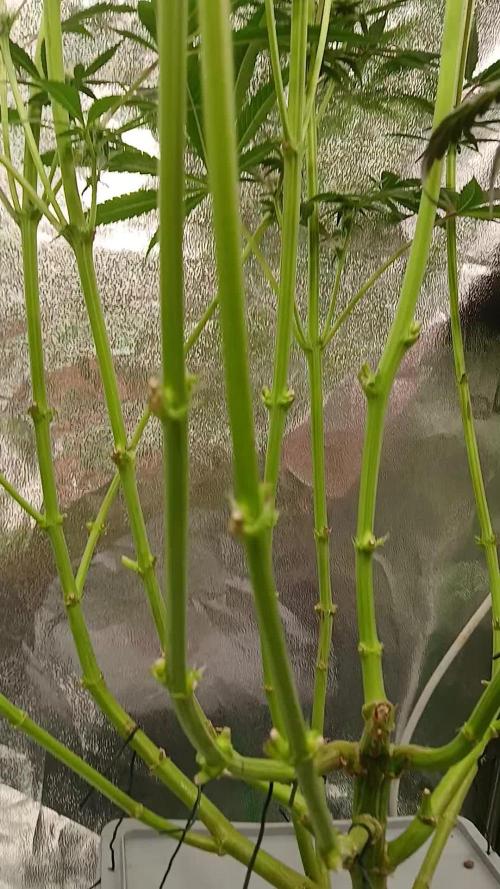
Blüten werden jetzt dicker, die Energie hat sich vom Höhenwachstum verlagert.
Geruch ist noch sehr dezent, aber schon merklich.
Likes
1
Share


Likes
2
Share


@Martin82
Follow
My Moms newest outdoor plant. i grew it up in my vgrow box(videos). now she is in ~45l living soil, after some time on the windowsil to prepare her for the real sun .😎


Likes
27
Share


@Ganjagrandaddy
Follow
It is officially time to admit they are women now !.... Seeing all the little white pistils and the "starfish" look to the tops shows hope.
They have been spreading out nicely This week with even the Ghost OG gaining more vertical and lateral growth. There are easily defined differences already between these 3 ladies and having the variety to train together is always a challenge. I am hoping the Ghost can fill put in the next bit of stretch to get her canopy level with the others. The wedding cake is Thickening and growing daily so well now. She shows no signs of slowing yet either so I think she will dominate this NGT tray if not kept under manners !!. GG#4 is setting herself up nicely for some fruit bearing and I look at her skinny arms and wonder how thehell this strain can hold such dense buds without a total collapse but know from experience they can too. With these ladies being the last to officially become women , we are now in a full flowering room. Roll on harvest time in a out 8 weeks for these girlies now. stripping out at day 21 will help fix the final buds.

Likes
8
Share


@GigglePickle
Follow
Leaves are filling out more after the defoliation. Some plants are showing difficulties from the cold root zones. No nug growth shown yet.


Processing
Likes
2
Share


@Greenbean15
Follow
Lollipopped the monster crop clones in the tent; defoliated everything a bit. Everyone seems to be moving alone nicely.
Everything is showing pistils except the two bagseeds in the middle of the tent. Smells great in the closet.
Between the two tents I have a 2x7’ area with three Sunraise lights running. I’m hoping to have a better harvest than last time. Last grow I only used the 2x4 tent with three plants and two lights yielded about 2 ounces per plant. I nute burned the hell out of them last time and I’ve been feeding about 1/4 the amount I was last grow.
These plants seem much healthier and are much larger than my last grow. I have also become more comfortable with defoliation than I was previously. This time I am focusing on larger, denser buds.
The plant in the solo cup is a Pineapple Express clone. It has not rooted but the stalk has turned white and it hasn’t been needing much humidity anymore. It is almost rooted; I have been spraying it with colloidal silver to try and Hermie it. If I can get it to Hermie I can separate it before the pollen sacs burst and selectively breed branches on my other plants to make feminized seeds.
**growdairies is messing up; I cannot change the temperatures on substrate, night air or day air. Average temp for all is about 75 degrees Fahrenheit.

Likes
30
Share


@DrewbieDoobieNoobie
Follow
Flower time is here. Transition Feeding as above 3/7/19 I will still irrigate during the week with PH 6.0 water with 1 mil CAL MAG and 1 mil SILLICA /gal I'll be using DJ Short's 11 on 13 off light shedule as I was using a 6/2 x 3 veg schedule I might a well keep it exotic. I have been reading that it will help bring out the flavor, smell and appearance of the buds at the cost of a small sacrifice in yield. Because this is my medicine I will have plenty off the 6 plants, and I'm looking for quality over quantity. As far as I can tell I have not seen any detrimental effects of the 6/2 light shedule it is the same amount of light as 18/6 I just broke it up in 3 parts. It did help keep the heat down. I found I did not have to water as often as well. Would the plants have been bigger had they had and 18/6 I don't have the data to confirm or deny that. All I know is that the plants are doing their thing and they look healthy to me so maybe for the home grower in a hot area this method might work for you. I wanted to try it and I'm just sharing my results with this amazing community of growers. As always I will be uploading more images and Time-lapse at the end of the week. Cheers to all yall😇


Likes
2
Share


@Ultraviolet_
Follow
We become aware at such times of man's wonderful ability to bring seemingly unrelated elements into harmonic balance, and receive a glimpse into a world where everything exists in conscious sympathetic attunement to everything else. When we listen to a piece of music that seems to strike a beautiful chord somewhere inside us, or view a painting that simply glows with harmonic awareness well executed, we probably do not spare much time to contemplate the wonderfully intricate combination of vibrations that our sensors make it possible for us to perceive. We tend to appreciate the relationship between the parts of something by an awareness of the harmony or dissonance of the whole. This ability enables us to say "what a beautiful house!" instead of "analysis has proven that this collection of building materials exhibits certain elements of harmonic proportion." While this ability to instinctively appreciate the beauty of true harmony has an important role to play in evolution, a more analytical understanding of the laws involved can be most useful. This is especially so if we wish to create works of art where each part exists in true harmony, not only with the other part of that particular whole, but with the universe within which the creator and the created exist.
Everything vibrates. From the most dense matter to the most subtle cosmic rays, everything which our senses allow our thoughts to become aware of, can be specified in terms of wavelength or frequency of vibration. These two terms define the same thing, but from different points of view.
The following are the approximate wavelengths of various energy carriers:
Cosmic rays 0.000,000,001 mm
Gamma rays 0.000,000,1 mm
X rays 0.000,500 mm
Ultraviolet rays 0.003 mm
Visible light 0.006 mm
Infrared 0.01 mm
Sound waves 1 meter
Radio waves 300 meters
Violet light 400 nm to 450 nm
Blue light 450 nm to 500 nm
Green light 500 nm to 570 nm
Yellow light 570 nm to 590 nm
Orange light 590 nm to 610 nm
Red light 610 to 700 nm
1 nanometer (nm) = 0.000,000,1 cm = 1/10,000,000 cm
If a guitar string is plucked and we hear a sound, it is not too difficult for the human mind to associate this sound with the vibration of the guitar string. With color it is quite different. It is difficult for us to conceive that the color of a substance is not an inherent property of the substance itself, but an indication picked up by our senses of that substance's ability to absorb or reflect the light which happens to be shining on it at that moment. Neither the matter nor the light is colored. What happens is that the brain learns to differentiate between the frequencies reflected or transmitted by the substance the eyes are focused on. The same thing happens with sound. When we say "Oh! Listen, they're playing my favorite song," what we really mean is: "My brain has stored within it a particular pattern of frequencies. I have compared the new information being received with this stored pattern and have deduced the answer that the two patterns are similar within certain specified tolerances." The 'pleasure' involved could have something to do with our running the pre-recorded pattern at the same time, in 'sympathy' with the new pattern as it is received.
The word sympathy describes very well our ability to appreciate color and sound. It also describes the reason behind certain elements of harmony. For instance, if a substance vibrating at 100 cycles per second (tone 1) is in the proximity of another substance vibrating at 200 cycles per second (tone 2), we could perceive, if we had the right equipment, a certain sympathetic relationship between the two.
We will see from this that there is a uniform doubling of the first tone seen in the second. At various points along the waves, the two are the same in amplitude. At other points, they are at opposite poles to each other. This doubled frequency has more points of similarity to the original than any other frequency except the original itself. If the equipment we had available for measuring these two frequencies was a soundboard amplifier and a pair of ears, then we would hear what would sound to us like one tone. If we had the opportunity to hear one at a time, we would hear that although they sound the same, one is higher in pitch than the other. This characteristic of 'the same but different in pitch', musicians have called the octave. Any two tones produced where one has exactly doubled the frequency of the other is called an octave. Speaking in ratios, an octave would appear then as the ratio 2:1 or 1:2, depending on whether we are talking of an octave up or down.
A single note produced by almost any instrument will contain more than one wavelength or frequency. It will have a dominant frequency, the wavelength of which we would call the note's 'fundamental' or 1st harmonic. It will also have a varying number of upper harmonics, gradually fading in intensity into infinity or silence.
Natural harmonics always have the same pattern of intervals between them. The interval between the 1st and 2nd harmonic is a perfect octave; between the 2nd and 3rd a perfect fifth; between the 3rd and 4th a perfect 4th; and so on, the intervals becoming smaller and smaller until they lose any relationship with the western 12 tone scale as it exists at the moment. Just as an octave has certain elements of sympathy with its fundamental, so some intervals have been noted to be more perfectly in sympathy with the fundamental than others. The ratio of the 'perfect 5th' or interval of 7 semitones, as it occurs in the harmonic series, is 3:2 or 2:3, while that of the 'perfect fourth" is 4:3 or 3:4. All the tones in the western 12 tone scale can be expressed in terms of the ratio between the upper tone and its fundamental. This would seem to be an ideal way of generating a scale from any given fundamental and several attempts have been made to do this, the Pythagorean system being probably the most well known. Although when working with a single tone instrument playing on its own, the Pythagorean formula works wonderfully well, if we had several instruments tuned this way together and asked them to play almost any western music, we would find that at times they sounded quite out of tune to each other.
The lack of flexibility of the various scale systems based on the harmonic series has led to what is known as the 'tempered' scale. This uses as its primary unit of interval the ratio of the octave or 2:1. It then proceeds to divide the interval between any fundamental and its upper octave into 12 smaller intervals by applying the ratio: two to the one-twelfth power, to one (21/12:1). This equals 1.059463094, so by multiplying any frequency by this number, we will obtain the tempered semitone next up from our fundamental. We will also find that any tone twelve semitones up from any other tone, in a scale generated in this way, will have exactly double the frequency.
If we took the note middle C on a piano and halved the wavelength, we would have the note C one octave above. If we halved this, we would have the C above, and so on. However, within about 6 octaves, we would find that although a 'sound' was being produced, no human ear could perceive it. If we kept on going, halving and producing upper octaves of our fundamental C, we would proceed through the infrared band, into the visible light spectrum. If we happened to be outside during the day, we would, for one octave only, see the note C with our eyes. The next octave above would already be in the ultraviolet band, and outside the eye's sensitivity range. If we can think of color as being an indication of a substance's vibratory rate or wavelength, we may begin to see a relationship that could exist between the color and sound spectrums.
The logical extension of what has so far been said is that there exists a scale in the color spectrum that corresponds exactly to the scale in the sound spectrum, each color tone being an octave of the equivalent note in the sound range.
This is not the end of the story but only the beginning. If we can for the moment accept that any wavelength in one band has upper and lower octave stretching out to infinity, then the next question is 'fine, but what shall we use as our fundamental? A particular color? A particular sound frequency?' The musicians among us will probably say 'A 440'. This means that the note A should vibrate at 440 Hertz, or 440 times per second. They would tell us that this is standard pitch has been adopted by most orchestras around the world; pianos are tuned to it, instruments are constructed to formulas based on it, and so to them it would probably seem the most appropriate place to begin. Some of these musicians may know of the battle that is still raging with regards to this being the standard, but few would know why A = 440 Hz was chosen except that it worked when it was set to be a suitable compromise between the many different pitches in use at the time.
432 Hz is said to be mathematically consistent with the patterns of the universe. Studies reveal that 432 Hz tuning vibrates with the universe’s golden mean PHI and unifies the properties of light, time, space, matter, gravity, and magnetism with biology, the DNA code, and consciousness. When our atoms and DNA start to resonate in harmony with the spiraling pattern of nature, our sense of connection to nature is said to be magnified.
Another interesting factor to consider is that the A=432 Hz tuning correlates with the color spectrum, while the A=440 Hz is off. Audiophiles have also stated that A = 432 Hz music seems to be non-local and can fill an entire room, whereas A=440 Hz can be perceived as directional or linear in sound propagation.
Once you adopt the idea that sound (or vibration in general) can have an equalizing and harmonizing effect (as well as a disturbing effect), the science of harmony can be applied to bring greater harmony into one's life or tune to specific energies. There is a form of absolute and relative harmony. Absolute harmony can, for example, be determined by the tuning of an instrument. The ancients tuned their instruments at an A of 432 Hz instead of 440 Hz - and for a good reason. There are plenty of music examples on the internet that you can listen to in order to establish the difference for yourself.
Attuning the instrument to 432 Hz results in a more relaxing sound, while 440 Hz slightly tenses up the body. This is because 440 Hz is out of tune with both macro and micro cosmos. On the contrary, 432 Hz is in tune. To give an example of how this is manifested microcosmically: our breath (0,3 Hz) and our pulse (1,2 Hz) relate to the frequency of the lower octave of an A of 432 Hz (108 Hz) as 1:360 and 1:90.
It is interesting to note that 432 Hz was the standard pitch of many old instruments and that it was only recently (19th and 20th century) the standard pitch was increased. This was done in order to be able to play for bigger audiences. Bigger audiences (more bodies) absorb more of the lower frequencies, so the higher pitch was more likely to “cut through”. One of the oldest instruments of the world is the bell ensemble of Yi Zeng (dated 423 BC), tuned to a standard F4 of 345 Hz, which gives an A= 432 Hz. The frequency of 345 Hz is that of the platonic year! Similarly, many old organs are tuned in A=432 as well; for example, St. Peter’s Capella Gregoriana, St. Peter’s Capella Giulia, S. Maria Maggiore in Rome.
Maria Renold’s book “Intervals Scales Tones and the Concert Pitch C=128 Hz” claims conclusive evidence that 440 Hz and raising concert pitch above scientific “C” Prime=128 Hz (Concert A=432 Hz) disassociates the connection of consciousness to the body and creates anti-social conditions in humanity.
The difference between concert pitch A=440 Hz and Concert A=432 Hz is only 8 cycles per second, but it is a perceptible difference of awareness in the human consciousness experience of the dream we share called existence.
Likes
4
Share


@ObloTheGrower
Follow
2 of 3 plants are females, Others are still unknown, females r hst ed and topped. I will repaet training with fimming after stress. 1 of them is a male ruderalis, I took him from the pot he lost around %95 of his roots but still alive and moved in quarantin to harvest his pollens to cross new combinations for the future,
I broke a flowered stem :( and I dont want to say good bye to that small piece so I will try to make a clone with it, the chance will be less because of her flowers also I have not root hormon so the only chance is aloa vera gel and honey to protect her from infection . 2 fresh cuts from topped girls and 1 broken stem are in a box now (which they borned in it, the destiny :)) . Looking a chance to survive, Im supporting them with foilar spraying 2 or 3 times a day which includes B52 and Revive. Good luck girls God bless u,
Likes
26
Share


@Roberts
Follow
G13 auto is doing good under the Medic Grow Mini Sun-2. She is in the Athena blended line nutrition. She is in bulking now. I had a little mistake. I accidentally hit the on off value for the air and shut it off to this plant. So it went for a few days with no aeration. I immediately changed the solution, and got the air going again. The solution was rancid from sitting. Hopefully I can ride out the rest of the grow with a decent result. Thank you Medic Grow, Athena, and Weed Seeds Express. 🤜🏻🤛🏻🌱🌱🌱
Thank you grow diaries community for the 👇likes👇, follows, comments, and subscriptions on my YouTube channel👇. ❄️🌱🍻
Happy Growing 🌱🌱🌱
https://youtube.com/channel/UCAhN7yRzWLpcaRHhMIQ7X4g

Likes
17
Share


@Ksouth1
Follow
3/4- Last few weeks have went well. Not much to say besides she was chugging along and beefing up nicely. She has some pretty long colas and a good bunch of them. Thank you very much Seedsman for the opportunity. This is a beast of a plant, being in a 2 gallon pot and getting the size it has. She has a few weeks left still. She is getting overdrive now and will be flushed for the last two weeks. Will start to flush when her trichomes are all milky and most of the hairs have turned and shriveled. I will update as she progresses. Happy growing to everyone!
3/8- Everything is fattening up. Bud is solid, sticky and stinky. Has some huge long colas. Can't wait to see the total of all the plants. First 8 weeks of their lives, they were under the Mars hydro tsw 2000 and now they are under a new brand, Szchlux 400. It's kickass. Have it 3 1/2 feet above my plants and they are praying. Showing signs that they are getting some extreme photons It's a truly amazing light for the price. Can't wait to see how it does full cycle. Using it with the Mars hydro to cover the 4×8 room I built. It's more than I need for veg and will be great for flowering! Until next time happy growing to everyone!

Likes
Comments
Share


@En_Eff_Tee
Follow
Ignition is amazing. The budsite development after just one week was incredible. First time I’ve used it and it is now a permanent addition. FIrst major de-leafing and lollipopping.

Likes
43
Share


@inversi0n
Follow
Hello, readers!
Branches keep falling down, because of it's weight. I'm trying to manage them. Very hard positioning them.
One of big brunches broke somehow... It's still on the plant, layd on the ties
I think next week will be last for her.
I didn't change solution, so i decided to fed her with TA only this week, so as not to accidentally overdose her.
Feeding that's not from TA is in gr/l
Likes
38
Share


@DaddyPrime
Follow
6/29 we had 3 super hot days in a row. 112, 115, and then 118 degrees. This is the only plant that didnt end up with heat damage/burns from the extreme temperatures. Top dressed with a cup of one shot.
7/3 watered with slf-100 and recharge
Likes
53
Share


@cheetah844
Follow
I tried to move a couple plants over to the smaller tent to get a little more air circulation in there because I had only a passive air intake. With this many plants in this space I didn't think they're getting quite enough fresh air. But upon moving them over to the tent the light even at the highest position slightly started light bleaching the tops of a few plants. So I then moved them back to this bigger grow space and bought an intake fan. The Zkittlez are fighting me the whole way, I don't know if she likes to be cloned or not. Only the Zkittlez often seem to look a little sad even with everything dialed in for them.


