




Likes
1
Share

@AsNoriu
Follow
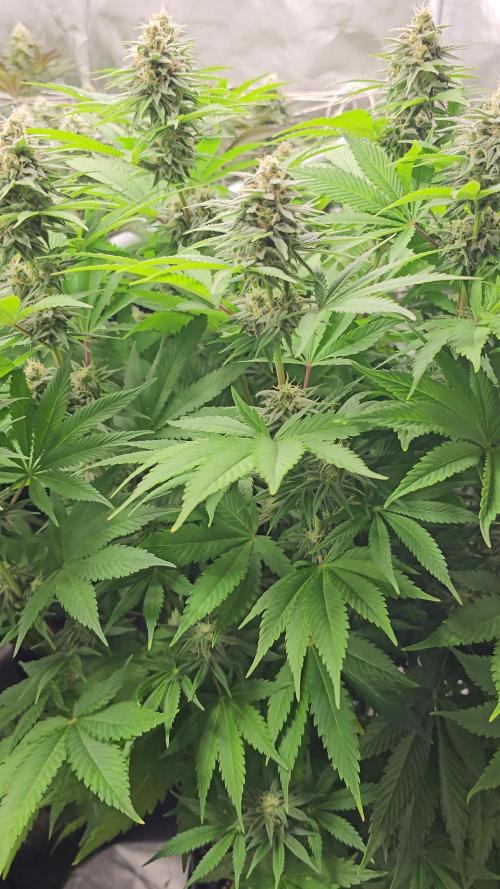
Day 63. All is going ok, she has very nice shade of green, maybe was expecting colas to be longer, but this girl jumped the grow train latest, so if i get even 70g of her - ill be very happy !
Day 67. All is progressing very very very nice !
Happy Growing !!!

Likes
34
Share


@WeedWhisperer
Follow
20 cm growth in one week! I am not even joking. This has to be the fastest that I have seen one of my plants grow.
Pure genetics here. Beautiful.

Likes
1
Share

@Organic_G
Follow
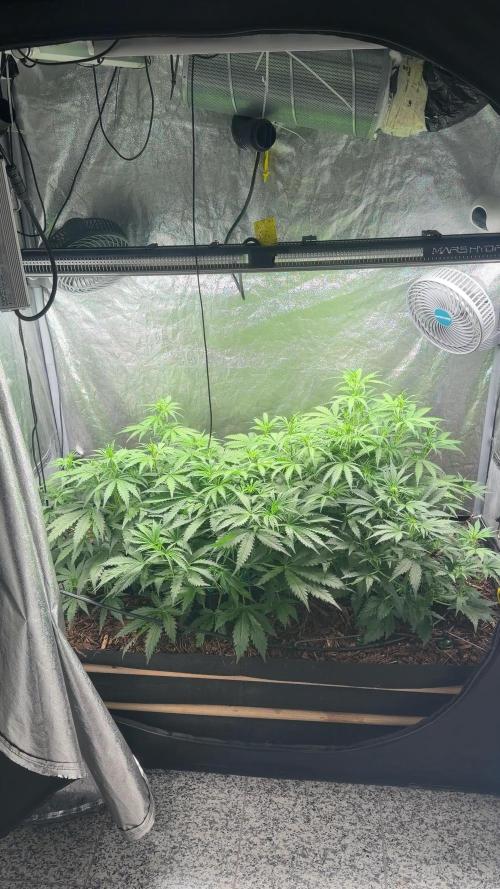
Scheinen gut auf Kurs zu sein, VEG Phase lief top auch wenn ich bei zwei Pflanzen reingeschissen habe aber man lernt…
Bin gespannt wann die fertig gewesen da die bisher ziemlich zügig unterwegs waren.

Likes
12
Share


@603grower
Follow
Just thought these girls where a 8 week strain. Looks like there gonna be another 1 or 2 more weeks. I’m kinda bummed cause I could of fed last week and might of gotten them a lil bigger. Oh well. The fade on the Saturn citrus is so sexy!
Likes
114
Share

@squalino
Follow
🌿 Journal de Culture : Cherry Cola (Auto) - Plante #2
Date : 20/04/2026
Âge : 88 jours
taille: 43 cm
Phase : Fin de floraison / Début du rinçage
⛺ Environnement de la tente
Température : 25°C constante.
Humidité : Maintenue à 50% pour éviter tout risque de moisissure sur les têtes denses.
Éclairage : Pure LED toujours à 100%, maintenue à 60 cm de la canopée.
📏 État de la plante
Taille : Elle a pris 1 cm depuis la dernière fois, elle culmine donc à 43 cm. Elle est restée bien compacte sous le filet.
Nutrition :
Aujourd'hui, elle a reçu son dernier apport nutritif : 4 ml de PK dilués dans 1 litre d'eau avec un pH de 6,3. C'est le dernier "boost" avant de passer à l'eau claire.
Action :
J'ai décidé qu'elle partait en rinçage dès maintenant.
📝 Descriptif et observations
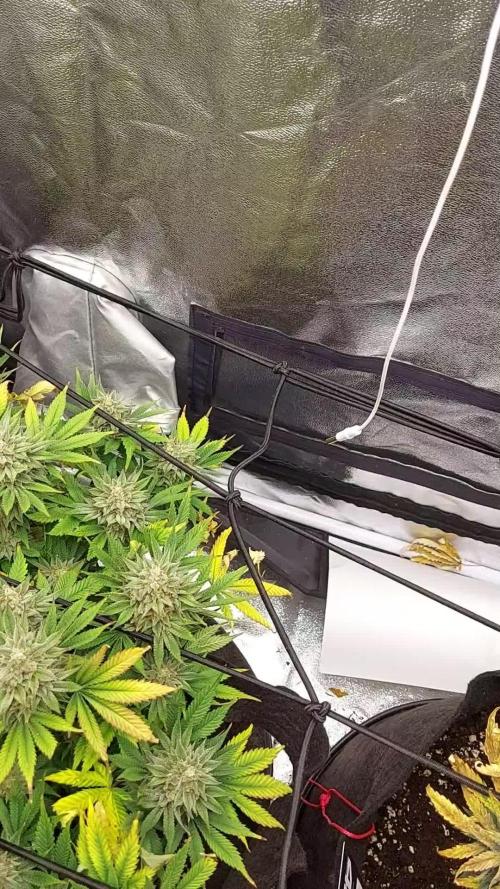
La plante est toujours aussi magnifique. Visuellement, on sent qu'elle arrive au bout de son voyage :
Sénescence :
Les grandes feuilles nourricières commencent à bien jaunir, signe qu'elle puise dans ses dernières réserves pour gonfler ses fleurs.
Trichomes et Résine :
Elle est littéralement recouverte d'une couche de résine collante et brillante qui lui donne un aspect givré incroyable.
Têtes :
Les buds sont bien formés et compacts. Les pistils ont bien bruni sur l'ensemble de la canopée.
Odeur :
C'est maintenant très puissant dans la tente. On sent une odeur forte, à la fois très sucrée et épicée. C'est beaucoup plus complexe que la première plante.
Le choix de passer au rinçage maintenant est judicieux. Avec le jaunissement prononcé des feuilles et la maturité visible des têtes ( trichomesmajoritairementlaiteux .trèspeux d'ambre), deux semaines à l'eau claire vont lui permettre de bien "se nettoyer" et de sublimer ses arômes sucrés et épicés. Contrairement à la plante #1 qui m'avait un peu déçu en production, celle-ci semble avoir des têtes plus denses et mieux réparties sur la structure.
La qualité de la résine sur cette génétique est vraiment son point fort, elle brille énormément sous la LED.
On patiente maintenant jusqu'au cut final !
merci a tous
MUSIQUE DIAPO FAST BUD
Likes
17
Share


Likes
53
Share


@DogDoctorOfficial
Follow
Ladies, gentlemen, and all the wonderful beings following this journey, I am thrilled to announce that we have reached the highly anticipated harvest week for our beautiful PCRs. This has been an incredible journey, and now it's time to reap the rewards of our hard work and dedication.
The PCRs are nothing short of perfection. Their frost-covered buds are a sight to behold, glistening like they've been kissed by winter's breath. The trichomes are abundant and sparkling, making these ladies look absolutely stunning. The aroma is intoxicating, a true testament to their strong genetics and the care they've received.
Upon taking them out of the tent, I was amazed by their strength and resilience. Despite my best efforts to make them dance, these ladies stood tall and proud, requiring no support at all. This just goes to show the exceptional quality and sturdiness of the PCR strain.
Aptus Holland's Enzym+. This product is a game-changer, breaking down dead root material and turning it into usable nutrients, ensuring our soil remains rich and fertile for future grows. Speaking of which, I do plan to reuse the soil, thanks to the amazing benefits of Enzym+. This enzyme product not only helps with nutrient uptake but also keeps the soil ecosystem healthy and thriving.
Here's the final stats for this week:
TDS: 130
PH: 6.8
Temp: 21°C
A huge shout-out to Aptus Holland for their incredible products that have consistently supported my plants' growth and health. Also, a massive thank you to Art Genetix for creating the phenomenal PCR strain that has brought so much joy to this grow.
To all my fellow growers, followers, and the entire community, your support and encouragement mean the world to me. This journey wouldn't be the same without you. As we move forward, let's continue to spread love, positivity, and the joy of cultivating these amazing plants.
Stay tuned for the final results and more updates as we dry and cure these beautiful buds. Until then, keep growing, stay positive, and never stop believing in the magic of cultivation.
Peace, love, and happy growing!
Genetics - P.C.R. @Art_Genetix_Team https://artgenetix.world/
Nutricion @aptusholland https://aptus-holland.com/
LED Power @Lumatek and @viparspectra
As always thank you all for stopping by , for the love and for it all, i fell blessed to have you all with me for one more love journey Thank you Thank you Thank you , you guys are great and have been amazing , thank you for everything !
#aptus #aptusplanttech #aptusgang #aptusfamily #aptustrueplantscience #inbalancewithnature #trueplantscience #dogdoctorofficial #growerslove
With true love comes happiness , Always believe in your self and always do things expecting nothing and with an open heart , be a giver and the universe will give back to you in ways you could not even imagine so !
Friendly reminder all you see here is pure research and for educational purposes only
Growers Love To you All
Discount Codes :
@thecannakan DOGDOCTOR 15% off
@theneutralizer PORKIT5-DOG 15% off
@kannabiaglobal DOGDOCTOR 30% off
@seedsmangenetics DOGDOCTOR 10%off
@terpyz.mutant.genetics DOCTOR 15% off
Have a fantastic week!

Likes
75
Share


@Dedon
Follow
Hi everyone !
everything is going well, except i have burn some leafs with light ( i was too greedy and put the light too close ) but it's only on 2 or 3 leafs so it's ok.
i can't wait !! i wanna taste it 😍😍😍
Likes
32
Share


@MadeInGermany
Follow
Info:
Unfortunately, I had to find out that my account is used for fake pages in social media.
I am only active here on growdiaries.
I am not on facebook instagram twitter etc All accounts except this one are fake.
Flowering day 43
since time change
to 12/12 h.
Hey guys, a quick update on the mini experiment :-).
Slowly but surely, the buds of this mini lady are developing very well :-).
It was poured twice this week with 1.2 l each.
Otherwise everything was checked and cleaned.
Stay healthy 🙏🏻
You can buy this Strain at :
https://www.zamnesia.com/de/5165-zamnesia-seeds-kalini-asia-feminisiert.html
Type:
Kalini Asia
☝️🏼
Genetics:
Black Domina x Purple Kush
👍
Vega lamp:
2 x Todogrow Led
Quantum Board 100 W
💡
Bloom Lamp :
2 x Todogrow Led
Cxb 3590 COB 3500 K 205W
💡💡☝️🏼
Soil :
Canna Coco Professional +
☝️🏼
Fertilizer:
Green House Powder Feeding
☝️🏼🌱
Water:
Osmosis water mixed with normal water (24 hours stale that the chlorine evaporates) to 0.2 EC. Add Cal / Mag to 0.4 Ec Ph with Organic Ph - to 5.5 - 5.8 .

Likes
3
Share


@gottagrowsometime
Follow
Week 5, days 35-38
Ztrawberry 1 pheno & Damn Sour 2 phenos
Both strains are on a very different path. Ztrawberry has been in a bigger pot since the start and after been put in an 11L pot. Wow, she has thrived. She's gotten so big. I've actually decided to flip her. Her nodes are grown and she is fully ready to flip and the process of waiting will be short. I gave her the last grow feed a few days ago. Already still having grow mix as she was moved into a solo pot of grow/light/pebbles 40-40-20 from plagron. She's pushing so hard. There is a few ph issues and a few other stuff. No nutrient defs so nothing that would stop her moving to the next phase. Ztrawberry has been put in 12/12.
More pics coming soon from week 4
Damn Sour
Both phenos have been stuck in a 2L pot and was only transplanted into each 2L pot. Been giving master root and Enzymes + silica for stress. They've only been put in 2L pots a few days ago. 1 was very stressful as I practically had to pull her up with as much of the roots as possible. They are the sane age as Ztrawberry but they had no space. I will uppot them to 9L pots in a few weeks once the root zone has recovered. I really should have left them and uppoted to a bigger pot. But been so long in that pot. They wouldn't have reached out which is what's happened to my 2 lemon photos I kept too long in a 20L hydro pot. Was really as waste of time by the looks of it.
More pics coming soon
Have had to PH to 6.7 and I used - on the silica feed which have been all on since they were transplanted. Ztrawberry 2 weeks ago & Damn Sours 2 dags ago..
Discount codes from sponsors for you
20% off Xpert Nutrients/KANNABIA with code:ggst
20% Zamnesias entire catalogue with code; ZAMMIGROW2024

Likes
3
Share

@Alvareas
Follow
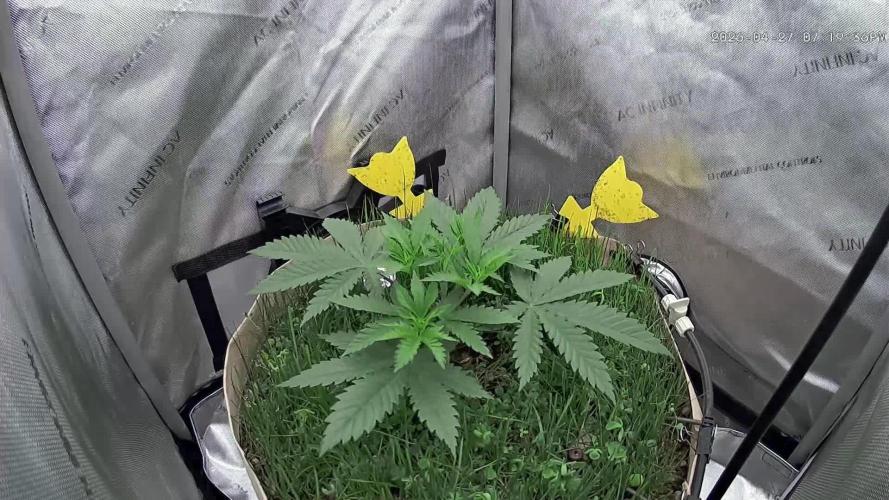
Die Pflanze wurde zu Beginn der Woche getoppt.
Dieses Mal bleibt es bei einem Topping, und ich lasse sechs Hauptriebe stehen.
Diese werde ich später mit einem Scrog-Netz auseinanderziehen, um möglichst viele Seitentriebe zu fördern.
Ziel ist ein ebenes Blätterdach mit möglichst vielen kleinen Mainbuds.
Die Pflanze hat das Toppen gut verkraftet und wächst weiterhin kompakt.
Sie ist nach wie vor sattgrün, und die Blätter richten sich steil zur LED aus.
Das zeigt mir, dass die Living Soil gut funktioniert und die Pflanze optimal versorgt wird.
In dieser Woche wurde erneut mit Nematoden gegossen.
Das ist für mich ein Nachteil der Living Soil.
Durch den dauerhaft feuchten Boden fühlen sich Trauermücken besonders wohl.
Dies ist mein zweiter Grow mit Living Soil, und in beiden Fällen hatte ich mit Trauermücken zu kämpfen.
Bei meinen früheren Grows mit normaler Erde, Flüssigdünger und zwischenzeitlich antrocknendem Substrat hatte ich dieses Problem nicht.
Zu Beginn der Woche wurde die LED auf 20% erhöht und der VPD während der Lichtphase leicht angehoben.
Die Parameter in Woche 4:
Controller Einstellung Tag: Advanced AI VPD 1,0 – 1,2
Controller Einstellung Nacht: Advanced AI VPD 0,9 – 1,1
Durchschnittliche Tagestemperatur: 26,4 Grad
Durchschnittliche Nachttemperatur: 23,0 Grad
Durchschnittliche Luftfeuchtigkeit Tag: 58,9%
Durchschnittliche Luftfeuchtigkeit Nacht: 55,7%
Durchschnittlicher VPD Tag: 1,1
Durchschnittlicher VPD Nacht: 1
Durchschnittliche Bodenfeuchtigkeit in Mbar: 100
LED Leistung: 20% = 90 Watt
Beleuchtungsdauer: 18 Stunden
Umluft: Stufe 1 oszillierend

Likes
Comments
Share


Likes
1
Share

@Dabking
Follow
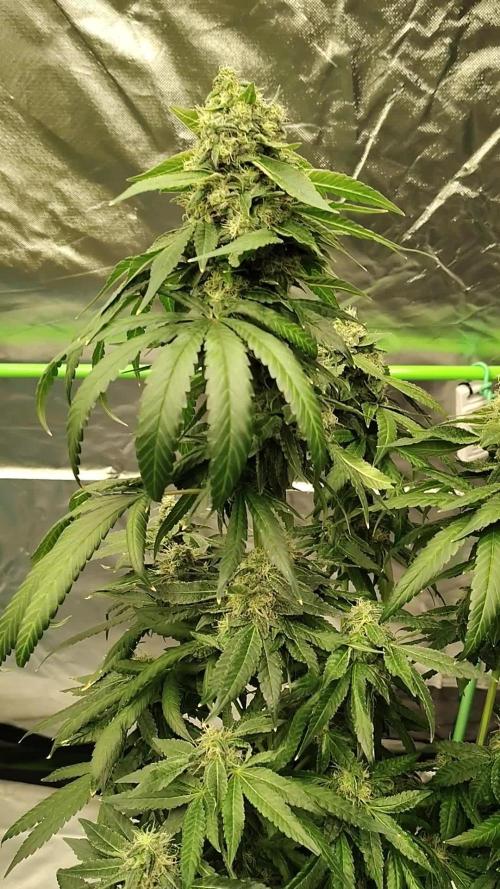
Some more light defoliation, and propped her up as the buds are VERY dense and she started leaning over.
Likes
55
Share


@w33dhawk
Follow
02.03.21 Anfang der 7 vegi Woche habe heute wieder einmal alles runter gebogen was ging und entblättert hab ja noch knapp 4 Wochen Zeit bis ich den Zyklus wechsle das scrog netz is bis jetzt nur zur Zierde drauf um abzuschätzen wie viel platz ich noch habe um das ganze rechtzeitig ein zu weben und trotzdem noch genug Luft zwischen Topf und netzt zu bekommen


Likes
4
Share


@losgrowershermanos
Follow
Rega com fertilizante. Aproximadamente 100 ml por planta. Observando. Observando, foi usado o mesma mistura de semana passada. alterando PPFD para 380
Likes
1
Share


@therealgrowmie
Follow
We’re in the midst of the bulking phase now, with a few buds stacking up nicely.
Unfortunately, the plant on the left has sparser bud distribution. Compared to other auto genetics, these three plants also show a broad variety in growth structure and phenological traits.
Also, overall plant health isn’t entirely satisfying, with high temperatures being the Main cause. The leaves are showing several stress-related issues like mild tip burn, nitrogen deficiency, and some cal-mag problems. But hey - we’re here to grow buds, not leaves! 😄
That said, the fade is to be expected as the plants start to cannibalize themselves for nutrients. The stretch is also in its final phase, so we’re likely 3 to 4 weeks away from harvest.
---
Quick rundown on everything else:
Watering: 1500ml every third day
Fertilizer: According to the BioBizz schedule
Light intensity: ~1000 PPFD
VPD: ~1.62 kPa
Temperature: ~28°C
Relative humidity: ~55%
Likes
15
Share


@Viccrazyweed
Follow
Buds keep fattening up more and more, this should be the amazing phenomenon Carl Linneus talked about
Flowers are getting enormous, gross, monster buds, everyone told me i had not enough light, not enough air flow, not enough badabee badaba but honestly i see them right, beautiful and healthy
Please, SUGGEST ME anything you can think about and ill try to improve it