





@Mxtrader144
Volgen
Definitely can't wait to grow this strain again with all autos and run 18/6 the entire time.


@Herbalize
Volgen
Hello Folks 😎
7th week of flowering,I'm really amazed by these girls !
They are beautiful, the smell is powerful, and these buds are dense like rock !! 💪
They drink 4/5 liters every 5/6 days, for the last watering with fertilizer, I reduced the dose about 650 ppm
my plan is to start the flush from day 50 until day 65 and from there, I'll see if I have to push a few more days while checking the color of the trichomes
I think I'm going to enjoy this already legendary strain, like the smell a lot 😻
Follow, like and comment if you enjoy it
I also have a second diary with 2 Moby Dick
Peace Love & Weed 😍👊


@PlantGod
Volgen
Excited to see the pistols keep coming and coming
I have such tight spacing that the buds will probably start connecting by the end of the week on the Royal Gorilla
Day 19- Tomorrow I will tie some branches down to open up the plants more. The LSD plants needs it the most!


@smoker420
Volgen
She has really orange and sweet terps on pheno1 and pheno 2 smelled like cat piss or something growing really zesty and gassy at same time both show great colours towards the end got cuts going again for next run will be better would recommend this strain first time with exotic and wont be the last all i can say haha


@Growyourownathome2x2
Volgen
Thursday the 8th of June day 43 of 12/12 just plain ph water from now until harvest


@Ratch33
Volgen
Outside Temps are plummeting - Entering Winter
Running Fan Heater at night.
First Dew Frost on the 1st of June
Added min-max hygrometer
There's still damages, pruned affected leaves
New growth looking normalised.
Budding is slow


@Budz_Bunny
Volgen
I grew an Apple Fritter feminized plant, which is a cross between Sour Apple and Animal Cookies. It is an indica-dominant strain with a high THC content and a sweet and fruity aroma.
I grew the plant in a tent under an LED lamp. The temperature was between 20 and 25 degrees Celsius and the humidity between 40 and 60 percent.I watered the plant regularly with water and organic fertilizer and protected it from pests and diseases.
The plant grew very fast and formed many side branches. I topped it several times to control its height and promote its branching. The flowering time lasted about 8 weeks, in which the plant developed many dense and resinous flowers.
The harvest was very satisfying. I harvested a total of 74 grams of dry flowers, of which 58 grams were large and 16 grams were small. The flowers had a beautiful color with orange hairs and a white coating of trichomes. They smelled very sweet and fruity. They also tasted very delicious and had a strong and relaxing effect.
I had hardly any problems with the plant, except that it was a bit cold-sensitive. I think it would have grown even better in a slightly cooler environment. But I am very happy with the result and would like to grow this strain again.👌
I thank you for the support from all of you and hope you stay tuned to see what happens to my other ladies.👆


@tigerbomb
Volgen
forse potrei ancora dargli un piccolo boost di fert se mancano altre 3 settimane ma non saprei


@BioBuds
Volgen
What a beautiful strain Orange Hill Special is, nice and bushy, great internodal spacing, sturdy and healthy. Happier and happier with how this grow is going.
The less beautiful parts on top are my doing, my blind as a bat FIM destroyed half the top of the plant. More patience next time...
The super soil is still performing great and I´m pushing up the dimmer to get the ladies used to more light, very carefully because leaves are folding every time.
Some of you might be happy to find my European recipe/shopping list for super soil. I tried to make it with widely offered products throughout Europe.
Feel free to use it and elaborate on it.
If one product is not available in your country, please check the brands at the bottom, which might be available in your country, and substitute.
The only thing one could add to the recipe (which I did but forgot in the shopping list) is some Epsom salt.
Fed them again with my permaculture tea, all seem to flourish and smells are starting to come from the plant, with that same distinct dankiness I had in earlier grows with this tea.
See the germination page and other diaries for more info on my Perma tea.
Now they were big enough, some might even say too big, to start the real training. I always love to give them a little bend the week before, to get used to the idea.
With some sterilized bamboo sticks I pushed the plants down to expose their sexy undersides. Let them become forests of buddy bush.
Thats it for this week! Thanks for following and happy growing!!


@Schnabeldino
Volgen
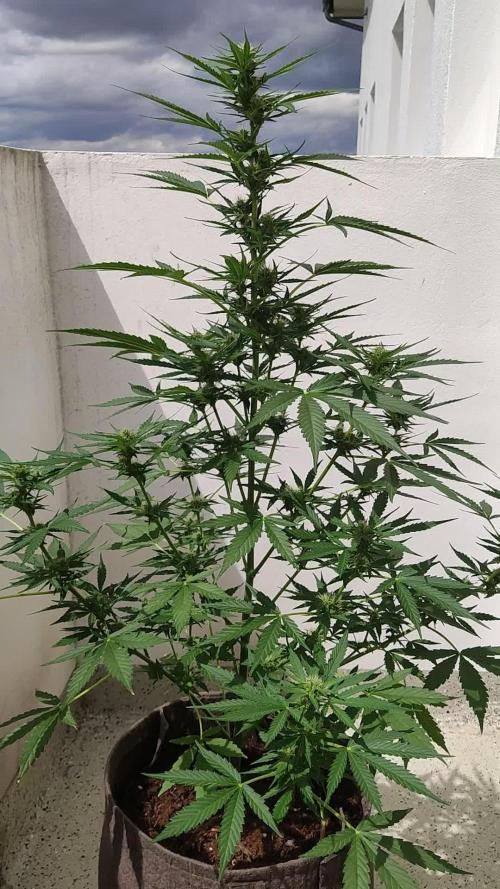
_____ Week 10 | Day 70 - 77 | 3rd week of Flower ______
Day 71 🌞
- I mounted a fan below the net for more air circulation
Day 72 🌞💧
- 24 liters were mixed and distributed among the 8 plants / each plant 3 liter, at the moment I can water them every 4 days
Day 76 🌞💧
- It remains every 4 days 3 liters of water each plant
____________________________________________________________________________________________
Light - 12/12 h - 560 Watt
- 2x 200 Watt Toplight
- 4 x 40 Watt Lightbars
PPFD - 900 - 1000 µmol
Temp. avg. - 22,9°
Hum. avg. - 61 % RLH



@SkunkyDog420
Volgen
Hallo zusammen 🤙.
Sie wächst sehr schön und macht keine Probleme.
Rabattcode für den BIOTABS-Webshop https://biotabs.nl/en/shop/ GDBT420, damit erhalten Sie 15 Prozent


@pareto
Volgen
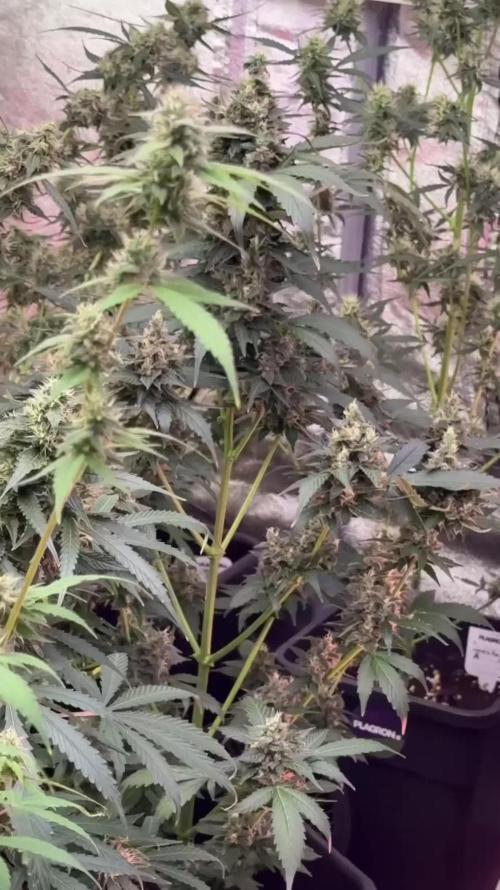
She had her issues and is not a big yielder. But she makes up for it in beauty and aroma!
The trichomes look absolutely awesome!
--------------------------------------------------------------------------------------------------------------------------------------------------------------------------------
Set up cost (fixed costs)
-Lamp: 40€
-Timer: 3,5€
-Pot: 4€
-Total fixed costs: 47,5€
Given 5 years (or 15 grows) usage time translates to around 3,17€ per grow in materials.
Variable costs:
-Seeds: 6,33€
-Soil: 6€
-Fertilizer: 3,50€
-Power: 20,22€
-Total variable costs: 36,05€
-Total costs per grow: 39,22€

@DogDoctorOfficial
Volgen
💜 Purple CousKush Auto by Zamnesia | Pheno B | Week 10
🌿 No Demands. No Drama. Just Beautiful Flowering.
Welcome back to another chapter of the 8×8 Adventure! 🌱💚
And once again...
Purple CousKush Pheno B isn't asking for much.
She's not complaining.
She's not creating problems.
She's not demanding special treatment.
She's simply growing.
Flowering.
Building.
And looking absolutely beautiful while doing it.
😂💜
At this stage of the adventure, I think that's exactly what I want from her.
We're reaching that part of the cycle where there isn't necessarily a lot left for the grower to do.
We've built the plants.
We've trained them.
We've managed the canopies.
We've provided the environment.
We've given them the nutrition and the light.
Now?
We mostly provide whatever they ask for and stay out of the way.
And Purple CousKush Pheno B isn't asking for much.
She's perfectly happy continuing at her own rhythm.
So...
let's give this girl her spotlight.
🌱 The 8×8 Adventure — Everybody Has Their Own Rhythm
For anyone discovering this diary for the first time, welcome to the 8×8 Adventure.
Twelve different plants.
Different genetics.
Different phenotypes.
One general cultivation environment.
One lighting philosophy.
One nutrition strategy.
One room.
And yet...
twelve different stories.
That's what makes this project so interesting.
Some girls have been more demanding.
Some have needed more attention.
Some are extremely compact.
Some spread themselves out.
Some move faster.
Some take their time.
And some, like this Purple CousKush Pheno B, basically look at me and say:
"I'm fine. Just keep the drinks coming."
😂💜
Fair enough.
That's exactly what we're doing.
💜 Week 10 — She's Still Doing Her Thing
She's sitting around 96 cm, which puts her firmly into the more moderate-sized category of this run.
She's not a giant.
She's not a dwarf.
She's not trying to take over the tent.
But she's also not cramped into a tiny little package.
Instead, she's developed a really nice spread through the available space.
And that's something I'm appreciating more and more.
She's not particularly compact.
Her branches have room to spread.
Her flowering sites occupy the space naturally.
And the plant has developed a nice relationship between height and lateral structure.
She's using the space she's been given.
Not excessively.
Not wastefully.
Just...
nicely.
And honestly, that's a very satisfying phenotype to work with.
🌿 Beautifully Spread Through Her Space
One of the things that catches my attention this week is how nicely she's occupying the space around her.
She's not simply a vertical column of flowers.
She's spreading outward.
The branches have developed into their own little framework, with flowering sites distributed throughout the structure.
That gives her a completely different appearance from some of the more compact girls in the room.
And that's exactly what I love about comparing phenotypes.
Her sister tells a different story.
Other Purple CousKush plants tell different stories.
This one?
She likes a little more room.
And she's using it beautifully.
There's something elegant about seeing a plant naturally occupy the space available to her without becoming excessively stretched.
She's simply finding her own shape.
And I like her shape.
🌸 The Buds Are Getting Serious
Now let's talk about the flowers.
Because...
damn.
😂💜
The buds are becoming seriously beautiful.
They're gaining density.
They're becoming more defined.
They're carrying more visual weight.
And the overall flowering structure is starting to look increasingly mature.
This is the point where you stop looking at little flowering sites and start seeing proper buds developing throughout the plant.
The structures are filling.
The individual flowers are becoming more substantial.
And the whole plant is increasingly dominated by those beautiful flowering formations.
This is what we've been waiting for.
And she's delivering.
❄️ Very, Very Frosty
And then there is the frost.
She's getting seriously frosty.
The resin is becoming increasingly obvious across the flowers and surrounding sugar leaves.
Get the camera close...
and suddenly everything becomes about texture.
Tiny resin-covered surfaces.
Pistils.
Calyxes.
Sugar leaves.
Layers upon layers of detail.
This is exactly where my love of macro photography and growing overlap.
Because you can stand back and see a beautiful plant.
Then you move closer...
and suddenly you're looking at an entire microscopic landscape.
And Purple CousKush Pheno B is giving me plenty to explore.
The name CousKush might be the first thing you read.
But that frost?
That's what makes you stay and look.
😂❄️💜
🌸 The Hairs Are Changing Beautifully
I'm also really enjoying the way the pistils are developing.
They're no longer just those fresh white hairs we see in early flower.
They're beginning to show more character as the flowers progress.
The colour is changing.
The flowers are maturing.
And that contrast between the developing pistils and the green floral structures is beautiful.
It's another little sign that we're moving forward.
Not finished.
Not ready to write the ending.
But definitely progressing.
And this is the stage where every week becomes increasingly interesting.
Because eventually, those little changes start adding up.
🌿 And Those Leaves...
The foliage continues looking beautiful too.
Nice colour.
Nice structure.
Nice overall appearance.
And there's something particularly satisfying about seeing healthy-looking foliage surrounding flowers that are becoming this dense and frosty.
The leaves are still doing their job.
They're still contributing to the plant.
They're still capturing light.
They're still supporting the flowering process.
And I'm not interested in removing healthy foliage just because we're getting deeper into flower.
At this point, if the plant is comfortable and the canopy is functioning...
leave her alone.
😂
She's got this.
✂️ No More Need for the Scissors
We've already done the canopy work earlier in the flowering cycle.
That work served its purpose.
The plant has room.
The structure is functional.
Air can move through it.
Light can reach the important areas.
And now?
I'm not going back in simply because I feel like I should be doing something.
That's one of the biggest lessons of this stage.
Sometimes the best cultivation technique is:
Don't touch it.
😂
At this point, we're not trying to redesign Purple CousKush.
We're watching her finish.
If she doesn't ask for something...
I'm not going to invent a problem.
💡 The Photons Keep Coming
The Future of Grow Black Series LED continues providing the primary overhead lighting, while Lumiflora contributes additional light beneath the canopy.
And this girl is clearly making use of that environment.
She's built plenty of flowering structure.
She's developing dense buds.
She's producing visible resin.
And she's filling her available space naturally.
That's what I want to see.
The light provides the opportunity.
The environment provides the conditions.
The plant's genetics decide what happens with that opportunity.
And Purple CousKush Pheno B has decided to make some beautiful flowers.
I'm perfectly happy with her decision.
💜🌿✨
🔬 This Is Why Phenotypes Are So Interesting
Looking at this girl beside her sister is particularly fun.
Same genetic line.
Same general room.
Same lighting.
Same environmental philosophy.
Same grower.
But completely different expressions.
One phenotype may be more compact.
Another may spread wider.
One may produce a different flower structure.
Another may develop different proportions.
And that's the entire reason I wanted to document these plants individually.
Because if I simply looked at Purple CousKush as one thing, I'd miss all of this.
There isn't one Purple CousKush story.
There are individual stories.
And this one is telling me:
"I'm going to spread out, build beautiful dense flowers, get very frosty, and otherwise leave you alone."
😂💜
I like that story.
🌸 We're Getting Into the "Watch and Wait" Stage
This is where the entire room is becoming especially interesting.
Most of the girls are moving quickly now.
The flowering structures are established.
The plants have largely finished deciding how they're going to occupy their space.
And the grower starts becoming less of a sculptor...
and more of a caretaker.
We provide what they need.
We monitor.
We observe.
We keep the environment stable.
And we wait.
Because from here, the plant has a lot of the work left to do.
Density.
Resin.
Maturity.
Final flower development.
And eventually...
the finish line.
Purple CousKush Pheno B is heading there beautifully.
💧 Feeding & Irrigation
The current recorded conditions remain:
🌸 Flowering: Week 10
📏 Height: 96 cm
💡 Light schedule: 12/12
🌡️ Day temperature: 29.9°C
🌙 Night temperature: 25°C
💧 Relative humidity: 60%
⚗️ pH: 6.0
⚡ EC/TDS: ~2.0 mS/cm
🌡️ Solution temperature: 25°C
🌱 Substrate temperature: 26°C
🌬️ CO₂: 639 ppm
? Pot size: 15 L
💦 Watering: approximately 1.2 L per plant / 24h
The nutrition and irrigation approach remains consistent.
And honestly?
She's not asking for anything different.
That's important.
There's no reason to change something that's working simply because we're getting closer to the finish.
Consistency remains the name of the game.
🌡️ Stable Environment, Happy Plant
The room continues operating under the same general environmental philosophy.
Stable temperatures.
Stable lighting.
Stable nutrition.
Stable irrigation.
And a plant that appears perfectly comfortable inside those conditions.
That's exactly what I want.
The less drama the plant gives me...
the more I can concentrate on observing what her genetics are actually doing.
And this phenotype is giving us plenty to observe.
📸 This Week's Gallery
The photographs this week really show the progression.
The full-plant shots demonstrate how nicely she's spreading through the available space.
The closer photographs reveal the flower density.
And once you get close enough...
the frost becomes impossible to ignore.
There's something very satisfying about photographing her now.
She's developed enough structure that the plant tells a story from a distance.
But there are enough details in the flowers that you can keep getting closer and still find something interesting.
And that's exactly what I want from these late-flowering photographs.
Not just:
"Here's the plant."
But:
"Here's what the plant has become."
💜 She's Not Asking for Much — And That's a Good Thing
I think I've said this several times about this girl now.
But it keeps being true.
She's not demanding.
She's not troublesome.
She's not dramatic.
She's not constantly asking for intervention.
She's just growing beautifully.
And at this stage?
That's almost the perfect plant.
Because we're reaching the point where there's not much I want to do to her anyway.
I want her to finish.
I want her to build.
I want her to mature.
I want her to show me what those flowers can become.
So if she's happy...
I'm happy.
Simple.
😂💜
🔭 Looking Ahead — How Will She Finish?
And now comes the fun part.
We're getting closer.
Not at the finish line yet.
But close enough that the question becomes increasingly interesting:
How is Purple CousKush Pheno B going to finish?
Will those dense flowers continue swelling?
How much more resin will appear?
How will the pistils continue changing?
How much more maturity will we see in the buds?
And what will this beautiful, nicely spread-out plant ultimately look like when she decides she's done?
I genuinely don't know.
And I'm not going to pretend I do.
That's the fun.
We watch.
We document.
We provide.
And we let the plant write the ending.
❤️ Final Thoughts — She's Shining
Purple CousKush Pheno B is another girl in this run who is making my job wonderfully simple.
She's growing.
She's flowering.
She's spreading nicely through her available space.
She's producing dense flowers.
She's getting very frosty.
The pistils are developing beautiful colour.
The foliage looks great.
And she's not asking me for much at all.
Honestly...
what more could I ask for?
😂💜
She's not the smallest plant in the room.
She's not the tallest.
She's not particularly compact.
She's not trying to be anything she's not.
She's simply using the space she's been given and turning it into flowers.
And I really like that.
This whole 8×8 Adventure keeps reminding me that there isn't one correct way for a plant to express itself.
Some plants compress.
Some spread.
Some stretch.
Some stay short.
Some build giant central flowers.
Some create beautiful clusters throughout the branches.
And Purple CousKush Pheno B?
She's found her own way.
A nice spread.
Beautiful structure.
Dense flowers.
Heavy frost.
Beautiful colour.
And absolutely no drama.
💜🌿❄️
We're at that beautiful point now where I don't feel like I need to do much.
I just need to provide whatever she asks for.
And this girl isn't asking for much.
So we'll keep doing exactly that.
Keep the environment stable.
Keep her supplied.
Keep watching.
Keep photographing.
And let her finish in her own time.
Because she's already given me a beautiful plant.
Now I want to see what she does with the time that's left.
And I have to admit...
I'm very curious.
Let's see how this beautiful Purple CousKush finishes.
She's earned the spotlight.
She's earned the attention.
And she's certainly earned another week of simply being allowed to shine.
💜✨🌿
🙏 Thank You
A huge thank you once again to Zamnesia for these beautiful Purple CousKush genetics and for giving us another fascinating phenotype to follow.
Thank you to Plagron for the nutrition supporting these girls throughout the flowering journey.
Thank you to Future of Grow LED for the Black Series lighting driving the garden.
Thank you to Lumiflora for bringing additional light beneath the canopy and adding another dimension to this experiment.
Thank you to TrolMaster for helping maintain the environment behind the scenes.
And, of course, thank you to everyone following this crazy 8×8 Adventure here on GrowDiaries.
We're getting deeper into the journey now.
The plants are becoming themselves.
The differences between phenotypes are becoming clearer.
And the amount of work required from the grower is slowly changing.
We're no longer building.
We're no longer shaping.
We're mostly watching.
Providing.
Maintaining.
And waiting.
And Purple CousKush Pheno B?
She's making that part very easy.
She's not asking for much.
She's not causing trouble.
She's just growing beautiful, dense, frosty flowers in her own beautiful way.
So let's keep watching.
Let's keep photographing.
Let's keep learning.
And most importantly...
let's see how this girl finishes. 💜❄️🌸
Until next week...
Beautiful structure. Dense flowers. Heavy frost. No demands.
Let's let her shine.
Growers Love & Happy Growing! 🌱💚💜


@Spazmagi
Volgen
12/8 - Here we are at the beginning of week 10. Her buds are starting to frost up and she is definitely bulking up more than her sister, but her sister has a longer projected flowering time-frame (Heavy Sativa vs Indica). Anyways, did some minor pruning for airflow optimization and to remove some unhappy leaves from her undergrowth. They weren't yellow, but they weren't getting enough light and it was showing. Haven't done much to her this week other than top her off with Tap every other day. Seems like her feed from last week was on point as her pH and EC were solid as the water level lowered. After her first top-off, her EC started to fall as she ate more (reflected in the lower ec in the res after topping off with tap). Tapered her down to 80% strength as she is moving further along in flower and should hopefully finish sooner than her sister. If she needs a bump in her EC, I may top off with full strength nutes, but I'm going to just wait and see how she responds.
Breeder's timeline reflects a ~65 day seed-to-harvest, but I can assure anyone out there growing this strain in DWC that she will not be ready in that time-frame. Currently she is sitting on day 67 and still looks like she has another 2 weeks or more. I grew her in soil before and she was ready pretty darn close to her expected time-frame (~70 days), but this strain responds to DWC differently. She didn't have slow growth or anything; just seems like she will veg longer in hydro than in soil. Not sure why.
Thanks for stopping by the garden, and, as always, Happy Growing!


@Gardens_of_Of
Volgen
I keep increasing the light and she seems to enjoy it, growing new bud sides and leaves everyday. Defoliation continues. I can’t go below 25-26 Celcius due to increased light though. She has also been moved to back middle.


@Hazecat_420
Volgen
Se aplicó una defoliación a todas las hojas amarillas y bajas que aún quedaban para ir limpiando un poco lo que no traerá frutos. Seguimos, cada vez queda menos 👽


@Mzsnoop2001
Volgen
Hoy fue la peor semana del cultivo y de mi experiencia cultivando, siendo el tercer día de la semana 5 se me desprendió el ventilador en el indoor y se me cae sobre una planta quebrando la punta principal (blue moby). día siguiente queriendo doblar el tallo principal lo arranque literal, ahora está en un mal estado, en comparación a la blue moby que recupero. Leo criticas y concejos! Bh


@Delta_9NPK
Volgen
Ciao a tutti!
Ormai siamo arrivati alla fine!
Fine 9° settimana di fioritura l'Amneisa lemon presenta già un buon 5% di ambrati invece la gelato 45 ne accena qualcuno qua e là.
Tutte e due sono state irrigate per l'ultima volta con flawless finish di ADV 2ml/l
La prossima settimana credo di staccare e iniziare la secca.
La tropicanna Banana a deciso di buttare fuori il fenotipo sativa e si sta prolungando il periodo di fioritura che secondo me complessivamente saranno 14 settimane di fioritura per la maturazione dei tricomi.


@Ultraviolet
Volgen
Its time to prepare for war. *Blows bagpipe*
FISH SH!T THE ORGANIC SOIL CONDITIONER (used twice before and always noticed instantly)
Fish Shit is a living product! It provides a complex Microbial profile that includes thousands of different species of bacteria, fungi, and protozoa. This profile is closer to a natural ecosystem than anything you will find on the market. Fish Shit helps release essential oils and terpenes which contribute to the building of a myriad of flavonoids. Flavanoids play a key role in the development of the most potent aromas and tasteful flavors of a plant and its fruit. Fish Shit contains beneficial microorganisms that help plants maximize nutrient uptake. It does this by transforming nutrients into more usable forms and keeping these nutrients in the soil longer. During photosynthesis plants naturally produce exudates (chemicals that are secreted through their roots). Through these exudates, plants can attract the types of good bacteria that are beneficial to them at different points in their growing cycle. These good bacteria cover the roots and act as a barrier to the invasion of disease-causing organisms that may harm the plant.
What Are Enzymes?
Before we dive headfirst into how, exactly, enzymes can benefit cannabis plants, it helps to understand a little about what these microscopic proteins do. Essentially, enzymes facilitate chemical reactions. They do so by binding with a substrate and forming or breaking molecular bonds. In this context, the substrate is the molecule upon which an enzyme acts to boost the efficiency of a reaction.
•substrate /sŭb′strāt″/
•noun
•The material or substance on which an enzyme acts. A surface on which an organism grows or is attached. An underlying layer; a substratum.
Enzymes are proteins with complex 3D shapes that feature regions called active sites. When the substrate binds to these active sites, it forms an enzyme-substrate complex that causes a chemical reaction to take place, temporarily changing the structure of the enzyme and ultimately causing molecules to either come together or break apart. As a result, molecular products are released, and the enzyme returns to its original shape.
Specific enzymes are capable of binding with certain substrates, as the substrate fits into the active site more or less via a lock-and-key principle. Although, new research suggests a more accurate theory of "induced fit", in which enzymes and substrates undergo structural changes to facilitate the reaction.
If you take the human body as an example, we have an abundance of enzymes in our saliva and digestive system. These molecules bind with substrates in these regions (food particles), working to break down the food we eat into usable parts before converting them to energy.
Enzymes in cannabis work in a similar way to the example highlighted above. Typically, enzymes occur in soil naturally, but if your soil mix is lacking organic material, or you're growing hydroponically, then adding enzymes directly to the substrate is crucial.
By using them in cannabis growing, enzymes not only help break down essential nutrients into smaller, more readily available pieces, but they also support the digestion of dead root cells, clearing a direct path for nutrients.
Overall, enzymes make it easier for your cannabis plants to absorb all the elements they need to reach their full potential. For growers, a plant that reaches its full potential means a bucketload of juicy buds come harvest. This is essential if you want to reuse a pot with old systems left over like mine.
Common plant enzymes include:
•Cellulase
•Xylanase
•Beta-glucosidase
•Hemicellulase
•Amidase
Amino acids are a crucial, yet basic unit of protein, and they contain an amino group and a carboxylic group. They play an extensive role in the gene expression process, which includes an adjustment of protein functions that facilitate messenger RNA
Nitrogen, phosphorus, and potassium are the three main pillars of nutrient solutions and fertilizers, but there are countless other nutrients that your cannabis plants need to produce the best possible harvest. Amino acids are one of them.
You may have noticed that amino acids get a lot of attention from bodybuilders and other athletes. That’s because they play a key role in the synthesis of protein, which, as you probably know, is super important for sports recovery and muscle growth. Amino acids are the building blocks of protein and the foundation of both plant and animal life.
But what do amino acids do for cannabis?
WHY IS PROTEIN IMPORTANT FOR CANNABIS?
Just like proteins are important for the human body, they are equally important for the growth and development of plants.
For example, proteins help plants:
•Facilitate the growth of intracellular plant structures
•Promote energy generation
•Stimulate metabolic processes
•Facilitate the absorption and transportation of nutrients
So, where do plants get these vital proteins from? Well, unlike humans, plants can’t source proteins or amino acids from other organisms. Instead, they need to create their own amino acids, and then use these to build protein. That's why gardeners, much like athletes, go wild for amino acid supplements.
Amino acids help plants by…
• Increasing their production of chlorophyll, which ultimately improves their ability to photosynthesize
• Serving as an easily absorbable form of nitrogen
• Stimulating the synthesis of key vitamins
• Improving their resistance to pests and diseases
• Boosting the strength of their cells
Amino acids also serve as the precursors to auxins, a group of plant hormones produced in the meristems—the apex of the stems where new leaves and stems are born.
Auxins play a key role in the plant, activating genes for plant growth and development by triggering a multitude of vital plant functions. In other words, they determine what its size and architecture will look like. Auxins influence the development of branches, flowers, and roots, and even help to regulate the photoperiod response of the plant.
Some amino acids, like cysteine, also work together with antioxidants like glutathione to help cannabis plants deal with oxidative stress, which can be caused by high-intensity lighting, some nutrient solutions, and high levels of CO₂.
Unlike humans, plants can synthesize all the amino acids they need to survive and develop properly. Unfortunately, however, amino acid synthesis is a really high-energy process, and plants may struggle to produce enough amino acids when exposed to stress.
WHAT FACTORS AFFECT A PLANT’S ABILITY TO SYNTHESISE AMINO ACIDS?
Any kind of stress can affect a plant’s ability to produce enough amino acids.
This includes:
• Drought
• Temperature extremes
• Poor soil health
• Pests
• Diseases
• Poor lighting
• Lack of space
• Poor root health
WHAT DOES ALL OF THIS MEAN FOR WEED PLANTS?
If you want to push your plants to their extreme in terms of floral growth and resin production, you should look into amino acid fertilizers. By making amino acids readily available to your plants, they’ll be able to use crucial energy to grow and bloom, rather than focusing on synthesizing amino acids themselves. Game of Inches, this is another Plants can absorb amino acids via their roots and leaves. They can also benefit from amino acids during both their vegetative and flowering phases. The fastest way for plants to absorb amino acids is via their leaves. The foliar application of amino acids is believed to improve the transportation of nutrients, increase transpiration, and boost photosynthesis. Hence, I recommend feeding your plants with foliar amino acid fertilizers. When doing so, however, carefully measure the amount of fertilizer you use, as—like with any nutrient—overfeeding can damage your plants.
FOLIAR FEED AND SOIL SOAK
• 1 crushed queen anne carrot
• Add 2 tbsp of NPK Raw powdered water-soluble cane molasses
• 20ml h2o2
• 1 crushed radish
• 0.25 tsp NPK Enzymes
• 0.25 tsp NPK Amino Acids
• 50ml coconut water ( nature's own amniotic fluid packed with amino, enzymes )
+ The sound of songbirds.
Onto the predators
1250 -Green Lacewings
Lacewings are extremely voracious predatory insects that feed on several pests. In adulthood, it feeds on pollen and nectar. In the larval stage, it feeds on aphids, thrips, and mealybugs at all stages of growth. It can also attack spider mites in moderate quantities. It is initially an aphid predator, but very effectively controls thrips and mealybugs infestations. It is so voracious that in the absence of prey, it will feed on its congeners. Lacewings are cannibalistic if there is no food available for them. It is therefore important to introduce them into an infestation situation, and not just preventively.
•congener /kŏn′jə-nər/
•noun
•A member of the same kind, class, or group.
•An organism belonging to the same taxonomic genus as another organism.
•A thing of the same kind as. or nearly allied to, another; specifically, in botany and zoology, a plant or an animal belonging to the same genus as another or to one nearly allied.
Ideal temperature 20°C – 26°C
Ideal humidity 60% – 70%
Predatory stage life cycle 21 days
Introduction rate 4 weeks
Storage Refrigerator
Use Immediately
Are there any specific instructions on how to use this predator?
Lacewings are available on small paper cards that you can hang to plant stems. On the cards are dozens of eggs ready to hatch. There are also sterile eggs they can feed on once they have hatched before they are ready to disperse in the foliage. It is important to use them quickly upon receipt to avoid cannibalism. If you don't use them right away, you can store the cards in the refrigerator for 24 to 48 hours to prevent the eggs from hatching too quickly. Avoid storing them for longer than this or you risk losing eggs. 1250 eggs are divided into 7.5 cards, 2500 eggs on 15 cards, and 5000 on 30 cards. The application rate is one card per square meter of growing surface.
Is this predator best used for preventive or curative treatments?
Lacewings are used as a curative solution.
Anything else I should know?
Lacewing eggs hatch approximately 24-72 hours after the cards are exposed to room temperature. When they emerge, the lacewings are just 1.5-2 mm long. They are very small so they are difficult to see. Once hatched, they will stay on the cards for a few hours and then disperse in the foliage. You quickly lose sight of them if you have not witnessed the hatching.
They then live in the foliage for about 3 weeks. Often, you will see them towards the end of their larval cycle. After feeding for 3 weeks, they will triple and even quadruple in size. At that point, they are easier to see. But they remain very discreet insects, it is not abnormal not to see them.
Egg carcasses left behind on the cards do not disappear after the hatching has happened. It's normal to see eggs still on the cards. Visually it is very similar before and after hatching.
Also, on the boxes, there are sterile ephestia eggs which are used to feed the lacewings once hatched. Not all lacewing eggs are viable either. Only a certain percentage of lacewing eggs will hatch. Once hatched, the eggs are white. You can observe this using a magnifying glass.
With,
5000 Stratiolaelaps Scimitus
It is used to prevent or control thrips pupae, fungus gnats larvae, and root mealybugs in the soil. It can also be used for red mites in bird farms or hen houses. The adult is about 1 mm long and is medium brown with a beige triangle on its back. Another fun fact about them is they can survive without prey. They can eat algae and plant debris. This is why they can reproduce and stay in plants for long periods.
Ideal temperature 15°C – 23°C
Predatory stage life cycle 18 days
Introduction rate 2 weeks
Storage Room temperature
Use Within one week
Are there any specific instructions on how to use this predator?
Sprinkle directly on the growing media. They can live in all types of substrates like potting soil, coconut fiber, rock wool, cedar mulch, etc. Stratiolaelaps establish easily so they are permanently fighting pests. One introduction is generally enough unless you have an infestation. In this case, introduce them at least twice at a 2-week interval for best results. If you grow your plants in a 100% mineral substrate, it will have to be released more often since there is less organic matter than in traditional soil.
Do I need to take any specific precautions?
Stratiolaelaps breed in the top layer of the soil. So it is important not to disturb them in the first days following their introduction. They don't like temperatures below 8 ° C. So be sure not to introduce them in a water-saturated or cold environment. Release them 24-48 hours after your last watering. They are very sensitive to chemical acaricides and diatomaceous earth. These methods are incompatible with their use.
