


Processing
Likes
Comments
Share


@Sctanley007
Follow
9/30/18. She still looks great. No burn and no deficiencies so far. I fed her a liter and a half . The pot is now heavy but not totally soaked. I did not water to runoff but the lower portion of the pot is wet. I don't like soaking the pots because the bottoms take ay too long to totally dry and I have had issues watering schedules.
10/5/18 Still doing perfect with minimal attention. Bumped up the amount of Grow Big last feeding with no ill effect.
Looking ahead and having weeks before the auto is done I didn't know how to face the upcoming issue of vertical space. Shes too big to LST and I did not want to top her because shes doing incredibly well and want to see what she will produce. I rigged up a scrog contained within the bucket. I did a mod years ago to a smoker which gave me the idea in the middle of the night. I might change out the screen itself since it was just what I had on hand but will see how it works.. The openings are 2.5" so it should suit my needs. I have it set at 8 inches above soil but it is fully adjustable up and down by the nuts on the threaded rod.
I plan on keeping the main stem under the screen to induce the plant to keep producing shoots and fill the area. Im pretty excited about trying this and Stay Tuned.

Likes
21
Share


@Trickybis82
Follow
06/06 - purple lemonade looking very nice and icy with crystal looking tricomes.
Wedding cheesecake has alot of bud sites and is a few weeks behind but should come along nicely.
I Have taken of alot of leaves off to open up the plants up to light and the bud sites below the plants.
Purple lemonade height 80 inch
Wedding cheesecake 60 inch
Grape gushers 8s very slow and didn't like the defoliate I done and may have been shocked to much and probably stunted the growth.


Likes
5
Share


@Gardengobblin
Follow
Belle grande plante avec de belle grande branche latéral qui devient presque aussi haute que la central.
Odeur de fraise assez forte qui donne le goût de goûté maintenant🤣
Likes
61
Share


@UnorthadoxDude
Follow
Hello growers and welcome to week 6. I expect Queen Citronella to gain a lot of height this week.
I will be doing the measurements shortly, but first I wanted to share some news! Queen Citronella has a new home, she hasn't moved in yet, but I'm working on it today. I will also be rearranging all the other grows and starting some new things off! I am not sure if I have mentioned it anywhere but I am using a 1.2m x 1.2.m x 1.8m tent.. I have just got a 60cm x 60cm x 140cm tent and a 300w LED. Her Majesty I hope will enjoy her new quarters.
Day 36: I have lowered the light to 30cm above the tallest plants.
Day 37: It is done! Queen Citronella resides in her own palace, while the rest of the plebs squat together in the communal living area. I have reorganised and moved my 4x4, mounting the carbon filter and duct fan properly in the center. Setup a 2 x 2 with a 300w LED and put the lights for both tents on the same timer (for now). I will measure and photograph Her Majesty a little later, including photos of her new home.
Day 37: Added media. Height: 31cm. Fertigated 2l.
Day 37.5: Alright she is really stretching fast, she grew almost 5cm in a little over 30 hours, A thought has just occurred to me; I could, if I chose to, put the Queen on a flower cycle at this point. Now I did want to do a full grow of clones, however we're talking something like another 2 weeks of veg then 2 weeks for cuttings to root, then I'd want to veg them for a few more weeks, maybe 2, 3 or 4? So that's 6-10 weeks before I start flowering. Then at least ten weeks of flowering, A week to dry, and at least a fortnight to cure. We're talking 20-25 weeks before I get to smoke it, that's six months! I probably wont be able to grow in the summer due to the heat. Now I already have the one cutting which I am hoping will root soon, which I can take forward, but I also have two more seeds. So, regretfully, I think I will change my plans. I will flower queen Citronella, starting on day 43. I still intend to do a full tent of Super Lemon Haze clones, but I think I will postpone that adventure until September.
So this is now the final week or final five days of veg, she will spend the bulk of her last week of veg under a different light. We wont get much data on vegging (unless there is a significant change this week) but it'll be a nice trial run flowering with an LED light for the first time.
Exciting!
I am still waiting for the Epislon F1 seeds from RQS. I set their pot up today, inoculated, fed, and sowed some Dark Opal (Purple) Greek Basil and a liberal sprinkling of chamomile. I am going to germinate all five seeds in jiffy pellets and then put them all in the same 40l
Day 38: I have realised Her Majesty was too tall to flower in this little tent so I snapped her neck a bit.
I installed a photometer app yesterday and discovered I was blasting Citronella with 75 DLI so I raised to light up until canopy level was 40 DLI. The LED is pretty good. The HPS Dual Spectrum bulb in the main tent must be on its last legs as output was around 40 DLI for optimally positioned plants and 30 least optionally positioned. I could do to buy a new bulb. Identical replacement is about fifteen bucks, best one is about fifty. For that I could get another one of those LEDs which seems like better value. At the moment though I really need the heat. So I am thinking identical replacement.
4 days to flower cycle!
Day 38.5: Replaced crappy old Dutch barn reflector with a much nicer angel wing model. Installed a significantly larger carbon filter into the main tent which has significantly increased air flow. The main tent vents into the bottom of Queen Citronella's tent, and from there and unfiltered duct fan in the far top corner exhausts it out. The exhaust pipe goes up the chimney. Why have I reorganised and moved the tents again so soon is because I was wasting power heating the little tent with the LED light, but the main tent has excess heat. Well this setup is working a treat. Citronella is sitting in a balmy 23-24 degree wind tunnel.
Check out the little video of the changes.
Day 39: I think her majesty likes her new quarters. It's going to be weird seeing her square in a few more days. We are 2 days into a "dry spell" I'm simulating for all my plants.
Day 40: Dry spell ended. Fertigated 6l.
Day 41: Fertigated 3l. Citronella's penultimate day of veg, she is going 12/12 from lights out after next. Photos taken 10:00 9/2/23. Current lights out is Citronella's last 6 hour night!
Day 42: Start: Have performed pre-flower LST, HST, and defoliation. 24 hours to flower cycle.
Day 42: End: photographed immediately before first 12h night.
End of week summary: Huge week for Citronella. I think this LED light is pretty good. Change of plans regarding the grow and preparing her for flower. Let's see how she does.


Likes
17
Share


@rockbo47
Follow
SUMMARY: Still on Mid Bloom strength nutes this week (+ 1 tablespoon of molasses per 5L). Irrigating once every 24hrs as always with her taking in about 2.2L average per day and always aiming for 20-30% runoff. Whilst she has many tops, they're very skinny and I'm not sure they are going to fill out to be honest.
DAY 58
------
Friday 19th February 18:30
I found the tent at 28% RH. No idea how that's occurred but I did notice it was hotter then usual this morning. I turned the dehumidifier of for a couple of hours and it jumped back up to 61% and so I will just set it to 55% RH.
I fed Jesus 2.2L of early bloom nutes which produced 195ml runoff (9%). Will up this back to 3L tomorrow. I adjusted a couple of ties to expose more bud sites. [24°C/52%]
DAY 59
------
Saturday 20th February 11:30
The tent temp has been sat at around 23°C overnight somehow. The dehumidifier keeping the humidity around 45-50% seems to also keep the temps between 23-27°C.
Saturday 20th February 18:30
I fed Jesus 3L of mid bloom nutes which produced 1050ml runoff (34%). Looks like i have a humidity problem and so ive reluctantly removed some more leaves from Jesus as she is bushy again after a week or perhaps I didnt defol enough. If I have the dehumidifier off the humidity is in the low 60s but if I lower it to like 45-50% then the temps stays too high between 24°C-33°C. [22°C/64%]
DAY 60
------
Sunday 21st February
11:30
I made 5L of early bloom nutes at a pH of 5.8 and 5L of mid bloom nutes at a pH of 5.6, both made with tap water.
Sunday 21st February 18:30
I fed Jesus 2.5L of mid bloom nutes which produced 825ml runoff (33%). [22°C/49%]
DAY 61
------
Monday 22nd February 11:45
I made 5L of mid bloom nutes with rain water at a pH of 5.9. I am adding half a tablespoon of molasses to every 5L now by adding just enough boiling water to liquify the molasses and then pour it into the feed.
Monday 22nd February 18:30
I fed Jesus 2.5L of mid bloom nutes with molasses which produced 710ml runoff (28%). [22°C/55%]
DAY 62
------
Tuesday 23rd February 18:30
I fed Jesus 2.3L of mid bloom nutes which produced 640ml runoff (28%). With the dehumidifier set to 50% RH it seems to keep it at around 50% RH though the temps between 25-30°C. If I turn the dehumidifier off the RH climbs to 60-64%. Removing more leaves will lower the humidity and I do pluck the odd one every day that is blocking light (I rotate the plants daily 25° per day to ensure all sides get a fair share of light). [25°C/50%]
DAY 63
------
Wednesday 24th February 18:30
I fed Jesus 2120ml of mid bloom nutes with molasses which produced 200ml runoff (10%). The temps have risen to 30°C due to the dehumidifier. It is currently set to 50% RH which keeps the temps around 28-30°C and the RH at around 38-40%. I have increased the setting to 65% to see if that helps lower the temp and increase the RH up to 45-50%. [30°C/40%]
DAY 64
--------
Thursday 25th February 11:30
I made 10L of mid bloom nutes with rainwater and molasses (level tablespoon per 5L). 5L at a pH of 5.9 and 5L at a pH of 5.8
Thursday 25th February 18:30
I fed Jesus 2.4L of mid bloom nutes which produced 700ml runoff (29%). [22°C/55%]

Likes
2
Share


@el_cultivito
Follow
Got some sealant to properly seal my DIY CO2 generator and lil maggie seems to like it. Her buds are starting to swell up.
For the CO2 generator I did the following:
2 Liter Bottle -> 1 Liter Bottle -> Fan
(Fermenting) -> (Water Filter) -> (Distribute)
Ingredients:
Sugar - 3/4 Cup
Yeast - 1 Teaspoon
Water - 6 Cups
Step 1:
Add 6 cups of room temperature water to the 2 liter bottle.
Step 2:
Add 3/4 cup of sugar to the water and mix until sugar is fully dissolved.
Step 3:
Add 1 teaspoon of yeast and let sit until bubbles appear in water filter bottle.
Step 4:
Direct the end hose to the plant canopy. CO2 is heavy so it falls, use fan to blow it to the plant canopy.

Likes
43
Share


@OrganicPower
Follow
Week 6 flower. Not much to report with this one. Growing very slow, little buds, smell musky and not very nice but improving, very frosty and getting frostier. Watered in Gaia Green Soluble Seaweed Extract 0-0-17. Day 36 flower I turned off Blumat drip and will water with the watering wand from here on out. Just another potential runaway dripper so I eliminated the risk. I will just build another reliable system with a timer and use the Blumat outside. Thanks for the view! Have a great week!

Processing
Likes
21
Share


@Siriuz
Follow
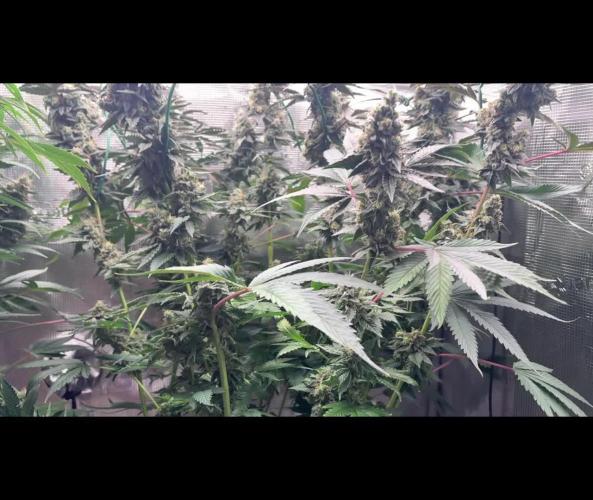
Week 12
Day 79
Guys we started this week flushing our ladies until lowered ppm to optimum ppm
Cant tell you how long it gonna take you but it took me a long time to finish each plant since you have to literally add 3 times the quantity of water that your pot can get and it takes so much time but it's worth it!
Day 80
They're looking good and smelling awesome, couldn't finish flushing one of the ladies yesterday but managed to finish today and they're all happy!
Day 81
Overall they're good can't wait for them only few days to harvest
Day 82
End of week 12
Looking pretty good



Likes
23
Share


@Rooflower
Follow
Week 4 Flowering
D1-3
Not so many happened except that plant getting bushier and bushier 😂
She's flowering still slow and seems like she lost a week compared to my other plant but if that's just genetics , no problem.
I m a bit worried if there's light leaking or something and shes stressed ...who knows, ill wait and see what will happen
skipped defoliation at d21 of flowering with her and will do it as long as she finish stretching !
Same nutrients as she looks really healthy!
till next update 💪🙏

Likes
65
Share


@TheBudWhisperer
Follow
Week 5 of flower and seed production for all these plants has started in earnest. We cleaned up the tent somewhat and took down all the males after having done their job. Alls left is to wait for finish now.
The nute deficiency appears to have corrected itself now that we’ve balanced out the ratios a little more. The WPM is no match for the sodium bicarbonate but still gonna have to keep on top of that to the end of the grow. Full fumigation of the grow spaces will be required - multi-day process I am not looking forward to. Time cleaning is time not growing, sadly.
We’re coasting to the finish now but should still have some decent updates on our super secret seed harvesting method once they’ve fully matured😉👍. Hope everyone’s well and grow’n that straight 🔥.
Background
Fingers crossed that these Spicy Bitch regs provide at least one male so that we can back build some stock of it. In the event that does take place we’ve got a single clone of each strain from the previous pollen chuck to sit in the tent with them so they can make babies for the next few months. The whole point of the last year was to start making some foundational genetics for a third generational cross we could call our own. If you’ve been following along than you’ll know that it’s been anything but easy. Our previous pollen picks didn’t pan out at all so we’re back to the drawing board with a new option from ExoticSeeds.
This’ll be a 10 plant run with 5 regs and 6 strains for pollination including the strain itself.
We’re running in a 2x4 MarsHydro grow tent all powered by a Mars Sp6500. That’s a little more than 600w packed into half the recommended footprint😳. Why? you ask - because we like our buds big and overcompensatory😂. Really, I’m just of the mind that we can pack more light into this space than recommended and get much better results. The math doesn’t lie. At least not as long as I wasn’t high when using the calculator again…..
Many thanks to @MarsHydroLED for the opportunity to test run the equipment👊.
In addition, we’ve also moved to a new nutrient system - Druid Nutrients out of the Netherlands. They don’t really have a presence on GD yet but you’ll be hearing about them very soon I’m sure. The beauty of this system is that it’s literally a 1 (one) component system for the entirety of the plants grow cycle. It really has changed the game in terms of ease of feeding and maintenance. It’s also very versatile and seems to provide everything needed across multiple different strains in the same ratios. Keep your eyes peeled for these folks. Pretty much a guarantee that they absolutely blow up once more people know about them👍👌😎.
Strain Background
Spicy Bitch: predominantly sativa, heavy yielder with a daytime kinda trip profile. It’s a cross of Queen Mother and a Pre-2000 AK47. We’ll pull what pollen we can and hope to have a female run out a larger supply of seed for the future.
Many thanks to @Exoticseeds for the chance to give these beans a go👍👊.
Pollination Strains:
Holy Surfer S1 - this is one of the focal points for this cycle. A fellow growmie was kind enough to ship over some S1 genetics I took an interest in. The only ask back was that if I did cross it to send a few his way for testing👍. Shoutout and cheers to @blendmedmedman. Hoping to have something back to ya in short order. For full details on this alluring hybrid option check my buddies link at seedfinder -
https://en.seedfinder.eu/strain-info/Holy_Surfer/Smiling_Tiger/
Northern Lights - this came from a particularly interesting batch of seeds that have shown a very dependable variegation trait. It’s a compact and squat plant requiring very little maintenance. Typical for the strain really. It’s been chosen as an option to potentially mellow out the high , shorten the stature of the resulting hybrid and inject it with some of that mellow indica effect.
Boogie Nights - total shot in the dark. Still haven’t even tried the strain myself yet but it was available at the right time and interesting enough to make a salad with. Big thanks to AMS who’ve been nothing short of an excellent seedbank to collaborate with. Expect similar growth characteristics to that of the Northern Lights. Better resilience however.
Blueberry - this particular clone is from extremely strong stock. Spliff seeds broke the mold with this strain. She’s lower maintenance than the NL, more resilient than anything else we’ve got on the menu and the terp. Profile on this girl is out of this world. If we can bring any of these qualities to the cross, then it could be magic👌.
White Widow - garrghh, I just can’t get away from this particular plant. Again, still haven’t even tested the buds yet and all I can say is that the growth characteristics are extremely vigorous and desirable. This plant is one of 3 unicorns that I have yet to tame due to a combo of extremely bad luck and circumstance.
All told, it’s still the same story: a VERY experimental breeding project designed to shotgun a broad swath of genetics against a reliable and dependable Breeder who’s put out proven fire 🔥🤟😎👍.


Likes
23
Share


@nonick123
Follow
Día 27 (20/05) Riego con 250 ml de Té de Compost
Día 28 (21/05) Vuelven a tener sed! Las riego con 250 ml sólo H20 pH 6.2
Día 29 (22/05) Riego con 750 ml H2O+ Regulator 0,15 ml/l + CaMg-Boost 0,25 ml/l + Startbooster 0,25 ml/l + TopBooster 0,2 ml/l- pH 6.2
NYC Diesel Auto vuelve a recibir aplicación foliar de sales de Epson (4 g/L) porque presenta de nuevo ligera clorosis
Día 30 (23/05) N/A
Día 31 (24/05) N/A
Día 32 (25/05) Las plantas no paran de crecer! 😍
Día 33 (26/05) Riego con 750 ml H2O + Regulator 0,15 ml/l + CaMg-Boost 0,25 ml/l + TopBooster 0,2 ml/l- pH 6.2
💦Nutrients by Aptus Holland - www.aptus-holland.com
🌱Substrate PRO-MIX HP BACILLUS + MYCORRHIZAE - www.pthorticulture.com/en/products/pro-mix-hp-biostimulant-plus-mycorrhizae
Likes
5
Share

@Organic710
Follow
Easy grow with lots of fails but its over now time for the next lot. I am behind this time usually I'd have plants ready to put into a scrog and veg but this time I was late with being in hospital. Running 2-3weeks behind now so hopefully these 8x Ethos clones work out as they have had 0 love so far but now is their time. Seedlings wont be getting transplanted for a few weeks but the clones will this week. Ive decided 8x 9L pots in the 4x4 see how that works. It will be a test so if its not the best it is what it is. Thanks for your time its been great to be back for another grow. Gutted I deleted my old account with all my diarys on but mental health can really mess with you sometimes 😭
Likes
104
Share


@Schnabeldino
Follow
_____ Week 11 | Day 78 - 84 | 4th week of Flower ______
Day 78 & 79🌞
- What should I write... Not much has happened, I leave the plants alone.
- I put my dehumidifier in the tent this week, it starts as soon as the LF rises above 60%. At the moment it is winter with me and the humidity is very low anyway, saves energy
Day 80 🌞💧
- each plant 3 liter
Day 83 🌞💧
- at the end of week 4 I provided them with nutrients again. They have become thirstier and now drink 3 liters every 3 days
____________________________________________________________________________________________
Light - 12/12 h - 560 Watt
- 2x 200 Watt Toplight
- 4 x 40 Watt Lightbars
PPFD - 900 - 1000 µmol
Temp. avg. - 24,4°
Hum. avg. - 58 % RLH

Processing
Likes
10
Share


@UrbanFog
Follow
Plants continued to mature this week and all the buds are getting fat they will have there last nutrient feed this week in prep for flushing and harvest next week.
The Lemon Zkittles looks and smells amazing looks amazing. Nearly all the plants look and smell the small, good genetics and breading.
The Cxx is again a very stable genetics and flowered and smells exactly as the last grow did. Good genetics.
The Peyote Cookies and Shishkaberry also grew well and similar, good genetics.
Afghan Kush amazing buds and very earthy smell.classic
The gorilla cookies had a rather large variation in pheno types but all look amazing and each will be a pleasure to smoke.


Likes
2
Share


@Earthsower
Follow
She has received no water for a week as her pot is not light enough for me to feed. Her roots are protruding the pot. Her stem is firming up more plus her third set of true leaves are through. I gave the soil a prune. I’ll keep her dry until she needs to be fead!


Likes
1
Share


@Bingbings_garden
Follow
Hello growers
-May 30-
Watering 0.3L every 72 hours. Nothing added just water until she ready to flip. Showing lots of lateral growth.
-Mother plant update-
She has hit her 8th week of flower and will be getting the chop in a few days. 90% red hairs and ambers trics started to show.
Looking forward to this plant again as the grow was easy and issue free.
Likes
115
Share


@DogDoctorOfficial
Follow
Cherry Cola's Grand Flourish in the Floral Symphony
Greetings, fellow cultivators! Week 4 has unfurled its petals in the mesmerizing floral journey of our beloved Cherry Cola Auto. The tent is now a stage for a grand botanical opera, and our green queen stands as a testament to the wonders of cultivation. Let's dive into the details of this flourishing spectacle!
As we venture deeper into Week 4, the floral elegance of Cherry Cola Auto takes center stage. What was once a lush bush has evolved into a breathtaking beauty, a true testament to the success of our horticultural endeavors. The topping technique and the release from training supports have paved the way for a regal display of colas and buds.
The decision to set our Cherry Cola free from the constraints of training supports continues to be a triumph. The tent is now a realm of bushy brilliance, and our green queen stands tall, a majestic presence commanding attention. It's a living masterpiece in perpetual motion.
The echoes of our topping tales from previous weeks resonate in the structure of Cherry Cola's colas. Each topped branch has evolved into a flourishing bud-laden entity, contributing to the overall grandeur of our green canvas. The decision to embark on this topping journey has truly paid off.
Our nutrient symphony, now joined by the magical touch of Potassium (K), continues to fuel the botanical brilliance. P-Boost and Topbooster, with their orchestration of phosphorus, organic grace, and now potassium magic, create a harmonious dance of blooming processes. The buds are becoming robust, laden with fibers, resins, and sugars, promising a top-tier end product.
Every day, the visual majesty of Cherry Cola unfolds with new growth, showcasing the resilience and vitality she possesses. It's more than a plant; it's a living testament to the artistry of cultivation.
As we conclude Week 4, Cherry Cola Auto stands as a botanical opera in full swing. The tent is alive with the grand flourish of a floral symphony. Stay tuned, fellow enthusiasts, as we eagerly await the next thrilling act in the Cherry Cola Chronicles!
Genetics Cherry Cola Auto @Fast_Buds @fastbuds_genetics_official @fastbuds_official @fastbuds_espana
Nutrition: @aptusholland @aptus_world @aptus_
Love, Care, and Attention: @dogdoctorofficial
As always, thank you all for joining me on this journey, for your love, and for it all. My horticultural odyssey would never be the same without you. Your love and support are cherished, and I feel both honored and blessed to have you in my life
Friendly reminder all you see here is pure research and for educational purposes only
Growers Love To you All 💚 💚 💚