Likes
Comments
Share
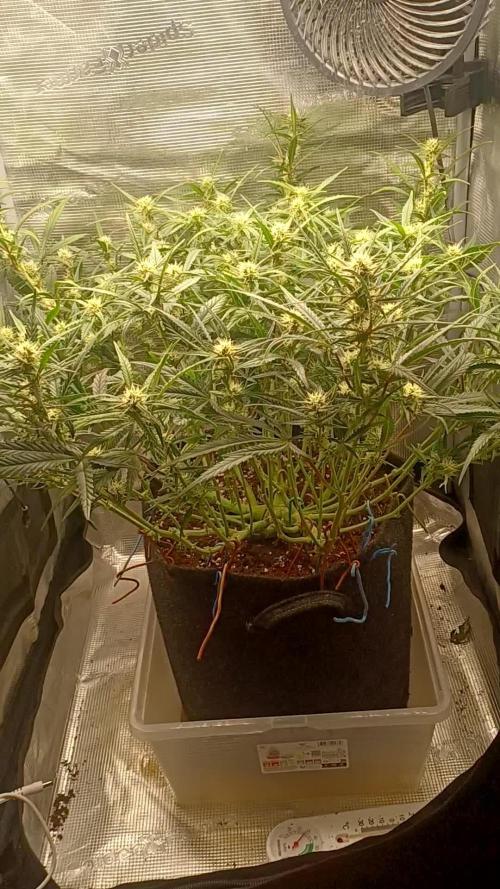
One more week here we go 💚🌱💚🌱💚🌱 Week 3 day 18 and the TSW2000 keeps delivering, today i decided to make a little video showing how i water my girls 😇 here is also the link for the Magnum auto TImeLAP video that i just uploaded today https://growdiaries.com/diaries/105893-grow-journal-by-dogdoctor 💚 i hope you guys enjoy it 💚 growers love 💚 And with and enormous honneur and pleasure that i start collaborating with MARSHYDRO, they wore kind enough and send me a 4x4 grow tent and a TSW2000 for me to do tests and reviews, i got to admit the quality on the materials, the easy assembling, the user manual, even the art detail that came with a bunch of cool stickers, are plus things that can not go unnoticed 🙏💚 Thanks Marshydro for so many details 🙌😉 i will try and post them all in here, but you can follow me on my instagram account https://instagram.com/dogdoctorofficial for every day updates , videos giveaways etc, or in my youtube channel- https://youtube.com/channel/UCR7ta4DKLFMg2xxTMr2cpIg keep tuned 💚💚💚 Thank you MARSHYDRO for having faith in my love for growing , lets make magic together 🙏🙏🙏 Genetics - Cookies Fam genetics - 3x SunsetSherbet Grow tent - MARSHYDRO 4x4 Ligth - MARSHYDRO TSW 2000 @ 85% Filter - vanguard hydroponics Falcon Filters Extraction - 2 x vanguard hydroponics 280m3h Extraction control - SMSCOM Smart MK2 All i grow is medicine for myself, for me and for my best friend with is me 😆 nothing to sell, so don’t even ask 😅💚💚💚 All info and full product details can be find in can find @ https://www.mars-hydro.com/grow-tent https://www.mars-hydro.com/led-grow-light/mars-ts-series-led-grow-light/mars-tsw-2000-led-full-spectrum-hydroponic-led-grow-light https://marshydro.eu/ DISCOUNT CODE - DOGDOCTOR 💚💚💚🙏🙏🙏💚💚💚 https://marshydroau.com/ More info and updates @ https://growdiaries.com/grower/dogdoctor https://instagram.com/dogdoctorofficial https://youtube.com/channel/UCR7ta4DKLFMg2xxTMr2cpIg 💚💚💚Growers love to you all 💚💚💚
Likes
8
Share
Welcome to Flower Week 1 of Divine Seeds Auto Big Demon I'm excited to share my grow journey with you all as part of the Divine Seeds Autoflowering Competition 2025. It's going to be an incredible ride, full of learning, growing, and connecting with fellow growers from all around the world! For this competition, I’ve chosen the Feminized Automatic strain: Big Demon Here’s what I’m working with: • 🌱 Tent: 120x60x80 • 🧑‍🌾 Breeder Company: Divine Seeds • 💧 Humidity Range: 90 • ⏳ Flowering Time: 8W-10W • Strain Info: 21-23%THC • 🌡️ Temperature: 26 • 🍵 Pot Size: 0.5l • Nutrient Brand: Narcos • ⚡ Lights : 200W x 2 A huge thank you to Divine Seeds for allowing me to be a part of this amazing competition and Sponsoring the Strains. Big thanks for supporting the grower community worldwide! Your genetics and passion speak for themselves! I would truly appreciate every bit of feedback, help, questions, or discussions – and of course, your likes and interactions mean the world to me as I try to stand out in this exciting competition! Let’s grow together – and don’t forget to stop by again to see the latest updates! Happy growing! Stay lifted and stay curious! Peace & Buds!
Likes
11
Share
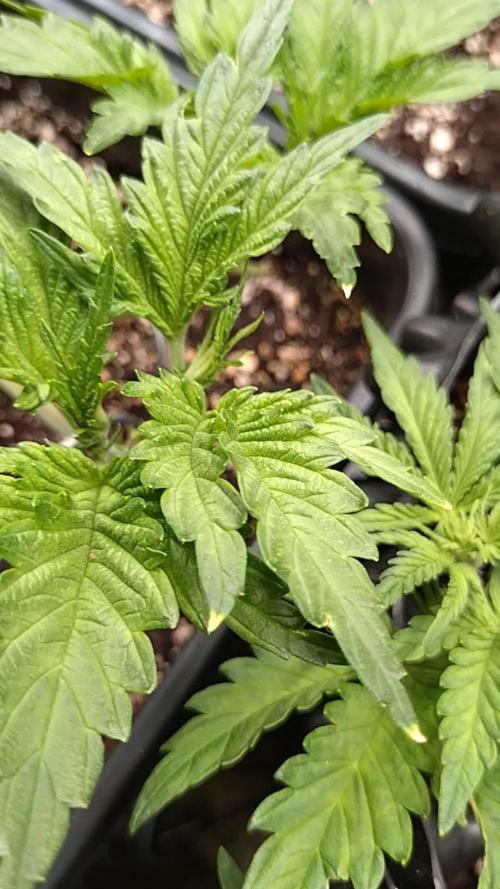
Hey mates, I'm happy with my first grow. I'm learning so much. Day 29: I'm looking like a hypochondriac, but for the plants, all I see I think it's a disease. Now I'm seem the older leaves getting yellowing, and gotting some brown/dark spots and saw little flies walking at the soil, I've googled it and can be fungus gnats, what I'm supposed to do? About the pH: I never measured the pH cause I'm using the pH Perfect products of Advanced Nutrients and they say you dont know care about this. But I've started to use mineral water, to see if have some difference. Obvious the mineral water is more puriest and clear than the tap water. Lets see. Day 30: I've did the defoliation on all seeds, but on Seed 2 and 3 I've just removed dead or yellow/brown leaves, and at the Seed 1 I've removed the most of fan leaves, leaving two or three at max. Day 34: I'm happy with these girls, Seed 3 I've did not LST and she have 49cm, Seed 2 I've did a soft LST and she have 45cm and 3 main colas, Seed 3 I've did a more little harder LST and she has only 33cm and I think has 4 or 5 main colas, I really dont know the exact number cause one of them is a little lower than the 4 others.
Processing
Likes
23
Share
Buenas a todos familia, 4 semana ya.Recta final del periodo de crecimiento,conforme cambiemos el foco cambiamos el fotoperiodo a 12/12 . El trasplante fue un éxito, no hubo complicación ninguna. La tierrra que usamos fue PLAGON LIGHT MIX. Todo va sobre ruedas , la condiciones en crecimiento fueron óptimas , las power plant xl, aún que parezca que no, acabarán recuperando, solo les falta ese pequeño estirón y ale.
Likes
62
Share
@BodyByVio
Follow
They were showing signs of Ca and Mg deficiencies and I increased my CalMg additive at 350ppm before I add my base nutrients. They seem to love it.
Likes
5
Share
This week, I adjusted the duration of the daylight hours.
Likes
15
Share
So many things have changed. My partner left me and took the left plant. I did more defoliation and performed lollipoping. It's a pity I couldn't do it a week ago. Hope they will grow much, I’m really scared of receiving popcorn.
Likes
4
Share
Temperatures this whole week: MAX - 25.8ºC MIN - 18.5º C MAX HUMIDITY - 90% MIN HUMIDITY: 44% Aprox Plants Height Sunday 26: Persian Pie 1 - 23cm Persian Pie 2 - 18cm Persian Pie 3 - 21,5cm Persian Pie 4 - 20,5cm All Gas OG - 14cm Irrigation: 21/3 - 2L (400ml each) of alkaline tap water (6.9 Ph, 127ppm) with 0.1 ml/L of silic boost, 1ml/L of Terra Leaves and 1ml/L of Atazyme. 24/3 - 2L (400ml each) of alkaline tap water (6.72Ph, 117ppm) with 0.1ml/L of silic boost and 0.2ml/L of Rootbastic. (last alkaline irrigation, last dose of rootbastic) -The stains seems to be drops of water from the humidificator, probably they're falling there when i move the deposit to refill it. Next week i should put the light closer, make apical pruning and pull in the tent a scrog web to put a limit to the plants height because they're starting to grow willowy and the tent is only 1.80m tall. I should also make an abundant irrigation to check earth's Ph and PPM again and get the A/C ready to be plugged to the tent because temperatures are rising up exponentially outside and some local growers are starting to have issueswith that. Cheers guys, have a great week and good luck with the outdoor season. Good luck with the harvest to those on the other side of the equator 🙌🙌
Likes
1
Share
So this week I added nutrients for the flowering stage. I gave her a little trim as well as added her netting. I flipped her on last Sunday PP
Likes
73
Share
@Roberts
Follow
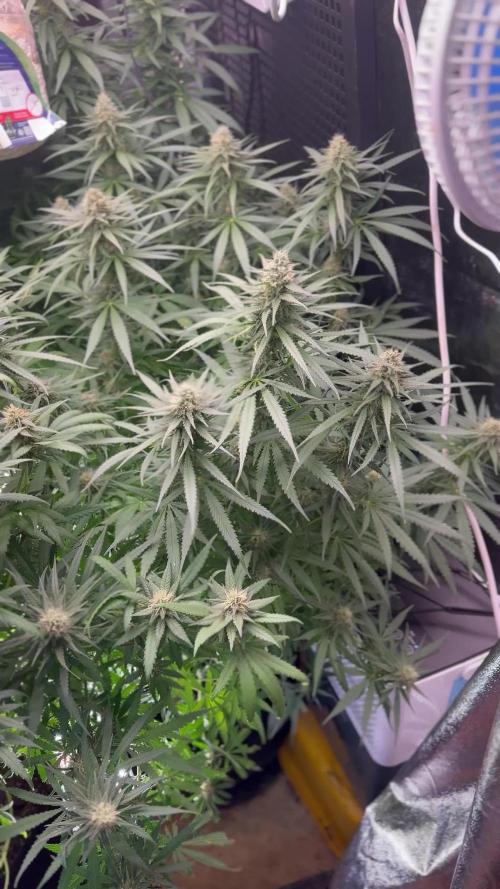
Lilly x White Widow is bulking strong. Very frosty and a flowery aroma. She is growing great under the Spider Farmer G5000/UVR40 lights. I am doing my best to keep her happy for these last few weeks. Everything is going really good. Thank you Spider Farmer, Athena, and Ripper Seeds. 🤜🏻🤛🏻🌱❄️ 🌱 Thank you grow diaries community for the 👇likes👇, follows, comments, and subscriptions on my YouTube channel👇. ❄️🌱🍻 Happy Growing 🌱🌱🌱 https://youtube.com/channel/UCAhN7yRzWLpcaRHhMIQ7X4g Spider Farmer Official Website Links: US&Worldwide: https://www.spider-farmer.com CA: https://spiderfarmer.ca UK: https://spiderfarmer.co.uk EU: https://spiderfarmer.eu AU: https://spiderfarmer.com.au G5000 Light Amazon Link: amzn.to/4643esa UVR 40: https://www.amazon.com/dp/B0BR7SGTHS Discount code: saveurcash (Stackable)
Likes
Comments
Share
Vamos familia, actualizamos la primera semana de floración de esta Amaretto Tarmac de Seedstockers. Empezamos abonando ya con varios productos de la gama Agrobeta para la floración. Temperatura y humedad dentro de los rangos correctos, 12 horas luz, 12 oscuridad. Una lástima que de todas solo aguanto una, y en concreto tiene un color espectacular aún así seguiremos con el diario hasta el final. Agrobeta: https://www.agrobeta.com/agrobetatiendaonline/36-abonos-canamo Hasta aquí todo, Buenos humos 💨💨💨
Likes
2
Share
Topping & Strukturaufbau​Training: Das erste Topping wurde erfolgreich durchgeführt; die Pflanze zeigt keine Anzeichen von Stress und fokussiert sich nun auf die Ausbildung der neuen Haupttriebe. ​Vitalität: Extrem kräftiger Wuchs mit einer sehr robusten Blattstruktur, typisch für eine gut selektierte RS11. ​Nährstoffe: Die Versorgung läuft weiterhin stabil nach Plan, was sich in der tiefgrünen Farbe und der allgemeinen Agilität der Pflanze widerspiegelt.
Likes
17
Share
Transplanted into a 3 gallon fabric pots. Cut off couple of the dried tips off the blue gelato, not sure what's up with it, the other two girl got topped left the gelato alone you can see why other than little blue everything is looking as I expected
Likes
52
Share
Lacewings seemed to have mostly killed themselves by flying into hot light fixtures. I may have left the UV on which was smart of me :) Done very little to combat if anything but make a sea of carcasses, on the bright side its good nutrition for the soil. Made a concoction of ethanol 70%, equal parts water, and cayenne pepper with a couple of squirts of dish soap. Took around an hour of good scrubbing the entire canopy. Worked a lot more effectively and way cheaper. Scorched earth right now, but it seems to have wiped them out almost entirely very pleased. Attempted a "Fudge I Missed" for the topping. So just time to wait and see how it goes. Question? If I attached a plant to two separate pots but it was connected by rootzone, one has a pH of 7.5 ish the other has 4.5. Would the Intelligence of the plant able to dictate each pot separately to uptake the nutrients best suited to pH or would it still try to draw nitrogen from a pot with a pH where nitrogen struggles to uptake? Food for stoner thought experiments! Another was on my mind. What happens when a plant gets too much light? Well, it burns and curls up leaves. That's the heat radiation, let's remove excess heat, now what? I've always read it's just bad, or not good, but when I look for an explanation on a deeper level it's just bad and you shouldn't do it. So I did. How much can a cannabis plant absorb, 40 moles in a day, ok I'll give it 60 moles. 80 nothing bad ever happened. The answer, finally. Oh great........more questions........ Reactive oxygen species (ROS) are molecules capable of independent existence, containing at least one oxygen atom and one or more unpaired electrons. "Sunlight is the essential source of energy for most photosynthetic organisms, yet sunlight in excess of the organism’s photosynthetic capacity can generate reactive oxygen species (ROS) that lead to cellular damage. To avoid damage, plants respond to high light (HL) by activating photophysical pathways that safely convert excess energy to heat, which is known as nonphotochemical quenching (NPQ) (Rochaix, 2014). While NPQ allows for healthy growth, it also limits the overall photosynthetic efficiency under many conditions. If NPQ were optimized for biomass, yields would improve dramatically, potentially by up to 30% (Kromdijk et al., 2016; Zhu et al., 2010). However, critical information to guide optimization is still lacking, including the molecular origin of NPQ and the mechanism of regulation." What I found most interesting was research pointing out that pH is linked to this defense mechanism. The organism can better facilitate "quenching" when oversaturated with light in a low pH. Now I Know during photosynthesis plants naturally produce exudates (chemicals that are secreted through their roots). Do they have the ability to alter pH themselves using these excretions? Or is that done by the beneficial bacteria? If I can prevent reactive oxygen species from causing damage by "too much light". The extra water needed to keep this level of burn cooled though, I must learn to crawl before I can run. Reactive oxygen species (ROS) are key signaling molecules that enable cells to rapidly respond to different stimuli. In plants, ROS plays a crucial role in abiotic and biotic stress sensing, integration of different environmental signals, and activation of stress-response networks, thus contributing to the establishment of defense mechanisms and plant resilience. Recent advances in the study of ROS signaling in plants include the identification of ROS receptors and key regulatory hubs that connect ROS signaling with other important stress-response signal transduction pathways and hormones, as well as new roles for ROS in organelle-to-organelle and cell-to-cell signaling. Our understanding of how ROS are regulated in cells by balancing production, scavenging, and transport has also increased. In this Review, we discuss these promising developments and how they might be used to increase plant resilience to environmental stress. Temperature stress is one of the major abiotic stresses that adversely affect agricultural productivity worldwide. Temperatures beyond a plant's physiological optimum can trigger significant physiological and biochemical perturbations, reducing plant growth and tolerance to stress. Improving a plant's tolerance to these temperature fluctuations requires a deep understanding of its responses to environmental change. To adapt to temperature fluctuations, plants tailor their acclimatory signal transduction events, specifically, cellular redox state, that are governed by plant hormones, reactive oxygen species (ROS) regulatory systems, and other molecular components. The role of ROS in plants as important signaling molecules during stress acclimation has recently been established. Here, hormone-triggered ROS produced by NADPH oxidases, feedback regulation, and integrated signaling events during temperature stress activate stress-response pathways and induce acclimation or defense mechanisms. At the other extreme, excess ROS accumulation, following temperature-induced oxidative stress, can have negative consequences on plant growth and stress acclimation. The excessive ROS is regulated by the ROS scavenging system, which subsequently promotes plant tolerance. All these signaling events, including crosstalk between hormones and ROS, modify the plant's transcriptomic, metabolomic, and biochemical states and promote plant acclimation, tolerance, and survival. Here, we provide a comprehensive review of the ROS, hormones, and their joint role in shaping a plant's responses to high and low temperatures, and we conclude by outlining hormone/ROS-regulated plant-responsive strategies for developing stress-tolerant crops to combat temperature changes. Onward upward for now. Next! Adenosine triphosphate (ATP) is an energy-carrying molecule known as "the energy currency of life" or "the fuel of life," because it's the universal energy source for all living cells.1 Every living organism consists of cells that rely on ATP for their energy needs. ATP is made by converting the food we eat into energy. It's an essential building block for all life forms. Without ATP, cells wouldn't have the fuel or power to perform functions necessary to stay alive, and they would eventually die. All forms of life rely on ATP to do the things they must do to survive.2 ATP is made of a nitrogen base (adenine) and a sugar molecule (ribose), which create adenosine, plus three phosphate molecules. If adenosine only has one phosphate molecule, it’s called adenosine monophosphate (AMP). If it has two phosphates, it’s called adenosine diphosphate (ADP). Although adenosine is a fundamental part of ATP, when it comes to providing energy to a cell and fueling cellular processes, the phosphate molecules are what really matter. The most energy-loaded composition for adenosine is ATP, which has three phosphates.3 ATP was first discovered in the 1920s. In 1929, Karl Lohmann—a German chemist studying muscle contractions—isolated what we now call adenosine triphosphate in a laboratory. At the time, Lohmann called ATP by a different name. It wasn't until a decade later, in 1939, that Nobel Prize–-winner Fritz Lipmann established that ATP is the universal carrier of energy in all living cells and coined the term "energy-rich phosphate bonds."45 Lipmann focused on phosphate bonds as the key to ATP being the universal energy source for all living cells, because adenosine triphosphate releases energy when one of its three phosphate bonds breaks off to form ADP. ATP is a high-energy molecule with three phosphate bonds; ADP is low-energy with only two phosphate bonds. The Twos and Threes of ATP and ADP Adenosine triphosphate (ATP) becomes adenosine diphosphate (ADP) when one of its three phosphate molecules breaks free and releases energy (“tri” means “three,” while “di” means “two”). Conversely, ADP becomes ATP when a phosphate molecule is added. As part of an ongoing energy cycle, ADP is constantly recycled back into ATP.3 Much like a rechargeable battery with a fluctuating state of charge, ATP represents a fully charged battery, and ADP represents a "low-power mode." Every time a fully charged ATP molecule loses a phosphate bond, it becomes ADP; energy is released via the process of ATP becoming ADP. On the flip side, when a phosphate bond is added, ADP becomes ATP. When ADP becomes ATP, what was previously a low-charged energy adenosine molecule (ADP) becomes fully charged ATP. This energy-creation and energy-depletion cycle happens time and time again, much like your smartphone battery can be recharged countless times during its lifespan. The human body uses molecules held in the fats, proteins, and carbohydrates we eat or drink as sources of energy to make ATP. This happens through a process called hydrolysis . After food is digested, it's synthesized into glucose, which is a form of sugar. Glucose is the main source of fuel that our cells' mitochondria use to convert caloric energy from food into ATP, which is an energy form that can be used by cells. ATP is made via a process called cellular respiration that occurs in the mitochondria of a cell. Mitochondria are tiny subunits within a cell that specialize in extracting energy from the foods we eat and converting it into ATP. Mitochondria can convert glucose into ATP via two different types of cellular respiration: Aerobic (with oxygen) Anaerobic (without oxygen) Aerobic cellular respiration transforms glucose into ATP in a three-step process, as follows: Step 1: Glycolysis Step 2: The Krebs cycle (also called the citric acid cycle) Step 3: Electron transport chain During glycolysis, glucose (i.e., sugar) from food sources is broken down into pyruvate molecules. This is followed by the Krebs cycle, which is an aerobic process that uses oxygen to finish breaking down sugar and harnesses energy into electron carriers that fuel the synthesis of ATP. Lastly, the electron transport chain (ETC) pumps positively charged protons that drive ATP production throughout the mitochondria’s inner membrane.2 ATP can also be produced without oxygen (i.e., anaerobic), which is something plants, algae, and some bacteria do by converting the energy held in sunlight into energy that can be used by a cell via photosynthesis. Anaerobic exercise means that your body is working out "without oxygen." Anaerobic glycolysis occurs in human cells when there isn't enough oxygen available during an anaerobic workout. If no oxygen is present during cellular respiration, pyruvate can't enter the Krebs cycle and is oxidized into lactic acid. In the absence of oxygen, lactic acid fermentation makes ATP anaerobically. The burning sensation you feel in your muscles when you're huffing and puffing during anaerobic high-intensity interval training (HIIT) that maxes out your aerobic capacity or during a strenuous weight-lifting workout is lactic acid, which is used to make ATP via anaerobic glycolysis. During aerobic exercise, mitochondria have enough oxygen to make ATP aerobically. However, when you're out of breath and your cells don’t have enough oxygen to perform cellular respiration aerobically, the process can still happen anaerobically, but it creates a temporary burning sensation in your skeletal muscles. Why ATP Is So Important? ATP is essential for life and makes it possible for us to do the things we do. Without ATP, cells wouldn't be able to use the energy held in food to fuel cellular processes, and an organism couldn't stay alive. As a real-world example, when a car runs out of gas and is parked on the side of the road, the only thing that will make the car drivable again is putting some gasoline back in the tank. For all living cells, ATP is like the gas in a car's fuel tank. Without ATP, cells wouldn't have a source of usable energy, and the organism would die. Eating a well-balanced diet and staying hydrated should give your body all the resources it needs to produce plenty of ATP. Although some athletes may slightly improve their performance by taking supplements or ergonomic aids designed to increase ATP production, it's debatable that oral adenosine triphosphate supplementation actually increases energy. An average cell in the human body uses about 10 million ATP molecules per second and can recycle all of its ATP in less than a minute. Over 24 hours, the human body turns over its weight in ATP. You can last weeks without food. You can last days without water. You can last minutes without oxygen. You can last 16 seconds at most without ATP. Food amounts to one-third of ATP production within the human body.
Likes
1
Share
@Organic_G
Follow
Absolut ungewohnt das Zelt mit so abgemargerten Pflanzen zu sehen 🤣🤣🤣 Die Ladys von draußen sind endlich nach innen gezogen für den restlichen Blüte Schub. Sehen wie Crackys aus im vergleich zu den den davor drin waren 🤣
Likes
31
Share
ok so everything has gone fantastic , no nutrient burns at all , and have been slowly creeping up the base nutrients , i have stopped the cal mag and now adding house and gardens bud XL at full strength these girls are now in full swing of flower and i bought a new ph stick this week , i have found when PHing the feed bucket that its best too have air stones in the bucket , add all nuts and then ph but do not use the feed that day as if you check the next day the ph is off again so i left it 24 hours after i add more ph down , and it seems too make the measurements alot easier and stable , i have bent down the main stems " without damaging them onto my netting too A keep the canopy all the same high so my lighting is covering all plants at the same distance and also it allowed the side stems too reach up too , the zkittlez did stay alot shorter and compact compared too the rest , but she has had the shame conditions than the rest , so she much just be a shorter pheno type i also was sponsored another new led light by kingbo this week so have added another 600watt led too the grow , so now have two 600's and one 900watt , and temps are still fine sitting at 24c lights on and 19-20 off , so am pleased with that , this lady stayed very short and compact and didn't really stretch much at all and it by far the smallest plant of the bunch ,
Likes
7
Share
Week 3 By week three, the plant begins to show more structure. Internodal spacing is moderate, resulting in a balanced but slightly open form. Leaf size increases, and the stem thickens gradually. The plant appears healthy overall, though a mild lack of uniformity remains visible in the canopy. Growth feels steady but not particularly energetic.
Likes
9
Share
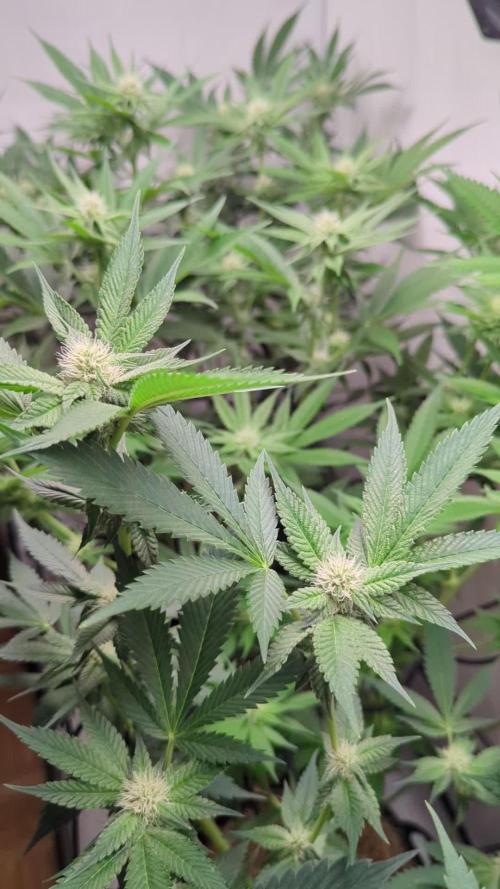
Pilot begins its first week of flowering with a very balanced and uniform structure. The plant has responded exceptionally well to training, developing a broad canopy with multiple active tops distributed evenly across the entire plant. The transition into bloom is progressing smoothly, with visible flower initiation on both primary and secondary branches. Internodal spacing remains moderate, creating an ideal framework for stacking dense flowers while maintaining excellent airflow throughout the canopy. Its architecture combines strong lateral development with controlled vertical growth, allowing efficient light penetration across all flowering sites. The main branches display good strength and support, suggesting excellent potential to handle increased flower weight during the coming weeks. At this stage, Pilot stands out for its symmetry, canopy uniformity, and productive branch structure. The combination of healthy vigor, multiple flowering sites, and a well-managed stretch indicates a phenotype with strong yield potential and excellent space efficiency moving forward. 🌱🔥🚀
Likes
2
Share
Ich habe die Pflanzen erfolgreich in größere Töpfe umgesetzt. Alle Ladys sind nun in 6-Liter-Töpfen mit BioBizz All-Mix untergebracht. Der Umzug verlief reibungslos, die Wurzeln sahen gesund und kräftig aus – ein gutes Zeichen für ein solides Fundament. Seit dem Umtopfen zeigen die Pflanzen ein gutes Wachstum. Der All-Mix scheint gut angeschlagen zu haben, erste Anzeichen von Nährstoffaufnahme sind sichtbar: sattes Grün, aufrechte Blätter und ein insgesamt vitaler Eindruck. Gießen erfolgt aktuell noch moderat, da der All-Mix gut vorgedüngt ist. Ich beobachte die Entwicklung genau, halte Temperatur und Luftfeuchtigkeit stabil und freue mich auf die weitere Wachstumsphase.