





Likes
4
Share


@Sadom
Follow
15.08.: Die zweite Blütewoche hat begonnen und beide Pflanzen haben sich seit der Umstellung gut entwickelt. Da ich vermute, dass die G41 noch weiter wachsen wird, habe ich ein zweites Netz zur späteren Stabilisierung installiert. Das zweite Netz hängt jetzt auf einer Höhe von 1,30m, sodass die oberen Spitzen der G41 bereits durchgucken. Damit die Pflanzen ihre Energie auf die wichtigen Bereiche konzentriert, habe ich bei beiden Pflanzen ein Lollipopping durchgeführt. Dabei hab ich alle Blätter, Seitentriebe und Blütenansätze unterhalb des ersten Netzes entfernt. Diese Blütenansätze liegen so weit unten, dass hier kaum Licht ankommt und sie am Ende stark unterentwickelt sein werden. Idealerweise hätte ich damit noch ein wenig gewartet, aber da ich die kommenden 9 Tage im Urlaub bin wollte ich es vorher noch erledigt haben, das gleiche gilt für das Netz. Updates werden in der Zeit auch eher schwierig, aber vielleicht bekomme ich ein paar Fotos zugeschickt.
18.08.: Ich habe Fotos zugeschickt bekommen. Anscheinend steckt die G41 immer noch in ihrer Stretchphase, da sie das 2. Netz auch schon ein gutes Stück überwachsen hat.
20.08.: Heute kamen nochmal ein kleines Video und ein Foto von der G41. Der Wachstum wird langsam weniger und man sieht, dass sich der Stretch dem Ende neigt. Am Ende der 2. Blütewoche hat die G41 die PBB in Sachen Höhe komplett abgehängt. So wie ich vermutet hab, war der Stretch von der PBB nicht mehr allzu dolle, sodass sie wesentlich kleiner als die G41 geblieben ist. Das ist eins der Probleme, wenn man kein Monocrop anbaut. Außerdem ist der Wasserbedarf der Pflanzen gesunken, sodass die Bewässerung aktuell 10min läuft, wenn das Licht angeht. Nächste Woche bin ich wieder zuhause, dann überlege ich mir, wie ich das Problem löse, entweder mit einer Zusatzbeleuchtung, einem 3. Netz mit dem ich die G41 noch etwas runterbiege oder beides. Da mein Mitbewohner heute vor Beginn von Blütewoche 3 ebenfalls wegfährt, hat er mir gestern noch die aktuellen Daten der Pflanzen zugeschickt. Daher passt es nicht ganz mit dem Diary, ich denke aber, dass es der beste Kompromiss ist.


Likes
7
Share

@Hazeberg
Follow
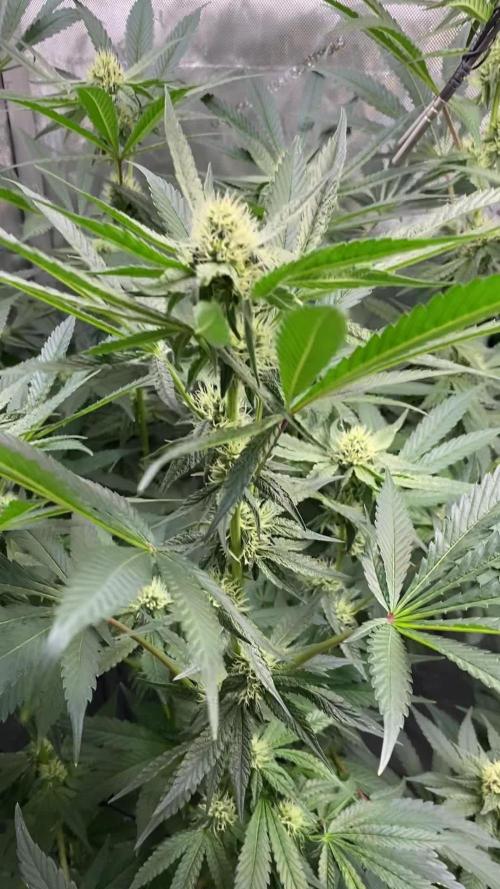
Day 63 Jungle Jimmy 69 cm / Day 64 Pink Cookies 99 cm: Nothing to do today.
Day 64 Jungle Jimmy 69 cm / Day 65 Pink Cookies 99 cm: Nothing to do today, except cleaning the reservoir.
Day 65 Jungle Jimmy 69 cm / Day 66 Pink Cookies 100 cm: Nothing to do today.
Day 66 Jungle Jimmy 69 cm / Day 67 Pink Cookies 100 cm: Nothing to do today. I noticed something, I thought I would never see in my grow, some leaf buds on Jungle Jimmy 😍
Day 67 Jungle Jimmy 69 cm / Day 68 Pink Cookies 100 cm: Nothing to do today.
Day 68 Jungle Jimmy 69 cm / Day 69 Pink Cookies 100 cm: Nothing to do today. Day 29 after switching to 12/12.
--------------------------------------------------------------
🙏 Thanks for visiting and follow for daily updates 🌱
Likes
10
Share


@Papastroumf
Follow
Day 43 : Watering with co2 tab / 5L. Also added food again because i think they need it. Increased ppm to 850. Maybe the next one will be pure water. Ventilation works all the time when lights are on. Temp and humi are stable and this is good for the girls. she still grows. Patience is the key always. Also removed some burned leaves from all ladies.
Edit (Day 47) : Watering with co2 tab every 5L. I watered with juices again at 850ppm because i felt that they need it. Only DsD drank pure water because of burns. All ladies enjoy this bright sun for sure. I have a very good combination of sprectrums. Cree cobs are in 3000k and HPS at 2000k.

Likes
7
Share


@Huntress007
Follow
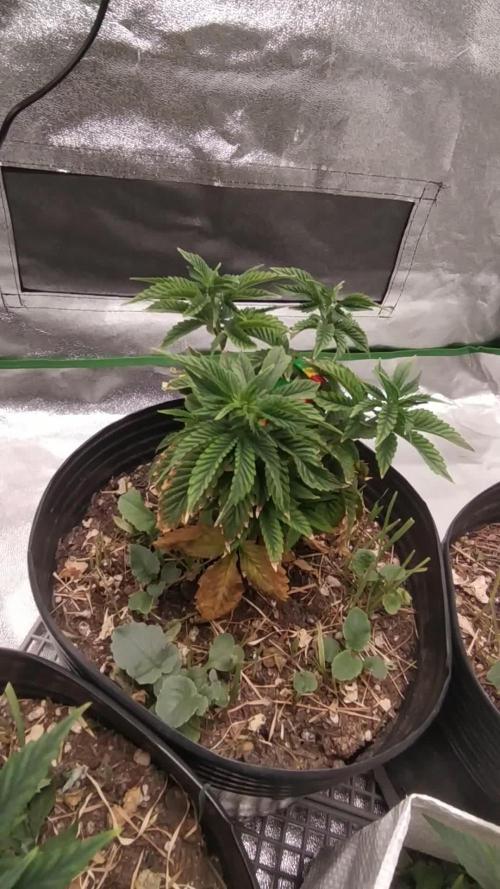
Germinating F1 Cosmos a success using humidity Tray & heating pad complete darkness!


Likes
Comments
Share

@MrGanjah
Follow
This week I only watered them with water and aloe vera. They are growing, but slower than I expected, but that's okay. I think I'll leave them for another two weeks before flipping them for flowering.

Likes
12
Share


@smallscaleorganics54
Follow
I fed the plant with Bio PK for the last time this week. From now on I will just water the plant without adding any nutrients.
The buds are starting to swell up and they are getting more frost. The aroma is getting more intense from day to day.


Likes
17
Share


@CZ420CZ
Follow
8.5.2024 its 2 weeks after my last post and today is chop of rest. I will make harvest after dry all. Later

Likes
4
Share

@HeizraumGrower
Follow
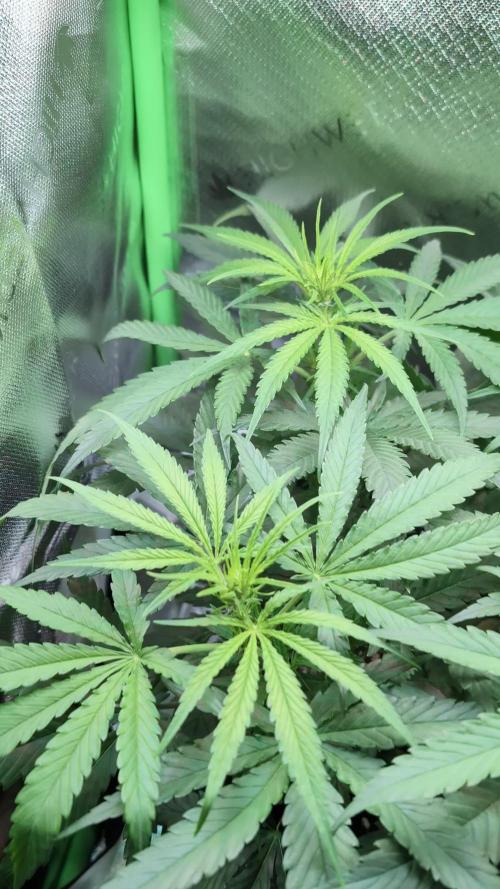
Week 6 is wrapped up and the plant is showing great vitality. Although the light intensity has stayed nearly the same, water consumption has increased massively and is now over 1.3 liters per day. I watered three times in total. I reduced the pH of the nutrient solution from 5.9 to 5.8 with an EC of 1.8 to counteract the slightly higher runoff pH of 6.3 and keep the medium stable.
The Wedding Cheesecake is now in full stretch and is growing about 2 cm taller every day. She currently stands at just over 30 cm from the soil level. Flowering has progressed significantly and white hairs are visible everywhere.
Since the plant is now growing as close as 20 cm to the lamp, the PPFD value at 90 percent power is currently between 600 and 700.
It is starting to get very crowded in the tent as the foliage is quite expansive and already touching the walls. To avoid stressing the plant unnecessarily during the stretch, I have only selectively removed small side shoots to ensure energy is directed to the main buds. A more thorough thinning to optimize air circulation is planned once the stretch is over.
Despite the strong growth, there is still plenty of vertical room in the tent. I am very curious to see the final height.

Likes
18
Share

@Cauli
Follow
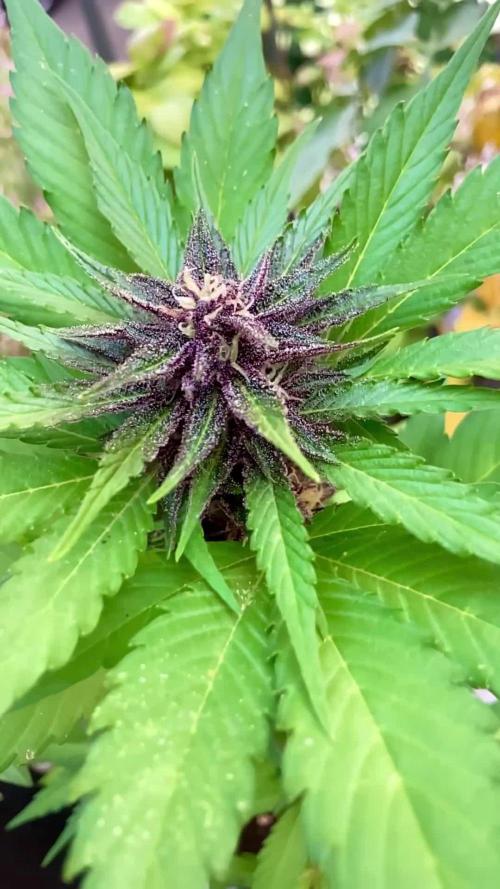
Weather was really changeable this week.
Again, still think this ladies lost a lot of potential in the beginning.
buds are getting a little bigger and look and smell very nice.
Likes
3
Share


@Grow_Outside
Follow
Jetzt wurde die Apple Strudel von Fastbuds geerntet. Ich bevorzuge sie nass zu Trimmen und sie in in ihre einzelnen Buds zu zerlegen um sie für die nächsten Tage in das abgedunkelte Zelt in einem Trocknungsnetz zu hängen! Bei einer Temperatur aktuell von 20Grad und einer Luftfeuchtigkeit von ca 55-60%
Hier liegen die Buds erstmal für die nächsten 10-14Tage
Trockengewicht lag bei 37g
Happy Growing
Likes
38
Share


@TrueNorth
Follow
SO UPDATE! OCTOBER 3rd 2019 finally dry in thee herbs now drier and i bought a new scale cause it seemed off not even an ounce wet! TURNS OUT 57grams dry!!!! Wooo!!!!! Spoke with the owner of herbsnow did some reverse calculations and the wet number was 69.6 WET. What a disaster
GREAT SMOKE GREAT HIGH
Likes
4
Share


@Ninjabuds
Follow
It’s been hot out. A perfect time to dry buds. I love when it’s super hot or super cold when it’s time to dry buds. When it’s hot the ac makes the humidity nice and low and when it’s really cold out the heater makes the humidity nice and low

Likes
3
Share


@Aleks555
Follow
Harvest — Amnesia X3 Turbo Feminized by Seeds Mafia
After 117 days from seed, our Amnesia X3 Turbo Feminized has reached harvest — and what a journey it has been! The plant matured into a stunning structure, with dense, resin-soaked buds and that unmistakable Amnesia aroma: citrusy, spicy, and uplifting.
We trained her under a SCRoG net, which helped to maximize light penetration and support the heavy colas. She responded beautifully, growing strong and full of energy.
🌡️ Day temp: 25–26°C
🌙 Night temp: 20–21°C
💧 Humidity: ~45%
💡 Light schedule: 12/12
💨 CO₂ supplementation
🌱 Nutrients: Xpert Nutrients (full cycle)
We couldn’t wait — and tried a quick sample dried in the microwave. The effect was intense, fast-hitting, and long-lasting — a true turbo Amnesia experience! Easily one of the most powerful sativa-dominant strains we've grown.
Huge thanks to Seeds Mafia for the top-tier genetics, and to Xpert Nutrients for the professional-quality fertilizers that helped bring this beauty to her full potential. We’re beyond satisfied with the results and can’t wait to enjoy the full cure!
Processing
Likes
2
Share


@MO_Gardens
Follow
Started some LST and removed a few leafs to get some light to the under branches. Trying to get those to grow up some for more tops in the end hopefully. Feed most of the plants some Liquid Seaweed this week with Molasses, plants seem to be enjoying it. Other then that, nothing to report really.
Likes
9
Share

@Oldwied
Follow
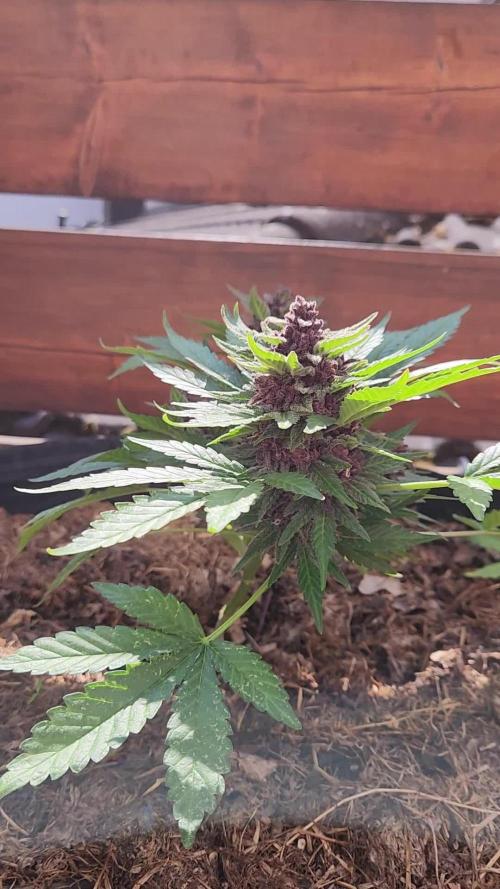
One day before I cut down this massive tree. The flowers are very thick, deep purple and exude a floral, fruity smell.
Day 85
Photoshooting
Processing
Likes
3
Share


@Promi
Follow
They grow and grow and grow ^^ am rather impressed by those Genetics.. once again. US beats EU very bad.. as a European.. sucks ^^ or does it.. good stuff is good stuff ;) doesn't matter who. If they taste like they grow. 42FastBuds has a serious contender on Auto genetics in the middle price tier.
Likes
39
Share


@Weird_Jimmy
Follow
👉this is week start of week 8 and the switch to the 12/12 schedule. the plant is on the 6th week on the GH nutrient chart for its flora series drain to waste schedule.This is considered early bloom and the only difference from the transition nutrients is the reduction of FloraGrow and addition of Liquid KoolBloom. The water I use is RO water from a medical grade industrial machine (not on site). Its conductivity is .04ms. Its 98.5% pure water. I believe this is helping me mix my nutrients at full strength and achieve the middle to upper end of the recommended ec range. The volume of plant uptake has increased quite alot. I am averaging 2 liters two times a day, but as the week progressed a couple of high flow fertigations were needed to keep the run off below +30ms. I feed my Marigold plant the run-off after Ive measured it. The fertigation station is in a closet in another room and doorways wipe my memory so I fed 99 the runoff a couple days ago (9-16). So I fertigated 1.5 liter immediately. That runoff was close to 30+. The lights were going out so the next morning i fertigated with 4liters. That runoff was +10. That night was 2liters w/.9 liter runoff +10. I plant on keeping the flow a little high to help prevent any nutrient deficiencies while its doing the early flowering stretch.
👉The plant is lush and green and growing as a nice round bush. Stout main stalk and is 21". I began plucking lower leaves that were reducing airflow around the base. These could pose a mildew risk if left on because they are in contact with the pot and reducing airflow across the top of the media. They were shaded now by the expanding branches above so it was time to remove them. I like to take leaves gradually, one or two per fertigation event. I also have taken off the bottom 3 branches. They were healthy and had plenty of potential bud sites...but they would be in the shade and never meet the potential of the upper buds. I may take two more low branches, but I will keep them if they keep stretching outward and upwards and stay in the direct light. When they start flowering full time I will have removed as many of the potential larf bud nodes on the interior of each branch. Nothing extreme, just the basic lollipop on the bottom and reducing larf production up top.
👉I am using a cordless work light to make the pictures better. My phone camera flash isnt bright enough to over come the LED blurple and the addition of the very bright work light makes the picture way better. As you can see I will still be taking some of the pix with the LEDs on, but also use the camera flash and the work light and that helps bring out the green better. But lights out show a more detailed realistic image and I will include more pix this way.
👉Switching to 12/12 has been a challenge. I work varied hours and making it home before lights out is hit and miss. Also being a stoner I forget stuff if I get distracted by a movie, a sporting event or a shiny object, so visits to the tent during dark times will happen. I have green lights installed in the room and in the hallway. I have a good headlamp with green LEDs. I missed the first day and had to fertigate after hours...sigh. I took pictures with the green light on but no flash.

Likes
4
Share


@KurtThePlantGuru
Follow
Very very happy with how this came out, I saved a branch and some smalls to smoke myself and filled an entire gallon bag to be put towards fresh frozen bubble and eventually into sum amazing rosin!