


Likes
Comments
Share


@Chedderbob112
Follow
El living la Vida chedda mother Fukin Bob 112 here wee fuking go usual rite troops need tae go see a man aboot a dug


Likes
11
Share


@eldruida_lamota
Follow
Que pasa familia, vamos a comenzar con el próximo proyecto, Gorilla cookies Auto de FastBuds.
Tiene muy buenas reseñas y pues me animé a colocar 4 plantas.
Va pues al lío e germinado 4 semillas y germinaron en 48h, 4 de 4 unidades, un 100% de éxito en el ratio.
Han sido Germinadas con Papel absorbente y un tupper para mantener la humedad, pasadas las 48 horas se colocaron directamente en tierra, a su maceta definitiva, en este caso 7 litros.
Mars hydro:
Code discount: EL420
https://www.mars-hydro.com/
Agrobeta:
https://www.agrobeta.com/agrobetatiendaonline/36-abonos-canamo
Hasta aquí todo, Buenos humos 💨💨💨

Likes
19
Share


@A_Rolling_Stoner
Follow
The one in the middle is struggling a little, but I'll just keep it and see how it turns


Likes
9
Share


@chapothegrower
Follow
Update. Photos from a few days from now, they way bigger, switched lights to 12-12 today, next weeks will try to make better photos out of the growroom. 100% organic grow😍 lst and defoliation
Likes
34
Share


@Birale91
Follow
Week 12.
Starting week 5 with a big smile.
Day 80.
Become bigger Nd bigger.
Smelling like grapes.
Start with new booster - bloombastic only 5ml to 10L all the way to the wash.
Lets see the results at the end, by comparing it to my last grows.
Day 83. Extra calmag.
Likes
9
Share


@Martymar021208
Follow
This tent has done amazingly they have veg strong and the branching has been extremely vigorous and lengthy really happy with ethos genetics to

Likes
55
Share


@Max1973
Follow
Day 37 - Everything looks good.... they are drinking so much.... i built a bit more stable light setup, and i'll need to buy afew more plugs and stuff, to fill it out ...... i organised all the 2700k globes, ready to swap in..... still waiting on the exhaust fan, so i'll keep em in "grow" mode another week or 2 .... i'm vaping a leaf or 2, and drinking "green tea hot chocolates" .... it is so delicious in hot chocolate .... my health has picked up since starting the vape/drinks... the 21 thc/19 cbd is supa healthy ...
Day 38 - Getting them ready for Flower, noticed they are lacking in nutrients, so i started em on the heavier dutch master gold flower nutrients.
Day 40 - Added some pics. (they look droopy because they in night mode, just turned on lights for pic) - Started them on 12/12 flower, still working on getting all the lights, gear, and globes, for the right spectrum and amount of light.... atm got - 7x 2700k (click) , 2x 6400k (osram), + 60w light panel .... i'll go get some more gear today and hope to expand it to 10x 2700k , 2x 6400k ...... I put the exhaust filter fan on seperate power, so it doesn't go on/off with the timer, but stays on all the time.... it totally fixed up any odour problems, haha ....... Added some different pics for my light spectrum ... etc.....
the outside winter temp is now at 40-60oF (5-15oC) so with the 12/12h, the temp inside the tent is dropping to 60-80oF (18-22oC), abit low, but flowering is supposed to be in winter, so idk, see how it goes.....
I'm new to growing, so idk how this will work out....... just working it as i go.... i noticed afew spots on a leaf, so i upped the neuts abit more, they are still drinking like fish, huge amounts....
Day 40 late - new vids - Got the extra gear and installed it all... redesigned the initial setup, refined it with proper measurements, had to get my steel rule out, lol.......
got the 12 leds in and running, 10x 2700k clicks, and 2x 6400k osrams, with the panel..... it's lookin beautiful and got the exhaust on 24 hrs now, all working perfect with 12/12 timer.... they are forming a few spots on leaves, so hammering the nute water into them now... they are drinkin 1-2 litre of nute water a day each.... (nute water = Dutch mater gold one grow/flower, 800-1000 ppm 6 PH)
😎
Some details about lights.... i did some maths on it, and included some handy pics..... because i'm using cheap leds, i'm keeping the distance at 25cm, they are leds so they won't burn, and it massively increases the lumens/lux/Par, and with my home built light setup, the leds are spread out enough to keep it lower.... worked out good..... something of note is that all the led globes are built/made in china... however different marketing/selling companies from around the world... and the german osrams are 1w leds ... by far the most superior, but anyone can design and send the requirements to china to build em, haha) it's not a contest, we all work together.... haha.... the person with the best led light globes gets my business, because i want the best for my babies.... :)
(let me explain- 1w led vs 0.5 w led, the watt of the led projects the light, lumens, LX/PAR etc much further the higher the watt of the led....my 600w panel has 0.5w leds, the philips has 0.75, the osrams have 1w leds..... )
each globe
philips (dutch)- 10.5w
internal - 14 leds 0.75w
1055 lumens
each globe
osram (german)- 10.5w
internal - 10 leds 1w
1080 lumens
each globe
click (cheap)- 9w
internal - 16 leds 0.56w
800 lumens
light panel - 70w - 600w
30 red - 8 red
12 blue - 8 white 7500k
1 ir - 1 uv
= 20x blue 6400k - 38x red 2700k
internal - 60 double leds - 120x0.5w
6000 lm
Likes
6
Share


@SecretC8keSociety
Follow
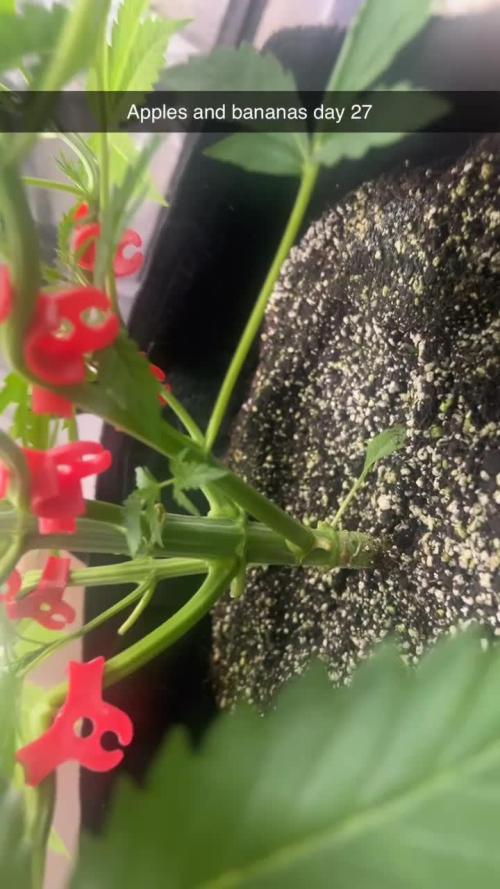
Today will be Day 44. The girls fan leave did grew back. I cut off the leaves that overshadowed the buds sites . I used half of Open Sesame 3g w/ Lotus 6 week in flower.

Likes
23
Share

@FatnastyzBudz
Follow
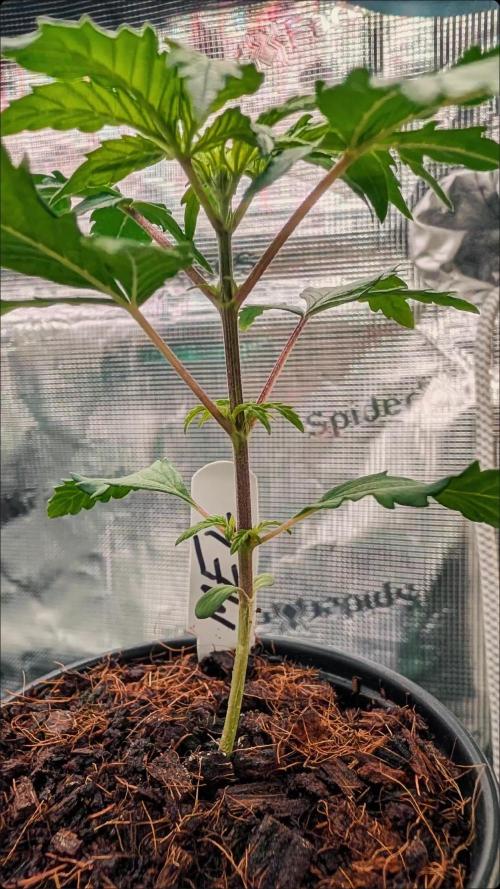
Fresh haircut, bigger home, and a few days to settle in. She's looking a little scruffy now, but the comeback has already started. 💚

Likes
28
Share


@MadeInGermany
Follow
Hey everyone ☺️
Both phenotypes are great 👍.
The leaves look like a nice sativa 😍.
Because of training I am still thinking about it because for some time now I have wanted to do one round completely without topping etc.
I will decide that in the next 1-3 weeks 😀.
Both were poured this week with 1.3 l.
I'm really excited about the coming week and until then I wish you all a lot of fun with the update 😃.
Stay healthy and let it grow 🍀🍀
You can buy this Strain at :
https://www.royalqueenseeds.de/feminisierte-hanfsamen/115-amnesia-haze.html
Type:
Amnesia Haze
☝️🏼
Genetics:
Original Amnesia Haze
👍
Vega lamp:
2 x Todogrow Led
Quantum Board 100 W
💡
Bloom Lamp :
2 x Todogrow Led
Cxb 3590 COB 3500 K 205W
💡💡☝️🏼
Soil :
Canna Coco Professional +
☝️🏼
Fertilizer:
Green House Powder Feeding
☝️🏼🌱
Water:
Osmosis water mixed with normal water (24 hours stale that the chlorine evaporates) to 0.2 EC. Add Cal / Mag to 0.4 Ec Ph with Organic Ph - to 5.5 - 5.8 .


Likes
244
Share


@DogDoctorOfficial
Follow
So here is my week report on the fabulous Supafreak by HiElevation Genetics. Buckle up, because this girl is a wild ride!
Oh my, let me tell you about this Supafreak. She's like no other girl I've ever grown before. From the moment she sprouted, I knew she was something special. Her unique characteristics and unruly growth had me hooked from day one.
Now, we're approaching her final days, and it's time to make some crucial decisions. I've decided to stop all feedings and switch to just watering with Aptus Holland Fluvic Blast. Why, you ask? Well, let me break it down for you.
First, let's talk about this Fluvic Blast. It's like a secret weapon for plant health. Fluvics are organic compounds that enhance nutrient uptake and stimulate plant growth. It's like giving my Supafreak a supercharge of awesomeness. And let me tell you, she's responding to it like a champ.
One of the reasons I've chosen to go this route is because I believe in reutilizing my soil for future grows. It's like giving back to Mother Nature and keeping the soil alive and kicking. Fluvic Blast helps to replenish essential nutrients and promotes soil health, ensuring that my future plants will have a solid foundation to grow upon.
Now, let's talk about her close-up shots. Oh boy, the trichome production is out of this world! It's like she's showing off her bling, sparkling with potency and beauty. I can't wait to see how she develops in these final days.
And the smell, oh my goodness! It's unique and peculiar in the most delightful way. It's like a symphony of aromas that tickle the senses. I can't even put it into words, but trust me when I say, it's a scent that will linger in my memory forever.
So, my friends, there you have it—my joyous, knowledgeable, and fun report on the magnificent Supafreak. She's one for the record books, and I'm grateful to have experienced this journey with her. Stay tuned for the grand finale, where we'll uncover the full extent of her freakiness. Until then, keep growing and keep smiling!
As always thank you all for stopping by , for the love and for it all, i fell blessed to have you all with me for one more love journey, and a different one form the rest i did so far <3 <3 <3 Thank you Thank you Thank you , you guys are great and have been amazing , thank you for everything <3<3<3
#aptus #aptusplanttech #aptusgang #aptusfamily #aptustrueplantscience #inbalancewithnature #trueplantscience #dogdoctorofficial #growerslove
With true love comes happiness , Always believe in your self and always do things expecting nothing and with an open heart , be a giver and the universe will give back to you in ways you could not even imagine so <3 <3 <3
<3 <3 <3 Growers love to you all <3 <3 <3
Here are the words from this peace of art from nature creator Shapeshifter's @ HI-ELEVATION GENETICS <3 <3 <3
"FREQUENTLY ASKED QUESTIONS
Q. How did you create/breed Freakshow?
A. Methodical selection, line breeding, and culling is the short answer. Read our About page for more details.
Q. Is it an indoor or outdoor type?
A. Everything I've ever worked has been outdoors, including of course Freakshow. It has been our experience that outdoor (or sun grown, as it's recently being referred to) cultivars seem to perform extremely well under artificial conditions. This is true of seed starts or clones made from seed starts. The opposite is not always true; indoor clones often give an outdoor grower headaches because they don't always make the transition smoothly. This is due to light spectrum, temperature, and/or photoperiod changes. Yes, Freakshow will do exceedingly well indoors, and will thrive and mature just fine in a wide variety of natural environments as well, so it's definitely both and I think might even prove to be more resilient to those sorts of transitions.
Q. What are the potency and terpenoid levels?
A. Average 18-20% THCa, THC; negligible CBD, CBN with terps variable, averaging 2.5-3.5, primarily limonene and pinene, but this is variable, there was a lot of diversity in terp combinations and compositions in all the prior generations, it's just something that was left "as is" for now. The different parallel lines that we are developing can be directed in a few different pathways flavorwise.
Q. Why are the seeds white?
A. Why is the sky blue? No, the mature seeds are shrouded by a rice paper thin membrane which has coloring and mottling on it, but it's so fragile that it disintegrates in the process of shucking. Stripped of the outer layer the seeds are very pale, nearly white. It came as no surprise that this plant would have abnormal seeds.
Q. Is it a GMO?
A. Wow...? Well, it's seriously "modified" and the modifications are definitely genetic, and it is an organism. (Genuinely Modified Organically!) Uh, no. No radiation, no recombinant DNA, no gene splicing or editing, no TALEN or CRISPR! These biotechnologies don't belong in the food and medicine plant industries. Sadly, in the near future it will become commonplace and widespread in cannabis and other medicinal plants as it is already is with food crops and ornamentals. I'll avoid discussion on this topic for now, but we hope some people enjoy consuming Frankenbud!
Q. What's the floral period length?
A. 8-9 wks, finishes early Oct. at most latitudes and elevations.
Q. Is it a big producer?
A. Freakshow will produce nice, fat, dense colas (see gallery) with remarkable trichome coverage, and you can expect yields according to your veg. time, root space, and general knowledge and expertise as a gardener. The same set of variables apply to expected outcomes regarding cannabinoid levels and terpene profiles.
Q.What is the lineage?
A. (Bigbud x Skunk#1) x (Big Sur Holy Weed x Banana Kush). NLD("Sativa") dominant, but the afghanica influence is apparent. I'm pretty sure that Freakshow contains some Trainwreck and some Maui Wowie based on some research I did on the origins of the Pineapple Express. Interestingly Big Sur Holyweed, OG Kush, Banana, Trainwreck, and Maui Wowie are all of unclear origins. We have to remember that these are all just names and that they don't really mean much. The exact heritage of any cultivar today is impossible to determine accurately. Also, considering the amount of continuous shameless hybridization that has occurred in the last 40 yrs., any modern kind could easily contain over 40 kinds. In the case of Freakshow, it's much more limited because the ancestry is largely older "Sativas" that didn't go through as much outcrossing. In the 70s in Santa Cruz, Haze was a favorite among surfers for the pure energy and I still have (greatly improved) stock of it around, simply because even when I made hybrids with it I always kept the original in pure form for obvious reasons.
Q. What is the psychoactive effect like?
A. Like the flavors, many people have commented that the "buzz" is somewhat different than other mainstream types out there. It's not entirely out of the scope of imagination that given that this strain has new alleles in so many other respects, that it could also contain new, unique cannabinoids, as well as new and unique terpenoids, some of which may not even be among the standard 16 or so that the average lab is testing for. Aside from the up, cerebral, energetic boost, some report a mild time/space warp effect. Creativity and idea induction should be mentioned, for sure. Freakshow has the pure energy effect and greatly alters perception to the positive side, so definitely destroys depression. Appetite suppression is a side effect, but the enjoyment of food is enhanced. I personally will attest to all of the above. We all have different receptor profiles, so these are just generalizations. Couch unlock.
Q. Is it pest and mildew resistant?
A. Indeed it is. On many occasions in the last few years, it has been observed that when pest and mildew issues were affecting other plants adjacent to in the vicinity of Freakshow plants, for unknown reasons the freaks remained entirely unaffected. This includes 0botritis, PM, various mites and insects, soil fungus, etc. We haven't heard any complaints along those lines so far, so if anyone has any problems, especially with a rigorous IPM regimen in place, we would like to hear about it. And if anyone can attest to the extreme level of resistance it seems to have we'd love to hear about that as well.
Q. Does it contain web-leaf genetics?
A. I thought I better clarify this because there are a few people thinking that because of an article "Growing Marijuana that Doesn't look like Marijuana" that mentions that I had worked web-leaf types years ago and had eventually turned that into Freakshow. This is incorrect and I'm needing to get ahold of the writer to have him change it. When I read the piece and saw the mistake I figured it didn't matter that much, that the actual method of breeding could just remain a "trade secret". Recently, I noticed online that a posting, "Freakshow only exists because of duckfoot" by Curious Cannabis Connoisseur, where he explains how I developed Freakshow using Duckfoot. Let me explain, about 20 yrs. ago a friend gave me a jar of seeds labeled "BC Bigbud" and I sprouted flats of hundreds to look for oddities and had found one web-leaf pheno which we named Webster. It was a female so I bred it to a normal leaf male and began selecting and stabilizing a line of Webster. About 5 or 6 generations later I had nailed it to 100% webs and had also stabilized it for a deep purple color and a nice "gingerbread" terp profile. I was busy working other lines at that point so I put Webster in the library. Also, I was having a hell of a time getting a pheno of it that flowered to my satisfaction. (it seemed to finish with a limited number of calyxes). I knew I would have to outcross it to something with a big tasty bud and restabilize it for web-leaf, and I no longer had the original BC Bigbud. I still have the Webster seeds, and trust me the thought has crossed my mind to make the cross with Freakshow, but why? Why mess around crossing things just to create something even weirder? I have heard that the "Duckfoot" also doesn't bud up well so maybe there's a correlation there. Anyway, people can do what they want to and I will too, but crossing Freakshow with some low-THC crap like ABC is in my opinion idiotic. I worked extremely hard stabilizing and perfecting a beautiful new subspecies and I believe it should be kept pure. I won't go on a rant here about the rampant crossing and the lack of line-breeding in the cannabis world in the last several decades, or where this will eventually lead us, but I will say that it's not in a good direction. Bottom line....Freakshow has no web-leaf genes, it was made using top-grade tropical narrow-leaf drug (NLD) cultivars.
Q.Why is Freakshow patented?
A. Although I and most others (including all the folks at HSC) believe in and subscribe to the concept of "open sourcing" because sharing in cannabis genetics was always the cultural norm, it was decided that Freakshow should be protected (1) because it is a novel and unique, not a preexisting strain (or even subspecies), (2) To keep the greedy corporate big boys from exploiting it, (3) To maintain control of the genetic refinement of it in all future generations. We really can't wait to share it with the entire collective world of cannabis enthusiasts and invite experimental breeding for personal use and curiosity."
source https://freakshowcannabis.com

Likes
15
Share


@tokesly
Follow
Ideally you want to drastically up your PK Week 5 of flower. Unfortunately adding PK late last week forced me to ramp up by 2ml/gal every day until 9 ml/gal to avoid shocking the plants. These plants were growing super bushy despite being Sativa dominant. Definitely played it too safe Week 3, gonna go heavy next run.

Likes
10
Share

@k0nz1
Follow
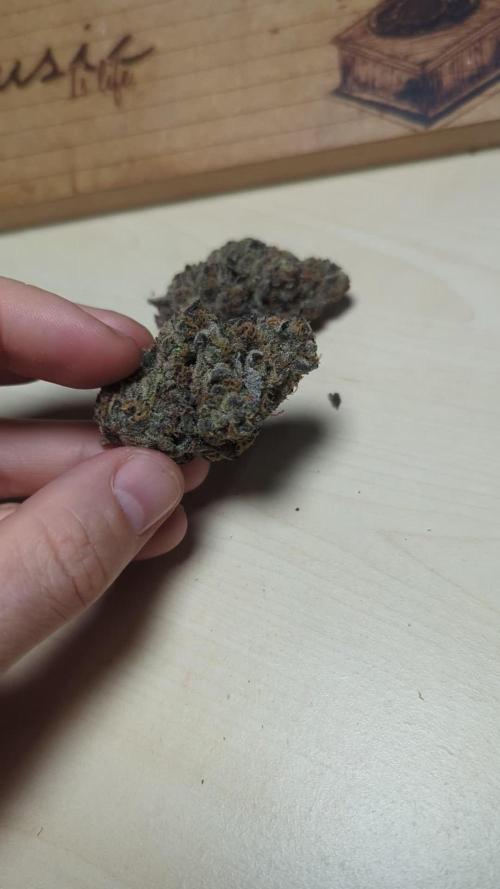
Hang dry 12 days by 60/60
Then cured with the new vivi cure Packs. They did a great Job. Final product is super smooth and tasty.

Likes
6
Share


@field_nigga
Follow
Every week I take leaves off. Only the bigger ones tho
I water twice a week but fertilise once
Likes
16
Share


@Young_agronomist
Follow
11.05.2023-предпоследняя неделя для ананасового экспресса .
Шишки отлично набрали вес и она стала пить меньше воды .
Перехожу на 10 дней рипена, 2 дня засухи и темноты .


Likes
13
Share


@BigDripFelgo
Follow
Sherbet is growing very well, fast and healthy. Want to take cuttings from this one but also want to top it, don’t know what route to take first?! Would also like to keep a clone to breed with GSC to make some Gelato 45, then eventually cross that with Zkittlez to make some Runtz and so on and so forth! Hopefully everything go as planned.

Likes
25
Share


@Ferenc
Follow
I had to take a big decision. I know it is not good it is way too hot in the tent but needed to remove from my garden because of some reasons.
Firstly, illegal which is fine but I do not want to take a risk for 3 g of harvest. She should start flowering in autumn when less sun and weather is basically shitty here in London it is okay to grow but when starts flowering.... so I planted an auto and saw that it wont yiled good so I was thinking what will happend to my Zkittlez in autumn when mush less sun and weather is going down. So realised I can have a 2-3 m plant but it ain't gonna flower just a bit. Soni decided to put under artificial light but it is summer my plants are suffering in the tent. Inhave no choice I will try to manage maximum I will cut back. Hopefully all goes ok.
Day 86: Fucked up she was totally wilt I removed all the leaves basically the stalk left only..... she will be okay
Likes
14
Share


@SunshineBud
Follow
Week just starting off and the one baby has still not broken thru so I take matters into my own hands and attempt emergency surgery!!!
I sanitized a Raw loader stick and gently pulled the sprout up. It laid over after and I'm going to give it a few hours before I try to put something to hold it up if it doesn't manage to orient properly. Any advice would be appreciated, This week just started so will edit it throughout the week..
11/18 Transplanted into 1ga pots and gave first n00tz FF 3tsp/GA Big Bloom.
11/19 Ok so my humidy has been plumiting to 33-36% so I tried putting a rag over a fan, putting a rag in a bowl over the inlet and nothing helped so I went to amazon and bought this! https://www.amazon.com/gp/product/B08GQZDS9J It has a gallon or so tank and a humidity sensor so it cycles to maintain humidity.
11/20 Anyways humidifier shows up today and I kicked it up to 80% and its about 70% after 4 hours.. I'll drop it down once the babies get to growing a bit more. I'm actually worried I transplanted too soon. Shout out to my boy Jeff! And a smaller shout out to James!
11/22 So no real changes the last few days, the plants still aren't thirsty so holding off on that. I did rearrange grow tent to allow me to set up a camera to capture time lapse of the process and I had to get some power to it so it doesn't cut off when the lights go out hehe. I mean all is well I guess, I'm still concerned bout my little plants and the one with the crooked stem. Although I'm thinking the more I keep hands off right now the better chance they'll have! Wish me (and my babies) luck!
11/24 So everything looks smooth, today I uploaded a time lapse of the last couple days which if you speed thru it can see movement of the plants which is cool, but I'm stressing that my 3 way meter isn't correct. Its reading like 6-7 on moisture scale after about 7 days of being on the same water/feeding. I am anxious to water again but don't want to overwater...I mean I do feel some moistness if I press down on the soil. I'm quickly learning this is a great means to work on your patience!!! Oh and I'm rapidly losing hope for the bent girl, so sad.
